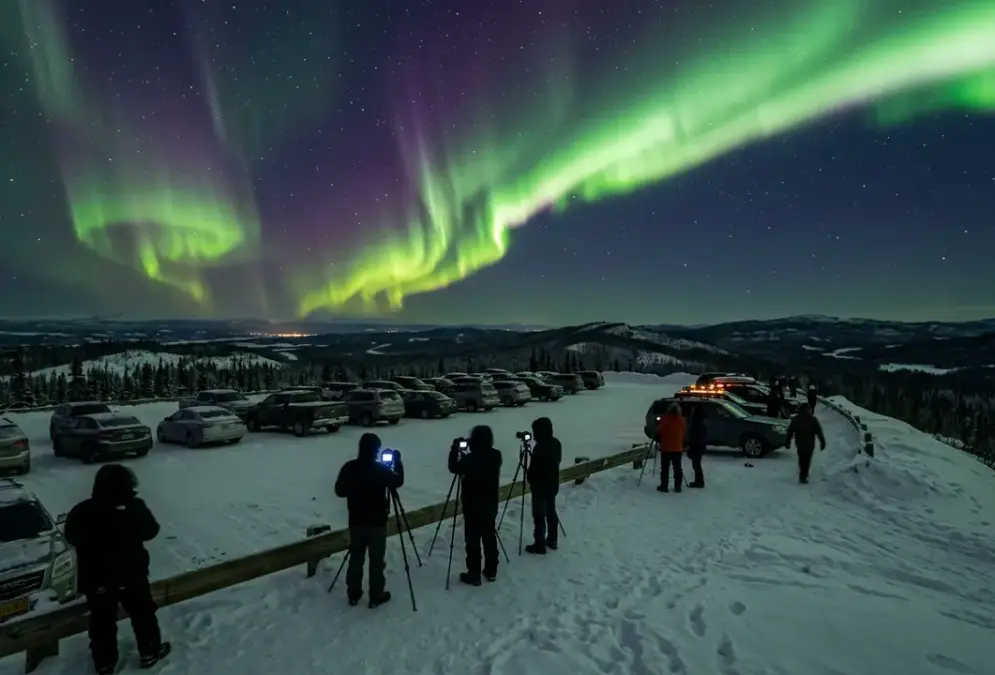

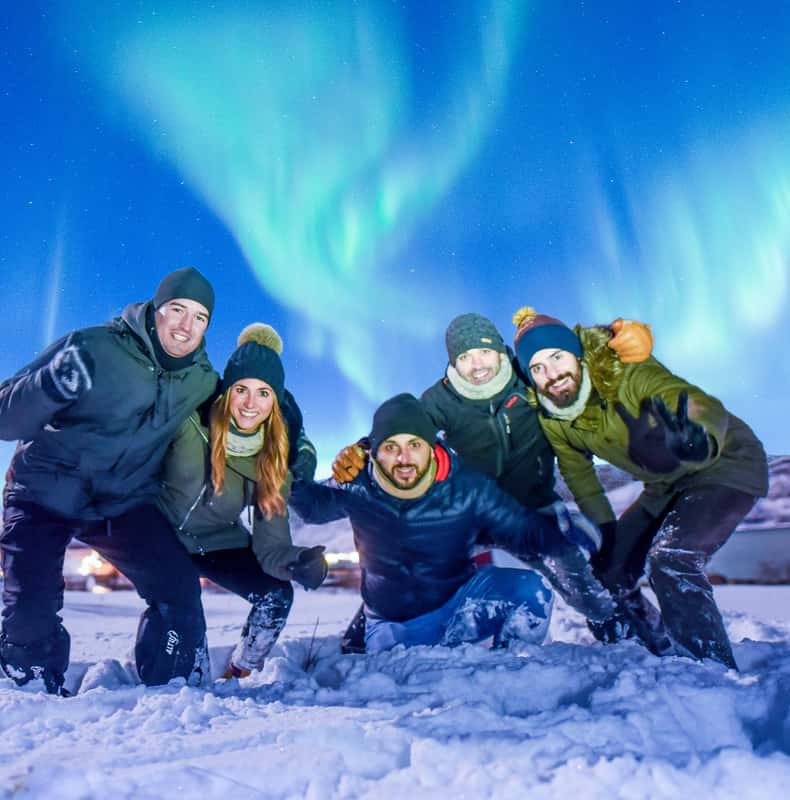
Wide shot of green and violet aurora borealis curtains over a snow-covered pullout at Cleary Summit near Fairbanks, Alaska, with parked cars and photographers silhouetted against the northern lights, one of the aurora viewing spots Fairbanks visitors drive to in order to escape downtown light pollution

Aurora Viewing Spots Near Fairbanks, Alaska

Six ranked aurora-viewing spots near Fairbanks, from Cleary Summit to the remote Chatanika corridor, with drive times and road conditions for DIY chasers.

Our top pick

Cleary Summit

Best overall

Cleary Summit wins because it's the only spot on this list that pairs a paved highway, a dedicated parking lot, and reliable cell service, no gravel, no guesswork. At 2,233 feet it's the lowest bar of entry among the elevated spots, with a north-facing horizon that opens for miles. The trade-off is company: tour buses use it as a standard stop, so a clear night in peak season brings a crowd.

Six named spots, all within roughly an hour and a half of downtown Fairbanks, and none of them require a tour booking.

Runner-up: Murphy Dome, highest ground near Fairbanks, clears low cloud decks other spots can't beat.

Fairbanks sits directly inside the auroral oval, the ring of peak geomagnetic activity that circles the pole, which is why interior Alaska built an entire winter industry around the northern lights. That doesn't mean you can watch from a downtown hotel window. Street light and the glow off the Chena River corridor are enough to flatten a moderate display into a faint green smear, and locals don't watch from their driveways for a reason: they drive.

This guide ranks six named viewing options within roughly an hour and a half of downtown, from the most accessible hilltop to the darkest, most remote corridor. None of them require a tour booking. This ranking is for the do-it-yourself version: where to park, what the road looks like in January, and which spot actually matches your comfort level.

Ranked list

How we chose

The places on this list were selected against the following editorial criteria.

  • Drive time and road conditions from downtown Fairbanks, paved versus gravel, maintained versus seasonal
  • Distance from the Fairbanks light dome and how dark the sky actually gets from the spot
  • Facilities and reliability: parking, cell service, and shelter if a display makes you wait
  • Ease of access for a first-timer without winter driving experience versus a spot that rewards experienced chasers

All picks at a glance

  • Cleary Summit

    Best overall
    Access
    Free · 20 miles north of downtown
    Why it makes the list
    Paved highway, dedicated lot, reliable cell service at 2,233 ft
  • Murphy Dome

    Best for beating cloud cover
    Access
    Free · 25 miles northwest, ~40-min drive
    Why it makes the list
    Highest point near Fairbanks (2,877 ft), clears valley cloud and inversion layers
  • Ester Dome

    Best short paved drive
    Access
    Free
    Why it makes the list
    Paved mountain road, open ridgeline view in more directions than Cleary Summit
  • Creamer's Field

    Best for first-timers
    Access
    Free
    Why it makes the list
    Free admission, flat open fields, but needs a moderate-to-strong display
  • Chena Hot Springs Road

    Best for escaping crowds
    Access
    Free · pullouts from ~4 miles out, resort at ~60 miles / 90 min
    Why it makes the list
    58-mile corridor of pullouts, Mile 25/35/37 named favorites, resort pools at the end
  • Two Rivers, Pleasant Valley, and Chatanika

    Best for darkest sky
    Access
    Free · Two Rivers/Pleasant Valley 20-35 mi, Chatanika 30-40 mi beyond
    Why it makes the list
    Darkest sky in this guide, but least reliable roads and cell coverage

When to go

Fairbanks' full aurora season runs August 21 through April 21, and February to March pairs the clearest skies with an equinox boost in geomagnetic activity.

  • Jan: Good
  • Feb: Peak — Clearest skies of the season, paired with the equinox boost in geomagnetic activity
  • Mar: Peak — Equinox boost in geomagnetic activity continues
  • Apr: Fair — Season winds down after April 21
  • May: Off-season
  • Jun: Off-season
  • Jul: Off-season
  • Aug: Fair — Aurora season begins August 21
  • Sep: Good
  • Oct: Good
  • Nov: Good
  • Dec: Good

Reporter notebook

Insider tips

Best time

Check the Kp forecast before you pick a night, not a spot

Fairbanks' aurora season runs late August through April, but the clearest skies pair with February and March's equinox boost in geomagnetic activity. Check the Kp index and short-term forecast the same evening you head out rather than committing to a spot days in advance; a strong forecast turns even Creamer's Field into a good night, and a quiet one won't save the darkest corridor.

What to bring

Download offline maps before you lose signal, not after

Cell service turns patchy past Mile 25 on Chena Hot Springs Road and for most of the Two Rivers, Pleasant Valley, and Chatanika corridor. Download offline maps before you leave Fairbanks, and tell someone your general plan if you're heading out solo.

In this guide

6 places
  1. Cleary Summit

    Best overall

    Free · 20 miles north of downtown

    Twenty miles north of downtown on the Steese Highway, Cleary Summit tops out at 2,233 feet, the lowest bar of entry among the elevated spots and the one with the best-maintained facilities. The highway is paved the whole way, there's a dedicated parking lot and trailhead, and the horizon opens up for miles to the north, the exact direction the aurora tends to build from first. Cell service holds up fine the entire drive.

    It's also the busiest spot on this list. Tour buses use Cleary Summit as a standard stop, and drivers occasionally leave headlights or dome lights on while loading passengers, which is annoying but rarely fatal to a good photo. Roads stay icy through the aurora season even though they're maintained, so winter tires and a slower pace matter more than horsepower. Best for a first night out, or anyone who wants real facilities and doesn't mind company.

    Pros

    • Paved highway the entire drive
    • Dedicated parking lot and trailhead
    • Reliable cell service throughout
    • North-facing horizon opens for miles

    Cons

    • Busiest stop on the list, tour buses included
    • Icy roads all season despite maintenance
  2. Murphy Dome

    Best for beating cloud cover

    Free · 25 miles northwest, ~40-min drive

    Murphy Dome climbs to 2,877 feet, the highest ground near Fairbanks, about 25 miles northwest of downtown and roughly a 40-minute drive. That height matters on nights when a low cloud deck or a temperature inversion sits over the valley floor: a display invisible from Cleary Summit can be perfectly clear from Murphy Dome's summit. Cell service holds up fine here too.

    The trade-off is the road. It's gravel with real elevation gain, less maintained than Cleary's highway, and winding enough that heavy traffic during peak season backs up on the narrow sections. Parking is limited to roadside pullouts rather than a proper lot, and there's likely no toilet, so plan ahead. Best for chasers comfortable on gravel and ice who want elevation above the clouds; skip it if you don't have winter driving experience.

    Pros

    • Highest point near Fairbanks at 2,877 ft
    • Clears low cloud and inversion layers other spots miss
    • Reliable cell service

    Cons

    • Gravel road with real elevation gain
    • Roadside pullouts only, likely no toilet
    • Traffic backs up on narrow sections in peak season
  3. Ester Dome

    Best short paved drive

    Free

    West of downtown on a winding but paved mountain road, Ester Dome is one of the shortest drives to real elevation gain near Fairbanks. Cell service stays good most of the way up, parking is available at several trailheads and pullouts, and the open ridgeline gives a clear view in more directions than Cleary Summit's north-facing horizon.

    The only downside is popularity: it's a well-known local spot, and a clear night in peak season will bring company. Best for anyone with a rental car and twenty extra minutes to spare who wants an easy paved drive to genuinely dark sky.

    Pros

    • Paved the entire way
    • Shortest drive to real elevation gain
    • Open ridgeline view in more directions than Cleary Summit
    • Cell service stays good most of the way up

    Cons

    • Well-known local spot, expect company on clear nights
  4. Creamer's Field

    Best for first-timers

    Free

    A short drive from downtown, Creamer's Field Migratory Waterfowl Refuge does double duty: birding trails in summer, open-sky aurora viewing in winter. Admission is free, there's a managed parking area, and the fields are flat and unobstructed in every direction, which makes it the easiest single option in this guide for a visitor without winter-driving experience or a 4WD rental yet.

    The trade-off is light pollution. Creamer's Field sits close enough to town that only a moderate-to-strong display clears the ambient glow. Best for the night you land in Fairbanks with no car yet, or as a backup for the first night or two, not your only stop on a multi-night trip.

    Pros

    • Free admission with managed parking
    • Flat, unobstructed views in every direction
    • Short drive from downtown, easiest option for winter-driving beginners

    Cons

    • Light pollution washes out faint displays
    • Only works for moderate-to-strong aurora activity
  5. Chena Hot Springs Road

    Best for escaping crowds

    Free · pullouts from ~4 miles out, resort at ~60 miles / 90 min

    Chena Hot Springs Road begins about four miles from downtown and runs 58 miles northeast into the Chena River valley, doing more work for aurora chasers than any other single road near Fairbanks. Multiple pullouts and recreation areas line the entire corridor, which means less crowding at any one spot and an easy plan B: if the first pullout is fogged in, keep driving. Three pullouts get named again and again in local guides: Mile 25, Mile 35, and Mile 37. Mile 25 sits close enough to town to still catch a signal; Mile 35 and Mile 37 push past most of the remaining light pollution into the Chena State Recreation Area, with access to public-use cabins and campground facilities.

    The highway is paved and maintained the whole way, but treat "maintained" as relative past the halfway point. Cell service holds up for roughly the first half of the drive and turns patchy for the rest, so download offline maps before you leave signal range behind. The road ends at Chena Hot Springs Resort, about 60 miles and roughly an hour and a half from downtown; its geothermal pools give you somewhere warm to wait out the gaps between displays even if you're not booking a guided tour. Best for chasers who want space from the crowds and a long enough corridor to outrun a cloud bank.

    Pros

    • 58-mile corridor with multiple pullouts, easy plan B if fogged in
    • Paved and maintained the whole way
    • Chena Hot Springs Resort has geothermal pools to wait out gaps

    Cons

    • Cell service turns patchy past the halfway point
    • Maintenance gets rougher past Mile 37
  6. Two Rivers, Pleasant Valley, and Chatanika

    Best for darkest sky

    Free · Two Rivers/Pleasant Valley 20-35 mi, Chatanika 30-40 mi beyond

    Northeast of Fairbanks, a mix of paved and gravel roads through Two Rivers, Pleasant Valley, and Chatanika offers the darkest skies in this guide, in exchange for the least reliable roads and cell coverage. None of these are single, named pullouts the way Cleary Summit is; they're loose clusters of turnouts along a corridor, and locals treat them as a rotating set of options rather than one fixed destination.

    Two Rivers and Pleasant Valley sit about 20 to 35 miles from downtown along Nordale Road and the Steese Highway area, with public-use cabins available if you'd rather commit to a full night out here than drive back to town at 2 a.m. Chatanika sits another 30 to 40 miles past that, far enough out that the Fairbanks light dome disappears from the horizon entirely, but with gravel conditions, patchy-to-absent cell service, and no facilities of any kind at the pullouts. Best for chasers who've already done a night or two at Cleary Summit or Ester Dome and want genuinely dark sky, or who are trying to escape a crowd; not the corridor for a first night in Fairbanks with a rental you haven't driven on ice yet.

    Pros

    • Darkest skies in this guide
    • Public-use cabins available for a full night out
    • Fairbanks light dome disappears entirely at Chatanika

    Cons

    • Gravel conditions with patchy-to-absent cell service
    • No facilities at the pullouts
    • Not recommended for a first night on unfamiliar ice

Every spot on this list assumes a vehicle with winter tires at minimum, and for Murphy Dome or the Chatanika corridor, real experience driving on ice. Rental logistics and block heaters aren't covered here.

Timing is a forecast question, not a location one: check the aurora forecast the same evening you head out, and if the Kp index numbers don't mean much yet, look up what the scale actually measures before you commit to a spot.

If you're still choosing, this is roughly how locals sort it. First night and unfamiliar with winter driving: Creamer's Field or Ester Dome. Want elevation above the clouds and comfortable on gravel: Murphy Dome. Want the easiest reliable option with real facilities: Cleary Summit. Want space from the crowds and don't mind a longer drive: Chena Hot Springs Road past Mile 25, or Two Rivers. Want the darkest sky in this guide and can handle no cell signal: Chatanika.

None of these are permanent choices. Most multi-night visitors rotate through two or three of them, chasing whichever direction the cloud forecast favors that evening.

Frequently asked questions

What's the best month to see the aurora from Fairbanks?

August 21 through April 21 is Fairbanks' full aurora season, and February to March pairs the clearest skies with an equinox boost in geomagnetic activity. This guide focuses on where to stand once you've picked your dates.

How far do I need to drive to escape Fairbanks' city lights?

Ester Dome and Cleary Summit, both roughly 15 to 20 miles out, are usually enough to clear downtown's glow on a clear night. For genuinely dark sky, Chatanika or the far end of Chena Hot Springs Road, 40 to 58 miles out, remove essentially all of it.

Is a standard rental car okay for these aurora viewing roads?

Cleary Summit, Ester Dome, and Creamer's Field are all reachable on paved, regularly maintained roads. Murphy Dome and the far end of the Chatanika corridor are gravel with real winter conditions, where AWD or 4WD and some ice-driving experience matter.

Where can I see the northern lights near Fairbanks without booking a tour?

Every spot in this guide, Cleary Summit, Murphy Dome, Ester Dome, Chena Hot Springs Road, Two Rivers, Pleasant Valley, Chatanika, and Creamer's Field, is a public road or public land you can drive to yourself, free of charge beyond gas. A guided tour is an option, not a requirement.

Which aurora viewing spot near Fairbanks is best for first-timers?

Creamer's Field, a short drive from downtown with free admission and dedicated parking, is the easiest option if you don't have winter driving experience yet. Ester Dome is the next step up: still an easy paved drive, but genuinely dark and a step above Creamer's Field's remaining light pollution.

What's the difference between Cleary Summit and Murphy Dome?

Cleary Summit is lower at 2,233 feet but has a paved highway, a maintained parking lot, and the most reliable facilities. Murphy Dome is higher at 2,877 feet, the tallest point near Fairbanks, useful when low cloud sits over the valley, but the gravel access road is rougher and less maintained.

Can I see the aurora from Creamer's Field, close to downtown Fairbanks?

Yes, but only on a moderate-to-strong display. Creamer's Field sits close enough to town that faint aurora gets washed out by the city's ambient light. Treat it as a convenient backup for your first night or two, not your primary viewing spot for a multi-night trip.

Do I need to hike to reach any of these viewing spots?

No. Every location in this guide, from Cleary Summit's trailhead parking lot to the roadside pullouts on Chena Hot Springs Road, is reachable by parking and stepping out of the car. Elevation gain happens by driving, not walking.

What happens if I lose cell service while driving to one of these spots?

Past Mile 25 on Chena Hot Springs Road, and for most of the Chatanika corridor, cell coverage is patchy to nonexistent. Download offline maps and check the forecast before you leave a signal area, and let someone know your general plan if you're heading out solo.

Further reading

Sources