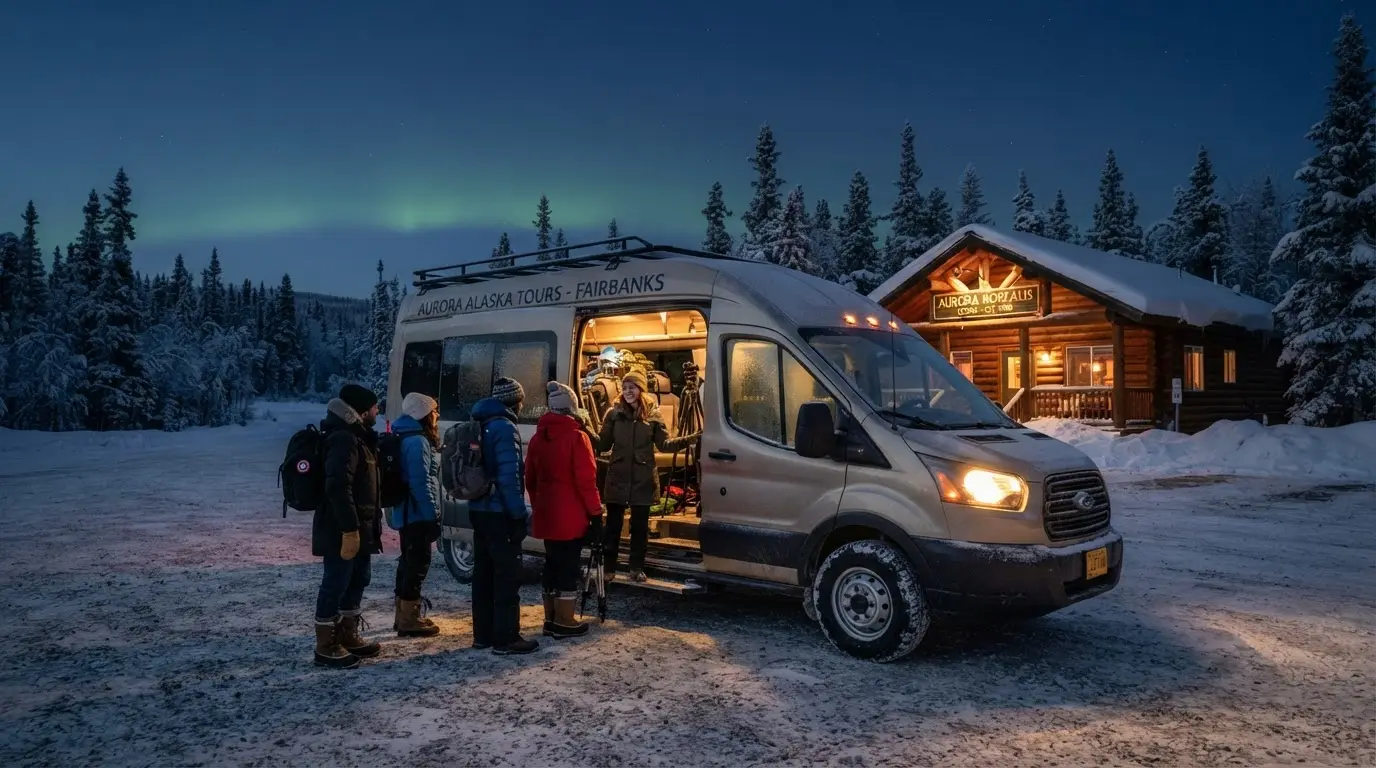

What a guided Fairbanks aurora tour actually includes
A Fairbanks aurora tour typically picks you up at your hotel around 9 or 10pm and drops you back off between 3 and 4am, timed around solar midnight[4]. You ride in a small heated van, usually capped at ten guests, with a guide watching the same forecast tools anyone can look up online, except that they'll actually drive on what it says. Most operators chase within about 100 miles of Fairbanks and will push to 200 miles in a bad-weather year, moving toward whichever stretch of the horizon is reading clear[5]. That range is the entire pitch: a rental car with no local read on tonight's clear-sky pocket has to guess the same decision a guide makes for a living, every single night of the season.
Featured · Destination
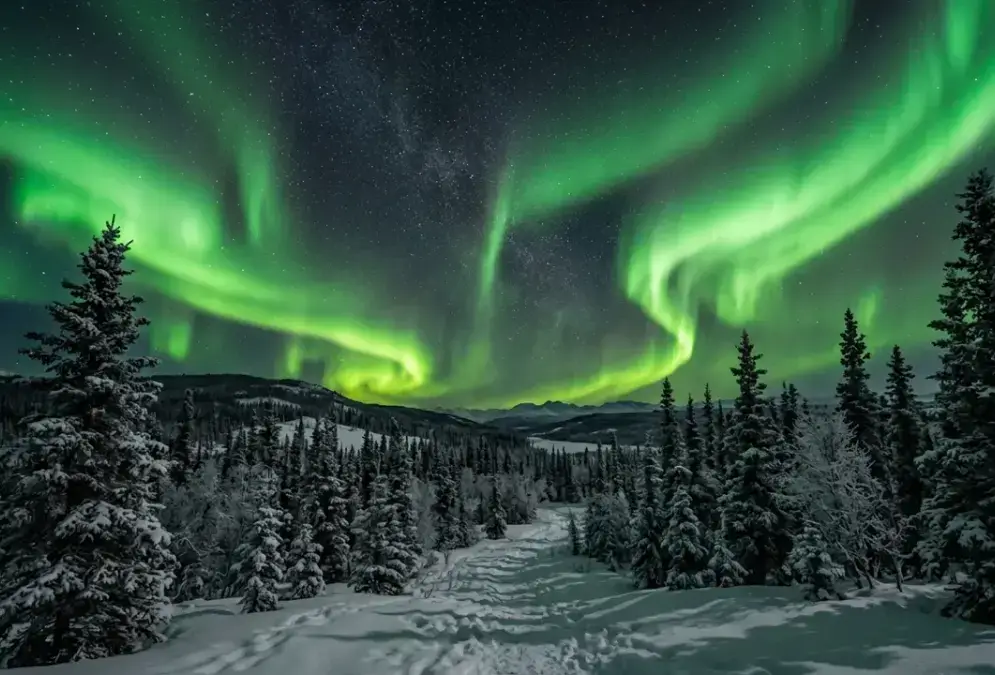
Fairbanks Northern Lights
Fairbanks sits directly under the auroral oval at 64.8°N. Aurora season runs Aug 21–Apr 21, peaking Feb–Mar, with roughly 90% odds if you stay 3+ nights.
The guide's judgment matters more than the app on your phone. Aurora forecasts are only reliably accurate about an hour out, even though they're published up to 27 days ahead[6], so part of what you're paying for is someone re-checking that forecast at 9pm and being willing to drive to chase a break in the clouds. The Fairbanks aurora forecast breakdown covers how to read that same gap yourself. What you're not automatically paying for is photography: a camera rental package runs about $65 and a printed aurora portrait costs $60, both billed as add-ons on top of the base tour price[7]. If you already own gear that shoots in the dark, skip those line items entirely.
Recommended tours
Tours are selected for quality, not commission. I earn a small fee if you book — at no extra cost to you.
What it actually costs, and what the no-refund policy really means
Ask around and Fairbanks guides quote $200 to $400 a person a night industry-wide, occasionally $500 for a private outing[8]. The four operator pages I could fetch and verify this season tell a more specific story than that range does on its own. For how that per-person price fits alongside the flight and the room, see the full trip cost breakdown.
The pattern holds across both self-drive operators: self-drive runs roughly a third of the pickup price, because you're paying almost entirely for the driving and the guide's judgment, not for the lodge, the heated shelter, or the staff running it; those are identical either way.
| Operator | Pickup price | Self-drive price | Refund if no aurora |
|---|---|---|---|
| Fairbanks Aurora Tours | $235-285/person | Not offered | Standby rebooking within 30 days, no cash refund |
| Aurora Borealis Lodge | $115/person | $45/person | Full refund 7+ days out; $5 fee same-day |
| Aurora Husky Lodge | $136/person | $45/person | No refund, no rebooking[26] |
The refund fine print
The pattern that matters more than price is the refund policy. Fairbanks Aurora Tours won't cancel for a cloudy forecast because its chasing format can often drive to clearer weather elsewhere[12], and The Aurora Chasers state almost the identical policy in almost identical words[13]; this is a category-wide standard, not one operator's fine print. Cancel your own booking more than a month out and it's fully refundable. Cancel inside that window and the standard policy is no-cancellation, no-refund[14]. The one scenario that guarantees a full refund is the operator cancelling the tour itself, usually for genuinely extreme winter weather[15].
Aurora Borealis Lodge is the outlier worth knowing about: full refund for a cancellation seven or more days out, and only a $5-per-person fee for cancelling the same day before noon[16]. If the refund terms matter to your decision as much as the price does, that's the policy to read in full before you book anything else.
The case for going without a guide
Fairbanks' own tourism board doesn't push tours as the only legitimate option, going as far as saying it's "cool if you are comfortable venturing out solo, but it's also wise to hang with the experts"[17]. The University of Alaska Fairbanks Geophysical Institute, the same group behind the region's forecast tool, names its own list of free, road-accessible Fairbanks aurora viewing spots: Chena Lakes and Tanana Lakes recreation areas, Cleary Summit, the Ester, Wickersham and Murphy domes, Haystack Mountain on the Elliot Highway, and turnouts along the Elliot, Steese and Parks highways and Chena Hot Springs Road[18]. None of that costs anything beyond a rental car and the fuel to reach it. NOAA's one hard requirement still applies wherever you go: the sky has to actually be clear[19], which a $285 tour can't manufacture any better than you can.
The catch is winter driving, and it's a real one. Alaska rental companies know it: Alamo, Enterprise and National won't let their Fairbanks cars go north of Fox at all, and an AWD or 4WD vehicle is a hard requirement for winter self-drive in the area[20]. Getting around Fairbanks in winter covers what that actually means for a rental booking; the short version is that not every car on the lot is legally allowed to take you where the dark sky is.
Ice, not the aurora, is the real risk
A Fairbanks-based guide says he's personally pulled "too many to count" aurora tourists out of ditches on winter roads[21]. If you've never driven on packed ice and hard-pack snow at night, this isn't the trip to learn on. Book a guide instead. If you have, scout your chosen pull-off in daylight first and watch for moose, which are common on these roads after dark and can total a car[22].
For the rental-contract fine print behind that boundary, and why Alaska's 511 road-condition system isn't a live feed, see self-drive versus guided tour, mile by mile.
The same guide who warns about ditches also says the opposite on a good night: "during high activity nights when it's crystal clear outside, you don't need a tour to see the aurora - you can see it right from your hotel or a few miles out of town"[23]. What independent viewing doesn't have is a clean cost comparison. The only real numbers here are proxies: the $45-per-person self-drive fee two lodges charge on top of whatever your rental car and gas already cost[10], and one guide's estimate that a bare week-long trip, flights and lodging only, runs $1,000 to $2,000 before a rental car enters the picture[24]. Stay the three nights Explore Fairbanks says gets you to roughly 90% odds with clear skies[25], and the marginal cost of skipping the guide is close to zero: you're paying for the same nights either way.
Guided vs. independent, side by side
Line the two paths up and the trade-off is fairly simple, once the price and the risk are both on the table.
- A guided tour buys a driver, a guide already reading tonight's forecast for a living, and door-to-door transport from your hotel, worth $115 to $285 a person depending on the operator[1][9].
- Going independently buys flexibility and a near-zero marginal cost per night, in exchange for driving Fairbanks winter roads yourself at night, watching for moose[22], in a vehicle your rental company may not even let you take where you need to go[20].
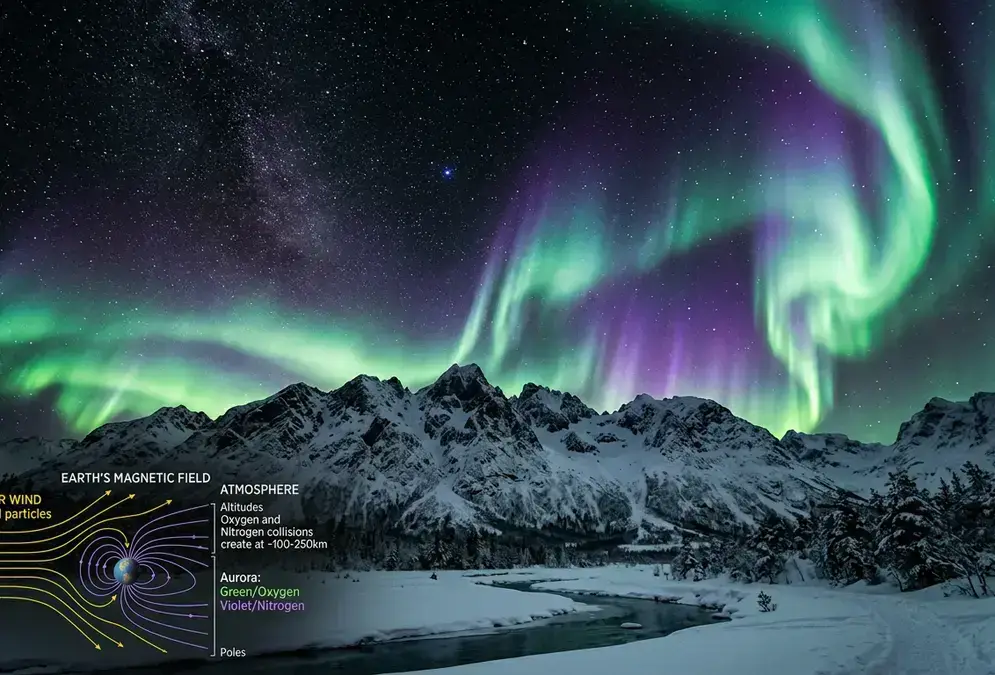
Featured · Article
What Causes the Northern Lights? The Science Explained
Solar wind collides with Earth's magnetic field, funneling charged particles toward the poles, where they excite oxygen and nitrogen into glowing color.
The math tips toward a guide when you're staying two nights or fewer and can't afford a bad one, you've never driven on packed snow and ice, or you'd rather have someone else responsible for getting you home at 3am. It tips toward driving yourself when you're already staying three or four nights, you're a comfortable winter driver, and you don't want to multiply a per-person tour price by every night and every person in your group.
So, is a Fairbanks northern lights tour worth it?
The honest answer is conditional, not a flat yes or no. Book a guide if you're not confident driving on ice, you're only in Fairbanks for a night or two, or standing in a parking lot alone at 2am doesn't appeal to you regardless of the odds. Skip the guide if you're staying three nights or more and comfortable behind the wheel; at that point the season's own odds, not a guide's chase radius, are doing most of the work[3].
If you do book, read the fine print before the price. Check:
- The refund policy for a clouded-out night: most operators offer a standby rebooking, not a cash refund[2][13]
- The cancellation window for your own change of plans: a month out is the common cutoff[14]
- The chase radius: 100 miles is standard, so ask what happens on the rare night nothing within it is clear[5]
- Whether a self-drive option exists at a lower price, for guests with their own AWD-capable rental[10]