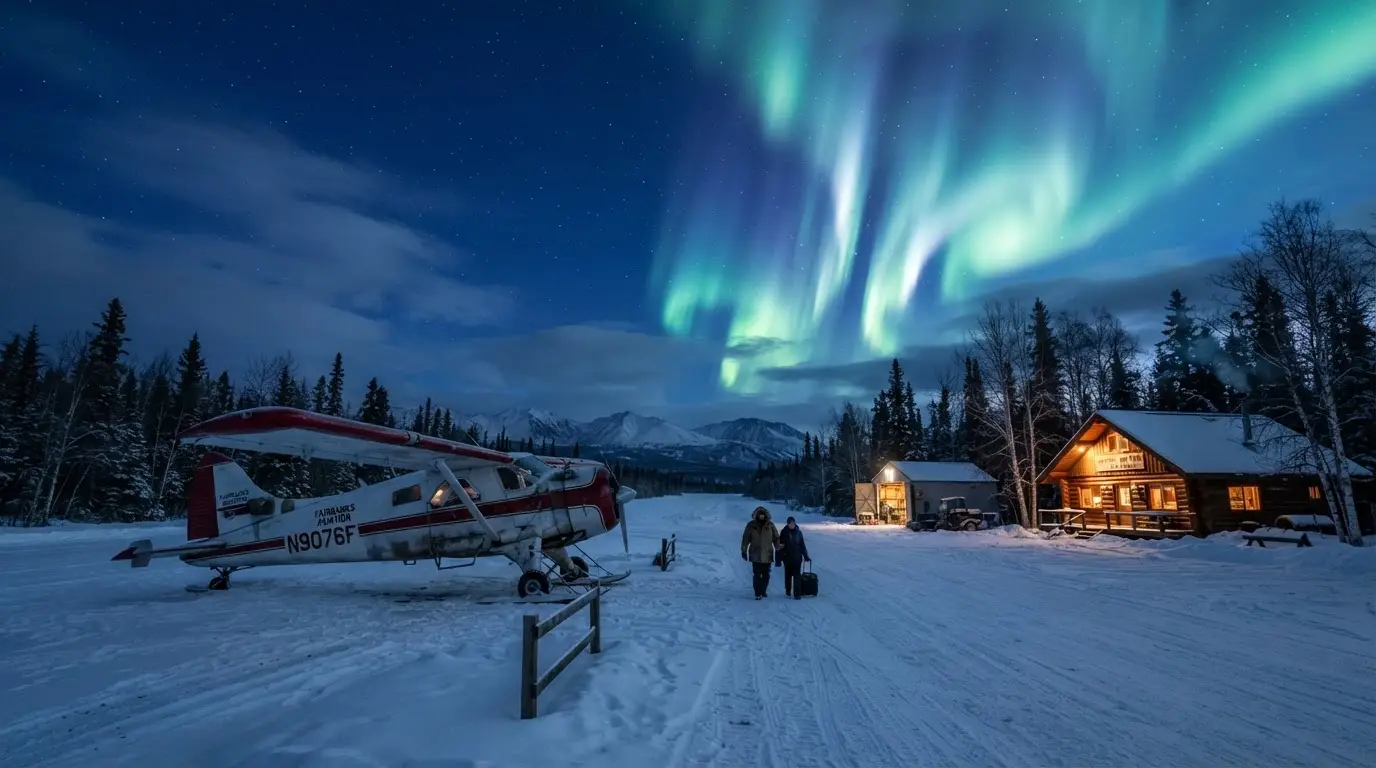

The three numbers that make up a Fairbanks aurora trip
Search for a Fairbanks aurora trip and you'll find a tour price, a flight price, and a hotel price, never on the same page, and never added together. That's the gap this piece fills: not whether a specific tour is worth it, but what the whole trip actually costs once every line item is on the table.
The honest range is wide. A round-trip flight from the Lower 48 typically runs $380 to $518[1], a downtown room in winter runs $120 to $250 a night[2], and how you choose to watch the sky adds anywhere from nothing, if you drive yourself, to $619 or more for the Arctic Circle splurge covered further down[3]. Two travelers staying the same number of nights can land in very different totals depending on which of those three dials they turn.
Flights: the number that swings the most
Fairbanks sits far enough into the Alaska interior that flying there is a real line item, not a rounding error. A Seattle round trip typically runs $380 to $518, with the lowest fare recently found at $292[1]. Alaska Airlines carries most of that route, and its own listed deals start as low as $247 round trip against a sampled weekly average of $440[4]. Where you land in that spread depends almost entirely on how far ahead you book and how flexible you are on dates.
Featured · Destination
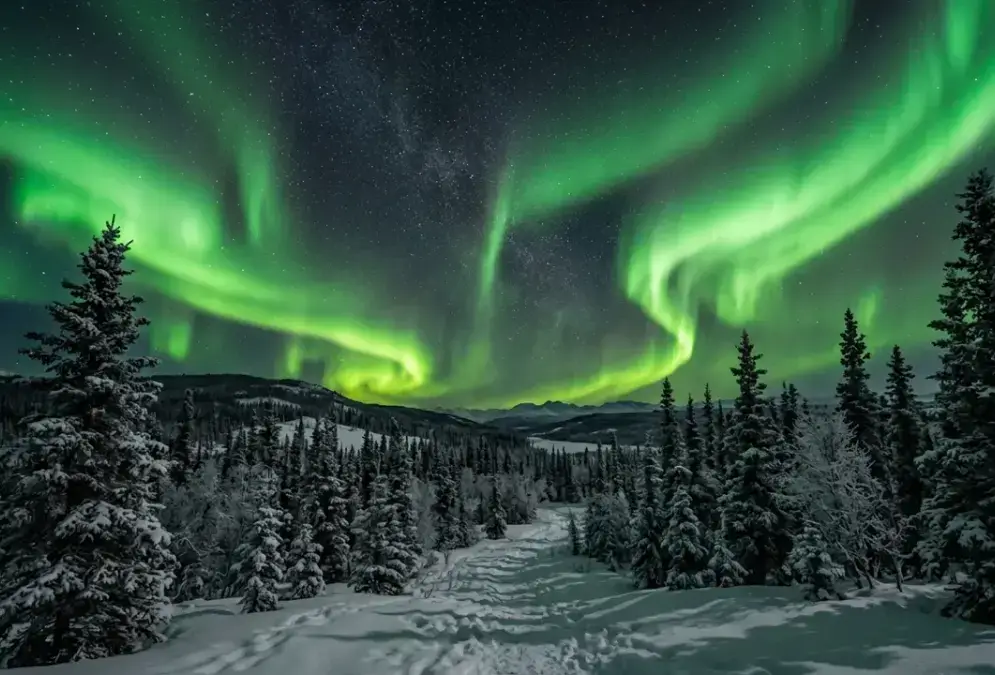
Fairbanks Northern Lights
Fairbanks sits directly under the auroral oval at 64.8°N. Aurora season runs Aug 21–Apr 21, peaking Feb–Mar, with roughly 90% odds if you stay 3+ nights.
The flight itself is short once you're in the air: Fairbanks sits 1,515.7 miles from Seattle, a little over 3 hours 48 minutes in flight[5]. What that distance doesn't tell you is when to fly — aurora season runs roughly August through April, and the cheapest fares and the darkest, clearest nights don't always land on the same calendar. If you haven't settled on dates yet, the Fairbanks northern lights destination guide breaks the season down month by month.
Lodging: the line item that moves the most
Where you sleep is the single biggest lever on your total, because you pay for it every night of the trip while a flight is a one-time cost. Downtown Fairbanks hotels run roughly $120 to $250 a night in winter, convenient for a short stay, but you'll see essentially no aurora from the property itself[2]. Hotels near the airport and on the west side of town run a similar $110 to $220 a night, with viewing odds barely better than downtown[6]. Lodges on the hillsides north of town cost more, roughly $180 to $400 a night, and that premium buys a real shot at watching from your own window instead of driving out to find clear sky[7].
Book before the room disappears
Aurora-season lodging fills up fast, especially anything with real dark-sky access. Operators recommend booking 4 to 6 months ahead for winter travel, particularly around holidays and peak December-to-February weekends[9].
Multiply any of those by three or four nights and lodging alone can rival or beat the flight that got you here. The best lodges for Fairbanks aurora roundup ranks the actual properties in each price band; the ranges above are what separates the bands, not the individual room.
A split stay is the honest way to control this cost without giving up a genuinely dark night. Front-load the trip in town for the arrival and the first tour, then move out to a hillside lodge once you can see which nights the forecast actually favors[8], rather than betting your one dark-sky night on the night you happen to land. That pairing works especially well against how many nights you actually need — the Fairbanks nights-needed math puts your odds at their best around three nights, so a split stay doesn't cost you a viewing night, it just moves where you spend it.
Evening tours: the cost everyone already asks about
An evening aurora tour is the most visible line item on a Fairbanks trip, and the one this site has already covered in the most depth. The going rate among operators verified this season runs $115 to $285[15][10] a person, with a cheaper self-drive option at some lodges for guests who bring their own AWD-capable rental. Whether that price is worth paying is a separate question from what it costs — the Fairbanks aurora tour worth-it breakdown covers the operator-by-operator comparison, the refund fine print, and when driving yourself is the better call.
For this budget, treat the tour as one line: free if you drive yourself and already have a rental, or $115 to $285[15][10] a person if you'd rather have a guide reading tonight's forecast for you. Neither number moves much whether you stay two nights or five, which is exactly why it's the smallest lever in this whole budget next to lodging and the Arctic Circle splurge below.
The Arctic Circle splurge, and the on-site Chena option
If a single evening tour isn't enough and you want the marquee splurge, the Arctic Circle day trip from Fairbanks is the one to price out properly. The verified rate for the one-day fly/drive version, a flightseeing leg to Coldfoot followed by a guided drive back down the Dalton Highway with aurora-viewing time built in, starts at $619 a person for the earliest February 2026 window[3]. Most of that day is spent driving back down the highway, not flying or standing at the Arctic Circle sign itself[11]. Divide the $619 by a roughly 14.5-hour day and you're paying something like $43 an hour[3][11] for the privilege, which is either a fair trade for crossing the Arctic Circle or an expensive way to spend a Tuesday, depending on how much that line matters to you.
$619+
There's a quieter, cheaper version of the same idea if you're staying at Chena Hot Springs Resort rather than in town: the resort runs its own on-site Aurora Viewing Tour, a 5-hour guided trip by SUSV, a tracked vehicle, out to Charlie Dome, with about four hours of actual viewing time from heated yurts[12]. You don't need your own cold-weather gear for it either; complimentary parkas, snow pants and boots are available if you didn't pack your own[13]. The resort sits about 65 miles northeast of Fairbanks, a spot gold miners stumbled onto back in 1905, long before anyone came for the aurora[14]. What the resort's own site doesn't publish is current pricing for its multi-night aurora packages, so get a direct quote before you build one into your budget rather than trusting a number you find secondhand.
Extras, and the verdict
A winter self-drive requires an AWD or 4WD rental, and not every economy car on the lot qualifies for it. The guide to getting around Fairbanks in winter covers what that actually restricts and what it typically adds to a rental quote, which is real money but not this piece's job to price. It also restricts which rental agencies you can even book with — some Fairbanks branches won't let their cars past Fox at all — and the full self-drive-versus-guided decision, including one lodge's $45-vs-$115 pricing split, is in self-drive vs. guided tour, weighed properly.
Most guided tours hand out parkas and boots at no extra cost if you don't already own cold-weather gear[13], which quietly earns back some of the price gap against buying an insulated parka and real winter boots outright. If you're driving yourself, budget to buy or rent that gear separately; it isn't folded into any of the numbers above.
Featured · Article
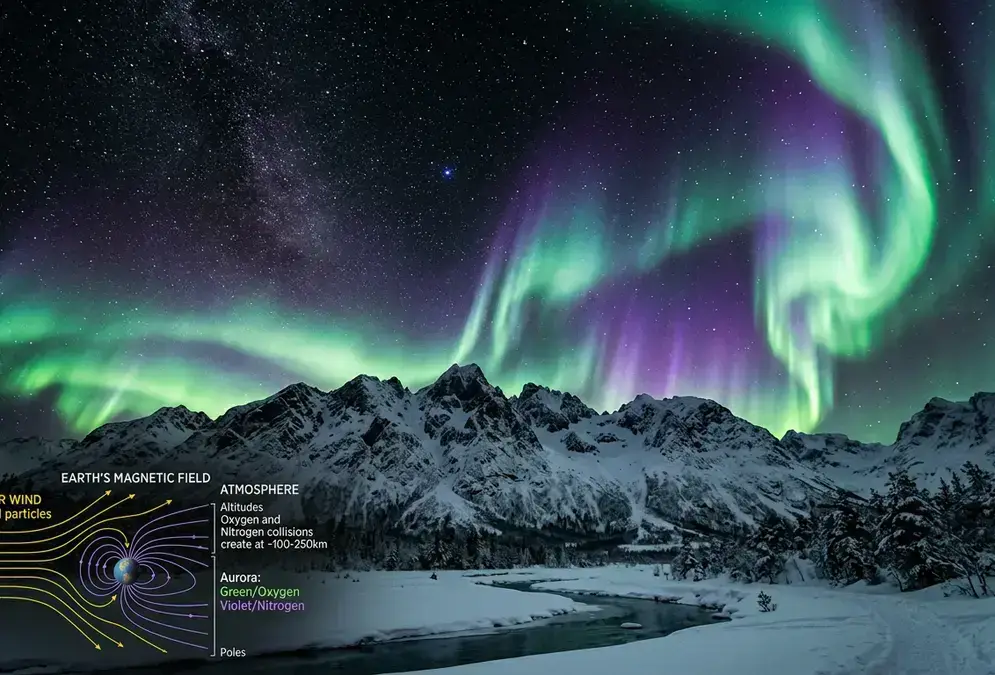
What Causes the Northern Lights? The Science Explained
Solar wind collides with Earth's magnetic field, funneling charged particles toward the poles, where they excite oxygen and nitrogen into glowing color.
Add it up honestly and the floor for a solo, DIY-minded traveler is a flight and a few nights in a downtown room, nothing more. Add one evening tour, or trade the downtown room for a hillside lodge, and you're solidly into a more comfortable middle tier. Add the Arctic Circle day on top of a properly dark lodge and you've built the splurge version, worth pricing out before you commit to it, not after. If I only had one dial to turn, it would be lodging, not the tour: a hillside night costs more than a guided evening does, but it's the one line item you pay for every single night of the trip.