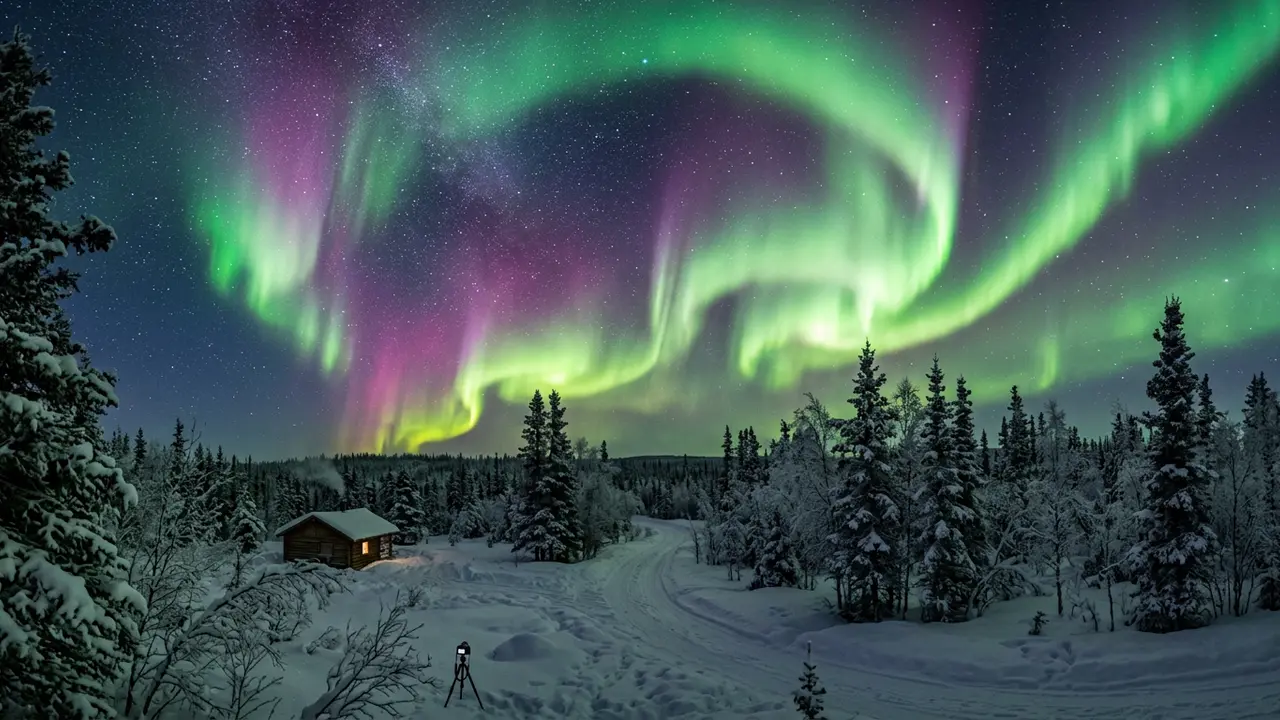

One night in Fairbanks: what the 40–50% odds mean
One night in Fairbanks gives you roughly a 40–50% chance of seeing any aurora[1]. That figure already assumes you're outside during the prime window: 10 PM to 2 AM, with activity typically peaking around 1:30 AM at what forecasters call magnetic midnight for this longitude.
The ceiling on single-night odds comes from cloud cover. Clear-sky probability during aurora season averages 55–60%[3] — better than coastal Norway, but still meaning roughly 40–45% of nights are opaque. On a clouded-over night, the aurora could be raging at Kp 5 overhead and you would not see a pixel of it.
Geography works in your favor. Fairbanks sits at 64.8°N[3], directly inside the auroral oval, meaning the aurora passes overhead rather than appearing as a faint smear on the northern horizon. On a clear night with a Kp of 3 or above, you stand a genuine chance. The problem is that you get exactly one.
One night makes sense if Fairbanks is an extension of other Alaska travel and aurora is a bonus. If you flew here specifically to see it, you are betting on roughly even odds of going home without a sighting.
Three nights: the baseline and its caveat
Three nights is what most Fairbanks tour operators package, and it earns its reputation. On three nights actively watching — outside every clear evening from 10 PM, phone alerts on — your probability of seeing some aurora climbs to 80–90%[1]. That is good enough for most travelers to call the trip a success.
The caveat is what "some aurora" actually looks like. At this probability level, a significant share of three-night visitors see a pale green band sitting low on the horizon, a wash of color lasting 20–30 minutes before fading. That counts as a sighting. It is not the same as curtains shifting overhead.
80–90%
For a strong display — the kind worth photographing, the kind that moves across the sky in real time — the probability on three nights drops to 45–55%[5]. That is close to a coin flip. Three nights also provides no buffer against a bad run: if your first two nights are overcast, the entire trip rides on a single evening and the margin disappears.
The practical consensus on three nights: it is the minimum, not the target. If you're deciding whether one of those packaged tours is worth booking for a trip this short, see the guided-tour cost breakdown.
Five to seven nights: where 93–98% odds live
Five to seven nights changes every number that matters. Any-aurora probability reaches 93–98%[1]. The chance of a strong, memorable display climbs to 70–85%[5]. And unlike three-night trips, you carry a real buffer if the first two nights close in.
Veteran aurora travelers describe this duration in terms of three overlapping stages. The first two nights are the learning curve: figuring out your viewing locations around Fairbanks, calibrating your read of the forecast apps, and understanding how cloud cover moves in from the Alaska Range. Nights three and four are the prime shooting window once you know your spots and have sorted your gear for the cold. The final nights are the buffer, catching the events that arrive unannounced after quiet periods.
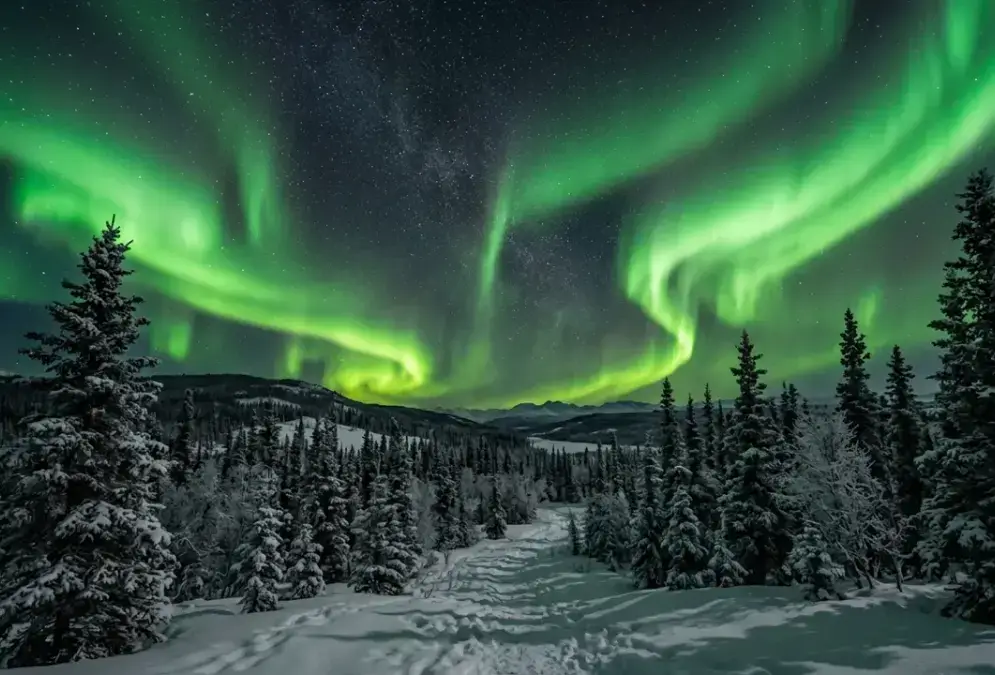
Featured · Destination
Fairbanks Northern Lights
Fairbanks sits directly under the auroral oval at 64.8°N. Aurora season runs Aug 21–Apr 21, peaking Feb–Mar, with roughly 90% odds if you stay 3+ nights.
Four nights sits between the two tiers. Four nights gives 88–93% for any sighting and 55–65% for a strong display[4]. For travelers with fixed schedules, four nights is a meaningful improvement over three and a reasonable compromise if the first two nights cloud over.
The Fairbanks northern lights destination guide covers the main viewing locations around the city and what each offers in terms of horizon clearance and access.
The probability math: how each extra night compounds
The underlying logic is simple. Each night is an independent draw from the same probability distribution. Clear-sky odds average 55–60% per night[3], meaning roughly a 40–45% chance of an opaque sky on any given evening. Given that aurora is active roughly 4 out of 5 clear nights inside the auroral oval, the probability of a usable aurora night on any single roll works out to around 44–48%.
The chance of seeing aurora at least once rises as you stack independent nights. Two nights gives roughly 60–70%. Three nights: 80–90%. The gains are largest early and shrink as you approach certainty[1].
What changes more significantly across the range is the strong-display probability:
Recommended tours
Tours are selected for quality, not commission. I earn a small fee if you book — at no extra cost to you.


- 1 night: 15–25%
- 3 nights: 45–55%
- 5–7 nights: 70–85%
- 7+ nights: 85–95%
| Nights booked | Any aurora | Strong display |
|---|---|---|
| 1 night | 40–50% | 15–25% |
| 2 nights | 60–70% | 30–40% |
| 3 nights | 80–90% | 45–55% |
| 4 nights | 88–93% | 55–65% |
| 5–7 nights | 93–98% | 70–85% |
| 7+ nights | 98%+ | 85–95% |
Strong displays require two things to coincide: a clear sky and elevated geomagnetic activity (a Kp of 3 or above registers well at 64.8°N; a G2 storm produces curtains directly overhead). Both conditions are common at this latitude, but they do not always arrive on the same night. More nights create more chances for that coincidence.
Understanding what drives Kp spikes and how to read the Bz component alongside the headline number is covered in the Kp index guide for northern lights forecasting.
Seasonal strategy: February, March, and the equinox window
Fairbanks logs 200–240+ aurora nights per year[3] across the aurora season, roughly late August through mid-April. The frequency is never the limiting factor. Two time windows are noticeably better than the rest.
February and March are the optimal months[2]. February has the fewest cloudy nights in the calendar, long usable darkness (around 14–16 hours), and geomagnetic activity that has not dropped off since the equinox period. March is almost as good and offers slightly milder temperatures. A five-to-seven-night trip in either month gives you the best odds the calendar allows.
September and October are the shoulder-season alternative. The autumn equinox enhances geomagnetic activity through a mechanism called the Russell-McPherron effect: Earth's magnetic field orientation near the equinox allows solar wind to couple more efficiently, producing statistically more storms than an equivalent window in December or January. September also offers milder weather, worth considering for first-time visitors not yet accustomed to -20°C nights.
December is long and dark but carries higher cloud cover than the peak months. January falls between the two: colder than March but often clearer than December.
The best time to see northern lights in Fairbanks covers monthly cloud-frequency data in more detail.
The banking mentality: extra nights as weather insurance
Think of any night beyond three as weather insurance. If nights one and two are overcast, a five-night trip leaves three more attempts. A three-night trip leaves one.
The cost math favors extending. Adding two nights to a Fairbanks aurora trip typically costs 15–25% more[1] in accommodation and guide costs — not anywhere near the price of a return flight. See what a Fairbanks aurora trip costs in total for how flights, lodging, and tours stack up against each other. A five-night trip that produces two clear aurora nights ends up cheaper per sighting than a three-night trip where cloud cover takes two evenings.
There is an asymmetry worth naming. Nobody comes back from Fairbanks wishing they had fewer nights. The stories of people who flew for hours, hit three overcast evenings, and came home with a pale green smear on their camera are common in aurora travel forums. The extra nights are cheap regret insurance by comparison.
Book a lodge with an aurora alert service that will notify you when conditions look promising after midnight. Set up an aurora forecast app before you land so you can monitor Kp trends in the days before arrival. Treat the first two nights as reconnaissance: find your viewing spots and sort your cold-weather kit before a Kp 4 event arrives at 1 AM on night five.