
Why UAF GI is the right tool for Fairbanks
The University of Alaska Fairbanks Geophysical Institute has been issuing aurora forecasts since 1994, when Syun-Ichi Akasofu and his graduate students built a solar wind model detailed enough to make useful public predictions[2]. The forecast at gi.alaska.edu/monitors/aurora-forecast[1] runs on decades of local calibration and real-time data from magnetometer stations across Alaska[4].
Generic aurora apps draw from the same global NOAA Kp data. UAF GI applies those numbers at 64.8°N latitude, where Fairbanks sits inside the auroral oval, the band of sky where geomagnetic activity translates into overhead aurora on nights that barely register as worth tracking farther south. An app calibrated for Edinburgh or Oslo flags Kp 1 as low activity. For Fairbanks, that is often a viable viewing night.
1994
The other reason to use UAF GI: it layers a cloud cover overlay directly onto the same interface as the Kp forecast. That combination shows both whether aurora is active and whether you can see it, without switching between services. For a comparison of the broader landscape of forecast tools, the aurora forecast apps guide covers the alternatives. This article focuses entirely on the UAF GI interface and the Fairbanks numbers.
How to read the 3-day Kp forecast
The 3-day chart is the planning backbone. Solar material ejected from the Sun takes 15 to 72 hours to reach Earth, which gives forecasters a genuine signal window at this timescale. The chart displays predicted Kp values in color-coded 3-hour intervals across the next 72 hours[1]. You are looking for which nights have aurora potential, not a second-by-second read.
Reading the colors:
Featured · Destination
Fairbanks Northern Lights
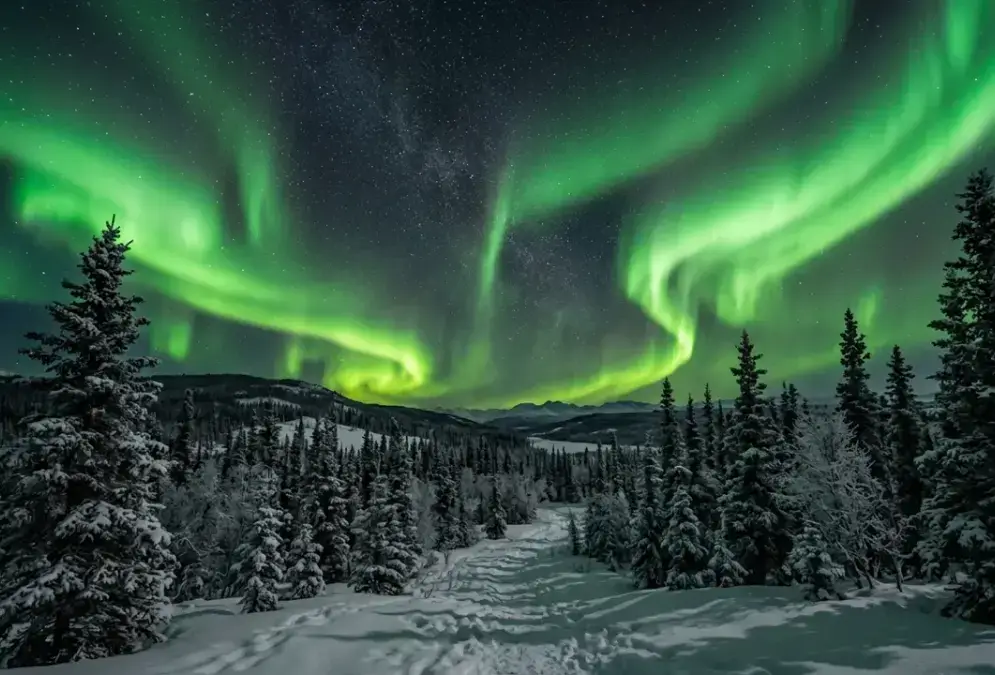
Fairbanks sits directly under the auroral oval at 64.8°N. Aurora season runs Aug 21–Apr 21, peaking Feb–Mar, with roughly 90% odds if you stay 3+ nights.
- Green bars = Kp below 4, quiet to active conditions
- Yellow bars = Kp 4, moderate geomagnetic activity
- Red bars = Kp 5 and above, a geomagnetic storm
Find the evening hours on the chart (roughly 10 PM to 3 AM local time in winter) and check the bar color for those specific intervals. A green bar at 11 PM on a night the cloud overlay shows as mostly clear is a go.
The forecast updates at least once daily, more often during active solar periods. Check it again the morning of any night you plan to be outside. The 48 to 72-hour predictions shift more than conditions within the next 24 hours.
The 30-minute forecast and the OVATION animation
Once the 3-day chart shows a promising night, the 30-minute forecast is the same-evening confirmation step. It runs on NOAA's OVATION model, which processes real-time solar wind data from the DSCOVR satellite and calculates predicted auroral power for the next 30 minutes, updated every 5 minutes[3].
The display is an animation of Earth's polar region. A colored ring marks the predicted position of the auroral oval as Earth rotates beneath it. Watch the final frame of the animation, not the middle; the last frame shows the predicted state 30 minutes from now. For Fairbanks at 64.8°N: if the oval's equatorward edge reaches down to roughly 65°N in the animation, you are inside the display zone.
The OVATION model lags slightly during the first hour after a sudden storm onset. On nights when geomagnetic activity is rising fast, the animation updates quickly but may understate conditions as they develop. Watch both the animation and the current Kp reading together on those nights.
| Tool | Update frequency | Best use case |
|---|---|---|
| 3-day chart | Daily (more often in active periods) | Choose which nights to plan around, 1 to 3 days out |
| 30-minute OVATION | Every 5 minutes | Go/no-go decision on the same evening |
Fairbanks Kp thresholds: aurora at 64.8°N
A common piece of aurora advice is to wait for Kp 5. That number is calibrated for mid-latitude locations like Scotland or the northern US border. For Fairbanks, it is the wrong threshold entirely.
At 64.8°N, Fairbanks sits so close to the geomagnetic pole that the auroral oval passes overhead at low activity levels. Kp 0 to 1 is enough for a visible display on a clear, dark night. At Kp 1, the oval's equatorward edge sits near 64°N; at Kp 3 the oval is actively over the city and aurora fills the sky with curtains and movement. Kp 5 produces the kind of full-sky storm where green light is bright enough to cast shadows.
| Kp | What to expect in Fairbanks |
|---|---|
| 0–1 | Quiet arc or band, overhead, greenish-white |
| 2–3 | Active curtains, movement, colour possible |
| 4 | Enhanced display, bright overhead |
| 5+ | Full-sky geomagnetic storm |
For how these thresholds vary with magnetic latitude and why Fairbanks behaves so differently from European aurora destinations, the Kp index explained article covers the underlying formula in detail. A Kp reading also doesn't tell you how the display will look on camera versus to your own eyes; why aurora photos look more vivid than what you saw covers why a quiet arc often reads as a gray smear to the naked eye even though a camera would show it in color.
Why cloud cover matters as much as Kp
A Kp 4 forecast under solid overcast produces nothing. Interior Alaska in winter cycles through rapid weather systems, and the UAF GI interface integrates a cloud cover overlay directly into the aurora forecast page to account for this.
The overlay shows predicted cloud cover bands across Alaska on the same map as the geomagnetic activity data. Read both layers at the same time. If Fairbanks is showing 70% cloud cover while Delta Junction, 90 miles to the southeast, reads 25%, that is your destination for the night.
Recommended tours
Tours are selected for quality, not commission. I earn a small fee if you book — at no extra cost to you.



A few things the overlay does not capture:
- Thin cirrus clouds at high altitude can block aurora without registering as significant cover. At temperatures below -25°C, ice crystal haze forms in otherwise clear air and washes out displays.
- Accuracy degrades with forecast range. At 12 hours out, cloud predictions over interior Alaska are reliable enough to commit to. At 72 hours, treat them as rough guidance only.
- Fog near rivers. The Chena River corridor through Fairbanks generates low-lying fog on cold clear nights. A location elevated 50 meters above the river valley can be clear while the city floor is socked in. Below about -30°F, that fog is genuine ice fog, a separate reason a clear-looking forecast can still show nothing from downtown.
Read next · Guide
Aurora Viewing Spots Near Fairbanks, Alaska
Six ranked aurora-viewing spots near Fairbanks, from Cleary Summit to the remote Chatanika corridor, with drive times and road conditions for DIY chasers.
The cloud overlay is your go/no-go gate, not a precise weather service. Mostly clear over your target area plus Kp 1 or above equals a real decision to go out.
Finding tonight's dark window in Fairbanks
Geomagnetic activity and clear skies are two of three variables. Darkness is the third, and in Fairbanks it changes dramatically across the season.
The aurora viewing season runs August 21 to April 21[1]. Outside those dates, twilight or the midnight sun prevents visibility regardless of Kp. Inside the season, the useful dark window varies by month:
- August to September: Dark from roughly 10 PM to 3 AM. Short window, often milder temperatures.
- October to November: Darkness runs from 5 PM to nearly 9 AM. Long windows, cold nights.
- December to January: Fairbanks gets under 4 hours of daylight; aurora can show from 3 PM onward.
- February to March: Nights still run 7 to 8 hours of deep dark, a good balance of darkness and survivable cold.
- April: Civil twilight starts cutting into evenings. By mid-April the window is under 5 hours.
To find tonight's exact window: look up Fairbanks civil twilight for the specific date. That is your usable dark band, give or take 20 minutes for astronomical twilight.
Moon phase matters on Kp 0 to 2 nights. A full moon washes out a quiet display the same way it washes out the Milky Way. At Kp 3 and above, moonlight is largely irrelevant; aurora at that level is bright enough to overpower it. For month-by-month timing and what to expect across the full season, Fairbanks northern lights covers the detail.