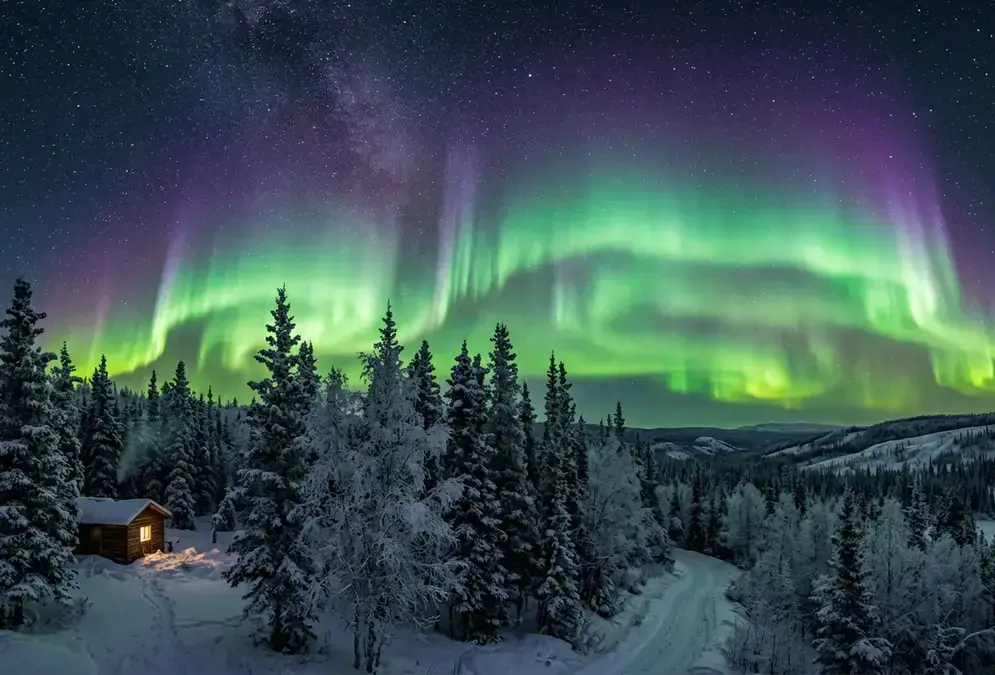

When to go: Fairbanks' aurora season runs August 21 to April 21
Fairbanks runs an official aurora season from August 21 through April 21 every year, and the boundary has nothing to do with when the aurora itself is active. Geomagnetic activity happens on its own schedule, year-round. What changes is the sky: at 64.84°N, Fairbanks gets close to 22 hours of daylight around the June solstice, and true astronomical darkness doesn't return until late August. It starts thinning out again by late April, which is why the season closes there.
Inside that window, the odds are genuinely good. Explore Fairbanks, the city's tourism bureau, says the aurora is visible on roughly 4 of every 5 clear, dark nights, and visitors who stay at least three nights and go out looking in the late-evening hours push their odds of a sighting above 90%.[1] That's a structural advantage rather than a marketing line: Fairbanks sits directly under the auroral oval, the ring-shaped zone of peak activity that circles the geomagnetic pole. For the physics behind that ring, the science of how the aurora forms covers the solar-wind mechanics this guide won't repeat.
90%
What actually changes month to month isn't whether the aurora shows up. It's how dark the sky gets, how likely cloud cover is to block the view, and how comfortable you'll be standing outside long enough to see it. That's what the rest of this guide is about.
Month-by-month: darkness, temperature, and snow from August to April
The table below breaks the season into nine months, from August's still-summery opening to April's fast-closing window, across four things that actually decide a trip: how cold it runs, what the snow looks like, how dark it gets, and how many other aurora-chasers you'll be sharing a viewpoint with. Overnight lows and snowfall totals come from Weather Spark's long-run climate averages for Fairbanks.[2] Darkness hours are rounded to the nearest hour rather than given to the minute: Fairbanks' precise sunrise-and-sunset tables vary source to source this far north, so treat the ranges below as a trend, not a schedule.[3]
| Month | Darkness / avg low | Viewing quality | Crowd level |
|---|---|---|---|
| August | 7-9 hrs / 48°F (9°C) | Good once dark | Low |
| September | 10-13 hrs / 37°F (3°C) | Strong, equinox boost | Moderate, rising |
| October | 13-16 hrs / 19°F (-7°C) | Good | Moderate |
| November | 17-19 hrs / -2°F (-19°C) | Very good, cold limits time outside | Lower |
| December | ~20 hrs / -11°F (-24°C) | Max darkness, but cloudiest month | High (holidays) |
| January | ~19 hrs / -13°F (-25°C) | Excellent darkness, extreme cold | Moderate |
| February | 15-16 hrs / -8°F (-22°C) | Excellent, clearer and more stable | Rising |
| March | 11-13 hrs / 2°F (-17°C) | Peak: clearest skies plus equinox boost | Highest |
| April | 8-9 hrs / 23°F (-5°C) | Fair, window closing by late month | Lower |
August opens the season already warm, with highs near 66°F and lows around 48°F and no snow yet, so the main adjustment is simply waiting for the sky to get dark enough after the 21st. April flips that pattern at the other end: highs climb back into the 40s, the ground starts thawing, and the viewing window closes fast as the sky brightens again week by week.
Deep winter, November through January, is the other extreme: 17 to 19-plus hours of darkness a night, but also the season's coldest stretch, with average lows near -13°F in January and routine cold snaps well below that. December is worth knowing about before you book, because it's a paradox: one of the darkest months of the year, but also the cloudiest, at roughly 64% overcast or mostly cloudy days. All that darkness doesn't guarantee a clear sky to see it in.
Why February and March are Fairbanks' peak aurora months
February and March are the sweet spot most Fairbanks operators point to, and the reasoning holds up. By February, interior Alaska has usually settled into the dry, high-pressure pattern that produces the clearest skies of the whole season: March runs about 45% clear, mostly clear, or partly cloudy days, versus roughly 64% overcast or mostly cloudy in December.[2] Long, dark nights matter less than clear ones, and February-March is where Fairbanks reliably gets both.
The calendar helps too. The equinox effect, also called the Russell-McPherron effect, makes geomagnetic activity statistically more likely in the weeks around the spring and fall equinoxes. The University of Alaska Fairbanks Geophysical Institute puts the practical result plainly: chances of seeing the aurora in March and September run roughly twice as high as around the June or December solstices.[4] Stack that on top of February-March's clearer skies and you get the strongest combined odds of the entire season.
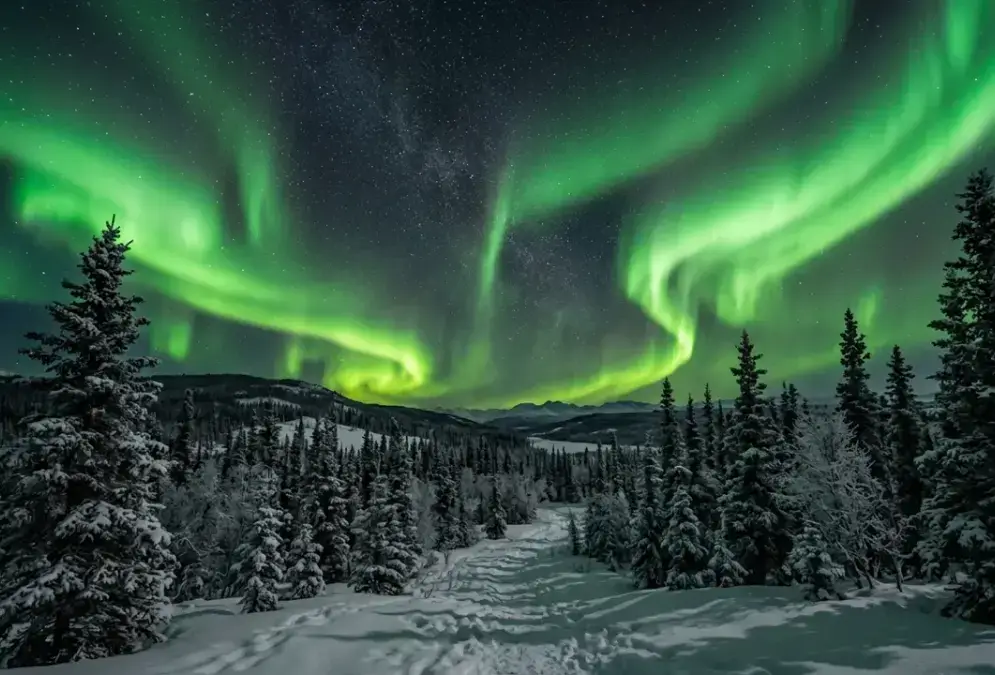
Featured · Destination
Fairbanks Northern Lights
Fairbanks sits directly under the auroral oval at 64.8°N. Aurora season runs Aug 21–Apr 21, peaking Feb–Mar, with roughly 90% odds if you stay 3+ nights.
Comfort plays a role too. Nights in February and March still run 11 to 16 hours of darkness, long enough for several viewing windows in one evening, but temperatures are typically less extreme and more stable than January's deep cold snaps. There's also enough daylight left, roughly 7.5 to 12.5 hours, for dog mushing, ice fishing, or a museum stop between aurora watches. The trade-off is demand: this is Fairbanks' busiest and priciest stretch of the season, so book lodging well ahead if March is the plan — see the real numbers behind Fairbanks trip costs for the full budget breakdown.
September: Fairbanks' mild-weather aurora shoulder season
September pairs the equinox activity boost with the mildest temperatures of the entire aurora season, roughly 37 to 54°F, and a landscape still holding fall color rather than deep snow.[2] For visitors who'd rather not pack an expedition parka, it's the easiest month to recommend.
It's also the only month where unfrozen lakes and rivers are still around, which means mirror-image aurora reflections: green curtains doubled on still water, a shot that disappears once everything freezes over in October.[5] Stargazing and aurora watching at Chena Hot Springs covers a specific spot where that reflection shot regularly works.
The trade-off is darkness. September nights run roughly 10 to 13 hours of true dark, against 15 to 20 hours in midwinter, so the nightly viewing window is shorter and you're more dependent on catching activity within that narrower stretch. For travelers skipping -20°F nights and February-March's peak pricing, it's usually a fair swap.
The equinox effect and the solar cycle: what's driving activity right now
The Russell-McPherron effect is the reason September and March consistently outperform the solstice months. First described by researchers Christopher Russell and Robert McPherron in 1973, it's a geometric quirk: near the equinoxes, the tilt of Earth's magnetic field lines up more favorably with the magnetic field carried by the solar wind, making it easier for the two fields to connect and funnel energy toward the poles.[6] It isn't a Fairbanks-specific phenomenon, but Fairbanks' position under the auroral oval means it benefits from it every time it happens.
- Aug 21
Aurora season opens
Nights get dark enough at 64.84°N for viewing to start.
- Late Sept
Fall equinox activity boost
The Russell-McPherron effect roughly doubles geomagnetic odds versus the solstice months.
- Feb-Mar
Peak viewing window
Clearest, most stable skies of the season pair with the spring equinox boost.
- Apr 21
Aurora season closes
Nights shorten too fast for reliable dark-sky viewing as the midnight-sun period approaches.
Where things stand in the solar cycle matters too, with a caveat. Solar Cycle 25 peaked in October 2024, with a smoothed sunspot number of 161,[8] well above both the original 2019 forecast (115)[7] and the revised 2023 range (137 to 173).[9] NOAA's own framing is that elevated geomagnetic-storm potential typically persists for several years past a solar maximum as the cycle declines. In practice, that means the 2026-27 aurora season should still see above-average activity, even with the numerical peak now roughly two years behind us. Treat that as a tailwind, not a guarantee tied to any single night.
None of this replaces checking a real forecast before you go outside. Moon phase matters the same way it does for any night-sky viewing: a bright moon within a few days of full washes out all but the strongest displays, so it's worth checking a lunar calendar and favoring the new-moon-to-first-quarter window when your travel dates are flexible. When to stargaze covers the general framework for planning around moon phase if that's new to you.
How many nights to book, and how to pick your dates
Three nights is the floor, not the ideal. Explore Fairbanks puts your odds of a sighting above 90% if you stay at least three nights and go out looking every one of them.[1] Four or five nights is the safer bet on a winter trip: it buys you a spare cloudy night in a region where interior Alaska's weather is genuinely variable, and it leaves daytime free for the Aurora Ice Museum, dog mushing, or a museum stop when the forecast looks quiet.
Picking a month comes down to what you're optimizing for:
Recommended tours
Tours are selected for quality, not commission. I earn a small fee if you book — at no extra cost to you.


- Longest, darkest nights, cold be damned: December or January, with lows near -20°F and colder cold snaps.
- Best combined odds of clear skies and geomagnetic activity: February-March, at the cost of peak-season pricing.
- Mild temperatures, fall color, and reflection shots: September, trading a shorter nightly darkness window for comfort.
Once you've settled on a month, layer in moon phase and check a real short-range forecast before committing to a specific night. The Fairbanks aurora forecast is the local tool worth bookmarking once you're within a few days of your trip, and the Fairbanks Northern Lights hub has the full breakdown on where to watch from and where to stay.