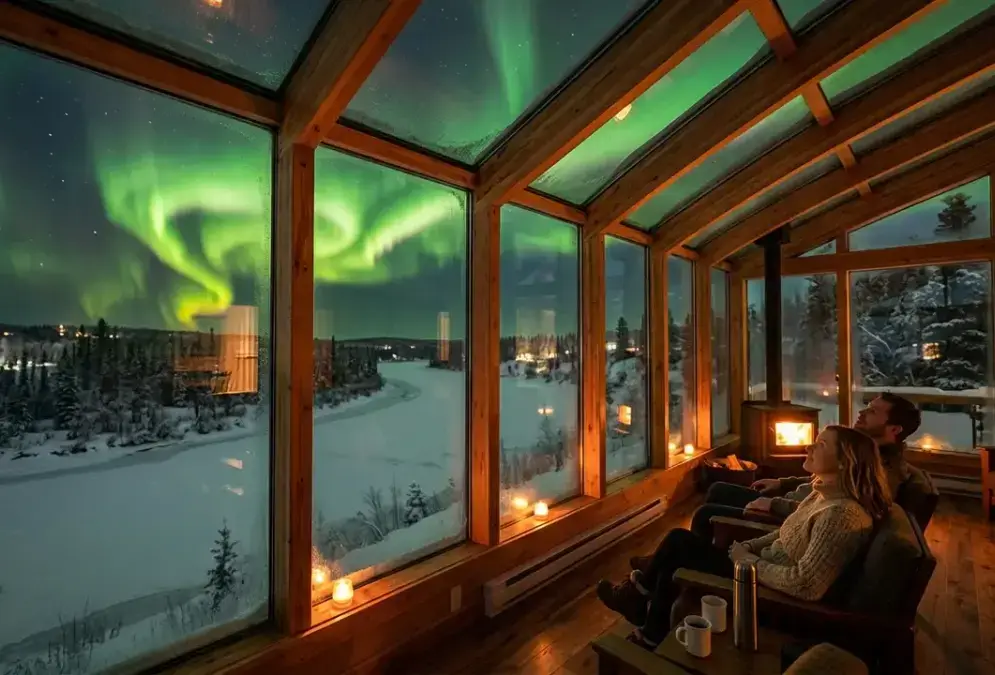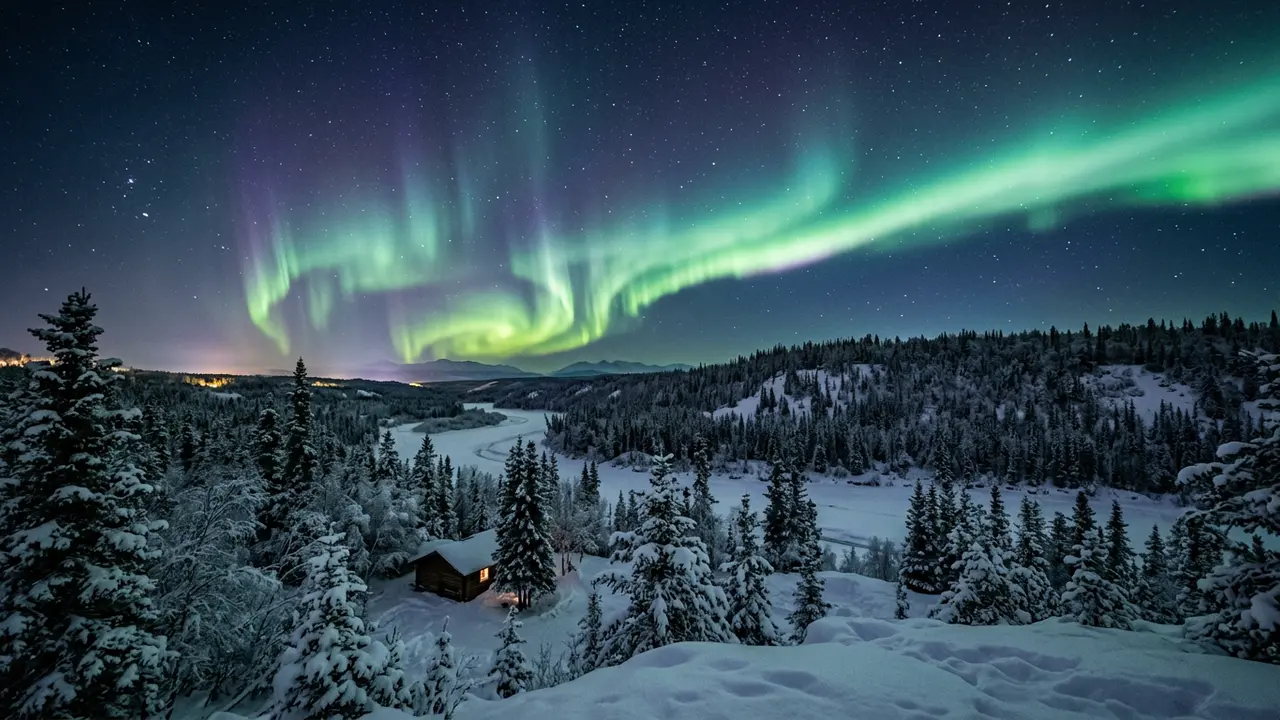
Aurora Borealis dancing in green curtains over snow-covered boreal forest in Fairbanks, Alaska
Northern Lights

Northern lights tours in Fairbanks: what the guarantee actually covers

6–8 hours
August 21 – April 21 (peak: February–March). Nightly departures 9–10 PM, return 3–4 AM. Hotel pickup from core Fairbanks area.
Hotel pickup from major Fairbanks area hotels (specific pickup details provided after booking)
All activities

Fairbanks sits at 64.8°N magnetic latitude, directly under the auroral oval — the ring-shaped zone of intense geomagnetic activity that circles the Arctic. On most clear nights from late August through April, the aurora borealis appears overhead, not as a faint glow on the horizon but directly above you. The city records 240+ aurora nights per year, with a 90% probability of a visible display across any three-night stay during peak season. Small-group guided tours depart 9–10 PM nightly from Fairbanks hotels and return around 3–4 AM, with most operators offering a free rebook night if the sky stays closed.

What a Fairbanks aurora tour looks like

Guides load up to 10 passengers into heated vans and drive 30–60 minutes out of Fairbanks' city glow to dark-sky sites with clear northern horizons. You watch outside, step back in to warm up, then watch again. The guide tracks live Kp index readings and NOAA aurora data throughout the night, moving the group if cloud cover rolls in from one direction. Having real-time space weather data on hand is what separates a professional guide from just driving out on your own and hoping.

Photography instruction is standard on most tours. Guides help set up tripod shots and walk through long-exposure settings for DSLR and mirrorless cameras on the spot. Hot beverages and snacks are included. Camera rentals ($65) and professional aurora portraits ($60) are available through some operators at additional cost.

How the rebook policy works

No operator controls solar activity or weather. The "guarantee" is a structured rebook: if no aurora is visible on your first tour, most operators bring you back on a second night free of charge within 30 days. Fairbanks Aurora Tours ($235 standard, $285 in peak March) and Face The Outdoors — a NatGeo-recommended owner-operated service limited to 10 guests — both offer this. Verify exact terms before booking; some operators apply the guarantee only when cloud cover is the documented reason.

The policy has real value in Fairbanks. Because of the city's position directly under the auroral oval, aurora is visible even at Kp 2–3 — geomagnetic levels that produce nothing visible at lower latitudes. Cloud cover, not weak solar activity, is the main obstacle. Fairbanks' interior location gives it 55–60% clear-sky probability during season, better than coastal Alaska. A three-night stay combined with a rebook policy covers most weather scenarios.

February and March vs. the rest of the season

The season runs August 21 to April 21, but the months are not equal. February and March offer the best combination: statistically clear skies over the Fairbanks interior, 15–16 hours of darkness, and strong solar activity in the current solar cycle. Book two to three months ahead for peak season — these months fill quickly.

September and October are cheaper and still viable. Geomagnetic activity often runs strong near the autumn equinox, and early-season tours carry warmer temperatures — a meaningful difference when you're standing outside at 2 AM. January hits the deepest cold (-40°F/-40°C is common) and suits photographers who value the atmospheric stability that extreme cold produces. Aurora viewing peaks each night from 10 PM to 2 AM, around solar midnight (approximately 2 am AKDT or 1 am AKST).
Highlights

  • Direct position under the auroral oval at 64.8°N — aurora visible even at Kp 0 on clear nights
  • 6–8 hour guided aurora chase with real-time Kp index and space weather monitoring
  • Professional photography instruction: tripod setup, long-exposure settings for DSLR and mirrorless
  • Hotel pickup and drop-off from core Fairbanks area included
  • Heated van transport to dark-sky sites away from city light pollution
  • Small groups of 5–10 for personal attention and guide access
  • Hot beverages and snacks during viewing sessions
  • Free rebook on a second night if no aurora is sighted on your first tour

Included

  • Hotel pickup and drop-off (core Fairbanks area)
  • Heated van transportation to remote dark-sky viewing locations
  • Professional aurora guide with real-time space weather monitoring
  • Photography instruction (tripod setup, long-exposure camera settings)
  • Hot beverages and snacks
  • Scientific commentary on aurora formation and Kp index readings

Not included

  • Camera equipment (rentals available for ~$65 through some operators)
  • Professional photographs (available for ~$60 per portrait through some operators)
  • Meals beyond hot beverages and light snacks
  • Travel insurance
  • Gratuities

Practical information

Languages

English

Group size

Small groups, typically 5–10 people

Good to know before booking

  • Insulated parka, thermal base layers, snow pants, waterproof insulated boots, gloves, hat — temperatures reach -10°F to -40°F (-23°C to -40°C) during peak season
  • Minimum age: 10 years for small-group tours (private tours available for younger children)
  • Ability to walk short distances in snow and stand outdoors for extended periods
  • Camera recommended; DSLR or mirrorless captures aurora significantly better than a phone

Prices & Booking

Bookable online

From €216 approx.

From $235 per person

August 21 – April 21 (peak: February–March). Nightly departures 9–10 PM, return 3–4 AM. Hotel pickup from core Fairbanks area.

Tags

aurora guided tour fairbanks alaska northern lights astronomy night sky winter outdoor activity photography family friendly

Frequently asked questions

What is the best time to see the aurora in Fairbanks?

February and March hit the best combination: statistically clear skies over the Fairbanks interior, 15–16 hours of darkness, and solar activity running strong in the current cycle. The season runs August 21 to April 21. Each night, peak viewing falls between 10 PM and 2 AM when geomagnetic activity clusters around solar midnight (roughly 2 am AKDT or 1 am AKST in winter).

What does the aurora guarantee actually cover?

The guarantee is a rebook policy, not a promise that aurora will appear. Solar activity and cloud cover are outside any operator's control. If no aurora appeared on your tour night, most operators bring you back on a second night free of charge within 30 days. Read the terms before booking: some apply the guarantee only when cloud cover is the documented reason; others honor it for any night without a visible display. The policy has real value only if your schedule allows a spare evening in Fairbanks.

What Kp level do I need to see the aurora in Fairbanks?

Fairbanks sits directly under the auroral oval at 64.8°N, so aurora is visible even at Kp 0 on a clear night — a level that produces nothing visible at 50°N. Regular displays occur at Kp 2–3. Strong activity (Kp 5+) produces the wide, curtain-filling displays you've seen in photographs. Your guide tracks live Kp readings throughout the night and repositions if cloud cover blocks the view.

Why is Fairbanks better for aurora viewing than Anchorage?

Anchorage sits around 61°N, outside the auroral oval's core band. Aurora appears there on strong solar nights (Kp 5+) but not regularly. Fairbanks at 64.8°N sits directly under the oval, meaning Kp 2–3 produces active overhead displays. Fairbanks also has lower cloud cover than coastal Southcentral Alaska. If northern lights are the main reason for the trip, Fairbanks is the right base.

How long do Fairbanks aurora tours last?

Most tours run 6–8 hours, departing 9–10 PM and returning 3–4 AM. Some operators extend if aurora activity is strong. Plan for a full rest the following morning and do not book early flights the day after.

What should I wear for an aurora tour in Fairbanks?

Insulated parka, thermal base layers (wool or synthetic — not cotton), snow pants, waterproof insulated boots, gloves, and a warm hat. Temperatures during peak season regularly drop to -10°F to -40°F (-23°C to -40°C). Hand warmers help during extended outdoor stops. A red-light headlamp lets you adjust camera settings without destroying your night vision or other passengers'.

What happens if we go out and do not see the aurora?

Most Fairbanks operators rebook you within 30 days at no charge if no aurora appeared on your first night. Some issue partial refunds for extreme-weather cancellations initiated by the operator. Confirm cancellation and rebook terms when booking. With a three-night stay, 90% of visitors see the aurora at least once, per operator statistics.

Further reading

Sources