
Why Teide forecasting is different from every other stargazing destination
Most stargazing forecasts are built for one of two scenarios: aurora destinations where you track the Kp index and solar wind, or continental sites where cloud cover is the only variable. Teide sits in a third category: a high-altitude subtropical island where the trade-wind inversion creates a permanent microclimate that separates the summit from the coast by a physical wall of cloud.
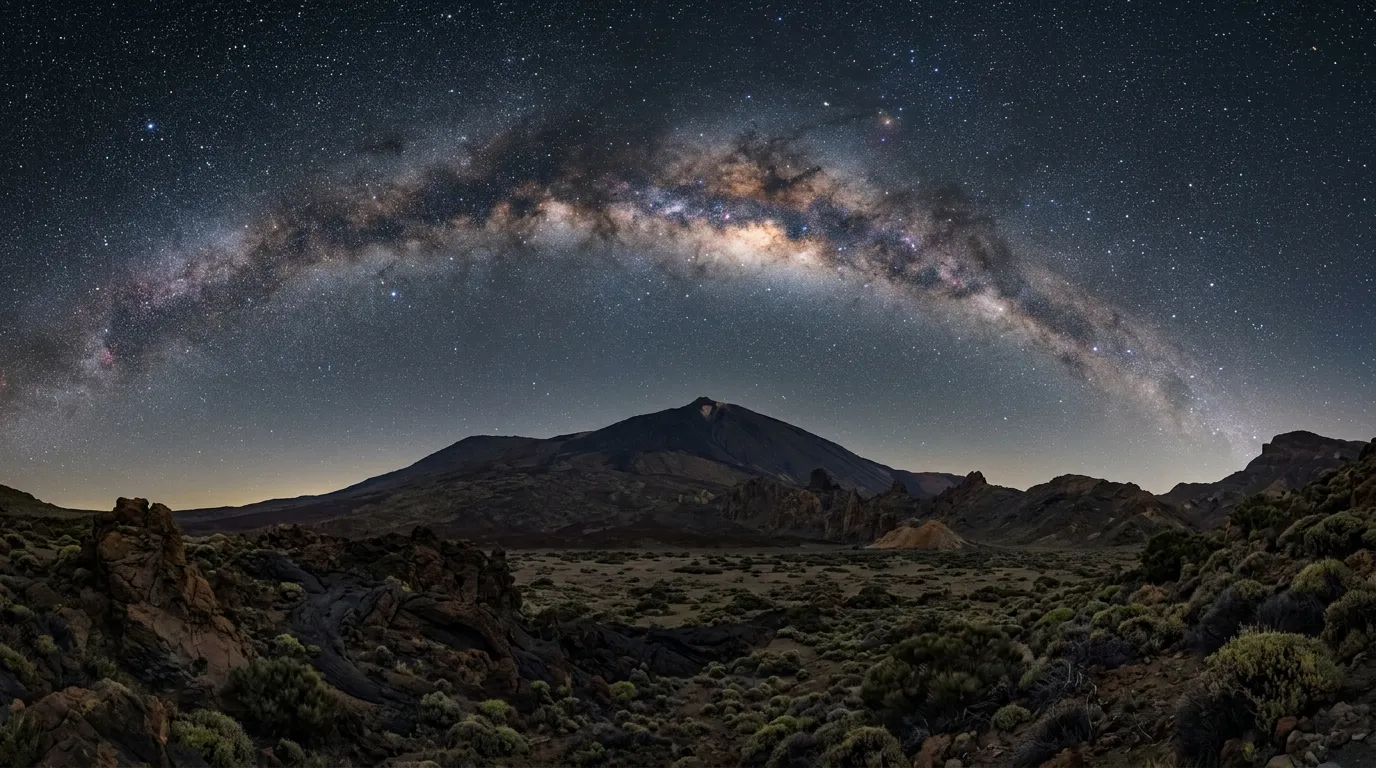
This is not a subtle effect. Drive from Puerto de la Cruz to the caldera on a typical afternoon and you pass through a grey ceiling at roughly 1,200 metres. Below it: humidity, haze, and the kind of sky where the brightest stars struggle through. Above it: bone-dry air, a sharp horizon, and the reason the Instituto de Astrofísica de Canarias chose this mountain for its northern-hemisphere observatory.
The practical consequence for trip planning is that a weather app showing cloud icons for Santa Cruz or La Laguna tells you nothing about what the summit looks like. The inversion layer traps moisture below 1,500 metres and the caldera floor at 2,000 metres sits in a different atmosphere entirely. Your forecasting workflow has to account for this split, and the tools that do it well are not the default weather widgets on your phone.
78%
The trade-wind inversion: a wall of cloud you drive through
The trade-wind temperature inversion is the physical mechanism that makes Teide forecasting tractable. North-easterly trade winds strike the island's northern slope, rise, cool, and condense into a persistent stratocumulus layer between roughly 800 and 1,500 metres. Above that band, descending dry air from the upper troposphere suppresses convection and keeps the summit clear.
This is the same inversion that gives the Canary Islands their north-south climate split: the northern coasts are green and often cloudy, the southern resorts are drier, and the high interior is a separate world entirely. On the mountain, the inversion acts as a lid. Cloud tops sit at a remarkably consistent altitude; you can watch them from the caldera rim as a flat white sea stretching to the horizon, punctured only by the peak of El Teide itself.
The inversion is strongest in summer, when the trade winds are most stable and the Azores High sits firmly over the eastern Atlantic. In June and July, the summit enjoys clear skies roughly 99% of nights[1]. Winter brings more variability: the inversion weakens, frontal systems from the north can push cloud over the summit, and clear-night probability drops to roughly 45 to 55%[1].
For the forecaster, the inversion means you are not asking will it be cloudy? You are asking at what altitude will the cloud ceiling sit tonight? If the ceiling is below the caldera floor, you are clear. If a winter front has pushed the ceiling above 2,000 metres, even the summit is socked in. The tools in the next two sections answer that question with increasing precision.
The free tools: Clear Outside, Windy, and AEMET
Three free forecasting tools cover most trip-planning decisions without requiring any meteorological training. Used together, they answer the three questions that matter: how much cloud, at what altitude, and for how long.
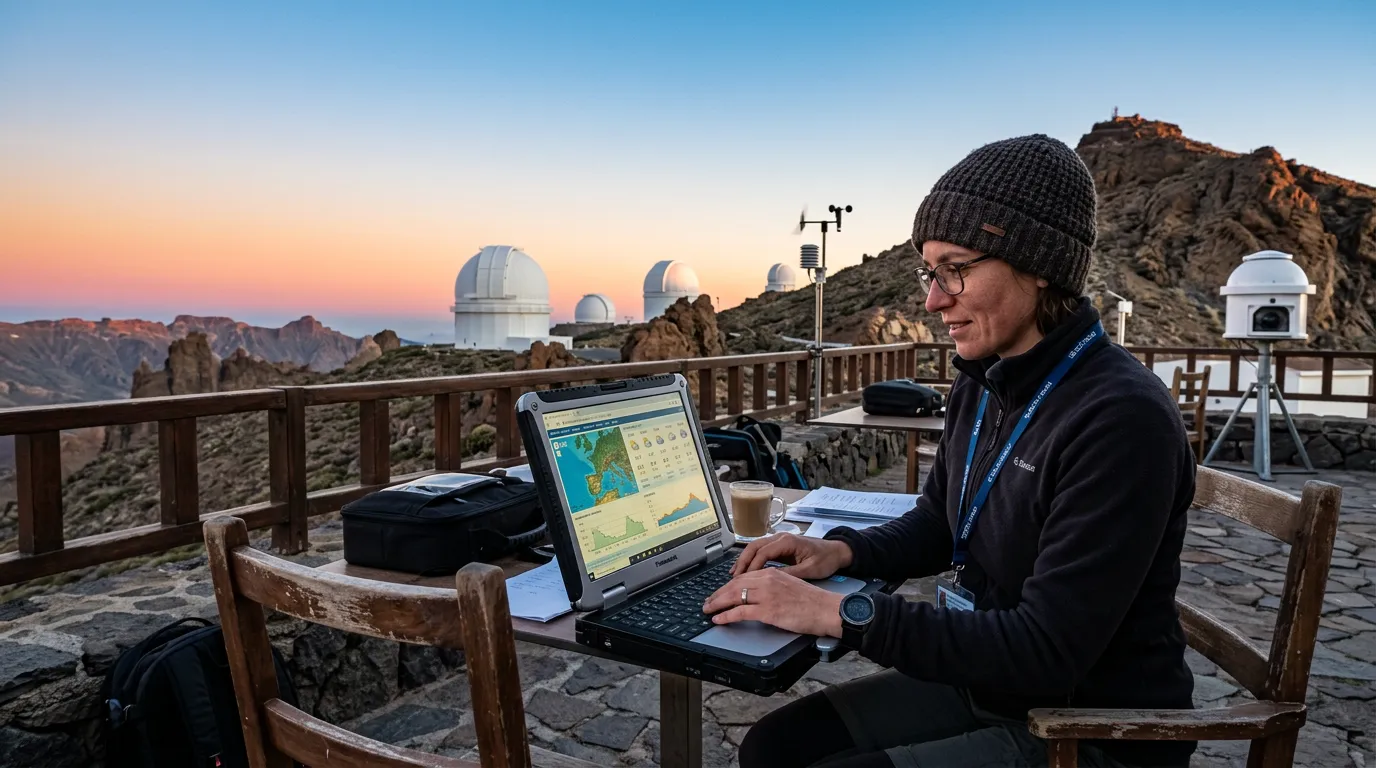
Clear Outside is a free 7-day cloud forecast built for astronomers. Set the coordinates to 28.27, -16.60 (the Teide caldera) and the tool displays cloud cover, humidity, temperature, and wind speed in three-hour blocks[2]. The interface is utilitarian: colour-coded percentage bars for low, medium, and high cloud — but it gets the altitude right: the forecast is for the summit, not the coast. A dark-blue bar across the next 48 hours means the caldera is clear. A mix of blue and light-coloured bars means patchy cloud. Yellow to red on the low-cloud row, and you are looking at a socked-in night.
Windy.com adds the visual layer that Clear Outside lacks. Switch to the Clouds overlay and select ECMWF as the forecast model. Zoom into the Teide massif and step through the animation hour by hour. What you are looking for: a clean gap over the caldera while the surrounding coast sits under a grey blanket; the inversion boundary in motion. Windy also shows cloud-base altitude in the sounding panel, which is the single most useful data point for Teide forecasting. If the sounding puts the cloud base at 1,200 metres, the caldera floor at 2,000 metres is above it. If the sounding shows 2,400 metres, the summit is inside the cloud.
| Tool | Forecast range | What it shows | Best for |
|---|---|---|---|
| Clear Outside | 7 days | Cloud %, humidity, temp in 3-hr blocks | Quick check: is tonight clear or not? |
| Windy.com | 10 days | Visual cloud layers, cloud-base altitude | Checking if the inversion is holding |
| AEMET Izaña | 72 hours | Meteogram: temp, dew point, wind, cloud | Authoritative mountain forecast, detailed timing |
AEMET (Spain's national meteorological agency) runs a mountain weather service with ECMWF-driven meteograms for high-altitude stations, including Izaña at 2,373 metres. The output is more technical than Clear Outside or Windy: it gives you temperature, dew point, wind speed and direction, and cloud cover in a table format — but it is the most authoritative free source for Teide conditions. Bookmark the AEMET mountain forecast page and select «Izaña» from the station list. The meteogram covers the next 72 hours in three-hour steps, with enough resolution to spot a mid-evening cloud clearing that a daily icon cannot capture.
Professional-grade tools: IAC ForO and Izaña climate data
Beyond the free tools, the IAC's ForO system (Forecast for Observatories) provides the kind of data that professional astronomers use to schedule telescope time. The ForO platform generates 72-hour forecasts specific to the Teide Observatory site, covering three parameters that matter for stargazing quality: seeing (the steadiness of the atmosphere, in arcseconds), PWV (precipitable water vapour, in millimetres), and coherence time (how long the atmosphere stays stable enough for high-resolution observation).
For a visual stargazer, the practical takeaway is simpler than the technical documentation suggests. The median seeing at Teide Observatory (2,390 m) is 0.76 arcseconds, median PWV is 3.5 millimetres[3]; both figures are among the best on the planet for a site at this altitude. When the ForO forecast shows PWV below 3 mm and seeing under 1 arcsecond, you are looking at exceptional transparency and unusually steady air. Stars will hold sharp in binoculars, and planetary detail through a small telescope will be well above what most amateur astronomers are used to at sea level.
Access the ForO forecast at the IAC's weather portal. The interface is functional rather than polished: a series of graphs with time on the x-axis and seeing/PWV on the y-axis — but reading it is straightforward: the lower the coloured line on each graph, the better the conditions. For a planning workflow, check ForO the morning of a planned summit night. If the 72-hour seeing curve stays below 1.0 arcseconds and the PWV curve stays under 5 mm for the evening window, the mountain is in good shape.
0.76"
The Izaña Atmospheric Research Centre (IARC), operated by AEMET, maintains a long-term climate dataset that gives you the background probability you need before checking any short-term forecast. The headline numbers: 3,500 annual sunshine hours, 393 mm total precipitation, and a summer humidity floor of 25% in July[1]. These are the macro statistics behind the micro forecast. A Clear Outside prediction of clear skies in July is not a lucky roll — it is the climatological default. For the broader method of cross-referencing forecast data with season and moon phase across any destination, the When to Stargaze guide covers the full framework.
Calima, winter storms, and what wrecks a clear forecast
The inversion handles ordinary cloud. Two hazards defeat it, and both are worth checking before you commit to a summit drive.
Calima is a Saharan dust event: a hot, dry wind from the east that carries fine desert particulate across the Atlantic and blankets the Canary Islands in a haze that reduces visibility and, critically for stargazing, cuts sky transparency even when no actual cloud is present. A calima sky at the summit looks clear in the sense that you cannot see a defined cloud layer, but bright stars lose their crispness, the Milky Way's dust lanes go flat, and the limiting magnitude drops by a magnitude or more. Calima is most common in late winter and early spring, and it can persist for several days. The Spanish meteorological agency AEMET issues calima warnings in its standard forecasts; Windy.com shows the dust concentration in its Air Quality / PM10 layer. If the PM10 reading over the Canaries is elevated and the sky at the coast has a milky, yellowish cast during the day, the summit transparency will be degraded even if Clear Outside shows zero cloud.
Winter frontal systems are the second hazard: deep Atlantic lows that push the inversion ceiling above the summit and bring actual precipitation to the caldera. From December through March, these systems can close the TF-21 and TF-24 access roads with snow, sometimes for days[1]. A Teide winter forecast that shows low cloud on the summit with temperatures near freezing is not a stargazing night; it is a stay-at-the-hotel night. Check the Cabildo de Tenerife road-status page before leaving.
Featured · Destination
Tenerife Stargazing
Tenerife stargazing guide: Teide National Park's UNESCO Bortle-2 skies, 83 constellations visible. Observatory visits from €21, Parador hotel, and best tours.
Summer brings none of these hazards. The calima frequency drops sharply, the Azores High locks the inversion in place, and clear-night probability reaches roughly 99%[1]. If you are booking flights for stargazing, July gives you the highest forecast reliability of the year; the tools above will confirm it rather than surprise you.
For the full month-by-month breakdown of what the sky looks like across the year, including how the Milky Way core position interacts with weather probability, the best time for stargazing in Tenerife guide covers the seasonal calendar in detail.
When to go and when to stay: a practical decision workflow
A forecasting workflow on Teide is a sequence, not a single tool check. The order matters because each step narrows the decision with more specificity and less guesswork.
Start with Clear Outside the evening before or the morning of a planned summit night. If the low-cloud row shows solid blue bars for the 21:00 to 03:00 window and humidity is below 60%, the broad picture is good. If low cloud is red or yellow, open Windy.com and check the cloud-base altitude. A cloud base at 900 metres is irrelevant — the caldera is clear above it. A cloud base at 2,300 metres is a problem. This is the inversion-height check that Clear Outside cannot give you on its own and that coastal weather apps get wrong by default.
If both tools agree that the summit is clear, open AEMET Izaña or the IAC ForO page for a quality check. Seeing under 1.0 arcseconds and PWV under 5 mm mean the air itself is steady and dry — you will get sharp stars, good binocular views, and astrophotography conditions worth the equipment weight. If the numbers are degraded but the cloud forecast is clear, it is still worth going; you will see stars, just not at the site's full potential.
Calima check: before committing, look at the Windy PM10 layer or the AEMET haze forecast. If the Canaries are under a dust plume, you will get a bright, washed-out sky. Whether that is worth a summit drive depends on your goals: a first-time visitor who has never seen the Milky Way from altitude will still be impressed. A photographer chasing dust-lane detail in the galactic core should reschedule.
Recommended tours
Tours are selected for quality, not commission. I earn a small fee if you book — at no extra cost to you.


Road access: from December through March, check the Teide National Park road-status page on the Cabildo de Tenerife website. The TF-21 and TF-24 can close after snowfall, and the cable car runs on a reduced schedule (09:00 to 17:00 in winter versus 09:00 to 18:40 in summer). In summer, road closures are rare and access is straightforward, but the getting to Teide guide covers the full access logistics, including the summit permit system and parking at the miradores.
The decision tree looks like this:
- All tools clear + inversion holding + no calima: go. These are the nights that reward the planning.
- Summit clear but seeing/PWV mediocre: go. Still well above what most stargazers experience elsewhere.
- Cloud forecast mixed, inversion uncertain: check Windy cloud-base altitude. If the caldera sits above the cloud ceiling, go. If the sounding is ambiguous, consider going but have a backup plan.
- Calima active, medium to high dust: go if it is your only night and you want to see the sky. Skip if you are photographing and can reschedule.
- Winter front, summit cloud, snow on roads: stay at the hotel. No forecast tool changes the physics of a frontal system at 2,000 metres.
One final note that experience teaches: the inversion is visible from the coast. On a clear afternoon, look toward the mountain from La Laguna or Puerto de la Cruz. If you see a flat cloud layer with Teide's cone rising cleanly above it, the summit is almost certainly clear for the night. If the mountain is hidden entirely, the ceiling has risen above 2,000 metres. That visual check — free, instant, and accurate — is the one that the websites confirm but your own eyes give you first.