Best best budget proximity
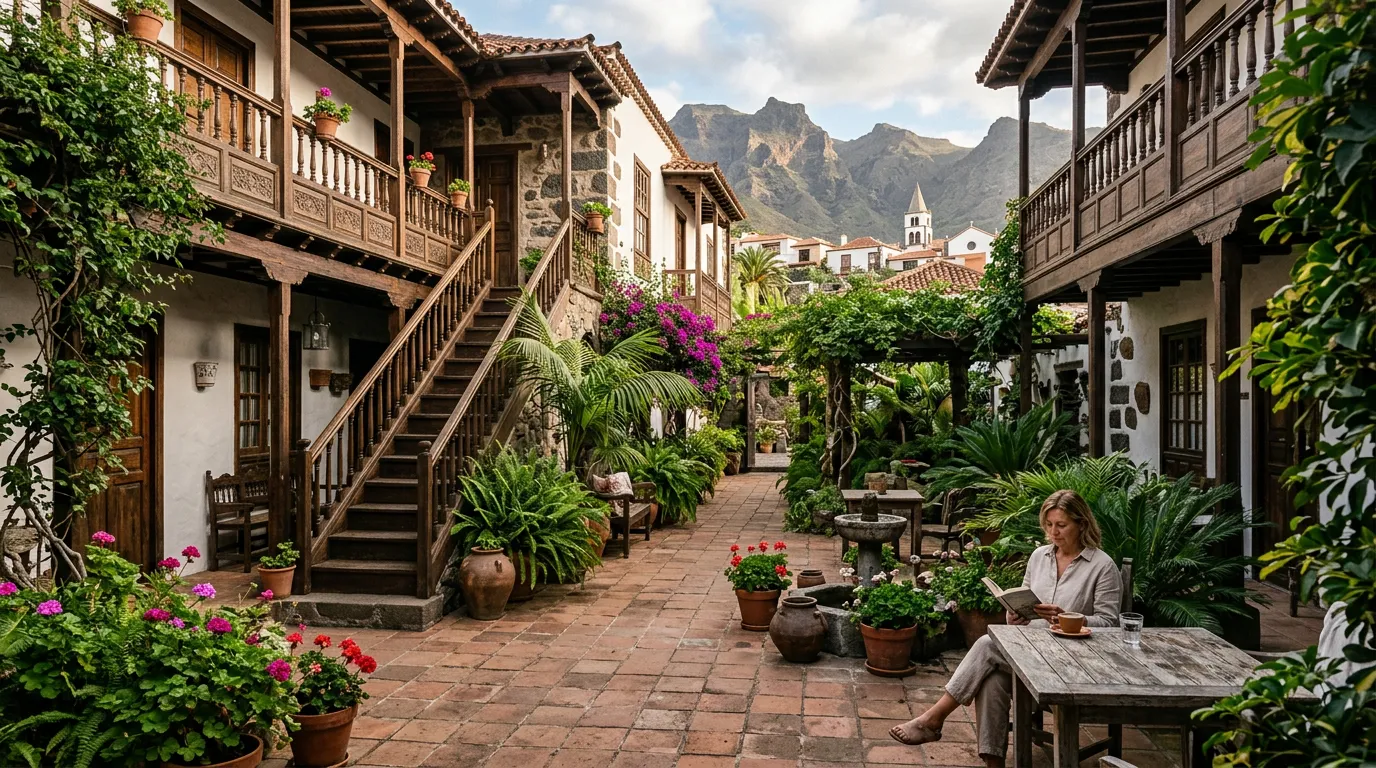
Casa Rural Las Llanadas
Self-catering house at 1,500 m, Bortle 3 terrace, 5 min drive to El Portillo park entrance, budget
Tenerife stargazing guide: Teide National Park's UNESCO Bortle-2 skies, 83 constellations visible. Observatory visits from €21, Parador hotel, and best tours.
Photo tour of the lodges, night-sky trips, and guides for this destination.
Best best overall
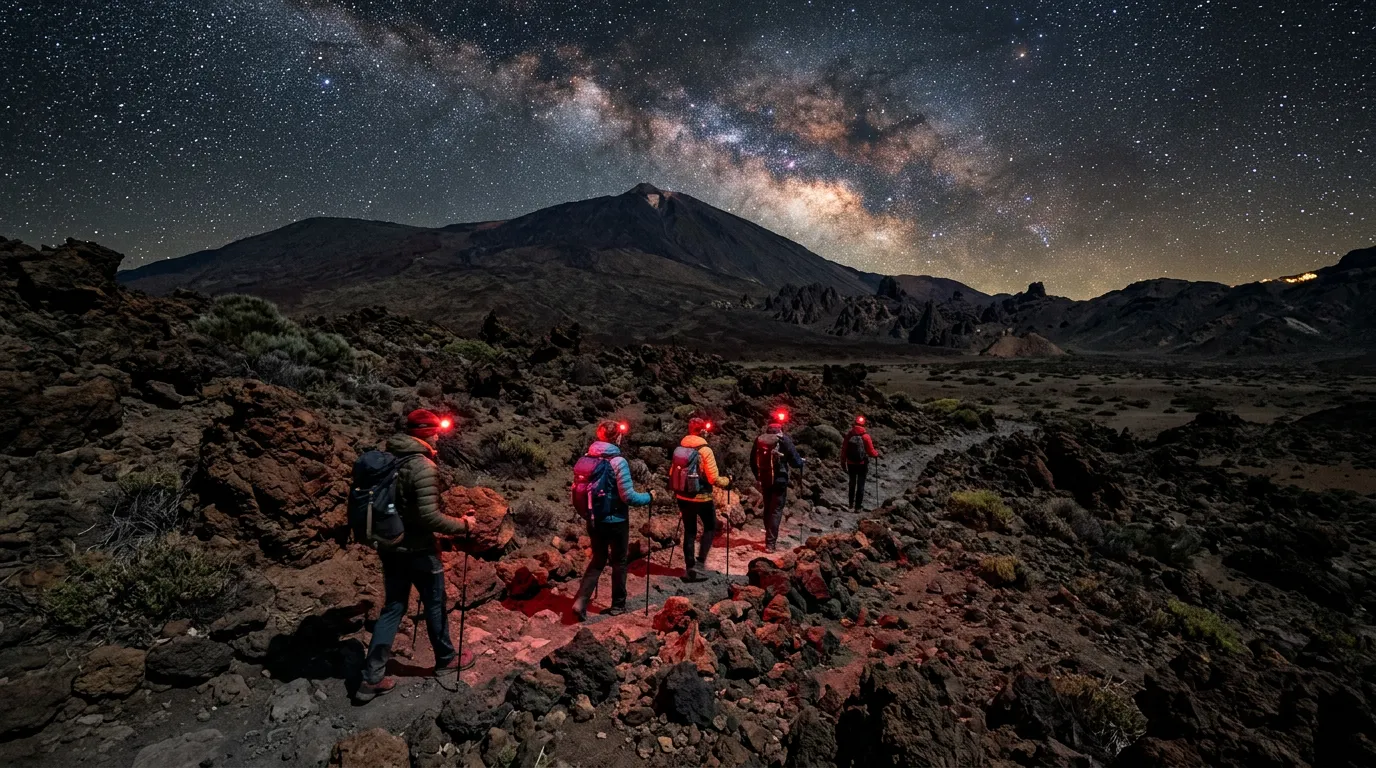
Night hike through Las Cañadas caldera at 2,000m under Bortle 2 skies. Telescopes, Starlight guides, 360° volcanic horizons. From €60. Tenerife, Canary Islands.
Five Tenerife lodges ranked for stargazing: Bortle class, dark-sky access, and value. From the only hotel inside Teide NP to budget bases above the clouds.
What camera, lens, and tripod work on Teide: fast primes over zooms, carbon-fibre tripods, and why the 15°C temperature drop at altitude fogs your glass hard.
Best best amenities at altitude
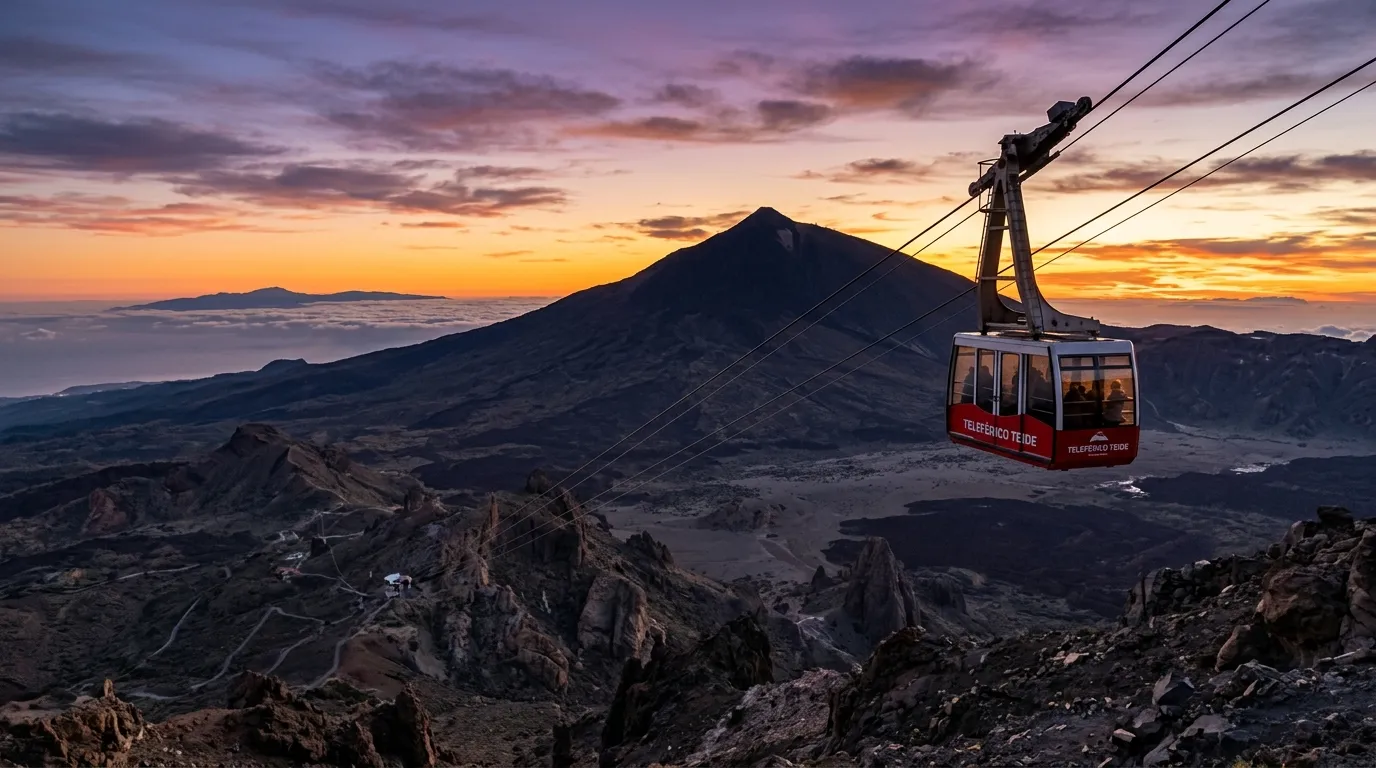
Teide cable car sunset stargazing from €182: ride to 3,555m for sunset then telescope viewing above the trade-wind inversion. 90 seats only, books weeks ahead.
Ranked by Bortle darkness, clear-night odds, and galactic-core season: 14 places worldwide where the Milky Way is genuinely visible, from Atacama to Uluru.
Seven Teide stargazing sites ranked by darkness and access. Which for Milky Way photography, which when mountain roads close, plus practical seasonal advice.
Weighing it against somewhere else? La Palma vs Tenerife Stargazing: How to Choose
Bortle 2 sky
What the Bortle scale meansThe Milky Way is richly structured overhead; the Andromeda Galaxy is an easy naked-eye smudge.
This destination rates Bortle 2 on the 9-level Bortle dark-sky scale, where 1 is a pristine dark sky and 9 is an inner-city sky. The Milky Way is richly structured overhead; the Andromeda Galaxy is an easy naked-eye smudge.
On this page
Updated
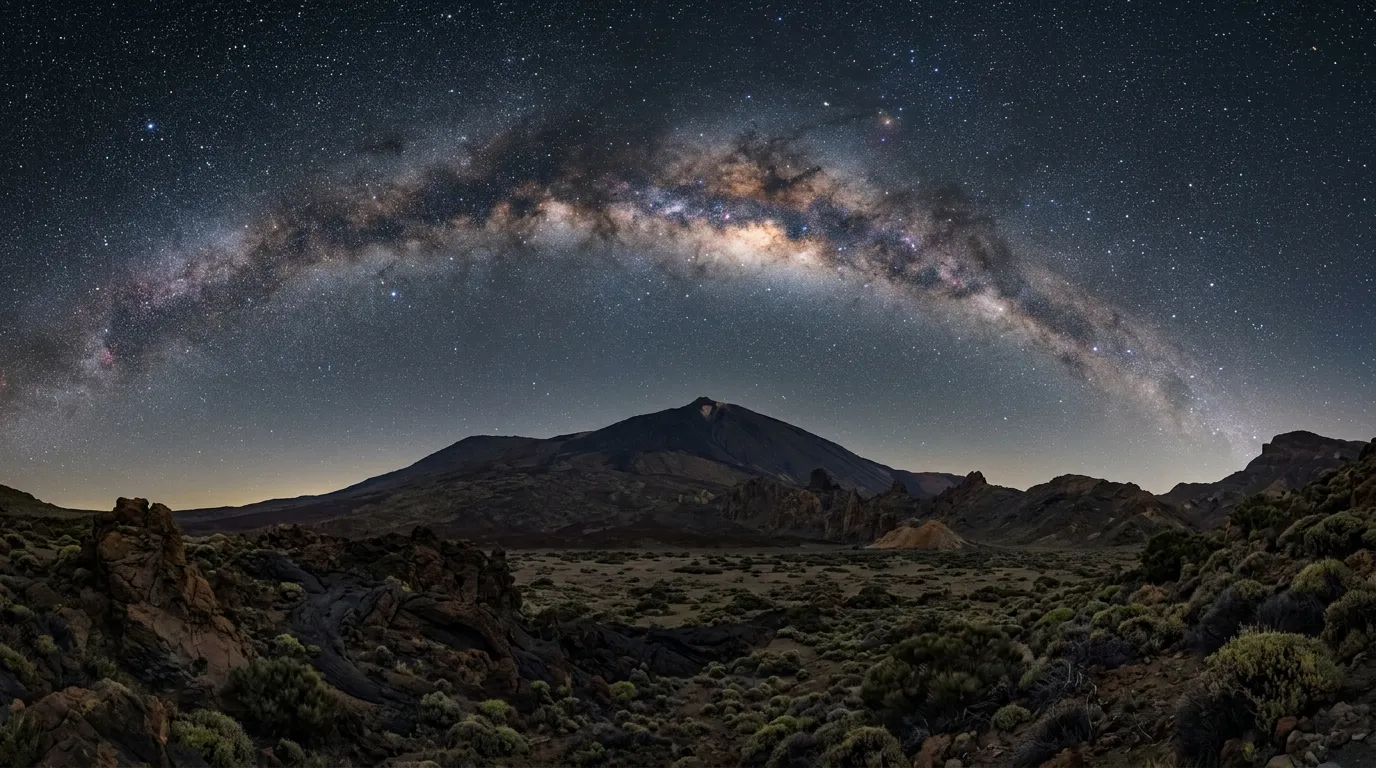
Tenerife is home to one of the three best skies on Earth for astronomical observation, alongside Chile's Atacama and Hawaii's Mauna Kea. The difference is accessibility: fly into a European holiday island with motorways, English-speaking services, and hotel infrastructure for every budget, then drive 45 minutes from the coast to an altitude of 2,356 metres, where the trade-wind inversion separates you from every cloud in the Atlantic. No altitude sickness to manage, no 12-hour desert drives. Just a volcano, a cable car, and a Bortle-2 sky on the Bortle scale, with a naked-eye limiting magnitude consistently above 6.5, where 83 of the 88 constellations are visible to the unaided eye.
Computed for Tenerife at 28°N. Updates nightly.
First quarter tonight, 36% illuminated
Next new moon August 12. The nights either side of it are the darkest of the month.
About 7 hours of astronomical darkness tonight
The sun drops more than 18 degrees below the horizon, so the sky gets genuinely dark for deep-sky viewing at 28°N.
Hours of astronomical darkness by month at Tenerife: January 11 hours, February 10 hours, March 9 hours, April 8 hours, May 8 hours, June 7 hours, July 7 hours, August 8 hours, September 9 hours, October 10 hours, November 11 hours, December 11 hours.
Perseids active now
Peaks August 12. Up to 100 meteors per hour at maximum. The 2026 peak lands on a new moon — a dark-sky year with zero lunar washout.
See the Perseids guideWhere to go stargazing in July
Three things make this island work for stargazing when other European sites don't. The first is altitude without the misery: Teide National Park's observing sites sit between 2,000 and 2,400 metres, high enough to deliver good astronomical seeing by rising above most atmospheric turbulence, low enough that most visitors feel fine. This is not the Chajnantor plateau at five thousand metres.
The second is the trade-wind inversion layer. Prevailing northeast winds push moist Atlantic air against Tenerife's northern slopes, where it condenses into a permanent band of cloud between roughly 800 and 1,600 metres. Above that band, at the caldera rim and the Izaña ridge, the air is dry and still. You drive up through grey stratus and emerge into clear sky. This sea-of-clouds effect fills every Teide sunset photo, but it also does real atmospheric work: it caps light scatter and moisture below the observing zone. Professional astronomers call it the Canarian anticyclone, and it is the same atmospheric quality that drew astronomers to this ridge decades before any formal oversight existed. The Instituto de Astrofísica de Canarias itself was not founded until 1975, inheriting a site whose value had already been proven.
The third is legal, not meteorological. The IAC's Sky Protection Office (OTPC), established in 1992, enforces the Ley del Cielo, the Canary Islands' light-pollution law. Municipalities above certain elevations face strict limits on luminaire type, beam angle, and spectral output. Enforcement is imperfect; the south-coast resorts still produce a visible glow on the southern horizon. Even so, the sky above the caldera has stayed dark while other European dark-sky sites have lost ground. In 2007, UNESCO inscribed Teide National Park as a World Heritage Site under criteria (vii) and (viii), citing both the volcanic landscape and the exceptional atmospheric conditions for astronomical observation.
The Izaña observatory station records nearly 3,500 sunshine hours annually. Most summer nights are completely clear. Average annual temperature at observatory altitude is 10.2°C, with June through August nearly rainless: 393 mm of precipitation falls across the whole year, concentrated in winter. The practical message: if you book a stargazing tour between May and September, your main weather risk is wind, not cloud.
Tenerife delivers roughly 300 clear-sky nights per year at altitude; the trade-wind inversion layer pins cloud below 1,500 m, and the caldera sits above it. Season matters less than moon phase: a new-moon night in November at 2,000 m beats a full-moon night in July at sea level. Still, summer gives you the warmest observing and the Milky Way core at its highest; winter gives you the longest nights and the sharpest seeing.
Going in May? See what else the sky offers that month
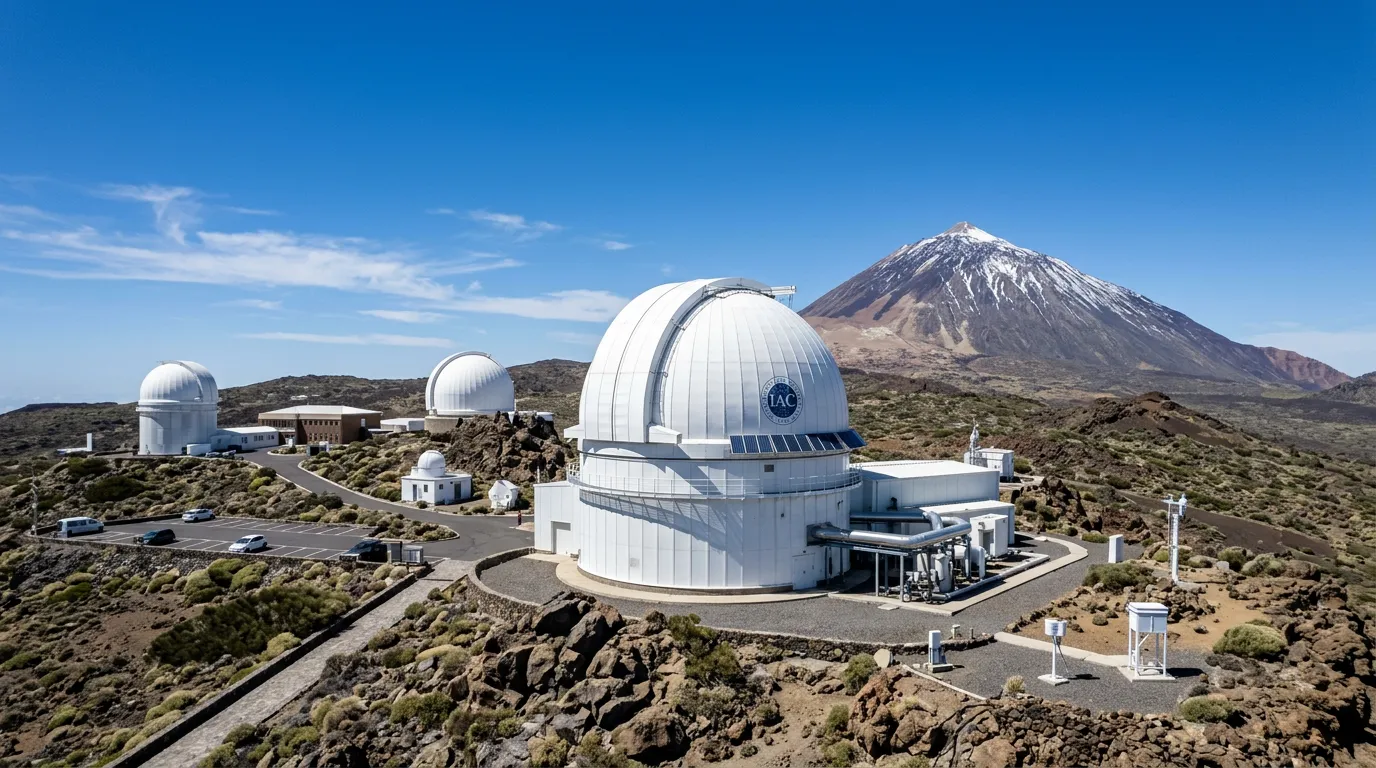
Teide Observatory sits at 2,390 m on the Izaña ridge, roughly 15 km east of the volcano itself. The University of Bordeaux installed the first telescope here in 1964. Since then the site has grown into the world's largest solar observatory, hosting the 1.5-metre GREGOR telescope and dozens of night-sky instruments operated by institutions from across Europe.
Two discoveries are worth knowing because they tell you what kind of place this is. In 1979, researchers at Teide Observatory developed helioseismology, the study of pressure waves travelling through the Sun's interior — a field that now underpins solar-weather forecasting. In 1995, astronomers using the IAC-80 telescope detected Teide 1, the first confirmed brown dwarf: a failed star, too small to ignite hydrogen fusion, sitting in the Pleiades cluster. One is why we can now predict solar storms. The other rewrote the definition of what a star is.
Public visits are possible, but with real caveats. The observatory runs guided daytime visits by reservation only through the VolcanoTeide operator, priced from €21 for 1.5 hours. Night visits are not permitted — the telescopes are working research instruments, not tourist exhibits. Children under 8 are not admitted, and visits are suspended between December and March. If you want to look through a telescope at night on Tenerife, you book a commercial tour operator on the caldera floor (see Tours section below), not the observatory.
The daytime visit does give you a walk past the GREGOR dome and the solar tower, plus a view down the ridge at the sea of clouds from 2,400 metres. On a clear morning the cloud layer below looks solid enough to walk on. The tour covers the science history and the current research programme; it earns the €21 if you have a free morning and want to see how professional astronomy actually works.
Tenerife has two airports, and they are closer to each other in drive time than most guides suggest. Tenerife South (TFS) handles most international flights and sits roughly 42–43 km from Teide National Park, about 46–49 minutes by car depending on traffic through Vilaflor. Tenerife North (TFN) handles fewer international routes, mostly inter-island and mainland Spain connections, and sits slightly farther out at around 60 km, roughly 56 minutes by car. TFS is the marginally closer option either way.
You need a rental car. There is no public bus service into the park that operates at night, and taxi fares from the coast to the caldera run well over €100 each way. The island has good roads: the TF-21 climbs from the south through Vilaflor, winding through Canary pine forest, and the TF-24 descends toward La Laguna in the north. Both are paved and well-maintained. Watch for ice in January and February above 1,800 metres; the road can close briefly after snowfall.
Park entry is free: no ticket, no gate, no timed entry. Parking at the main viewpoints is free but limited; arrive early on weekends and during school holidays. The park covers 18,990 hectares with a 54,127-hectare buffer zone, so there is always somewhere to pull over, but the best stargazing pull-offs fill after sunset in summer. For road-by-road parking and route details, read the full guide to getting to Teide.
The Teleférico del Teide runs from the base station at 2,356 m to the upper station at 3,555 m. A return ticket costs €42 for adults (non-resident rate), €21 for children. Hours: 09:00 to 17:00 in winter, 09:00 to 18:40 in summer. The sunset service, a special evening ascent, carries a maximum of 90 people and books out weeks in advance. Check current schedules on the VolcanoTeide website before building a sunset plan around it.
For the summit: the trail from the upper station to the crater rim covers 163 vertical metres on a marked path. Since Tenerife introduced its summit eco-tax on 1 January 2026, the permit reserved in advance through the national park authority is no longer free: it costs roughly €10–15 depending on the route and whether you go independently or with a guide, with only residents and children exempt. The daily cap rose at the same time from 200 to 300 permits, issued across three 100-person slots. Without a valid permit, rangers turn you back at the checkpoint above the upper station.
Tap a pin to open the lodge, tour, or destination page.
Best season
May through September for highest clear-night percentage and stable trade-wind inversion; June offers the longest dark hours with comfortable evening temperatures; July–August are clearest but busiest at viewpoints
Quietest hours
Post-midnight when most guided tours have finished and day-trippers have left the caldera; independent stargazers get the park's pull-offs almost to themselves after 01:00
Visit duration
3 nights minimum for a stargazing-focused trip (one guided night, one independent night, buffer for weather); 5–6 nights if combining daytime hiking and Mount Teide summit
You have three approaches to sleeping near the dark sky, and they are not equal.
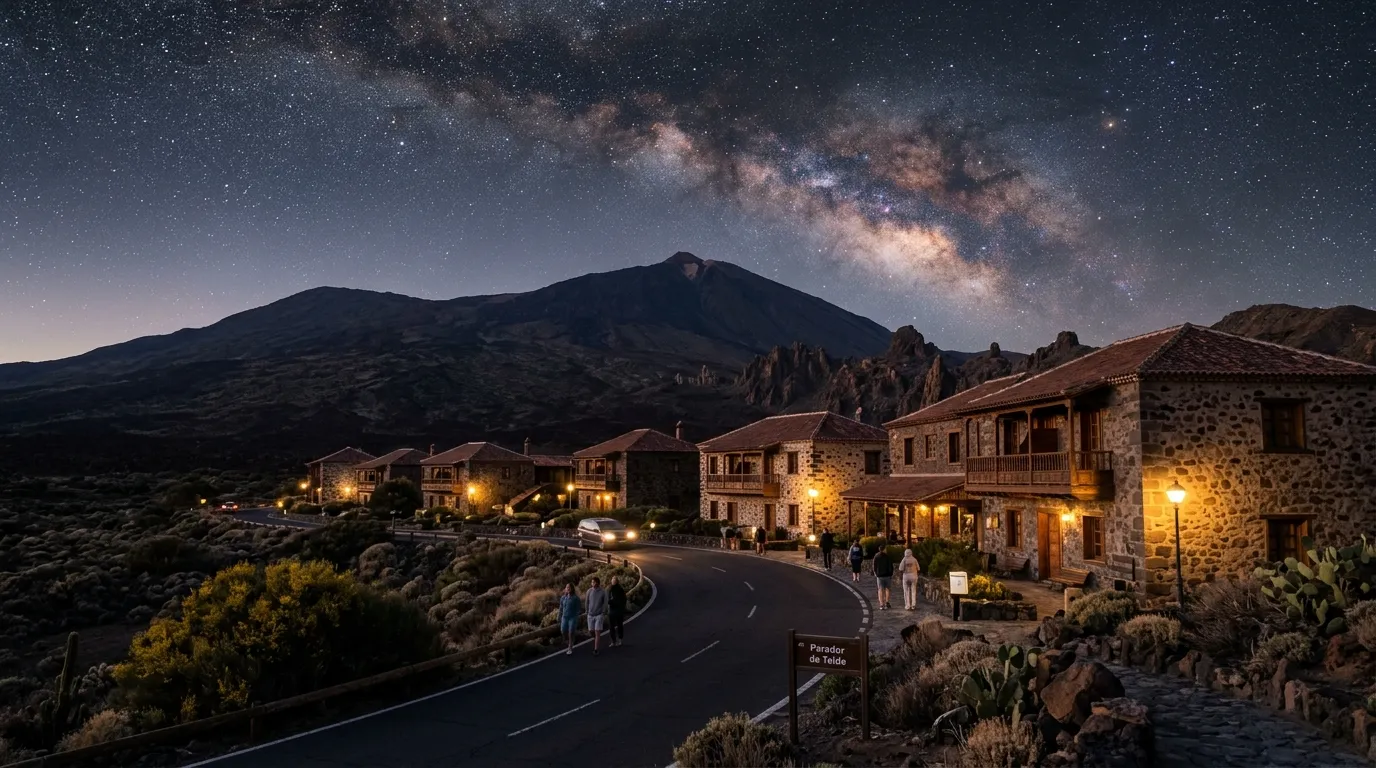
Inside the park: the Parador de Las Cañadas del Teide at 2,150 m is the only hotel inside the national park boundary. It has 37 rooms, mountain views, a restaurant serving Canarian food, and, crucially for stargazing, a front door that opens straight onto a sky where the Milky Way is already visible after dinner. No driving, no waiting for eyes to recover from headlights, no altitude-transition logistics. The tradeoff: it books out months ahead, especially around new moon and during summer. If you want to stay here, plan six months in advance. Rates are moderate for what you get (€120–200/night), but availability is the real constraint.
Near the park: the Hotel Spa Villalba in Vilaflor at roughly 1,400 m is the best compromise. Thirty minutes from the caldera floor, cheaper than the Parador (typically €80–120/night), and located in the Canary Islands' highest village. Vilaflor's altitude and small size mean less light pollution than the coastal resorts, and the drive up the TF-21 after dinner is straightforward. The hotel has a spa, genuinely useful after a cold night standing still at 2,000 metres.
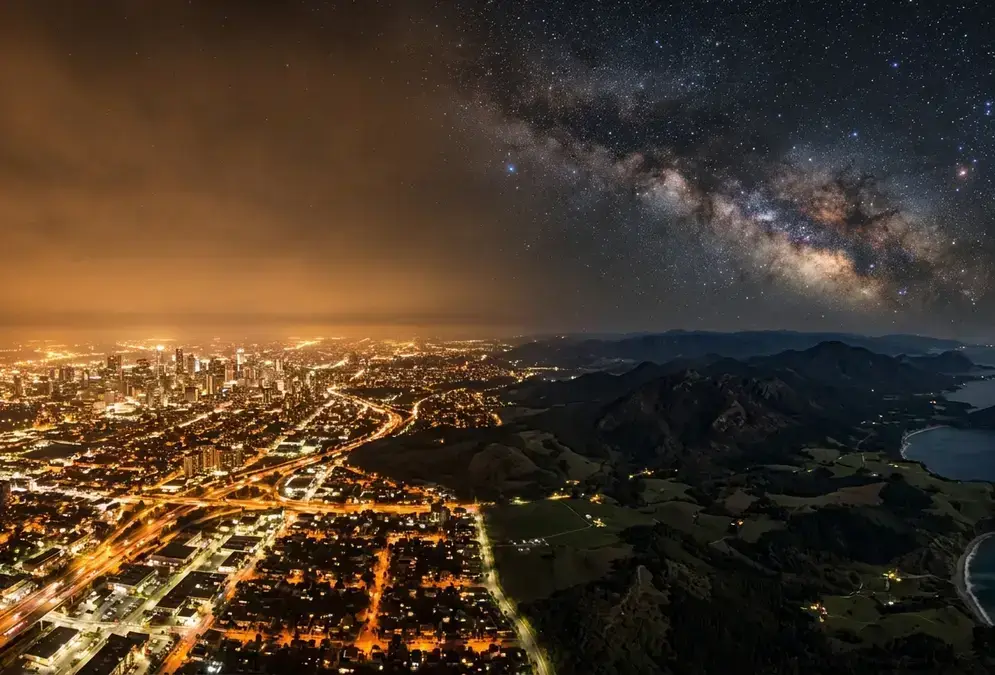
Coastal resorts: you can stay in Costa Adeje, Los Cristianos, or Puerto de la Cruz and drive up for the night, but the round trip runs 2–2.5 hours and you lose the advantage of being already in place when darkness falls. The south-coast resorts also produce the light dome visible on Tenerife's southern horizon, which makes staying there and stargazing there somewhat contradictory goals.
Between the three, the Parador wins on convenience, Villalba wins on value, and the coast only makes sense if stargazing is a side trip rather than the point of the visit.
Best best budget proximity
Self-catering house at 1,500 m, Bortle 3 terrace, 5 min drive to El Portillo park entrance, budget
Best best above-cloud base
925 m above the marine cloud layer, 10 min to park via quiet TF-38, walkable village with restaurants, from €112/night
Best best town-and-park combo
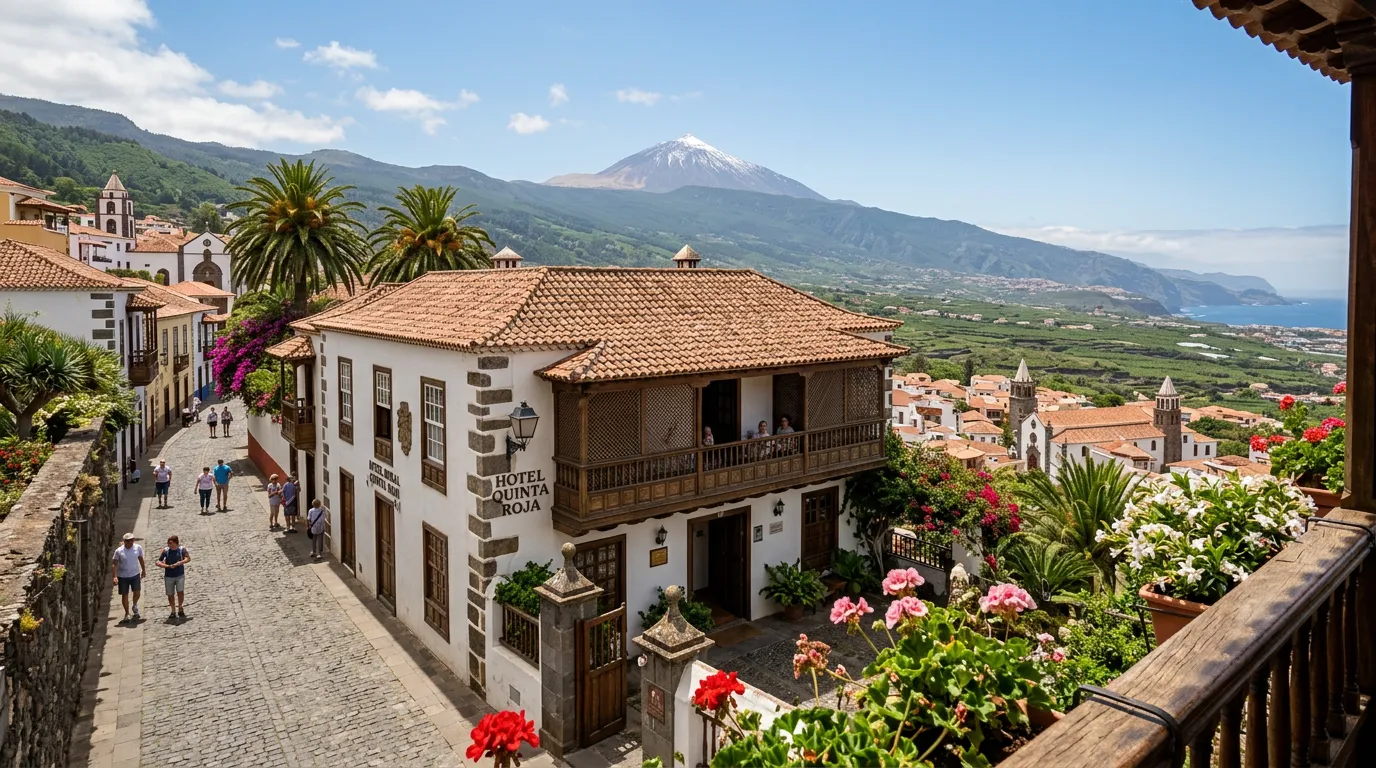
16th-century mansion in La Orotava's heritage zone, from €86/night, 30 min drive to Bortle 2 skies, cheapest base
Tenerife's stargazing tour market is more mature than most destinations. VolcanoTeide operates the official concession for Teide National Park, running several options that bundle transport, guides, telescopes, and on the premium tier, sunset dinner:
Each tier is worth weighing against your own tolerance for cold and your budget: the cheapest gets you an hour at the eyepiece, the top tier gets you dinner above the clouds first and a night under them after.
Independent stargazing is straightforward. Drive into the park at sunset, find a pull-off with a clear southern horizon, and wait. The spots around the Mirador de las Narices del Teide and the pull-offs along the TF-21 above 2,000 m give a clear view south toward the galactic core. For a full map of verified pull-offs, viewpoints, and the quietest corners of the caldera, see the best stargazing spots in Tenerife. Bring a headlamp with a red mode, a jacket (temperatures drop to single digits after midnight even in August), and a tripod if you are shooting. No permit needed for roadside stops; just do not set up in the middle of the road.
Daytime tour of the Teide Observatory, Tenerife, from €21. Enter a working solar telescope dome, see sunspots live, and visit the birthplace of helioseismology.
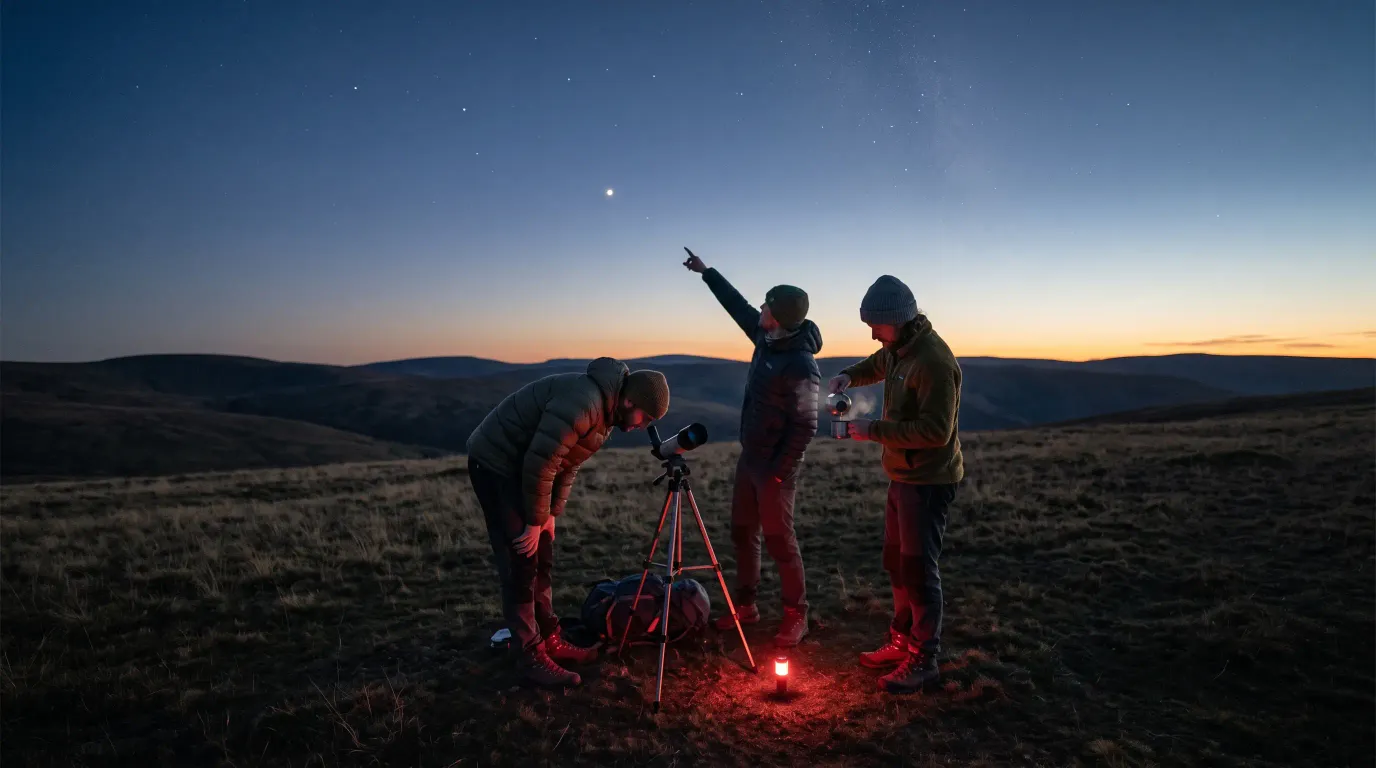
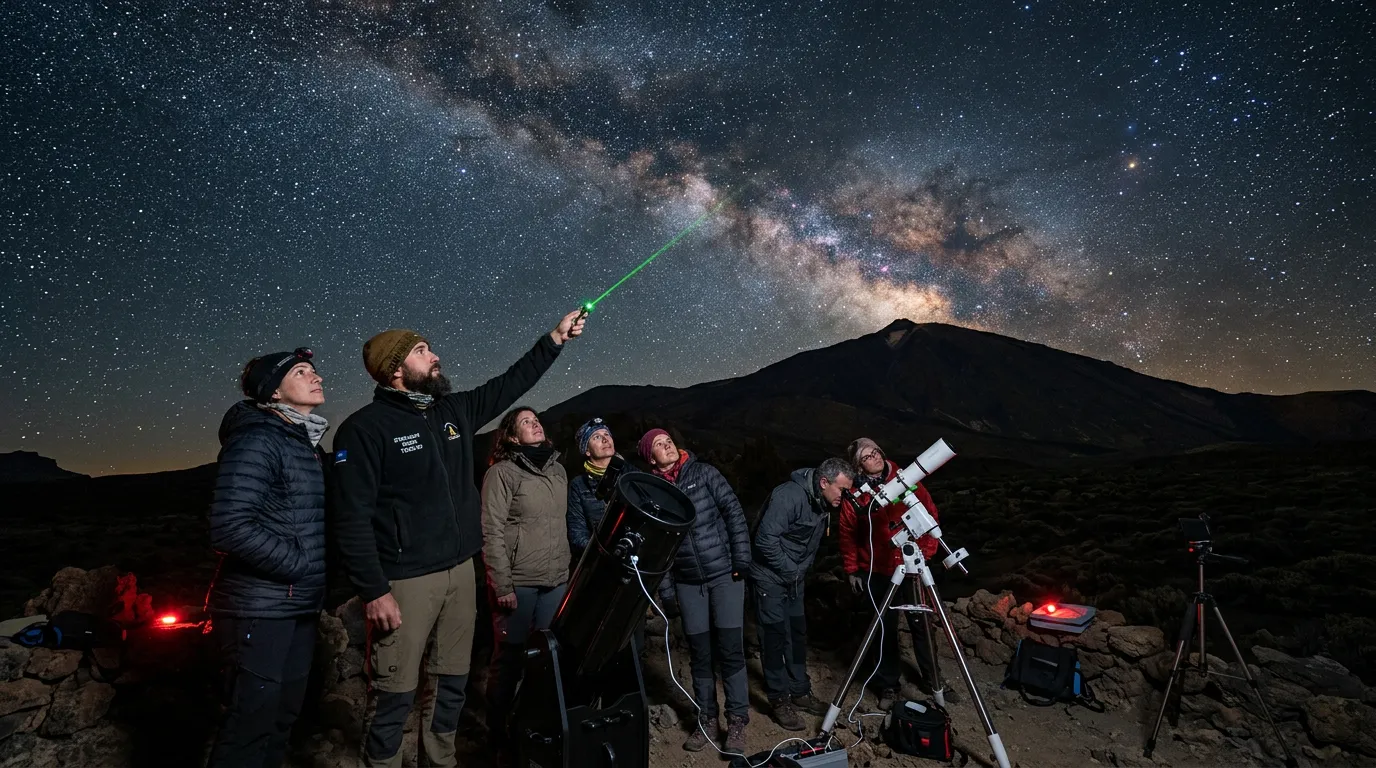
Teide stargazing from €42 with the official concessionaire. Sunset & Stars includes cable car, telescopes, Starlight guides, hotel pickup from Tenerife south.
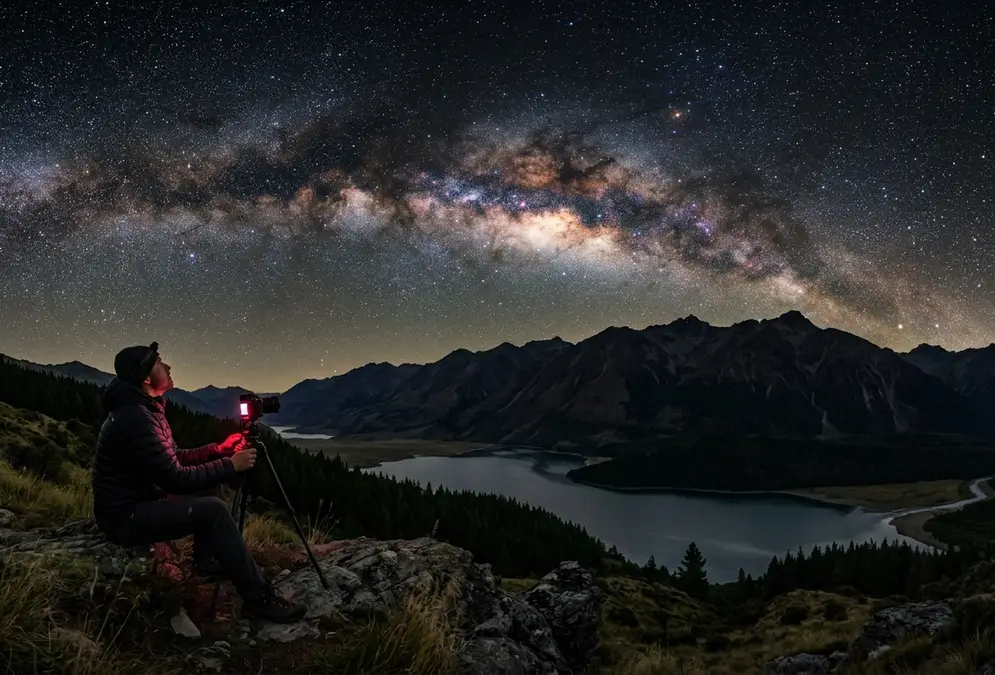
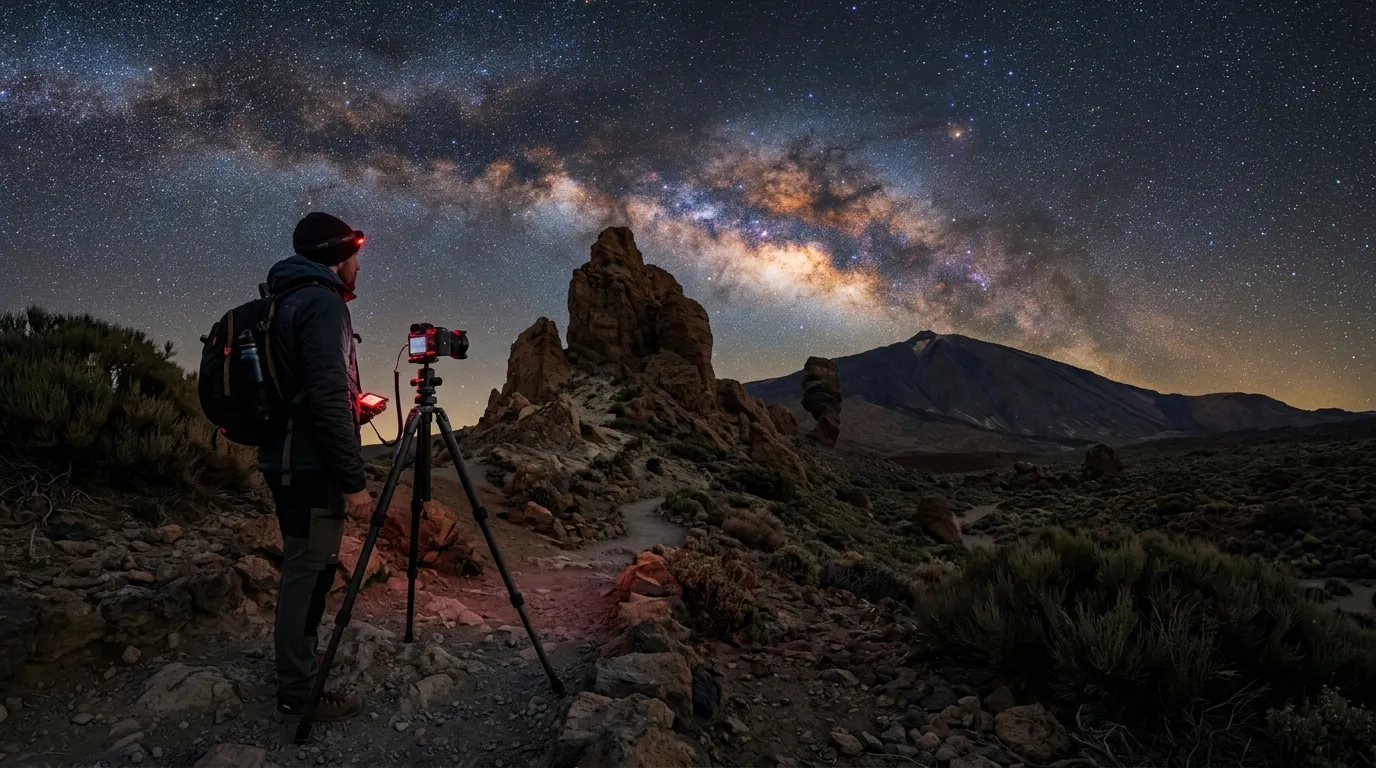
Small-group Milky Way photography tour on Teide: camera coaching at Roques de García under Bortle 2 skies. Tripod included, from €80 with south Tenerife pickup.
How many nights? Three at minimum, five if you are serious. One night to get oriented and handle the drive, one night for a guided session with telescopes, and at least one night for independent observation or astrophotography. The how many days guide covers itineraries from a weekend to a full week.
When to go? May through September for the most reliable clear skies. July and August bring the highest number of completely clear nights, but also the most visitors; the park's viewpoints can feel crowded at sunset. June is the sweet spot: long nights with sunset around 21:00, warm evenings at altitude, and the Milky Way's core already high by midnight. For a month-by-month lunar calendar and detailed sky-quality breakdown, see the best time to stargaze in Tenerife.
What to bring? Layers. Daytime temperatures at the caldera can reach 25°C in summer; after midnight they drop below 10°C, sometimes to 5°C. A chair, too: standing at a telescope for two hours is harder than it sounds. A red headlamp. Binoculars if you have them; even cheap 7×50 binoculars on a calm night at 2,300 m will show more structure in the Milky Way than most telescopes at sea level.
Moon phase: Book your trip within five nights of a new moon for peak deep-sky conditions. A first-quarter moon gives you a few hours of real darkness before moonrise; a full moon washes out the Milky Way almost completely.
Getting there from the airport: road routes, rental-car recommendations, and parking logistics are covered in the getting-to-Teide section above.
Reporter notebook
A July trip on a full moon will wash out the Milky Way almost completely; a March trip on a new moon will still give you hours of deep darkness. Check the lunar calendar before locking in dates and aim to be on the mountain within three to four nights of the new moon. The summer tourist crowds thin noticeably in the week after a full moon; use the phase as both your sky-quality tool and your crowd-avoidance tool.
Hiking at 2,300 m during the day in August feels warm. Standing motionless at a telescope for two hours at the same altitude after midnight feels freezing. The difference is roughly 10–15°C of perceived temperature. A thermal base layer, a mid-layer fleece, and a down jacket are not optional: they determine whether you stay for the session or leave early. Tour operators provide blankets but they are thin and shared; bring your own layers.
The Parador de Las Cañadas del Teide is the only hotel inside the park and the best stargazing base on the island. It sells out months in advance, particularly for new-moon weekends between June and September. Check availability before you book flights. If it is full, the Hotel Spa Villalba in Vilaflor is the next-best option: cheaper, 30 minutes from the caldera, and you avoid the light dome that coats the south-coast resorts.
Further reading
Jupiter opposition happens roughly every 13 months, when the planet rises at sunset, outshines every star, and its four Galilean moons appear in binoculars.
The Leonids peak November 17–18, 2026 with a modest 10–15 meteors an hour — not a repeat of 1833 or 1966's storms, but a solid, free show worth watching.
The 2026 Perseid meteor shower peaks August 12–13 under a new moon, with up to 90 meteors an hour. Here's when to look up and the best dark-sky places to watch.
Quadrantid meteor shower 2027 peaks Jan 3-4 with a sharp ~6-hour window, ZHR up to 120, radiant in Boötes, parent asteroid 2003 EH1. Northern hemisphere best.
Spain · Best Year-round
La Palma stargazing guide: the world's first Starlight Reserve since 2012, Bortle 1-2 skies above Roque de los Muchachos, plus where to stay and go year-round.
Saudi Arabia · Best Oct–Apr
Stargaze above Hegra's 2,000-year-old Nabataean tombs in AlUla, the Gulf's first DarkSky-accredited Dark Sky Park. When to go, where to stay, and how to plan.
United States · Best Year-round (moonless summer nights best)
Joshua Tree earned International Dark Sky Park status in 2017, just two hours from LA. Here's where to see the Milky Way, dodge crowds, and stay the night.