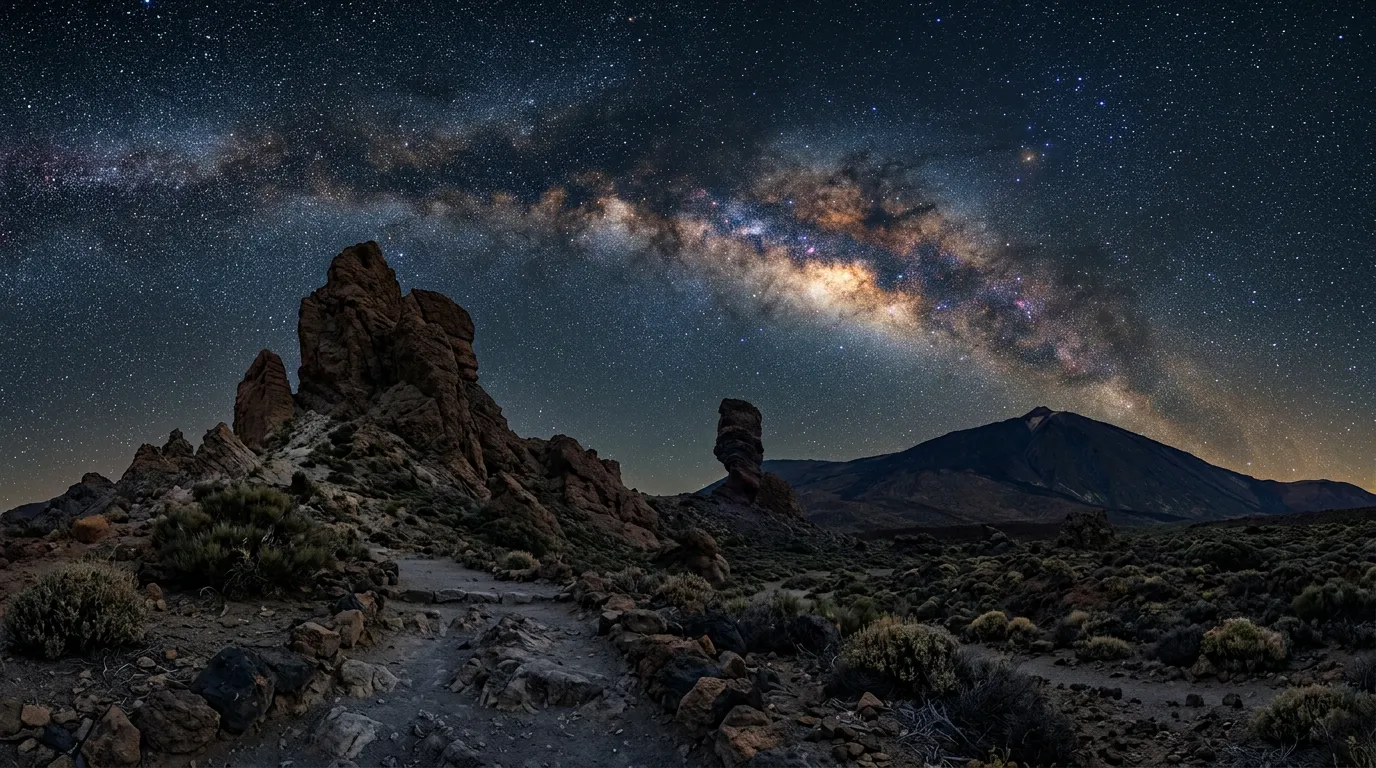

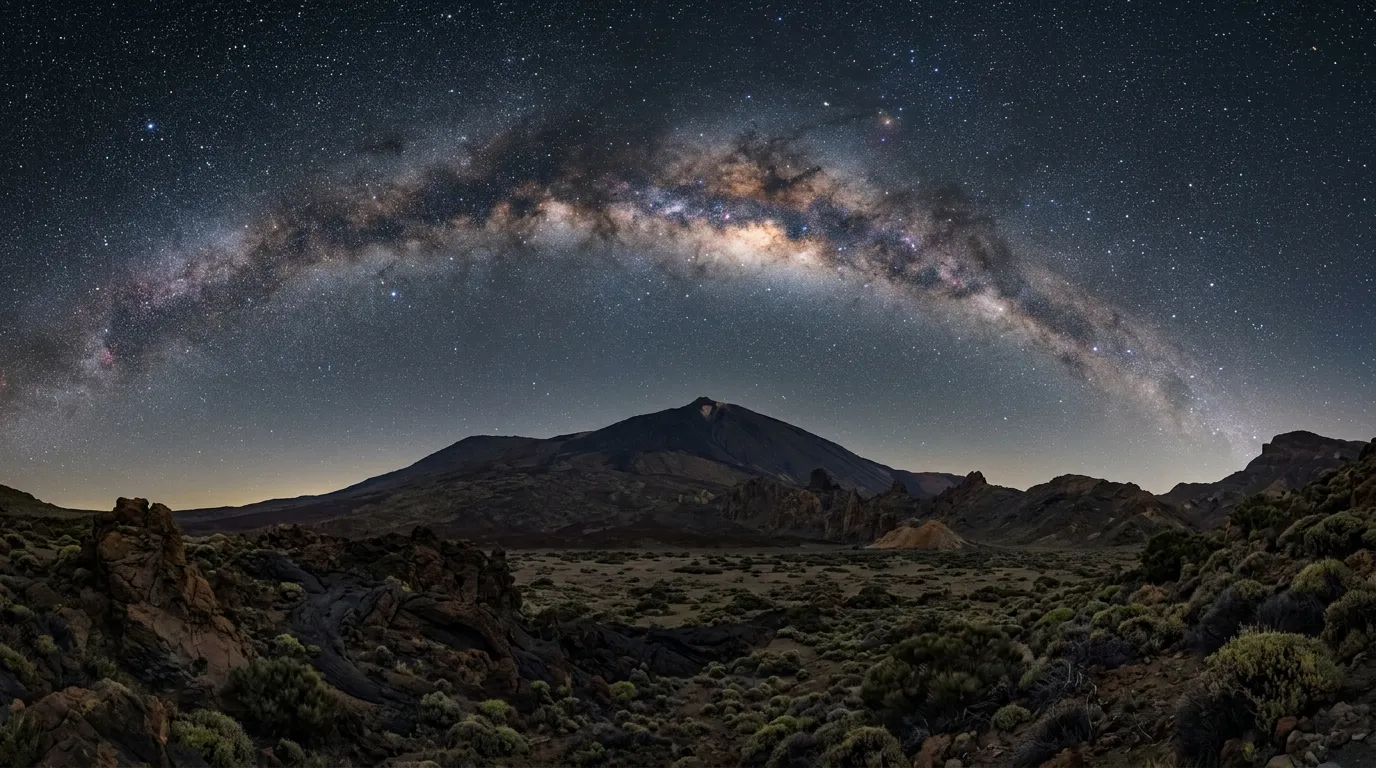
What makes Teide's caldera special for stargazing
Teide National Park is a UNESCO World Heritage site and a certified Starlight Reserve, one of only a handful of places on Earth where both designations overlap[1]. The park sits inside the Las Cañadas caldera, a volcanic depression roughly 16 km across[2] whose rim peaks at 3,715 metres at the summit of Mount Teide[4]. At night, from most of the caldera floor, you are standing at 2,000 to 2,300 metres[5] above sea level with no town light dome closer than 14 km.
The physics making this work is the trade-wind inversion. Moist north-easterly winds strike Tenerife's northern slope and condense into a persistent cloud layer between roughly 240 and 490 metres[13]. Above that band the air is dry, stable, and largely free of the particulate haze that degrades atmospheric seeing at sea level. Drive up from Puerto de la Cruz on a summer evening and you break through the cloud well before 1,400 metres[9] into sharp sunlight; the same boundary holds after dark, coast under the mar de nubes, caldera under stars.
The Ley del Cielo (Sky Law), in force since 1992, controls outdoor lighting across Tenerife and restricts flight paths near the Izaña Observatory at 2,390 metres[3]. Municipalities must use shielded low-pressure sodium fixtures, so even the towns on the southern slope produce less upward light spill than European settlements of similar size. The sky above 2,000 metres[5] on Tenerife is among the most legally protected in the world.
1992
In practical terms, on a new-moon night in June or July, from any of the seven spots in this guide, you can see the Milky Way's galactic core at a galactic core altitude of roughly 30 degrees, the Andromeda Galaxy naked eye, and detail in the Lagoon Nebula through 10×50 binoculars. Naked-eye limiting magnitude at these Bortle 2 sites reaches into the mid-6s[11], dark enough to pick out stars invisible from any European city. Tenerife Stargazing covers the wider planning picture, lodges, and tours; this guide is about the seven spots themselves, where to park, what to point your camera at, and which one to pick when weather narrows your options.
The seven spots ranked by sky darkness
The table below ranks all seven sites by what determines whether you get the shot: sky darkness (Bortle class), altitude, access, and what each spot suits. The ordering is practical, not a beauty contest: sky quality first, then altitude, then how unique the photograph is.
| Spot | Altitude / Bortle | Access | Best for |
|---|---|---|---|
| Las Minas de San José | 2,300 m · Bortle 2 | Unpaved, 4×4 advised | Pure darkness, 360° horizon, deep-sky |
| Roques de García | 2,100 m · Bortle 2 | Paved, roadside parking | Milky Way core with iconic rock foreground |
| Llano de Ucanca | 2,000 m · Bortle 2 | Paved parking, easiest | Accessible Bortle 2, no hiking |
| Parador grounds | 2,200 m · Bortle 2 | Hotel parking, paved | Convenience, Mirador de la Ruleta |
| El Portillo | 2,100 m · Bortle 2–3 | Paved, visitor centre | Winter wind shelter, pine silhouettes |
| Vilaflor / El Pino Gordo | 1,400 m · Bortle 3 | Paved pull-off | Backup when caldera roads close |
| Teno Alto | 800–900 m · Bortle 3–4 | Narrow paved, remote | Ocean-horizon Milky Way, unique composition |
Las Minas de San José takes the top spot for pure darkness. At 2,300 metres[5] on an unpaved track beyond the main road, it is the highest publicly reachable observing site in the caldera, with a 360-degree unobstructed horizon. The European Space Agency has used the same volcanic isolation for lunar-analogue rover trials; that remoteness is exactly what makes it the darkest spot in the park.
Roques de García sits one notch below on darkness but pulls ahead on foreground. The Roque Cinchado pinnacle, wind-carved rock at 2,100 metres[6] with paved roadside parking, is the most photographed object in the park. The viewpoint faces south, toward the galactic core's path, so from May through September the Milky Way rises behind the rock column. It is the default choice for a recognizable foreground without hiking.
Llano de Ucanca is the caldera's flat floor at roughly 2,000 metres[7]. Paved parking sits right on the TF-21, making it the easiest Bortle 2 site to reach on Tenerife. There is no foreground of note; the value is the 360-degree sky and the convenience of stepping straight from the car into full darkness.
The Parador de Las Cañadas del Teide grounds sit at 2,200 metres[8] inside the caldera, the only hotel in the park. The car park and the adjacent Mirador de la Ruleta, a 200-metre walk away, share the same Bortle 2 sky as the caldera floor. If you are staying here, it is your spot by default.
El Portillo, at the northern park entrance, is slightly brighter at Bortle 2 to 3 but offers the best wind shelter of any high-altitude site thanks to the surrounding Canary pine forest. It is the smart choice on a cold winter night when the caldera floor is too exposed.
Vilaflor and the El Pino Gordo pull-off sit at 1,400 metres[9], below the caldera but above the inversion layer on most nights. The sky is Bortle 3, a step down from the caldera, but this is your backup when the TF-21 closes for snow. The giant Canary pine at El Pino Gordo, 2 km east of the village, gives you a distinctive foreground.
Teno Alto, on the island's western cliff edge, is the outlier. At roughly 770 metres[12] it is the lowest site and registers Bortle 3 to 4, but it is the only spot on Tenerife where the Milky Way's core sets over open ocean with no land in the frame. On a clear night with no Saharan dust, transparency can be excellent.
Astrophotography foregrounds at each spot
Each spot earns its place on a different kind of photograph. The ranking above orders them by sky darkness; this section orders them by what the ground does for the sky.
Roques de García gives you the single most recognizable foreground in the park. Roque Cinchado, a 27-metre[10] phonolitic pinnacle shaped by wind erosion, stands on a broad platform at the caldera's southern end, facing south along the Milky Way core's path from May through October. For a wide-angle shot (14 to 24 mm on full frame), put the rock column in the lower third of the frame and let the core arc across the top. Roadside parking at TF-21 km 42 puts you at the viewpoint in under five minutes on foot; walk 200 metres west for a tighter composition with Pico del Teide behind the rock.
Las Minas de San José is the opposite: a blank canvas. There is no foreground of note; the value is the 360-degree horizon with no obstruction in any direction, at the highest altitude a vehicle can reach in the park. This is where you shoot deep-sky mosaics, tracked wide-field panoramas, or star trails with Polaris north and the galactic core arcing south. Load gear carefully; the unpaved track will rattle a scope mount loose on the approach.
Llano de Ucanca is a flat caldera floor whose foreground is the ground itself. After rain, shallow ephemeral pools form on the volcanic surface, and on a lucky windless night the reflection doubles the Milky Way. The pools are unpredictable; you cannot plan for them, but when one is there, it is the best mirror shot in the park. Without water, the flat floor still works as a clean foreground for star-trail photographs with Teide's cone on the northern horizon.
El Portillo trades open caldera for forest edge. Canary pine trees at the northern entrance stand as dark silhouettes against the sky, and the low-profile stone visitor centre can anchor a composition lit faintly with a red headlamp. The forest also blocks wind, making this the best spot for long tracked exposures in winter. Set up at the picnic area west of the centre after sunset and frame the pines against the southern sky.
Vilaflor's El Pino Gordo is a single foreground element: a giant Canary pine, the largest of its species on the island, standing beside the road roughly 2 km east of the village. It is lit faintly from the south by the town's sodium streetlights, giving it a warm amber tone against the cool blue-grey of a moonless sky. Use a focal length of 24 to 35 mm, place the tree in the lower right third, and let the Milky Way rise above the canopy. The Milky Way Photography Guide covers sensor choice, lenses, and exposure settings for this kind of shot.
Teno Alto offers a foreground no other spot on Tenerife matches: the ocean. From the cliff edge at roughly 850 metres[12], you look west over the Atlantic with roughly 180 degrees of open water in frame. The Milky Way core, reaching the south-western sky in late summer and early autumn, sets directly over the water. Photographing the Milky Way over water here needs a clear western horizon (no marine layer, no calima) and a light wind, since the exposed cliff has no shelter. When conditions align, it is the most distinctive composition on the island.
The Parador grounds give you two foregrounds: the hotel itself, lit warmly from within, which competes with the sky unless framed deliberately, and the Mirador de la Ruleta, a stone platform 200 metres away facing south over the caldera toward the Roques de García ridgeline. Use the mirador for a clean southern horizon without the hotel in frame; guests can walk there from their room in three minutes.
Accessibility and logistics for every spot
The sky at every spot in this guide is free. What separates them is how you get there, what you need to bring, and what happens if something goes wrong.
Roques de García is the most accessible serious site in the park. Take the TF-21 to km 42, where a large paved parking area serves the viewpoint, a 500-metre flat walk from the car. Daytime hours bring a café and toilets nearby, and phone signal is good. This is the spot for anyone nervous about remote-night logistics.
Featured · Destination
Tenerife Stargazing
Tenerife stargazing guide: Teide National Park's UNESCO Bortle-2 skies, 83 constellations visible. Observatory visits from €21, Parador hotel, and best tours.
Las Minas de San José is the opposite end of the spectrum. The access track leaves the TF-21 roughly 2 km south of the Parador and climbs over unpaved volcanic gravel. A 4×4 or high-clearance vehicle is strongly advised; a standard hatchback risks a punctured sump on the rougher sections. There are no facilities, no shelter, and no phone signal beyond the first switchback. Bring water, offline maps, a backup light, and tell someone your return time. The payoff is zero artificial light in any direction.
Llano de Ucanca splits the difference perfectly. Paved parking on the TF-21 at roughly km 38 places you directly on the caldera floor; step out of the car and you are under a Bortle 2 sky, no hiking, no vehicle-clearance worries. Phone signal is patchy but usually present; bring everything you need, as there are no facilities. This is the spot for a first night on Teide, testing gear with the car five metres away before attempting Minas on night two.
El Portillo uses the visitor-centre infrastructure at the northern entrance. Parking is large and paved, lit during centre hours (09:00–17:00) and dark after. Café and toilets lock at 17:00, but the forest gives natural wind shelter, making this the most comfortable high-altitude spot for a long winter session. Phone signal is generally available. Casa Rural Las Llanadas, a short drive south in the highlands, puts you five minutes from the entrance.
Recommended tours
Tours are selected for quality, not commission. I earn a small fee if you book — at no extra cost to you.
The Parador de Las Cañadas del Teide is the only accommodation inside the caldera. Guests walk to the Mirador de la Ruleta in under five minutes; non-guests can use the same car park and viewpoint, but the restaurant closes early (last seating around 21:00 in summer), so eat before you start observing. The Parador de Las Cañadas del Teide review covers room types and the on-site observatory. If it is full, the Hotel Spa Villalba in Vilaflor puts you 20 minutes south at 1,400 metres[9] with a heated pool for post-session recovery. For the full comparison, see the best Tenerife stargazing lodges guide.
Vilaflor and El Pino Gordo require the least commitment. The pull-off is a paved roadside stop on the TF-21 roughly 2 km east of the village, room for three or four cars. Vilaflor has a supermarket, a petrol station, and restaurants, making this the best-supported village site, with reliable phone signal. The dew point here is higher than at the caldera, so bring a dew heater for spring or autumn shoots.
Teno Alto demands a drive. The TF-436 from Buenavista del Norte winds through the Teno massif on a narrow, fully paved mountain road with hairpin bends and occasional rockfall. Allow 40 minutes to the hamlet, then another 5 to the cliff-edge viewpoints. There is no phone signal and no facilities. Go with a full tank and a companion if you are not confident driving a mountain road at night; the same remoteness that makes the sky good makes a flat tyre at 23:00 a serious problem.
A practical note that applies to every spot: the temperature difference between the coast and the caldera after midnight is routinely 10 to 15 degrees Celsius year-round. You need a down jacket, windproof outer layer, insulated boots, gloves, and a beanie even in July. The Stargazing Packing List covers the full gear checklist.
Which spot for which season
The Teide caldera changes character across the year, and the spot that works perfectly in July can be unreachable in January. This section maps the seven sites to the seasonal windows that suit them best.
Summer (June through September) is the peak window. All seven spots are accessible, the sky is clearest, and night temperatures at the caldera stay mild enough that a warm layer is all you need, rather than expedition-grade cold-weather gear. The galactic core reaches its highest point of the year, making this the season for Roques de García, Llano de Ucanca, and Las Minas de San José. Book early: the Parador sells out weeks ahead for summer new-moon weekends. Teno Alto works well too, but in August and September the core sets over the ocean earlier, so plan your session before midnight. The Best Time for Stargazing in Tenerife walks through the full calendar.
Winter (December through March) reshuffles the list. Snow closes the TF-21 and TF-24 without warning, sometimes for days. When the caldera is cut off, the order becomes El Portillo (northern approach road, cleared more often), Vilaflor and El Pino Gordo (below the snow line, almost always reachable), then Teno Alto (no snow risk, but a winding drive in possible rain). The Milky Way core is absent; instead you get Orion overhead, sharp Pleiades, and exceptional sky transparency when cold, dry air settles over the island.
Read next · Article
Best Time for Stargazing in Tenerife
Tenerife stargazing peaks Jun-Jul with 99% clear skies. Trade winds, moon phase, and snow shape the real calendar. Month-by-month planning for the best windows.
Shoulder seasons (April, May, October) offer the best compromise between sky quality and solitude. April and May give a rising core visible for the second half of the night, roughly 70 to 90 percent clear-night probability, and far fewer tourists than summer. Roques de García and Minas de San José are fully accessible and rarely crowded. October is the tail: the core is low in the west by evening, clear-night probability drops to roughly 65 percent, and snow risk resumes, but a solid two-hour session is still possible. El Portillo and Llano de Ucanca are the safest bets.
Calima events (Saharan dust haze) can hit in any season but are most common in summer. When a calima settles over the island, even the caldera sky turns milky and contrast drops sharply. The highest-altitude spots, Las Minas de San José and the Parador grounds, may sit above the thickest part of the dust layer. Check the AEMET visibility forecast for the Izaña Observatory station; if the observatory reports clear air, the caldera sites will be clear.
Lunar-cycle planning applies across all seasons. The practical dark window for deep-sky observing is roughly five nights before and five nights after new moon. For astrophotography of the Milky Way, narrow that to three nights either side. Book your trip dates around the new moon first, then apply the seasonal guidance above to pick your spot.
Quick-reference: pick your spot in thirty seconds
If you have read this far and just need the answer for your specific situation, here is the thirty-second spot picker.
- I want the darkest sky, period. Las Minas de San José. Bring a 4×4, download offline maps, and tell someone where you are going.
- I want a great sky with an iconic foreground and no hassle. Roques de García. Paved parking, a five-minute walk, and the Milky Way rises behind Roque Cinchado from May through October.
- I want the easiest possible Bortle 2 access. Llano de Ucanca. Park on the caldera floor and step out into full darkness.
- I am staying at the Parador. The Mirador de la Ruleta, 200 metres from your room. You already paid for the location; use it.
- It is winter and I need shelter from the wind. El Portillo. The pine forest blocks the caldera wind that makes every other high-altitude spot punishing in January.
- The mountain roads are closed and I need a backup. Vilaflor and El Pino Gordo. At 1,400 metres[9] you are below the snow line, above the inversion on most nights, and two minutes from a supermarket.
- I want a shot nobody else has. Teno Alto. The Milky Way setting over open ocean with 180 degrees of dark water, lower altitude, further to reach, and dependent on a clear western horizon, but the composition exists nowhere else on the island.
- I am new to this and want the safest bet. Llano de Ucanca on your first night to test your gear with the car within reach, then Roques de García on night two once you are comfortable.
For every spot: check the Teide National Park road-status page before you leave, fill the fuel tank in La Orotava or Vilaflor before ascending, carry at least one litre of water per person, and dress for temperatures 10 to 15 degrees colder than the coast. The dark-sky etiquette article covers how to share these spots with other observers and photographers without ruining anyone's night vision.