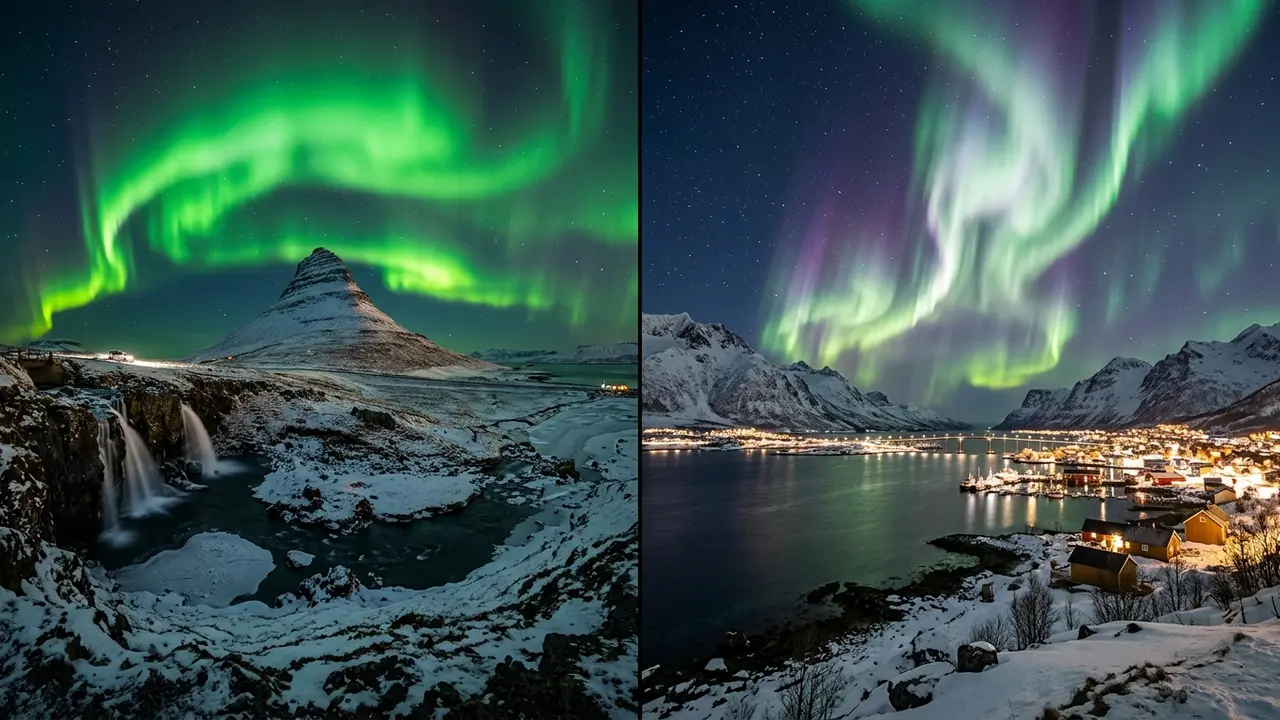

Two different positions on the map
Iceland and Norway put you in front of the same phenomenon from two different vantage points, and the geography behind that gap decides more of the trip than any packing list will. Iceland spans roughly 64 to 67°N, near the outer edge of the auroral oval, the ring-shaped zone of peak aurora activity centered on the geomagnetic pole. Tromsø sits at 69.6°N, deep inside the high-magnetic-latitude zone (roughly 60°+ magnetic latitude) where aurora displays are strongest and most frequent, while Iceland sits nearer the edge of that same zone.[6]
North Iceland, around Akureyri and the Mývatn area, sits deeper inside the oval than Reykjavík and the south coast, which matters if you're tempted to base an entire trip in the capital. That difference shows up directly in the Kp index, the 0-to-9 scale that measures geomagnetic disturbance: SpaceWeatherLive's own auroral-visibility table puts Tromsø at Kp 0 and Reykjavík at Kp 1, so Tromsø's deeper position inside the oval means aurora becomes visible there at an even lower geomagnetic threshold than Iceland needs.[6] A weak night that stays invisible from Reykjavík can still be a solid display in Tromsø, and the same night in northern Iceland lands somewhere between the two.
Neither location is objectively better positioned; they're built for different trips. Iceland's terrain, black-sand beaches, volcanic fields, glacier-capped highlands, sits under a variable stretch of the oval that rewards self-drive flexibility and patience. Tromsø's fjords and mountains sit inside a far more forgiving band, which is why the city's tour industry can promise realistic odds instead of hopeful ones, and the Northern Lights in Iceland hub breaks down the country's own aurora zones in more depth.
Aurora odds: why clear skies beat raw latitude
Position inside the oval sets the ceiling on how often aurora shows up overhead; weather decides how often you actually get to see it. Tromsø's clear-sky odds win by a wide margin: travel-industry estimates commonly put the figure at around 80% of nights clear enough to show something during aurora season, against roughly 60% in Iceland.[3] The gap traces back to climate more than latitude. Tromsø experiences a comparatively stable, continental weather pattern, while Iceland catches the brunt of Atlantic moisture that piles cloud cover across the country's western and southern regions. That single percentage swing is the most important number in this whole comparison; almost everything else downstream, tours, pricing, even how you pack, follows from it.
Cloud cover, not a weak Kp reading, is the real problem in both countries. Iceland's guides sometimes drive travelers hundreds of kilometers between regions chasing a gap in the clouds, because a high Kp reading over an overcast sky delivers nothing.[1] If you want to translate a given Kp number into what to actually expect once you're standing outside in either country, the Kp index guide explains how NOAA builds the scale and what each threshold means at different latitudes.
80% vs 60%
None of this makes Iceland a bad bet. A clear night in Iceland, especially in the north, can rival anything Tromsø produces; you're simply rolling the dice more often for the one clear night that makes the whole trip worth it.
What a week actually costs in each destination
Sticker shock hits early in both countries; the question is where the money actually goes. Iceland leans more expensive on accommodation and food, a function of remote supply chains and a krona that has held its value for years. Tromsø counters with slightly cheaper organized tours, though Norway's own cost of living shows up hardest at restaurant tables.
The one place the two countries land close to each other is glass-roofed accommodation, though exact nightly rates shift with season, operator, and availability. Icelandic glass igloos and geodesic domes fall into the upper-budget bracket, and Tromsø's equivalent glass domes run in a similar range, close enough that it's worth comparing current listings before booking either. Standard Tromsø aurora tours, the five-hour guided kind most first-time visitors book, run in the evening and adjust their route in real time against cloud cover and the Kp forecast.[2]
| What you're paying for | Iceland | Tromsø |
|---|---|---|
| Standard hotel | €80–200/night | €60–200/night |
| Glass dome/igloo | Upper-budget bracket | Upper-budget bracket |
| Aurora tour | €50–150/person | €60–120/person (5-hour excursion) |
| Rental car | €40–80/day (often required) | Optional; tours include transport |
Beyond the glass domes, budget for both destinations the way you would for any Nordic or Western European winter trip. Iceland's self-drive flexibility tends to save money on tours, while Tromsø's tour-inclusive model saves money on car rental and fuel, and either budget has room to flex if you shift a few nights into the shoulder season.
Beyond the lights: geothermal Iceland versus Arctic Norway
Take the aurora out of the itinerary for a moment and the two trips stop looking like variations on the same theme. Iceland packages the northern lights into a multi-activity winter vacation: glacier hiking on Vatnajökull or Sólheimajökull, ice-cave exploration near Mývatn, waterfall stops at Skógafoss and Seljalandsfoss, and a soak at the Blue Lagoon or the smaller Secret Lagoon.[4] Aurora is one stop on a longer road trip, not the entire reason for the flight.
Tromsø runs the opposite model. The city itself is compact, and winter activities exist mostly to fill the hours around an aurora tour rather than to anchor a road trip of their own:
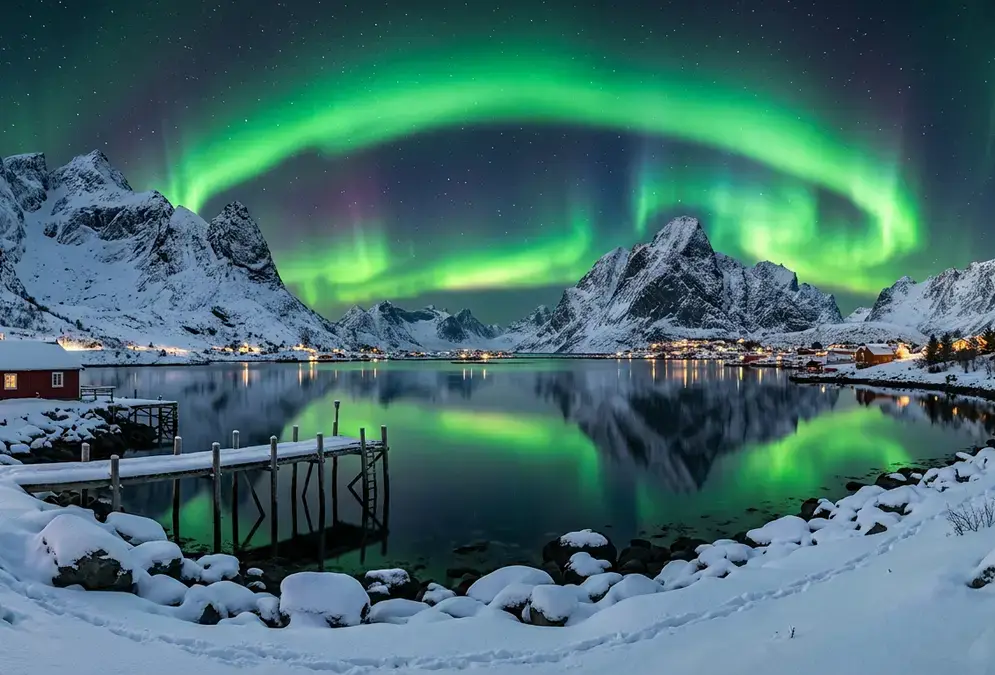
Featured · Destination
Northern Lights in Tromsø
At 69.6°N inside the auroral oval, Tromsø sees aurora at Kp 2. Peak season November–February. Best viewing spots, tour advice, and aurora forecast strategy.
- Dog sledding and husky safaris, a Sami-tradition activity run as 2- to 4-hour trips through snow-covered forest trails
- Whale watching for humpback and orca, running November through January in the fjords right outside the city
- Sami cultural experiences, including reindeer herding, traditional meals, and time at a lavvu camp
- Cross-country skiing and snowshoeing on marked trails just outside the city, no experience required
If the aurora is a no-show on a given night, Tromsø's backup plan sits closer to your hotel than Iceland's does. The What to Do in Tromsø Beyond the Northern Lights guide covers all of this in more depth, and the Northern Lights in Tromsø hub has the viewing-spot detail for nights when the sky does cooperate.
Getting there, crowds, and how independent you want to be
Iceland rewards independence. Reykjavík's Keflavík Airport (KEF) connects well to North America and Europe, but once you land, a 4WD rental car is close to mandatory: the drive from Reykjavík to the better aurora zones around Akureyri and Mývatn runs about five hours, and chasing clear skies can add another hundred kilometers on a bad night. Daylight in midwinter runs three to four hours, so most of that driving happens after dark. Winter road conditions vary by week, and a route that's clear on Monday can need snow tires and extra caution by Thursday.
Tromsø rewards the opposite instinct. Tromsø Airport (TOS) sits five kilometers from downtown, a 10- to 15-minute bus ride, and tour operators handle transport for the standard aurora excursion, so a rental car is optional rather than required. Starting October 23, 2026, Icelandair begins a new twice-weekly Keflavík–Tromsø route, giving North American travelers a same-day connection through Icelandair's Keflavík hub to reach Tromsø during aurora season.[7]
Crowds follow a similar split. Iceland is busier overall, especially in December and January when every operator is booked solid, but self-driving lets you build an itinerary that avoids the group-tour crush entirely. Tromsø sees fewer total visitors, but almost everyone books an organized tour, so the crowding you do encounter concentrates into evening hours rather than spreading across the day.
September and March carry a real advantage in both countries. The equinox effect, a statistical 20 to 30% jump in geomagnetic storm frequency, lines up with noticeably smaller crowds and lower prices than the December-to-February peak.[1]
Which one fits your trip
Run the two lists below honestly, and the choice mostly makes itself.
Choose Iceland if:
- You want the aurora bundled into a road trip with glaciers, geothermal pools, and volcanic scenery
- You'd rather drive yourself than sit in a tour van
- You're comfortable with roughly 60% clear-sky odds in exchange for a multi-activity trip
- You want a major international airport with strong North American connections
Recommended tours
Tours are selected for quality, not commission. I earn a small fee if you book — at no extra cost to you.

Choose Tromsø if:
- Seeing the aurora is the entire point of the trip, and the odds matter more than the scenery around it
- You'd rather let a guide manage the driving, the Kp forecast, and the cloud-chasing
- You're new to aurora hunting and want the higher success rate of a destination inside the oval's core
- You're booking travel from October 2026 onward and want the new direct Icelandair route
Iceland's season runs late August/early September through mid-April,[5] and Tromsø's runs a close enough window that the calendar isn't the deciding factor. What actually decides it is whether you want the northern lights as the headline of the trip or as one very good night inside a longer one. Check moon phase against your travel dates either way; a bright week can undercut even a strong Kp night, and the When to Stargaze guide walks through how to cross-reference lunar phase with season and weather for any destination, aurora included.