
Why some Icelandic aurora spots beat others
Every ranked list of Iceland's aurora spots is really answering two different questions at once: which locations are dark enough to see a faint display, and which are close enough to actually reach on a two-week trip. The six spots below split into both camps. Þingvellir and Seltjarnarnes sit under an hour from Reykjavík but carry some residual sky glow from the capital; Jökulsárlón and Hvítserkur reach genuinely dark skies but cost three to five hours of driving each way.
The gap in sky quality is real. Reykjavík's city centre rates Bortle 7-8 on the light-pollution scale, while most of Iceland's interior sits at Bortle 2-3[1], dark enough that the aurora's fainter structure, not just the bright green band most people picture, becomes visible to the naked eye. That gap matters more now than it has in years: the sun reached the peak of its 11-year solar cycle in 2024, and NASA and NOAA expect elevated activity to continue for roughly another year afterward, producing brighter and more frequent displays than the industry has seen in over a decade[2].
7-8 → 2-3
None of that darkness helps if the Kp index reading is too low for your magnetic latitude that night. See How to See the Northern Lights for how the auroral oval actually expands and contracts with a storm. For the full framework on timing an entire trip around Icelandic aurora season, the Iceland northern lights guide covers the whole-country picture; this piece is about exactly where to stand once the forecast lines up.
The six spots, ordered by drive time from Reykjavík:
- Seltjarnarnes / Grótta Lighthouse: 15 minutes, bus-accessible, no car needed
- Þingvellir National Park: 45 minutes, Golden Circle route
- Kirkjufell Mountain: about 2 hours, Snæfellsnes Peninsula
- Hvítserkur: about 3 hours, gravel road, least visited
- Reynisfjara Black Sand Beach: about 3.5 hours, South Coast
- Jökulsárlón Glacier Lagoon: about 5 hours, the darkest sky of the six
Þingvellir National Park: the easiest dark sky near Reykjavík
Þingvellir National Park, the UNESCO-listed rift valley where Iceland's medieval parliament once met, is 45 minutes from Reykjavík by Route 36 and rates Bortle 3-4[3], dark enough for a genuinely good aurora display without giving up an entire night to driving. The valley itself does some of the work for you: its walls block wind that would otherwise cut a viewing session short, and Þingvallavatn, Iceland's largest natural lake, gives you flat water for a reflection shot when the surface is calm. What actually keeps this rift valley's sky dark is its distance from Reykjavík's population, not the volcanic rock underfoot — see why Iceland's volcanic landscape doesn't explain its dark sky.
Öxarárfoss, a modest waterfall that drops into the rift, adds a second foreground option a short walk from the main car park. The site is well-maintained year-round, with a visitor centre, marked pullouts along the road, and free parking, which makes it the most straightforward of the six spots logistically. That convenience is exactly why it fills up first on any clear, active night in peak season.
Featured · Destination
Northern Lights in Iceland
Iceland's whole-country aurora guide: best regions to base in, aurora season Sep–Mar, ice caves, winter driving reality, and where cloud cover ends every plan.
Þingvellir works from September through April, with the darkest, most reliable stretch running October through February. It is not the darkest sky on this list, but it is the one you can reach on a whim after a bad forecast somewhere else, which counts for more than an extra half-magnitude of darkness on a trip with only a handful of nights to spare. Guided tour buses from Reykjavík also default to this stop on their standard aurora-chase routes, so it's the easiest option if you'd rather not drive at all.
Jökulsárlón Glacier Lagoon: the darkest sky of the six
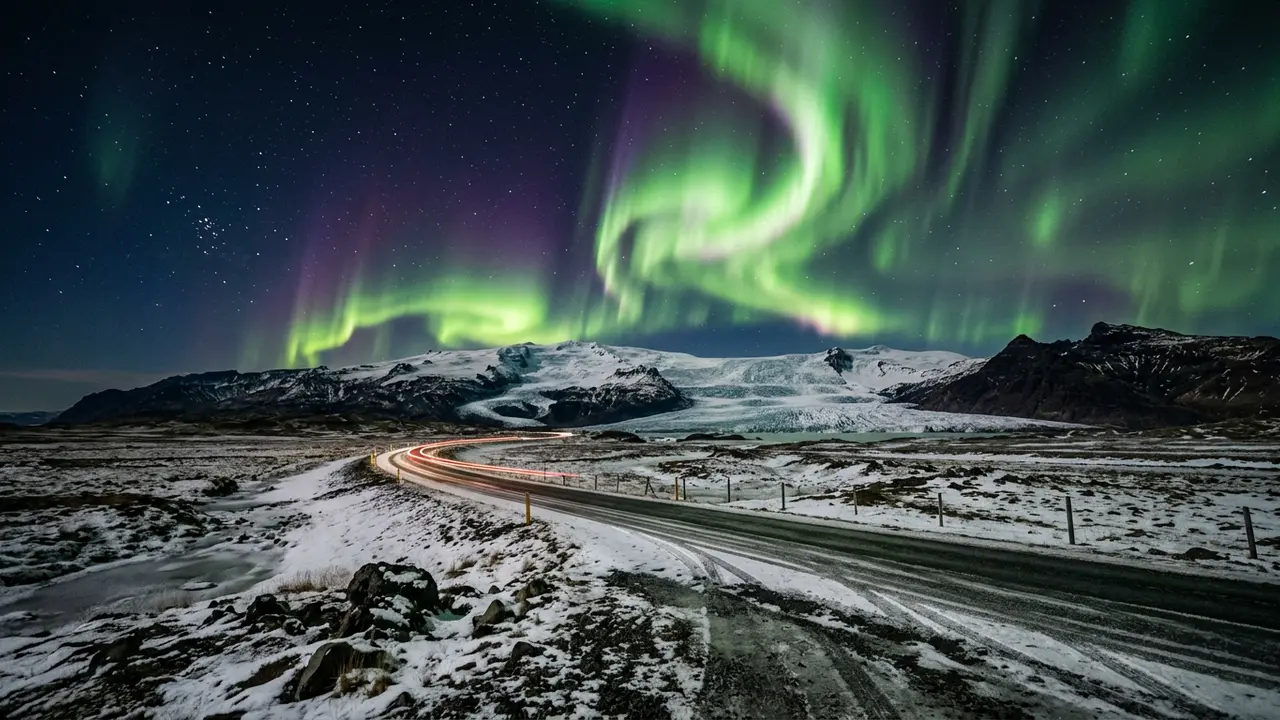
Jökulsárlón Glacier Lagoon sits 370 kilometres from Reykjavík, roughly five hours along Route 1, and it rewards the drive with Bortle 2 skies[4], the darkest rating of any spot on this list. Icebergs calved from Breiðamerkurjökull drift across the lagoon and hold a reflection of the aurora on calm nights, an effect no other Icelandic viewing spot can offer.
Diamond Beach, the black-sand shoreline next door where stranded ice chunks wash up glittering under headlamps, gives you a second, drier composition if the lagoon itself is too choppy for reflections. Both sites have parking and are accessible around the clock, but this is remote southeast Iceland in winter: fuel up well before you arrive, since service stations thin out fast east of Vík, and treat the glacier margin above the lagoon as off-limits after dark given the avalanche risk from unstable ice.
The trade-off is obvious. Five hours each way is not a casual detour, and winter driving conditions in Iceland on this stretch of Route 1 can turn a five-hour drive into something considerably longer. Most visitors build Jökulsárlón into a multi-day South Coast itinerary rather than a single overnight dash from the capital, pairing it with Reynisfjara and Vík on the way down. If you're driving from Reykjavík in one push, break the trip at Vík or Höfn rather than doing the full round trip in a single day; fatigue on Route 1's narrower stretches is a bigger risk than the cold.
Kirkjufell Mountain: the postcard shot that doubles as a backup plan
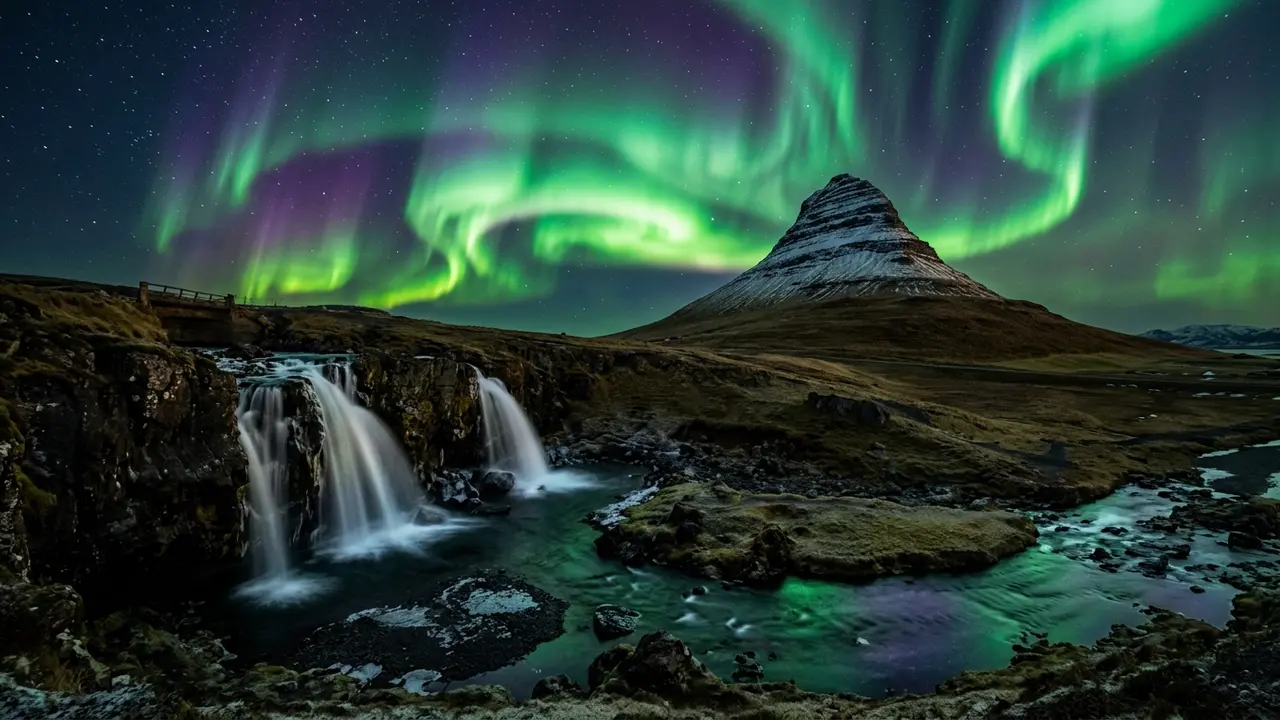
Kirkjufell, the 463-metre conical peak on the Snæfellsnes Peninsula, sits about two hours from Reykjavík via Route 1 and Route 54[5]. Its instantly recognisable silhouette, plus Kirkjufellsfoss, a two-tier waterfall at its base, make it one of the most photographed aurora backdrops in the country. The nearby fishing village of Grundarfjörður has the closest guesthouses if you'd rather not drive back to Reykjavík the same night.
Recommended tours
Tours are selected for quality, not commission. I earn a small fee if you book — at no extra cost to you.
Composition here is almost too easy. Park in the designated lot roughly a kilometre from the mountain, walk the short trail to the falls, and frame the peak in the lower third of the shot with the aurora filling the sky above. The waterfall's stream, when it isn't frozen solid, throws in a reflection that most Icelandic viewing spots can't match.
“one of the best places in Iceland for northern lights photography”
Kirkjufell has a second job besides being photogenic: Snæfellsnes often clears when the South Coast doesn't. Iceland's coastal weather runs on tight microclimates, so a night that sinks Reynisfjara or Jökulsárlón under cloud can still be wide open two hours west. Serious aurora chasers treat Kirkjufell as the fallback for exactly that reason, not just the postcard. For camera settings once you're framed up, see How to Photograph the Northern Lights.
Reynisfjara and Hvítserkur: dramatic coastlines that demand respect
Reynisfjara, the black-sand beach outside Vík roughly 3.5 hours from Reykjavík, pairs basalt hexagonal columns with the Reynisdrangar sea stacks rising straight out of the ocean, a silhouette that needs no editing to look otherworldly against an aurora. It is also the one location on this list with a genuine safety warning attached, not a theoretical one: sneaker waves can surge in without warning even on a calm-looking night. Stay at least 25 metres from the waterline at all times, and never turn your back on the water[6]. Parking sits directly at the beach and the walk to the best vantage point takes only a few minutes, which is part of why so many visitors underestimate how quickly conditions here change.
Hvítserkur, the basalt sea stack nicknamed the Troll of the North, sits on the Vatnsnes Peninsula about 250 kilometres north of Reykjavík, roughly a 3-hour drive via Route 1 and the gravel Route 711, which needs a 4WD vehicle in winter (November through March) or after heavy rain[7]. A short walking trail leads from the car park to a viewing platform above the rock, a gentler walk than the drive to reach it suggests. Almost no aurora tourists make the detour, which is the point: you get genuinely dark, isolated skies and a rock silhouette that looks almost prehistoric against the northern lights, with none of the crowd that gathers at Kirkjufell or Jökulsárlón on a clear night.
Both spots reward caution over confidence:
- At Reynisfjara, watch the ocean, not your camera screen, between shots
- At Hvítserkur, check Route 711's winter status before you drive it in the dark
- At low tide, you can walk the beach out to Hvítserkur's base, but check the tide table first
- Neither location has cell coverage worth counting on, so tell someone your plan before you go
Seltjarnarnes and Grótta Lighthouse: the no-car option, plus how to choose a night
If you don't have a rental car, Seltjarnarnes, the peninsula on Reykjavík's western edge, is the honest answer to whether you can see the aurora without leaving the city. A short public bus ride reaches the area from downtown, and Grótta Lighthouse at the peninsula's tip has an open ocean horizon facing north with minimal nearby light sources[8], the closest thing to a real dark-sky spot inside Reykjavík's limits.
It comes with two catches. Sky quality here is noticeably compromised by the capital's light dome, better than downtown but well short of the truly dark spots on this list, so you'll see a strong storm clearly but miss the fainter structure that Þingvellir or Jökulsárlón would show on the same night. And low-lying coastal paths like this one can flood at high tide, so check the tide schedule before you walk out, not after. If you're chasing a photograph rather than just a sighting, the extra hour or two to Þingvellir is usually worth it; save Seltjarnarnes for a spontaneous check on a night when the forecast looks promising but you don't want to commit to a long drive.
Whichever spot you pick, the calendar matters as much as the location. Iceland's viewing season runs late September through early April, with October and February offering the best balance of true darkness and manageable weather[9]. Outside that window, the sky either stays too light or the storms that make winter driving hazardous become the bigger risk. Cross-reference your dates against the moon phase too: a bright moon washes out a faint aurora the same way it washes out the Milky Way. When to Stargaze covers how to line up moon phase with any other night-sky trip.
| Location | Distance from Reykjavík | Bortle rating | Best for |
|---|---|---|---|
| Seltjarnarnes / Grótta | 15 min, bus-accessible | Moderate | No car, quick check on a clear night |
| Þingvellir National Park | 45 min | 3-4 | Easiest reliable dark sky |
| Kirkjufell Mountain | About 2 hours | 2-3 | Photography, South Coast weather backup |
| Hvítserkur | About 3 hours, gravel road | 2-3 | Solitude, darkest north-west sky |
| Reynisfjara Beach | About 3.5 hours | 2-3 | Sea-stack silhouettes (mind sneaker waves) |
| Jökulsárlón Lagoon | About 5 hours | 2 | Iceberg reflections, darkest overall |