
Renting a car: what a 4x4 actually buys you
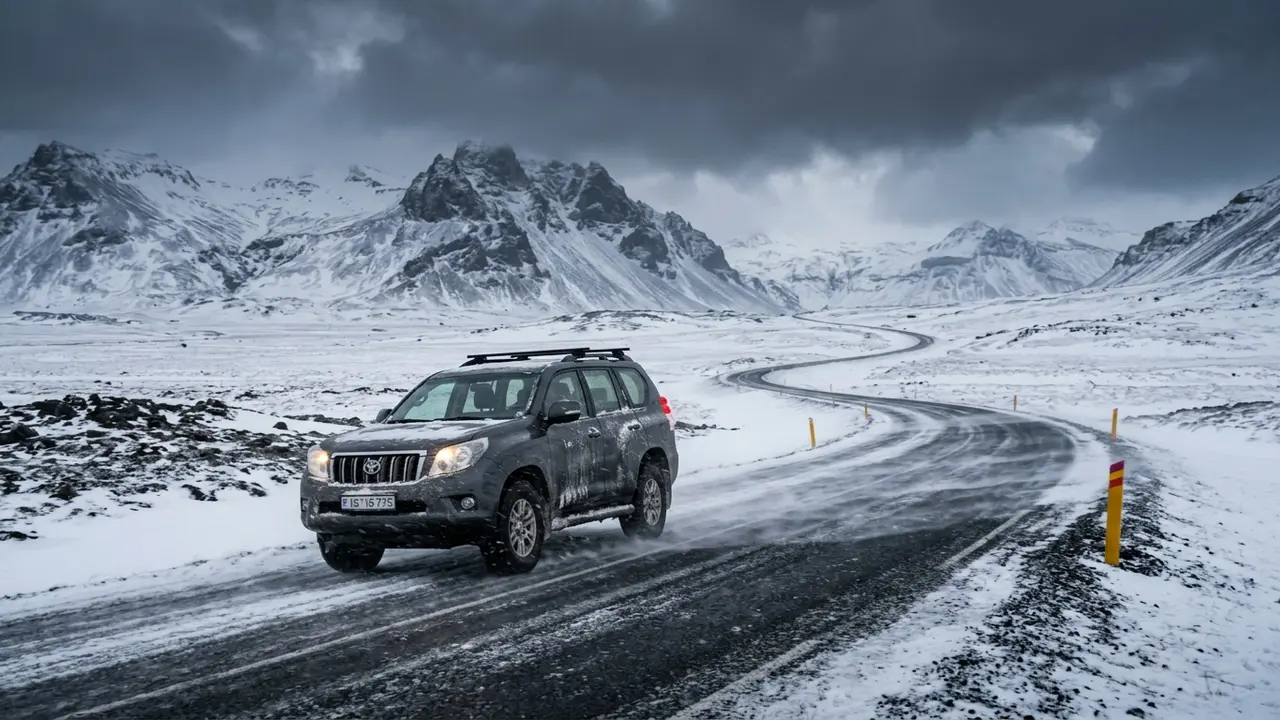
For anyone chasing the northern lights in Iceland, driving logistics are not a footnote to the trip; they are half of it. Ask an Icelandic rental agent whether you need a 4x4 for winter driving, and the honest answer is more nuanced than the marketing implies. A 4x4 is not legally required for Ring Road winter driving, but every operator recommends one for December through February travel or for routes beyond the populated southwest corner. Either way, your rental already comes fitted with studded winter tyres as standard through roughly November to March[1]. Check current regulations before you travel, since exact dates can shift year to year; either way, that equipment is not something you request, it's simply part of the car you collect. For a short, daylight-only loop around the Golden Circle in decent weather, a well-equipped 2WD compact can be perfectly adequate. It's longer routes and darker months where the extra clearance and traction actually earn their rental surcharge.
A few things push the calculation toward 4x4 even when it isn't mandatory:
~5 months
- A multi-day route that leaves the Ring Road for gravel side roads or mountain approaches
- Travel in the darkest months (December to February), when snow accumulates fastest and daylight for course-correcting is shortest
- Any plan involving higher-elevation stops: mountain passes, glacier viewpoints, or remote lodges
Snow chains ride in the boot of some rental fleets but see real use only on steep, unploughed farm tracks; on the Ring Road and its paved feeder roads, the studded tyres already fitted to your car do the work.
The one place a 4x4 stops being optional is the F-roads, Iceland's unpaved highland routes, several of which cross rivers at places like Sprengisandur and Landmannalaugar. In summer, driving them without four-wheel drive is against the law. In winter, the distinction is academic: the highlands are only accessible during a short summer window, typically June through October or November[2], which means the entire winter aurora season falls outside it. Snow accumulation and meltwater are why that window is so short in the first place, and neither eases off just because your trip dates don't line up with them. If your itinerary depends on highland access, winter isn't the season for it; your driving stays on the lowland Ring Road regardless of what you rented.
road.is and vedur.is: checking conditions before you drive
road.is is the site every Icelandic winter-driving guide converges on, and for good reason. It is the official real-time resource run by the Icelandic Road Administration, Vegagerðin, and it color-codes every stretch of national road by current condition. Green means driveable, yellow means caution, and a grey Lokað label means closed, and that word is not a suggestion. Stop immediately: a closure gate marks snow, flooding, or an avalanche risk that road crews haven't cleared yet, and driving past one puts you somewhere genuinely unsafe[3].
Pair road.is with vedur.is, the Icelandic Met Office's site, which layers wind-speed and precipitation warnings on top of the road-condition map. Neither tool alone tells the full story. A route road.is shows open at 8am can carry a 'Lokað' label by noon if a storm front rolls in off the North Atlantic. Check both before you leave your accommodation, and check again at your first fuel stop if the drive runs longer than an hour. This dovetails with the broader picture in how to see the northern lights, which covers Kp index and cloud-cover fundamentals that apply wherever you are chasing aurora, not only in Iceland.
Featured · Destination
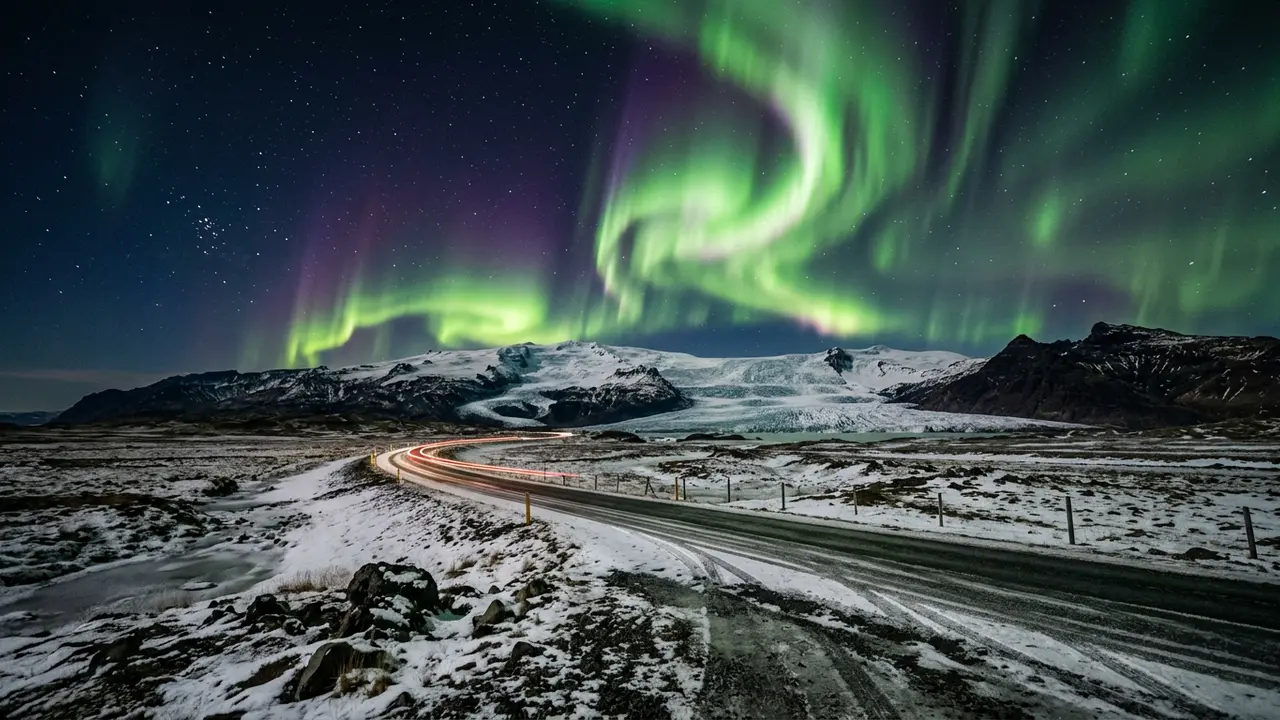
Northern Lights in Iceland
Iceland's whole-country aurora guide: best regions to base in, aurora season Sep–Mar, ice caves, winter driving reality, and where cloud cover ends every plan.
Ring Road closures: when mountain passes shut down
The Ring Road, Route 1, is Iceland's one continuous highway loop, and officially it stays open all year. In practice, winter storms close sections of it routinely, and the closures aren't distributed evenly. Mountain passes take the brunt of it. The Öxnadalsheiði pass, which carries Route 1 west of Akureyri toward Skagafjörður and Varmahlíð in the north, closes during blizzards often enough that locals treat rerouting around it as a standing contingency rather than a rare workaround.
East Iceland's mountain passes see similar treatment. A closure might last two hours while a plough clears drifted snow, or most of a day if a low-pressure system settles over the fjords. Either way, the planning lesson is the same: build slack into your itinerary rather than a tight point-to-point schedule. If your plan has you driving from Akureyri to a specific lodge on a fixed evening for an aurora forecast window, a same-day closure can force a multi-hour detour, or an overnight stay you didn't budget for. Drivers who leave a spare day or two, rather than racing the clock between towns, are the ones who don't lose a clear-sky night to a closed pass.
Fuel scarcity: why the quarter-tank rule matters
Iceland's fuel network looks reassuring on the map until you leave the Ring Road. Along Route 1 itself, coverage holds up well: stations appear roughly every 50 to 80 km in most sections, spread across four chains, N1 (the largest network), Orkan, Olís, and Atlantsolía, running more than 200 stations between them. The rule nearly every rental company repeats is to keep your tank above a quarter full whenever you're driving outside Reykjavík in winter[4].
Venture off Route 1 into the Westfjords or the Eastfjords, or onto any secondary road serving a remote fjord village, and the gap between pumps can stretch past 150 km. Most of those rural stations are unmanned, self-service pumps that read a card's chip and PIN rather than take a signature, and cold temperatures, headwind, and unpaved surfaces all push your fuel consumption higher than it would run on a summer road trip[5].
Recommended tours
Tours are selected for quality, not commission. I earn a small fee if you book — at no extra cost to you.
Get your PIN sorted before you fly. A signature-only card can leave you stuck at an empty pump on a stretch of road where the next station is an hour away, and in sub-zero temperatures, running out of fuel is not merely inconvenient. It is the kind of mistake that turns into a genuinely cold wait for help.
Black ice and wind: the two hazards that catch visitors out
Two hazards define Icelandic winter driving more than snow itself, and both are dangerous mainly because they're invisible until they aren't.
Black ice forms without warning on shaded road sections, bridges, and anywhere the road runs close to a lake or river. It looks like wet asphalt, not a hazard, which is exactly the problem. Risk climbs sharpest around sunrise and sunset, when the temperature swings either side of zero and refreezes meltwater on the surface. Ease off well before you'd normally brake if you're crossing a bridge or driving through a valley shadow during those hours.
Wind is the hazard visitors underestimate most, because it doesn't look like anything at all until the car is fighting it. High sustained wind speeds are the point at which driving in Iceland stops being safe, and gusts across exposed coastal stretches and bridge crossings can be severe enough to push a vehicle off its line with no warning. In a van, a camper, or any other high-profile rental, that crosswind risk is higher still. Check road.is and vedur.is before you leave, and when either flags a wind warning for your route, the right response isn't slower driving. It's staying parked until the warning lifts.
Guided tour or self-drive: the real trade-off for aurora hunters
Iceland occupies an odd middle ground compared with the other aurora destinations people cross-shop it against. In Tromsø, Norway's fjord country, public buses and short taxi hops cover a meaningful share of aurora viewing without a car, and mountain roads rarely close for more than a few hours. In Fairbanks, Alaska, the cold runs far more extreme, but the roads themselves stay dependably open through winter because the interior climate doesn't bring Iceland's coastal wind and freeze-thaw cycling. Iceland asks more of a self-driving visitor than either place: real weather vigilance, real fuel planning, and a genuine tolerance for the plan changing at short notice.
That's the honest trade-off. Self-drive buys the freedom to chase a clearing sky two hours down the coast at 9pm on a whim, to pull over the moment a gap opens in the cloud at one of the best northern lights spots in Iceland, and to build your schedule around checking the aurora forecast rather than a tour operator's departure time. It costs constant attention: checking road.is, watching the fuel gauge, and accepting that a closed pass might rewrite your evening.
| Factor | Self-drive | Guided tour |
|---|---|---|
| Flexibility | Chase clear skies anywhere, any time | Fixed departure, guide's route |
| Local hazard knowledge | You read road.is and vedur.is yourself | Guide already knows the ice and wind spots |
| Cost over 4+ nights | Often cheaper across a longer trip | Adds up fast per person, per night |
| Best for | Experienced winter drivers, longer trips | First winter visit, short trips, no driving experience |
Guided tours hand all of that to someone else. A local guide already knows which stretch of coast is clear tonight, already carries the experience to read the exact ice patches and wind corridors that catch visitors out, and will simply drive somewhere else the moment the forecast changes. For a first winter visit, especially a short one, that trade is often worth the extra cost. For a longer trip, or for travelers already comfortable with winter driving at home, a rental car paired with a genuine habit of checking the forecast twice a day gives a kind of flexibility no tour departure time can match.