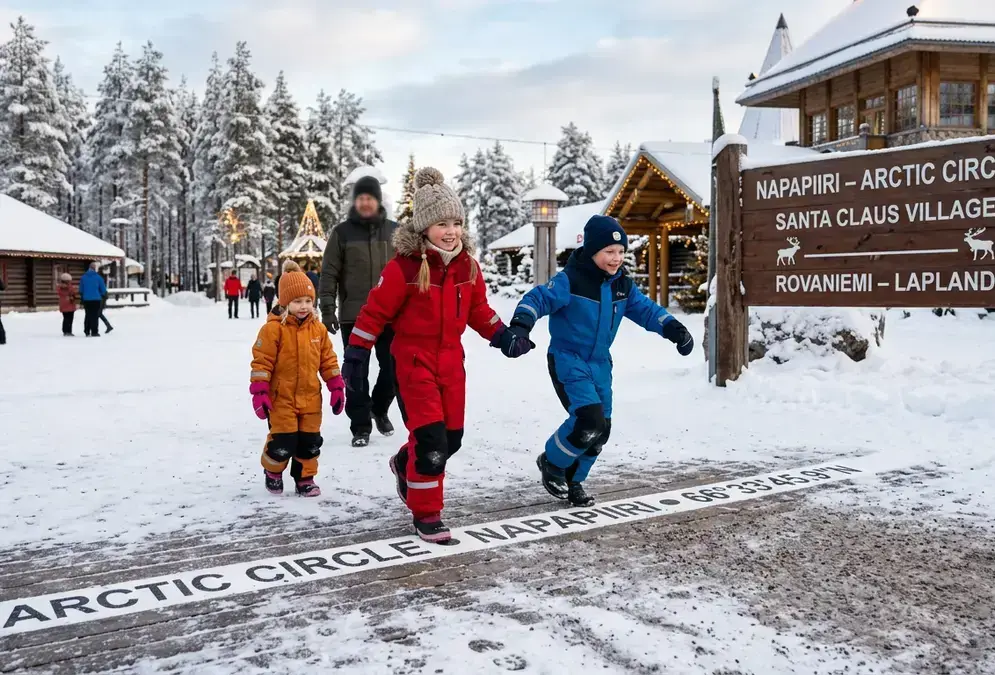

Santa Claus Village and the Arctic Circle crossing
Santa Claus Village sits eight kilometres northeast of Rovaniemi, three kilometres from the airport, and it has stayed open every single day of the year, with an official white line marking the Arctic Circle painted across the ground.
Entry to the park itself is free. You pay for what you do once you're inside: a meet-and-greet with Santa, a photo package, a guided tour that folds in lunch. Families with young children get the most out of this stop, but even a skeptical adult traveling solo tends to leave with a photo at the Arctic Circle line, because the marker itself is the actual attraction, not the gift shop around it.
365
Because the village sits directly on the airport road, it slots naturally into an arrival or departure day: land at Rovaniemi Airport, stop at the village on the way into town, and you've covered the region's single most photographed spot before you've even checked into a hotel.
Husky and reindeer farms: the region's two working animals
Lapland runs on two animals that show up in almost every winter itinerary: huskies and reindeer, and they deliver genuinely different experiences rather than a repeat of the same sled ride with different fur.
Husky farms, concentrated around Rovaniemi and Levi, run everything from a 20-minute taster sled to multi-day mushing expeditions where you drive your own team and camp overnight in wilderness cabins[3]. The dogs are working animals, not props: most operators run kennel tours in summer, when sledding isn't possible, specifically so visitors understand the animals' training and care outside the winter rush. If you only have time for one, book a session long enough to actually drive the sled yourself rather than just ride in it; the difference between sitting in the sled and standing on the runners is the difference between a photo and a memory.
Reindeer sleigh rides move at a different pace entirely: slower, quieter, and rooted in the traditional Sámi mode of transport rather than a modern adventure-tourism product. A typical excursion includes a stop at a herder's camp, a chance to hand-feed the animals, and an explanation of how reindeer husbandry actually works, which is closer to ranching than to the domesticated-pet framing most visitors arrive with.
Both experiences run primarily December through March, when snow cover supports sledding; summer visits to the same farms trade the sled for a kennel or paddock tour. The husky sled aurora tour and reindeer sleigh aurora tour both combine the daytime animal experience with an evening aurora hunt, useful if your schedule is tight.
| Husky sledding | Reindeer sleigh | |
|---|---|---|
| Pace | Fast, adrenaline-driven | Slow, traditional |
| Season | Dec-Mar for sledding; summer kennel tours only | Dec-Mar for sleigh rides |
| Best for | Active travelers who want to drive the sled | Visitors wanting cultural context and a quieter pace |
Snowmobiling and ice fishing: the wilderness afternoon
Snowmobiling is Lapland's fastest way to cover wilderness ground, and it's available from every major base, Rovaniemi, Levi, and Saariselkä chief among them[3]. Guided tours run two to four hours, follow marked forest and fell trails, and require no prior experience beyond a driving license; an instructor rides in front and sets the pace. It pairs naturally with an aurora hunt after dark, since the same machine that gets you to a dark-sky spot at speed during the day works just as well once the sun is down.
Ice fishing occupies the calm, quiet end of the energy spectrum. You drill a hole through a frozen lake, drop a line, and wait, often with a sauna and a cooked-lunch stop built into the same outing. It's a genuinely quiet, meditative counterpoint to the sled-and-snowmobile pace of everything else on this list, and it works as a half-day activity for anyone who wants one slow morning in an otherwise packed itinerary. Lakes freeze to a safe thickness from November through April, and operators check ice conditions before every outing rather than relying on a fixed calendar date.
Neither activity depends on clear skies or aurora activity, which makes both useful as backup plans for a cloudy afternoon between night-time aurora attempts. The Lapland aurora snowmobile tour folds the two halves of the day together: wilderness riding in daylight, aurora-hunting once it's dark.
Ranua Wildlife Park and the ski fells
Ranua Wildlife Park, 80 kilometres south of Rovaniemi, bills itself as the world's northernmost zoo, and its roster reads like a checklist of animals most visitors will never see in the wild: polar bears, brown bears, wolves, lynx, wolverines, and a resident elk alongside the more familiar reindeer[3]. The park frames itself around Arctic biodiversity rather than a generic zoo experience, with enclosures built to reflect each species' actual range and climate. It's an easy half-day trip from Rovaniemi and one of the few activities on this list that runs the same way regardless of weather, useful for filling a grey, cloudy afternoon between aurora attempts.
Levi and Ylläs, Lapland's two major ski fells, add a different kind of daytime programme entirely: downhill runs, cross-country trails, and enough lift infrastructure that a family can split a week between skiing and aurora-hunting without relocating[4]. Both resorts run year-round, but the winter season, roughly late November through April, is when the full lift network operates. Neither requires prior Arctic experience; ski schools at both resorts run beginner lessons daily through the season.
Featured · Destination
Northern Lights in Finnish Lapland
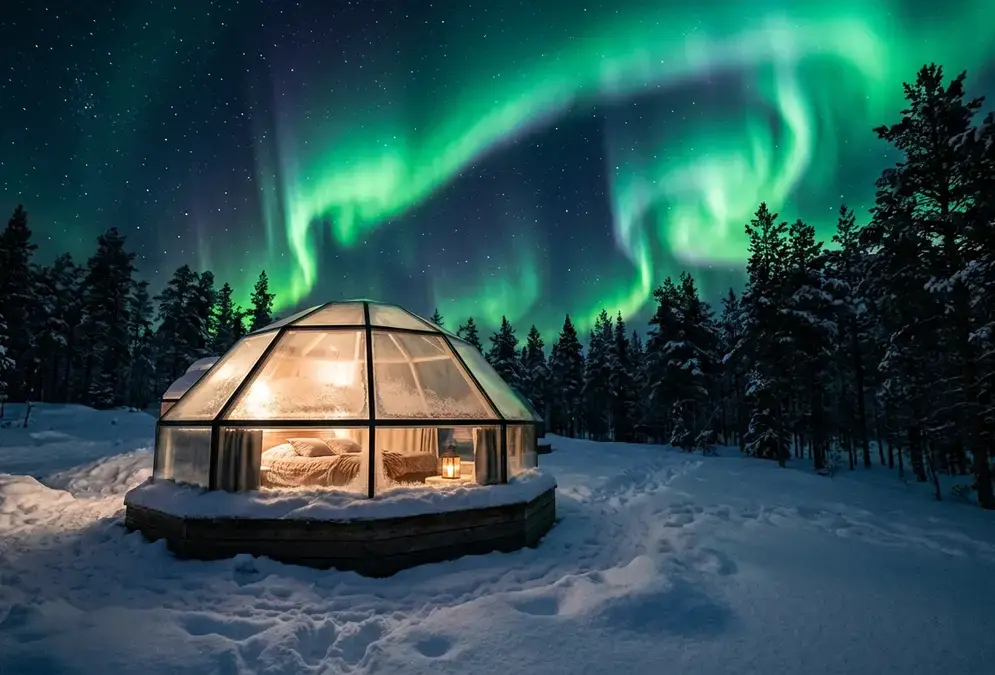
Finnish Lapland's whole-region aurora guide: glass igloos, Santa Claus Village, six bases from Rovaniemi to Inari, aurora season Sep–Mar, no road drama.
Combining a ski day with an evening aurora hunt is easier here than almost anywhere else in the Arctic: you're already dressed for the cold, already at altitude, and already away from Rovaniemi's coastal glow, so the transition from the slopes to the dark-sky spot is a matter of swapping skis for a snowmobile or a short drive, not repacking for an entirely different kind of day.
Arktikum Museum: science and Sámi heritage under one roof
The Arktikum museum sits in central Rovaniemi, home to both the University of Lapland's Arctic Centre and the Regional Museum of Lapland[5]. It's the single best rainy-day, or cloudy-night, stop on this list: exhibits explain the physics behind the aurora itself, walk through the region's Arctic wildlife and geography, and dedicate serious space to Sámi culture and history, not as a sidebar but as a core part of the regional story.
For anyone whose aurora hunt got clouded out the night before, Arktikum answers the question a disappointed tourist inevitably asks a guide the next morning: what actually causes the lights, and why didn't they show up? The science exhibits cover geomagnetic activity and the auroral oval in plain, visitor-friendly terms, which pairs well with a guided aurora tour booked for the following night; you'll understand what the guide is watching for on the Kp forecast instead of just following instructions.
Budget 90 minutes to two hours for a full visit, less if you're moving through with restless kids. It's an indoor activity that works in any weather, at any time of year, which is more than can be said for almost everything else in this guide.
Sámi culture: visiting respectfully, not as a photo backdrop
The Sámi are Finland's only recognized indigenous people, part of a broader Sámi population spread across Arctic Norway, Sweden, Finland, and Russia. Three Sámi languages are spoken within Finland alone: North Sámi, Inari Sámi, and Skolt Sámi, each tied to a specific region and community rather than treated as interchangeable dialects.
Sámi culture has a real history of being commercialized and flattened into costume photos and gift-shop souvenirs, and that history is worth knowing before you book anything branded as a 'Sámi experience.' The meaningful difference is between an experience that is Sámi-led, or run in genuine partnership with Sámi operators, and one that borrows Sámi imagery without any Sámi involvement at all.
A few starting points that fit this distinction:
Featured · Article
What Is Astrotourism? The Complete Beginner's Guide
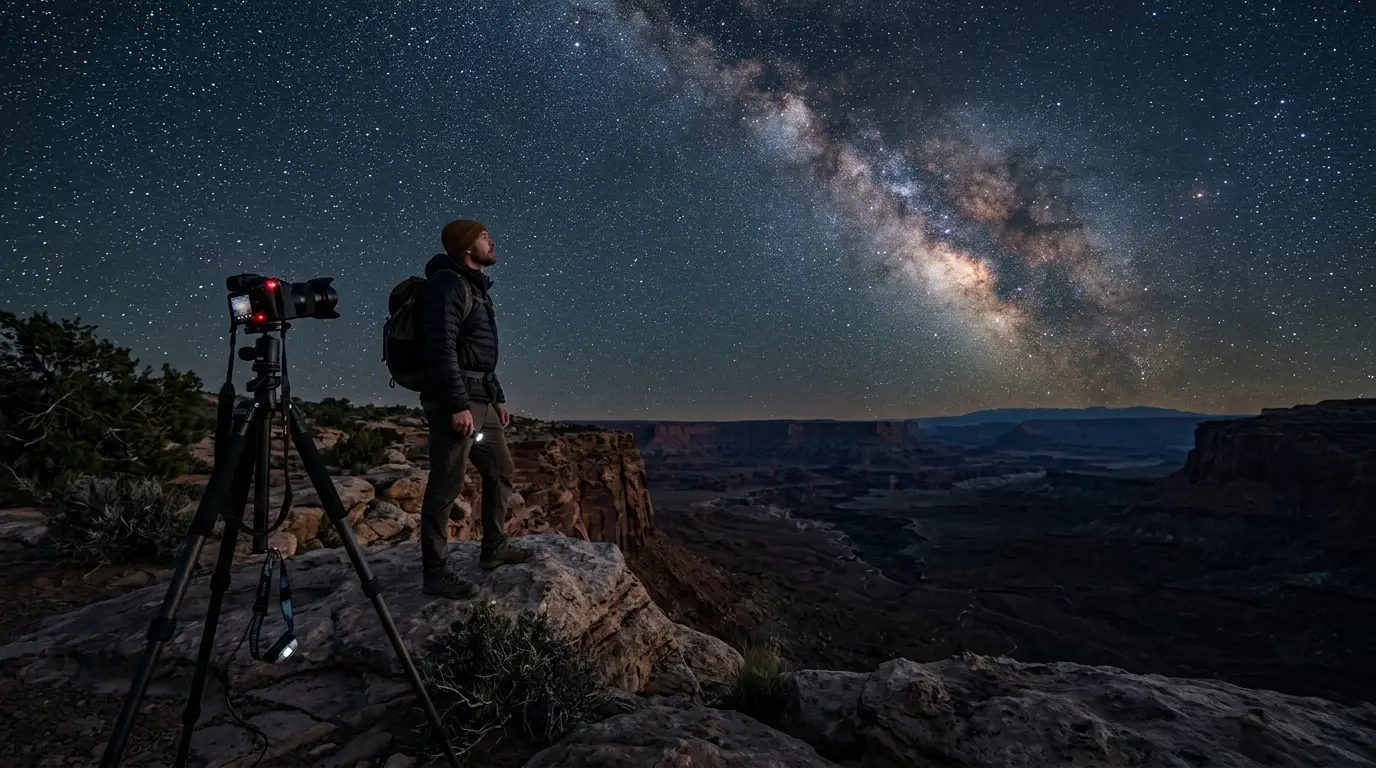
Astrotourism means travel built around dark skies: meteor showers, auroras, the Milky Way. What it means, where to go, and how to plan your first trip.
Recommended tours
Tours are selected for quality, not commission. I earn a small fee if you book — at no extra cost to you.
- Sámi Museum Siida, in Inari, covers Sámi history, language, and traditional livelihoods through a museum built and run with Sámi input
- Vasara Reindeer Ranch, in Kilpisjärvi, is a working farm run by a twelfth-generation Sámi reindeer-herding family
- Nutti Sámi Siida, just across the border in Swedish Lapland, offers reindeer feeding and sledding through a Sámi-owned operation
None of this means every reindeer sleigh ride needs to be a cultural deep-dive; a straightforward sled ride is a fine thing to book on its own terms. But if the point of your trip includes actually learning something about the people who have herded reindeer across this landscape for centuries, seek out the operators who are Sámi themselves, and ask directly when you're not sure. It's a reasonable question, and any operator worth booking will have a straightforward answer. For the honest cost-versus-payoff picture that ties daytime activities into the whole trip, see is Lapland worth it for the northern lights.