
Flying into Rovaniemi: Finnair, routes, and what a ticket costs
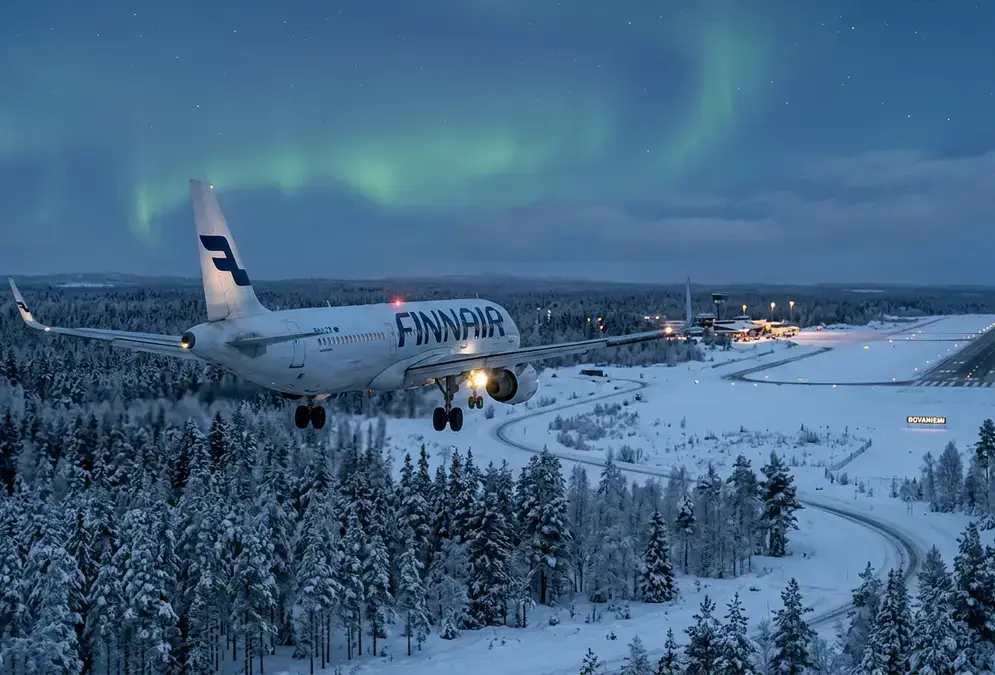
Finnair operates the Helsinki-Rovaniemi route (HEL-RVN) almost single-handedly, carrying roughly 80% of travelers on the route and posting the best on-time performance of any carrier flying into Lapland[1]. The flight covers 689 kilometres in 1 hour and 20 minutes, about the time you'd spend clearing a slow security line at Helsinki-Vantaa. There's no long-haul route flying directly into Rovaniemi; every international connection, whether from London, New York, or Tokyo, clears passport control at Helsinki Airport (HEL) first and catches the short domestic hop north into Finnish Lapland's aurora season.
Finnair runs 29 direct flights a week year-round[2], so there's no shoulder-season gap where service drops to twice weekly, a real risk at smaller regional airports elsewhere in the Arctic. One-way fares start around €50 to €65, with round trips from roughly €100 to €130 depending on how far ahead you book and which week you fly[3].
29
Prices climb fast once November arrives. Winter, November through March, sees Finnair add frequency to meet demand, and flights around Christmas and New Year fill months in advance[4]. If your travel dates are fixed to a specific week, especially the last two weeks of December, book the flight before you book anything else. The hotel and the aurora tour can wait; a seat on a sold-out flight can't.
The Santa Claus Express: Finland's overnight sleeper train
For travelers who'd rather watch Finland scroll past a cabin window than clear airport security twice, VR (Finnish Railways) runs the Santa Claus Express, an overnight sleeper connecting Helsinki and Turku to Rovaniemi. The trip takes about 12 hours, long enough for dinner in the restaurant car, a full night's sleep through the featureless stretch of central Finland, and breakfast delivered outside your cabin door somewhere north of the Arctic Circle.
Two departures run most nights: 19:29, arriving in Rovaniemi at 07:20, and a later 23:13 service landing at 11:03. A standard sleeper compartment, priced per compartment rather than per person, starts around €49 for up to two people; a nicer cabin with a private shower runs from about €74[5]. Nostalgic three-person cabins exist too, for anyone chasing a slower kind of Arctic arrival. Bookings open up to two years in advance, and during the Christmas and New Year peak that lead time matters: wait until a month out and you're choosing from whatever compartments nobody else wanted.
The train also carries cars, loaded onto double-deck wagons, which solves a genuine problem. If you want a vehicle waiting in Rovaniemi without renting one in Helsinki and driving it north yourself, put your own car on the train instead. It's slower than flying by a wide margin, but it turns a transit day into part of the trip rather than a chore to get through before the trip starts.
From the airport into town: transfers and first-night logistics
Rovaniemi Airport sits just 3 kilometres from Santa Claus Village and 8 kilometres from the city center[4], which means the transfer that eats a chunk of most Arctic travel days, the long shuttle through unfamiliar dark, barely exists here. A taxi into town runs a fixed, predictable fare and takes under 15 minutes. Airport shuttle buses run on flight schedules and drop directly at the main hotels.
Most lodges and tour operators run their own pickup if you've booked a stay with them, worth confirming when you reserve since it removes the transfer question entirely. Kakslauttanen Arctic Resort, three hours further north, arranges transport for guests making the longer trip; closer to town, rental car desks operate inside the terminal for anyone driving onward the same day.
Featured · Destination
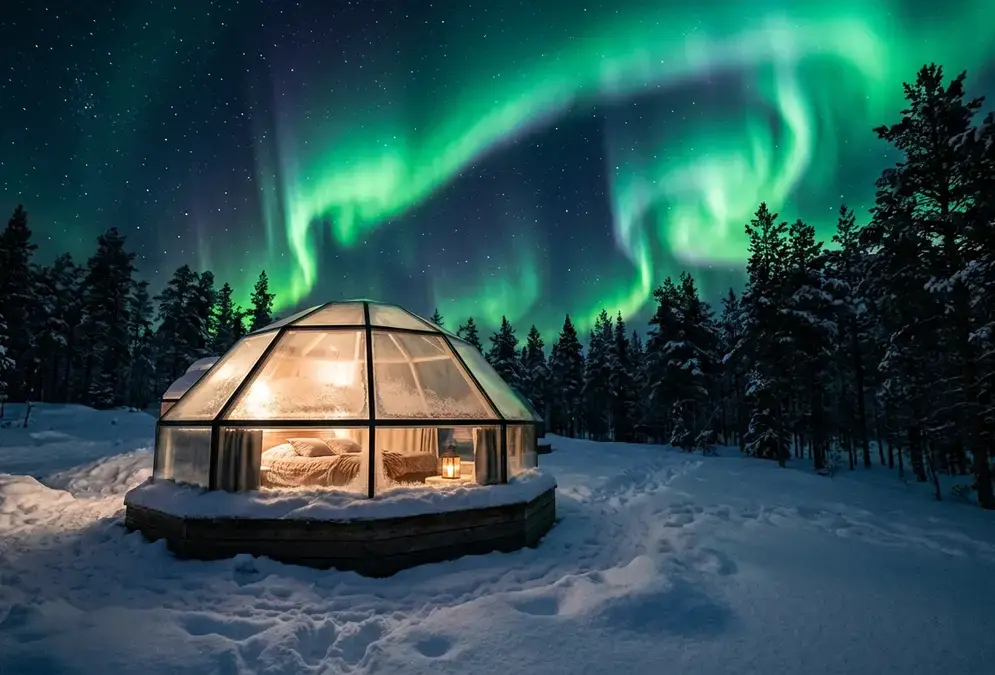
Northern Lights in Finnish Lapland
Finnish Lapland's whole-region aurora guide: glass igloos, Santa Claus Village, six bases from Rovaniemi to Inari, aurora season Sep–Mar, no road drama.
Your main options from the airport:
- Rental cars - the default if your plan includes day trips to Levi, Saariselkä, or beyond
- Hotel shuttles - most lodges and larger hotels arrange pickup at booking
- Taxis - metered, reliable, and quick given the airport's proximity to town
- Pre-arranged tour pickups - many guided aurora tours collect guests directly from Rovaniemi hotels
For a first night in Rovaniemi before heading further into the region, this is about as low-friction as Arctic arrivals get.
Renting a car: winter tires, road conditions, and why Lapland isn't Iceland
Self-driving in Lapland runs on different assumptions than a rental trip through Iceland or coastal Norway. Studded winter tires are legal, and standard, from October 1 through April 15, and rental agencies across Rovaniemi fit them by default the moment autumn turns; you won't need to request them or pay extra. Finland's roads through Lapland are well-built and regularly plowed[6], which sounds like a minor detail until you compare it to Iceland's Ring Road, where a strong enough storm can shut the whole route down for a day or more.
That said, expecting bare tarmac in the depths of winter is unrealistic. Continuous snowfall from December through February means roads typically carry a packed layer of snow rather than clear pavement, even on well-maintained routes. This isn't a sign of poor upkeep; it's how a road surface behaves at -20°C. Studded tires on a snow-packed surface are a stable, predictable combination that Finnish drivers handle daily, and rental cars are set up for exactly this.
| Finnish Lapland | Iceland | |
|---|---|---|
| Road closures | Rare; roads plowed and open year-round | Ring Road can close for a day or more in storms |
| Winter tires | Studded tires standard Oct 1-Apr 15, fitted by default | Winter tires standard, studded less common |
| #1 driving hazard | Deep cold and short daylight | Sudden closures and high wind |
A small hatchback with proper winter tires handles the main routes between Rovaniemi, Levi, and Saariselkä without trouble. Where the driving actually demands care is what comes next.
Reindeer, black ice, and deep cold: the real winter driving hazards
The hazards that matter on a Lapland winter drive are specific, and none of them is a closed road. Black ice is the main one: a glassy, near-invisible layer that forms on bridges, shaded curves, and low-lying stretches. The standard advice is to double your normal stopping distance the moment temperatures hover around freezing[6]. Go slowly into anything you can't see clearly ahead, and brake early rather than hard.
Reindeer cross Lapland's roads constantly, and unlike deer elsewhere, they don't reliably bolt when a car approaches. A reindeer standing in your lane at dusk, unbothered by headlights, is a normal Tuesday in rural Lapland, not a rare wildlife encounter. Slow down through open, unfenced stretches, especially at dawn and dusk when reindeer move between grazing areas, and never assume the animal will move first.
Then there's the cold itself, which is Lapland's real logistical concern rather than the road surface. A car left outside overnight at -25°C needs a warm-up period before it drives normally, door seals can stiffen, and a dead battery is a far more likely trip-ending event than a snowed-in pass. Keep a phone charged, dress for the temperature even for a five-minute fuel stop, and treat every outdoor errand as something that takes longer than it would at home.
A reindeer standing in your lane at dusk, unbothered by headlights, is a normal Tuesday in rural Lapland, not a rare wildlife encounter.
None of this makes winter driving in Lapland difficult. It makes it different: slower, more deliberate, and built around cold and daylight rather than around dodging a closed pass. If self-driving still sounds like more logistics than you want to manage, guided aurora tours handle the driving, the dark-sky spotting, and the cold-weather gear questions in one booking.
Getting around the region: day trips to Levi, Saariselkä, and Kakslauttanen
Rovaniemi works as a hub, not a cul-de-sac. Levi is roughly two hours north by road, Saariselkä about three, and Kakslauttanen's glass igloos sit close to Saariselkä at a similar distance. None of these require an overnight relocation if your base stays in Rovaniemi and your itinerary allows for long driving days, though most visitors find a split trip, a few nights in Rovaniemi followed by a few nights further north, works better than commuting back and forth.
Bus and coach connections exist between the main bases, aimed mostly at travelers without a rental car, but they run on a limited schedule that doesn't suit spontaneous aurora-chasing. If your plan includes checking the forecast and moving to wherever the sky is clearest that night, a rental car is the only option that keeps you flexible.
For a first trip, the practical sequence looks like this:
Recommended tours
Tours are selected for quality, not commission. I earn a small fee if you book — at no extra cost to you.


- Fly or take the train into Rovaniemi and spend your first one to two nights adjusting to the cold and the light
- Rent a car, or confirm your tour pickups, once you've settled in
- Day-trip or relocate to Levi, Saariselkä, or Kakslauttanen for the glass-igloo nights and darker skies further north
- Build in a buffer day near Rovaniemi at the end of the trip in case a flight or the Santa Claus Express requires an early return
If you'd rather skip the extra driving altogether, the Arctic SnowHotel & Glass Igloos sit a short transfer from Rovaniemi itself, so a glass-igloo night doesn't have to mean a trip further north.
Once you've sorted the transport, the bigger question is what to do with the rest of the trip. What to do in Lapland beyond the northern lights covers the daytime side, and is Lapland worth it for the northern lights walks through the honest cost-versus-payoff math before you book.