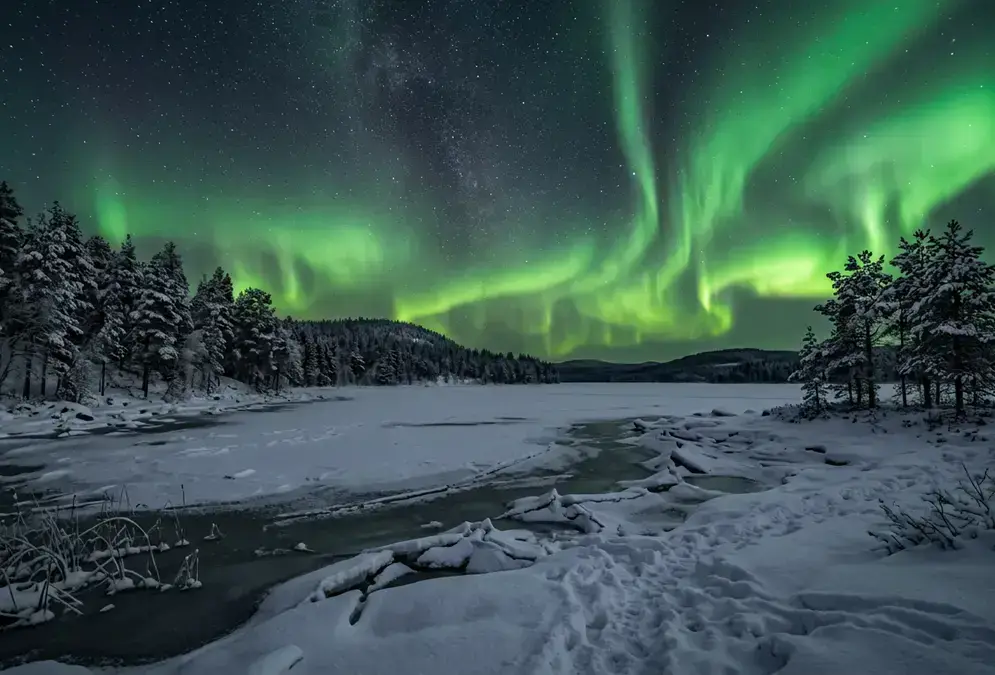

Why Finnish Lapland's Named Spots Beat One 'Best Place' Answer
Finnish Lapland doesn't have one best spot for the northern lights, and treating it like Reykjavík or Fairbanks, where a single dark-sky pullout north of town covers most of what you need, misses how the region actually works. Lapland spreads its aurora-viewing terrain across six named bases stretching more than 300 kilometers from Rovaniemi to Lake Inari, and each ranks differently on access, aurora frequency, and what's actually on hand once the lights show up.
That spread is the whole point. Aurora frequency climbs the further north you travel, and a first-time visitor who reads only about Rovaniemi ends up with worse odds than the trip actually allows. This guide covers six named spots, from Ounasvaara's short walk from a Rovaniemi hotel to Lake Inari's frozen-lake wilderness, ranked by how good the sky actually is and how much you give up in convenience to get there. For the underlying Kp index mechanics behind why frequency varies by latitude, that's covered separately; this piece is about exactly which fell, lake, or village to head for once conditions line up.
Ounasvaara, Rovaniemi: Aurora a Short Walk From Your Hotel
Ounasvaara is Rovaniemi's answer to a north-facing hill inside city limits, and it's the spot a first-timer with no rental car should actually use. The fell sits close enough to central Rovaniemi that you can walk there in about 25 to 30 minutes, or take a taxi and be standing under open sky in five[1]. A short bus ride or a ten-minute drive covers the same ground if walking through snow with a tripod doesn't appeal.
Two structures do the heavy lifting once you arrive: the Ounasvaara Observation Tower, a five-to-ten-minute walk from the Santasport Resort area, and the rooftop viewing deck at Lapland Hotels Sky Ounasvaara, open to hotel guests. Neither is wilderness. Rovaniemi's streetlights still throw a visible glow low on the horizon, and the fell's aurora frequency runs lower than the darker bases further north. What it trades away in darkness, it makes up in logistics: no car, no guide, no three-hour transfer, just a walk up a hill after dinner.
Featured · Destination
Northern Lights in Finnish Lapland
Finnish Lapland's whole-region aurora guide: glass igloos, Santa Claus Village, six bases from Rovaniemi to Inari, aurora season Sep–Mar, no road drama.
That convenience is why most Rovaniemi-based visitors treat Ounasvaara as their default check, not their only stop. If a storm is strong enough to punch through some light pollution, you'll see it from the tower without leaving town. If the display is faint, the fell's residual glow will wash it out, and that's when a Rovaniemi northern lights chase tour earns its price: a driver working from real-time cloud data can put you somewhere genuinely dark within an hour.
Levi, Ylläs, and Pyhä: Fell-Top Views in Western and Central Lapland
West and central Lapland trade Ounasvaara's convenience for real elevation. Levi, Ylläs, and Pyhä are ski-resort fells with open plateaus above the tree line. Standing above the tree line removes the one obstacle every valley-based viewing spot has to fight: the forest canopy itself. All three sit inside the active aurora zone, though none of them publish the kind of hard frequency numbers Saariselkä and the far north do.
The three aren't interchangeable. Levi is Finland's biggest, busiest ski resort and the most built-out of the trio; Ylläs markets itself on some of the cleanest air on the continent and a quieter, more Lappish village feel; Pyhä sits closest to Rovaniemi and reads as a middle ground between the two.
standing outside in Arctic cold for an hour is the actual limiting factor on most aurora hunts, not whether the lights show up
Levi: a Heated Gondola to the Fell Top
Levi's fell plateau is reachable by a heated gondola, which matters more than it sounds: standing outside in Arctic cold for an hour is the actual limiting factor on most aurora hunts, not whether the lights show up. The resort runs its own guided night tours and keeps chalets and restaurants a short walk from the base station. Levi also has its own glass-roofed stay, Levi Igloos, a lower-key alternative if Kakslauttanen is booked out or its transfer from Rovaniemi doesn't fit the itinerary. Reaching Levi from Rovaniemi by road eats most of a day, so treat it as a separate base, not a day trip.
Ylläs and Pyhä: Quieter Fells, Same Aurora Oval
Ylläs spreads across seven fells inside Pallas-Yllästunturi National Park and leans harder into the wilderness angle than Levi's resort scale, with open terrain that works for aurora photography without Levi's crowds. Pyhä, under two hours from Rovaniemi next to Pyhä-Luosto National Park, is the closest of the three to the regional capital and the easiest to add as a side trip rather than a full relocation. Neither publishes frequency numbers the way Saariselkä does, but both sit far enough from any town's light dome that a clear night at fell elevation beats anything visible from a valley floor.
Saariselkä: Doorstep to Urho Kekkonen National Park
Saariselkä is where the numbers start working harder in your favor. The resort town sits on the edge of Urho Kekkonen National Park, remote enough that the aurora shows up here on a very high share of clear nights, among the highest frequency anywhere in Finland with real tourism infrastructure attached. That combination, genuine darkness plus restaurants, guided tours, and accommodation from budget cabins to the region's flagship stay, is what separates Saariselkä from the ski-resort fells further west.
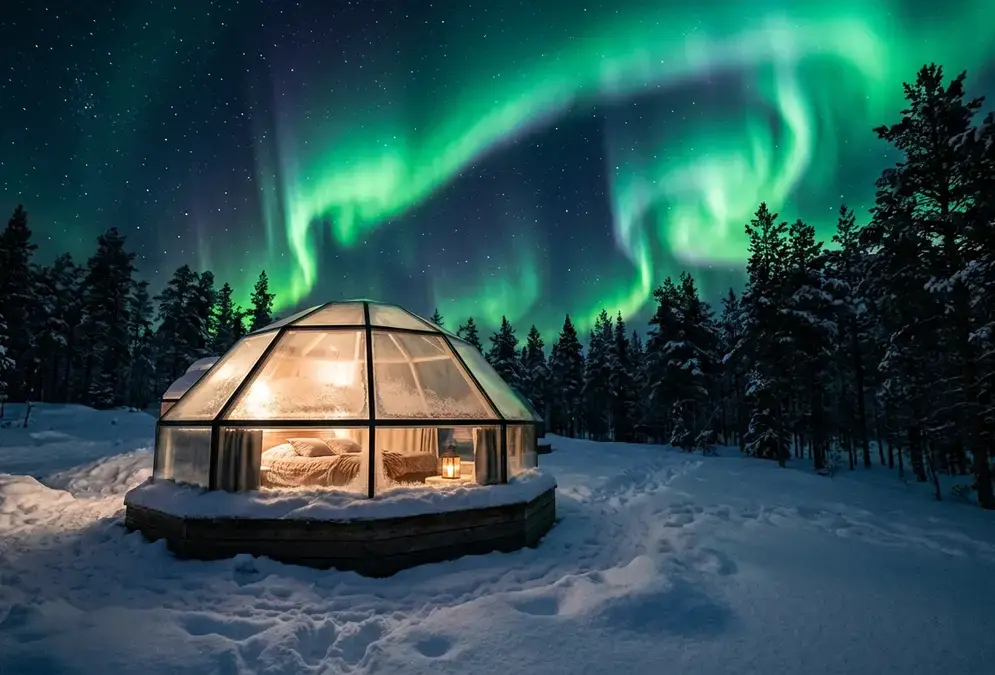
The flagship stay is the original Saariselkä glass-igloo resort, the glass-igloo property that put Saariselkä on the aurora-tourism map in the first place. Its Kelo-glass roofs let you watch the sky from a heated bed rather than standing outside in deep cold, and the resort's remoteness means light pollution barely registers on a clear night. If Kakslauttanen is fully booked, or its price doesn't fit the trip, the best glass igloos in Lapland roundup covers five alternatives across the region, including options closer to Rovaniemi.
Read next · Lodge
Kakslauttanen Arctic Resort
Kakslauttanen Arctic Resort: the original 1973 glass igloo hotel, 250km above the Arctic Circle in Lapland. Kelo-Glass Igloos from €424/night, 8.0 rating.
Saariselkä works equally well without booking an igloo at all. Standard hotels and guesthouses sit a short walk from national park trailheads, and the darker sky above the resort town alone, away from any specific hotel roof, is enough for most visitors chasing a genuine sighting rather than a bed with a view.
Recommended tours
Tours are selected for quality, not commission. I earn a small fee if you book — at no extra cost to you.
Lake Inari and Nellim: Sámi Territory and the Frozen-Lake View
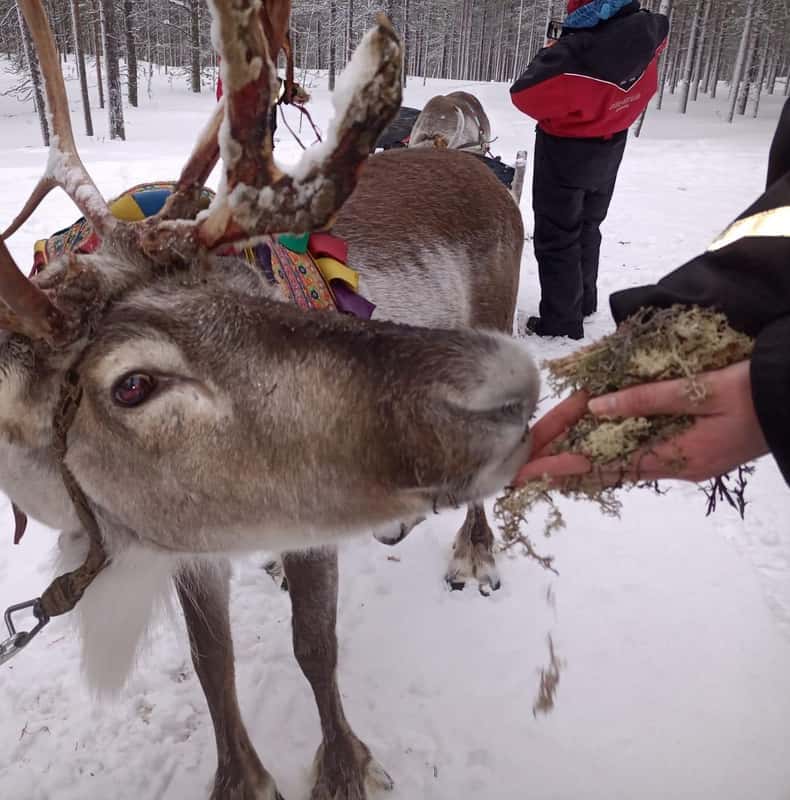
Lake Inari and the village of Nellim sit at the far northern edge of Finnish Lapland's tourism map, close enough to the Kilpisjärvi-Utsjoki latitude band, Finland's single highest-frequency aurora zone[2], that they share in some of that same advantage. Inari itself is widely known as the cultural capital of Finland's indigenous Sámi people[3], and that context adds a dimension no ski-resort fell can match: guided viewing here often comes paired with Sámi cultural programs, not just a snowmobile and a thermos of coffee.
The signature experience is watching from the lake itself. Once the ice is thick enough, Inari freezes into a flat, treeless expanse with an open horizon in every direction, and standing on the frozen surface at night puts you further from any tree line or building than at any of the other five spots in this guide. Nellim and Inari lie at roughly comparable distance from Saariselkä; reaching either from Rovaniemi is the longest transfer of any spot on this list.
That distance is the honest trade-off. Facilities thin out compared with Saariselkä or Levi, restaurants and shops close earlier, guides are fewer, but the aurora frequency and the near-total absence of competing light make the detour worth it for anyone whose whole trip is built around seeing the lights rather than combining them with a ski resort or a Christmas theme park.
Choosing Your Spot: Frequency vs Access
Six spots, one decision: how much convenience are you willing to trade for a darker sky? Ounasvaara wins on access, a walk from your Rovaniemi hotel, but loses on frequency. Lake Inari and Nellim win on frequency and near-total darkness, but cost most of a day to reach. Levi, Ylläs, Pyhä, and Saariselkä sit somewhere in between, each with a genuine reason to pick it over the others.
- First trip, no car, short stay: Ounasvaara, walkable from Rovaniemi
- Want elevation and daytime skiing between aurora nights: Levi or Ylläs
- Want the region's highest-profile stay and strong odds without the longest transfer: Saariselkä and Kakslauttanen
- Want the darkest sky and genuine Sámi cultural depth, and don't mind the drive: Lake Inari and Nellim
None of these choices override the two things that actually decide whether you see anything on a given night: clear sky and enough solar activity. Pick your base on convenience and frequency, then check the forecast the same way regardless of where you're standing. For the region-wide picture on how long to budget across more than one of these bases, see how many days in Lapland for northern lights; for exactly which Finnish tools to check once you've picked a night, the Lapland aurora forecast guide covers the FMI and University of Oulu resources built specifically for this region.
| Spot | Distance from Rovaniemi | Best for |
|---|---|---|
| Ounasvaara | 25-30 min walk from central Rovaniemi | No car, first-timers, short stays |
| Levi | Most of a day by road | Fell-top elevation, ski resort infrastructure |
| Ylläs | Combinable with a Levi-region itinerary | Quieter fells, cleaner air |
| Pyhä | Under 2 hours | Middle ground between convenience and remoteness |
| Saariselkä | About 3 hours | Kakslauttanen, national park access, high frequency |
| Lake Inari & Nellim | Longest transfer of any spot on this list | Highest frequency, Sámi culture, frozen-lake views |