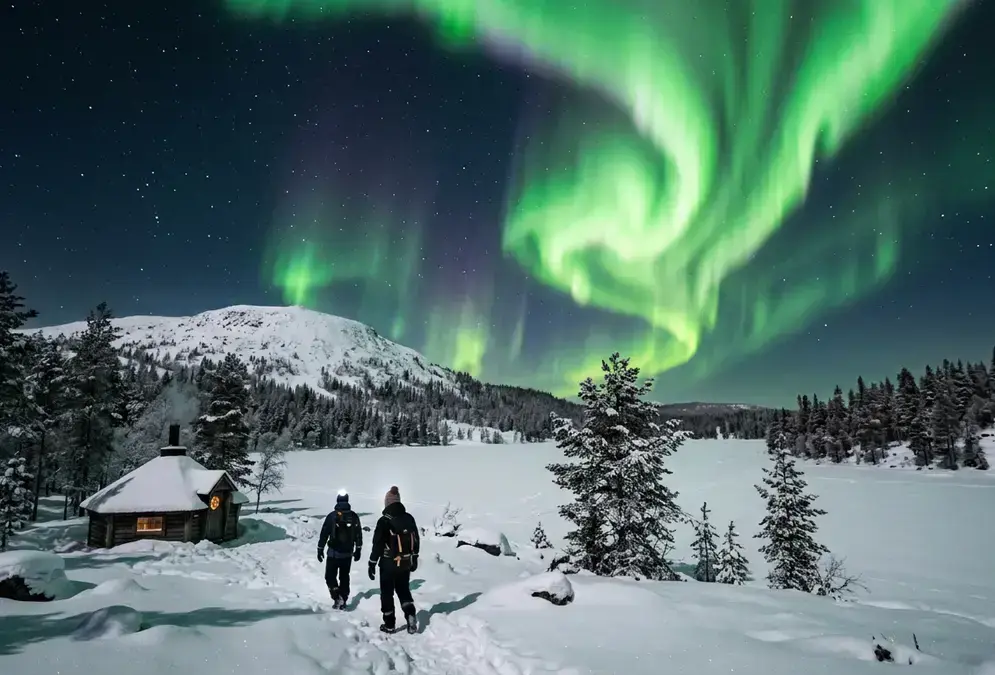

Why Base Count, Not Cloud Cover, Decides Your Odds in Lapland
Lapland's trip-length math works differently than Iceland's or Norway's. There, the gamble is against fast-moving Atlantic cloud; here, Finland's continental climate is comparatively stable across a season, and the real variable is how many separate aurora-frequency zones your trip actually touches. Saariselkä, three hours north of Rovaniemi, sees the aurora on a very high share of clear nights. The far north around Kilpisjärvi and Utsjoki, close to Lake Inari, does even better: roughly three nights out of four when skies are clear[2], the highest frequency anywhere in Finland. Rovaniemi, the capital most visitors fly into, sees the lights only a fraction as often as either of those, enough for a quick trip but not the country's best odds.
That gradient is the whole logic behind how many nights to book. A short trip that never leaves Rovaniemi caps your odds at the capital's frequency. Add a second base and you stack a higher-frequency zone on top of the first. Add a third, out at Inari, and you're combining all three. For the mechanics behind any single night's activity, Kp index explained covers that separately; this guide is about how many nights, and which bases, actually move the needle.
| Base | Aurora frequency | What it adds |
|---|---|---|
| Rovaniemi | Moderate, city-adjacent | Airport, city infrastructure, easy access |
| Saariselkä | High, up to 200 nights a year | National park access, Kakslauttanen glass igloos |
| Lake Inari / far north | Highest in Finland | Frozen-lake views, Sámi cultural depth |
3 to 4 Nights: Rovaniemi Only
Three to four nights based entirely in Rovaniemi is the trip most business travelers, Finland stopovers, and budget-conscious visitors actually book. It works as a quick add-on to a longer Finland or Scandinavia itinerary, or as a standalone weekend for anyone who wants a real shot at the aurora without committing a full week to it.
The structure is simple: fly into Rovaniemi, base at a city hotel or one just outside town, and spend your evenings on Ounasvaara fell, covered in full in best northern lights spots in Lapland, or on a guided chase tour when the forecast looks promising. Daytime fills in around it:
- Ounasvaara fell exploration and the observation tower
- The Arctic Circle line and Santa Claus Village
- Museums or indoor attractions on cloudy days
- Short excursions into the surrounding countryside
The honest limitation is frequency. Capped at one location, you're working with Rovaniemi's more modest aurora odds and three or four single-night attempts to catch a clear sky. That's a real constraint, not a dealbreaker: minimal travel time, a real airport, and the widest range of restaurants and services in the region make this the lowest-friction way to see the lights at all. It's just not the highest-odds way.
5 Nights: Rovaniemi Plus Saariselkä (or Levi)
Five nights, with four actually spent in Lapland once travel days are accounted for, is where a second base starts paying off. The standard structure: two nights in Rovaniemi, then relocate to Saariselkä, about three hours by car or bus[3], for two more. Some visitors substitute Levi for Saariselkä, trading some aurora frequency for ski-resort infrastructure and a shorter psychological adjustment, since Levi still reads as a resort town rather than genuine wilderness.
The extra base buys you two different microclimates and two different frequency zones instead of one, which matters more than the raw travel time suggests. A cloudy night in Rovaniemi doesn't necessarily mean a cloudy night in Saariselkä, and vice versa. Daytime activities split naturally by base too:
Featured · Destination
Northern Lights in Finnish Lapland
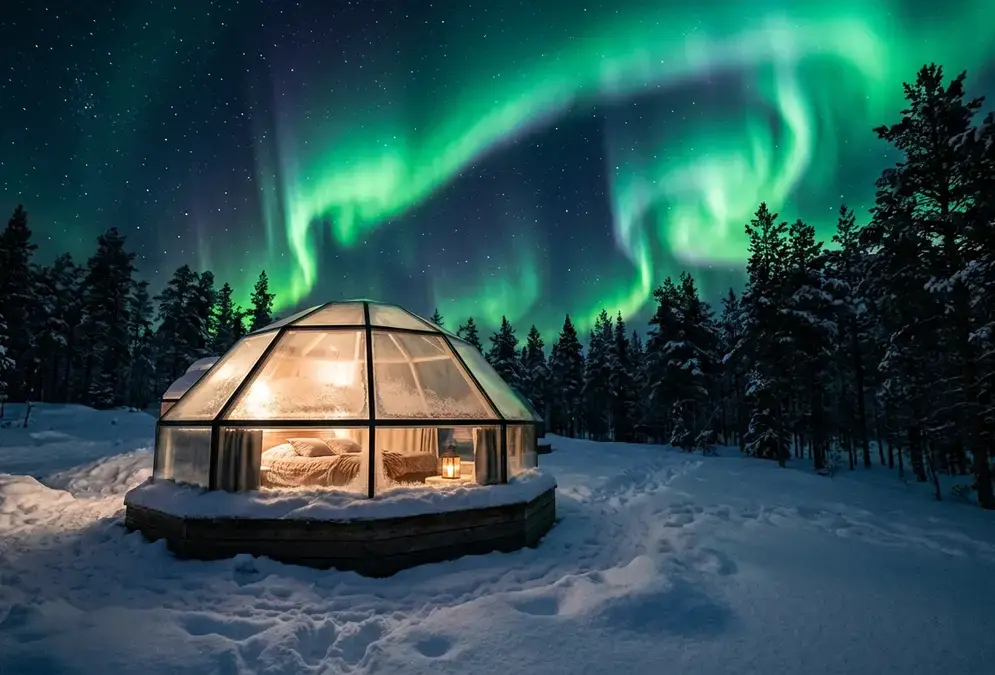
Finnish Lapland's whole-region aurora guide: glass igloos, Santa Claus Village, six bases from Rovaniemi to Inari, aurora season Sep–Mar, no road drama.
- Rovaniemi: Arctic Circle monument, husky sledding, reindeer sleigh experiences
- Saariselkä: Urho Kekkonen National Park snowshoeing, winter hiking, dog sledding
- Levi (if substituted): ski runs, snowmobile safaris, thermal spa visits
The trade-off is one travel day spent relocating rather than aurora-hunting, and the logistics of moving between two accommodations instead of one. For families or first-time visitors who want variety alongside a real frequency boost, this is the itinerary length that balances both.
7 to 8 Nights: The Three-Region Tour With Inari
Seven to eight nights is the itinerary for aurora enthusiasts, serious photographers, and anyone with a flexible schedule who wants to stack all three of Lapland's main frequency zones into one trip. The structure typically runs two nights in Rovaniemi, three in Levi or Saariselkä, and two to three more out at Inari, reachable from Rovaniemi in four to five hours by road[4].
Recommended tours
Tours are selected for quality, not commission. I earn a small fee if you book — at no extra cost to you.
That third region adds more than just another frequency zone. Inari brings genuine Sámi cultural depth, frozen-lake viewing, and reindeer-herding communities that neither Rovaniemi nor the ski-resort fells offer. With seven or eight separate clear-sky attempts spread across three distinct microclimates, the probability of seeing multiple displays within a single trip runs substantially higher than any shorter itinerary in this guide.
Read next · Article
Best Northern Lights Spots in Finnish Lapland
Six named spots across Finnish Lapland, from Rovaniemi's Ounasvaara fell to Lake Inari's frozen shore, ranked by aurora frequency, access, and facilities.
The cost is real: more total travel, more accommodation changes, and a noticeably higher budget than a three- or five-night trip. It's the right length if seeing the aurora, ideally more than once, is the entire point of the trip and you can't easily come back. It's overkill if the lights are one part of a broader Finland visit. If the glass-igloo resort in Saariselkä's glass igloos are part of the plan for this leg, book the Saariselkä nights around the resort directly rather than treating the igloo stay as a spontaneous add-on.
How the Travel Times Actually Work
How you spend those extra nights depends on distances that don't always match intuition. Rovaniemi to Saariselkä is the three-hour leg used in the five-night itinerary above; Rovaniemi to Levi is actually the shortest of the three legs, about two hours by road, and many visitors fly directly into Kittilä airport anyway for the convenience. Nellim and Inari sit close enough to Saariselkä to add as a short extension rather than a full relocation, which is why the standard seven-night itinerary treats Saariselkä and Inari as a single combined leg rather than two separate ones.
4-5 hrs
None of these distances are dangerous the way an Icelandic winter road can be. Finland's continental climate keeps roads more predictable across the season, and the country's aurora-tourism infrastructure, buses, transfers, guided tours, is built around exactly these town-to-town gaps. The real planning question isn't whether you can make the drive; it's whether the extra travel day is worth the frequency gain waiting at the other end.
Matching Trip Length to Who's Traveling
The right length also depends on who's making the trip, not just the math. Families juggling Santa Claus Village and one aurora hunt are usually well served by three to five nights based in or near Rovaniemi; the deep cold and short daylight of Lapland's winter make a shorter, city-adjacent trip easier on younger kids than a multi-region tour. Couples and photographers chasing the best possible odds should lean toward the five-to-eight-night range, and treat Saariselkä or Inari as worth the extra travel.
As a working range, four to seven nights buys the best mix of aurora odds and time to explore, and it lines up with what the base-count math in this guide already shows: three nights works as a bonus activity, but a dedicated aurora trip should budget at least five.
Whatever length you land on, pair it with the right forecast tool once you're actually in Lapland. The Lapland aurora forecast guide covers the Finnish Meteorological Institute's tools built specifically for this region, and Lapland's named aurora spots guide covers exactly where to stand once you've picked your nights.