
The Golden Circle: Iceland's essential day trip
The Golden Circle is the day trip every Iceland itinerary builds around, and it earns the reputation. The route covers roughly 300 kilometres and loops through three sites, starting and ending in Reykjavík, typically taking 6 to 8 hours door to door[1]. All three stops are free to enter, so the only real cost is fuel, a rental car, or a seat on a tour bus. Do it on a day with a bad aurora forecast, because nothing about the Golden Circle depends on clear night skies.
Renting a car gives you control over how long you linger at each stop, but a guided option works well if you would rather not drive Icelandic roads in winter. The Golden Circle Aurora Combo Tour pairs the daytime loop with an evening aurora-hunting session, which solves the scheduling problem: you see the geological highlights in daylight, then chase the lights after dark without burning a separate day.
Read next · Tour
Golden Circle & Northern Lights Combo Tour
A 10.5-hour Reykjavik day trip: Þingvellir, Geysir, and Gullfoss, then a guided evening aurora hunt. From $100. No sighting guarantee; weather decides.
Þingvellir National Park: walking the tectonic rift
Þingvellir sits about 40 kilometres northeast of Reykjavík, in a rift valley that marks the crest of the Mid-Atlantic Ridge and the boundary between the North American and Eurasian tectonic plates[2]. It is a UNESCO World Heritage Site for more than the geology: this is also where Iceland's medieval parliament, the Althing, convened in the open air starting in 930 AD. You can walk the Almannagjá gorge along the plate boundary itself, basalt cliffs rising on either side and the glacial Öxará river cutting through the valley floor. Admission is free and the park stays open year-round, though the boardwalks ice over in winter.
Geysir and the Strokkur eruption
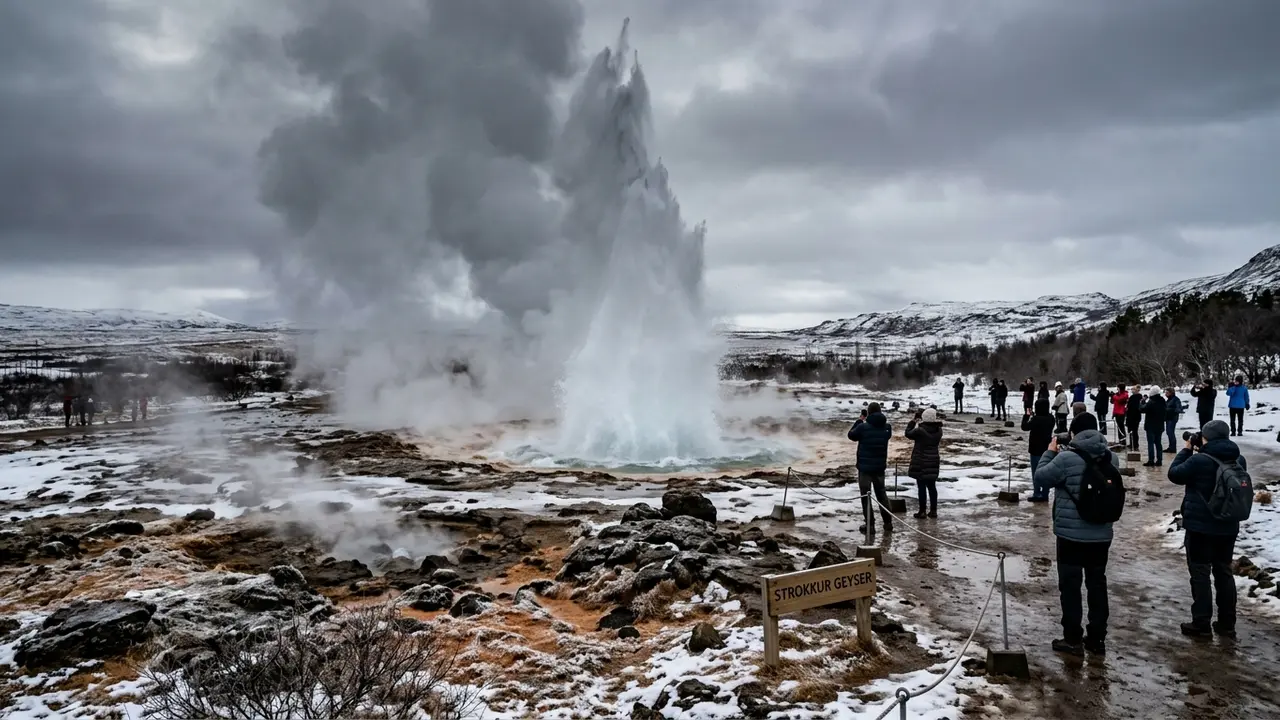
The Geysir Geothermal Area gave the world the word "geyser," though the original Geysir itself now erupts only rarely. The show belongs to its neighbour, Strokkur, which erupts every 5 to 10 minutes and throws a column of water around 20 metres into the air, with occasional bursts reaching as high as 40 metres[3]. Watch closely and you will notice the dome of water swell for a second before it lets go; that half-second warning is the only cue you get. Boardwalks loop around the wider geothermal field, past smaller bubbling pools and steam vents that make the ground feel alive underfoot.
Gullfoss: the Golden Falls
Gullfoss, meaning "Golden Falls," plunges 32 metres in two tiers into a gorge carved by the Hvítá river[4]. The upper platform puts you close enough to feel the spray on a windy day; the lower path drops you nearly level with the second tier, where the roar drowns out conversation entirely. In summer, the Hvítá above the falls is a popular rafting run, one more way to see the river before it disappears over the edge.
Silfra Fissure: snorkeling between two continents
Silfra is the only place on Earth where you can snorkel or dive between two tectonic plates, in a submerged rift inside Þingvellir National Park. The fissure opened in 1789, torn apart by earthquakes that accompanied the same plate divergence visible above ground at Þingvellir, and the two continents continue drifting apart at about 2 centimetres a year[5].
What makes Silfra worth the cold is the water itself: meltwater from the Langjökull ice cap, filtered through porous lava fields for 30 to 100 years before it reaches the fissure, giving visibility beyond 100 metres and a steady 2 to 4°C year-round[6]. That narrow, unchanging temperature is also what makes the site accessible. Snorkeling requires no diving certification, and participants float at the surface in a drysuit rather than submerging, which means non-swimmers and first-timers can do it safely. Diving below the surface, if that's what you want, requires a dry-suit certification from any certifying agency, or proof of equivalent dry-suit diving experience[7].
>100 m
Because the water temperature never changes, Silfra runs year-round, which makes it one of the easiest activities to slot in regardless of what the Kp index says that night. A summer visit means driving straight from Þingvellir's parking lot; a winter one means suiting up over thermals in the snow, which sounds worse than it feels once you are floating between continents.
Ice caves and glacier hikes: Vatnajökull and Sólheimajökull
Iceland's glaciers are worth building a day around, and two sit within reach of a South Coast itinerary. Vatnajökull is Europe's largest glacier, and guided ice cave tours inside it run from October to early April[8], when the caves are structurally stable enough to enter safely. Outside that window, meltwater destabilises the tunnels and operators stop running trips.
Featured · Destination
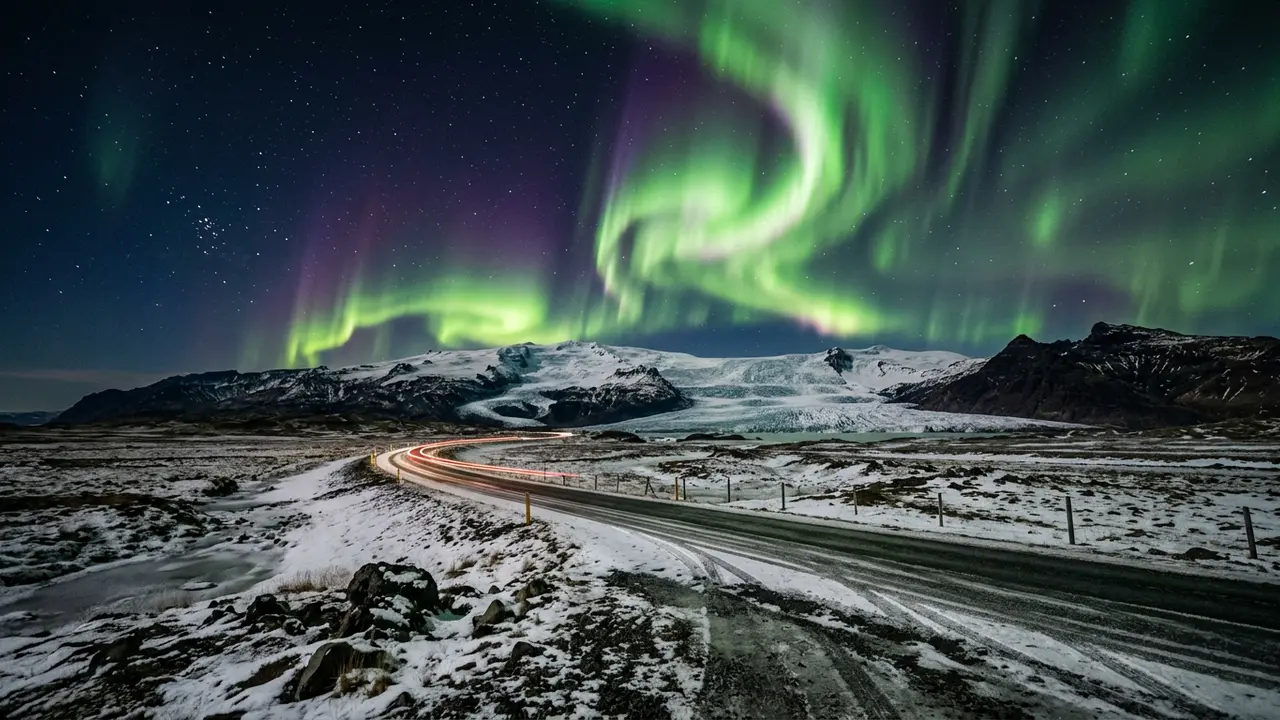
Northern Lights in Iceland
Iceland's whole-country aurora guide: best regions to base in, aurora season Sep–Mar, ice caves, winter driving reality, and where cloud cover ends every plan.
Sólheimajökull, an outlet glacier of the Mýrdalsjökull ice cap in the south, is the more accessible option for a half-day trip[9]. Guided glacier hikes here run for most of the year, crampons and ice axe provided, across a surface streaked with volcanic ash from past eruptions. Inside the ice caves, the walls turn a deep, saturated blue, a trick of physics rather than dye: glacial ice compresses out nearly all its air bubbles, and what's left absorbs the red end of the light spectrum and reflects the blue, which is why old, dense ice glows in a color fresh snow never does.
A few things worth knowing before booking either:
- Glacier surfaces shift constantly, so always go with a guide, never on your own
- Winter delivers the most dramatic ice-cave formations; summer trades that for easier access and longer light
- Wind exposed on open ice cuts harder than the ambient temperature suggests, so layer accordingly
Between the two, Vatnajökull rewards the ice-cave-specific trip, while Sólheimajökull works better if you want a straightforward glacier walk without committing a full day. Either is worth booking regardless of the forecast; for help deciding which nights to keep free for aurora hunting instead, see When to Stargaze.
South Coast waterfalls: Seljalandsfoss and Skógafoss
The South Coast road trip earns its reputation for waterfalls, and two of them justify stopping the car twice in under twenty minutes of driving.
Seljalandsfoss drops 60 metres, fed by the Seljalandsá river, which begins at the Eyjafjallajökull volcano-glacier; a short drive further along, Skógafoss falls 60 metres across a 25-metre width near the village of Skógar[10]. The two waterfalls sit close enough together on the same stretch of road that skipping one to save time barely saves any time at all.
| Waterfall | Height | Signature feature | Best time |
|---|---|---|---|
| Seljalandsfoss | 60 m | Walk behind the curtain | Summer, dry trail |
| Skógafoss | 60 m | Rainbows in the spray | Sunny days, any season |
What sets them apart isn't the drop, it's the approach. At Seljalandsfoss, a path circles behind the curtain of water in summer, when the trail dries out enough to walk without a soaking; looking out through the spray at the green cliffs beyond is a different vantage point than the one everyone photographs from the car park. At Skógafoss, the volume of spray thrown off the drop produces single, and sometimes double rainbows, on sunny days, arcing directly in front of the falls, and a steep staircase beside the falls climbs to a viewing platform where the Skógá river continues inland past a string of smaller cascades most visitors never hike toward. Either waterfall is worth the stop regardless of what the Iceland Northern Lights forecast says that night.
Geothermal lagoons: Blue Lagoon versus Sky Lagoon
Iceland has more geothermal spas than most visitors realize, but two dominate the itinerary because both sit within easy reach of Reykjavík and the airport. They serve different trips.
Blue Lagoon
The Blue Lagoon, Iceland's best-known geothermal spa, sits in a lava field on the Reykjanes Peninsula, supplied by runoff water from the adjacent Svartsengi geothermal power station[11]. The water holds at 37 to 40°C and carries a milky-blue cast from its high silica content, along with algae and minerals the lagoon markets as skin treatments. It's Iceland's single most famous geothermal spa, and its lava-field setting is a large part of why. Because it sits close to Keflavík Airport, it works well as a first stop after landing or a last one before a flight home, though its popularity means booking a time slot well in advance.
Sky Lagoon
Sky Lagoon, the newer option, sits just 15 minutes from downtown Reykjavík with open views out toward the ocean rather than a lava field[12]. It structures the visit as a seven-step ritual, in order: a warm soak, a cold plunge, a sauna, a cold mist, a body scrub, a steam room, and a final shower. The sequence gives the visit a shape the Blue Lagoon doesn't impose, which some visitors prefer and others find overly choreographed. If proximity to the city matters more than the brand-name lagoon, Sky Lagoon is the more convenient choice.
Reykjavík beyond the tour bus: architecture, music, and food
Most Iceland itineraries treat Reykjavík as a place to sleep between day trips. That undersells a city with two genuinely distinctive buildings and a food scene worth an evening on its own.
Hallgrímskirkja is the largest church in Iceland, and, at 74.5 metres, the second-tallest structure in the country; its stepped concrete facade was designed to echo the basalt columns found across Iceland's lava coastline[13]. The tower is open to visitors, and the ride up trades the climb for a panoramic view over the city's coloured rooftops, the harbour, and the mountains beyond, on a clear day reaching as far as Mount Esja across the bay.
Down toward the water, Harpa Concert Hall, which opened in 2011, is the more photographed of the two. Its glass facade came out of a collaboration between the artist Ólafur Elíasson and Henning Larsen Architects: 714 individually shaped, individually coloured glass panels arranged to mirror the basalt landscape outside[14]. Inside, Harpa is home to the Iceland Symphony Orchestra and the Icelandic Opera, plus two restaurants; check the schedule before you arrive, since a concert night changes what the building feels like from the inside[15].
Recommended tours
Tours are selected for quality, not commission. I earn a small fee if you book — at no extra cost to you.
Reykjavík's food scene leans hard on what the country actually produces. Lamb, Arctic char, and langoustine show up on nearly every serious menu, often alongside foraged herbs that change with the season. Grillmarkaðurinn does the traditional end of that spectrum well; Dill pushes the same ingredients toward something more experimental. Either one turns what could be a forgettable hotel dinner into a reason to stay in the city an extra night.
None of this depends on a clear night. Save the aurora chase for when the forecast actually cooperates, and use How to See the Northern Lights to read a Kp forecast properly before committing an evening to standing outside in the cold.