
Which airport, which route: TFS via Vilaflor vs TFN via La Esperanza

Tenerife South Airport (TFS), also called Reina Sofía, is the main international gateway. It handles the bulk of European charter and low-cost flights, and most visitors to Teide National Park start here. The TF-21 runs north from the airport through the town of Vilaflor, at 1,400 metres the highest municipality in the Canary Islands, and climbs into the caldera past the Los Roques de García rock formations before reaching the cable car base station at kilometre 43. The total distance is 47 kilometres and the drive takes 1h30 to 2 hours depending on traffic and how many times you stop for the view.
The road is well-surfaced, two-lane, and winding once you leave the coastal plain. The climb from Vilaflor to the caldera rim gains roughly 900 metres of elevation in 15 kilometres. If anyone in your group gets carsick, this is the stretch where it happens: the switchbacks are tight and the bus tours move slowly. Pull over at the Mirador de Boca Tauce to let the queasiness settle and take in the lava fields on the caldera floor before continuing.
Tenerife North Airport (TFN), or Los Rodeos, sits at 633 metres near La Laguna. It serves mainly inter-island and Spanish mainland flights. From TFN you take the TF-24, which cuts east through the pine forests of La Esperanza and climbs gradually through the Corona Forestal Natural Park before joining the caldera road network. The route is 55 kilometres and takes roughly 1h15 to 1h30. The forest section is scenic in a different way: tall Canary pines, mist in the early morning, and far fewer tour coaches than the TF-21. The road surface is good, though in winter the TF-24 closes more often than the southern route because it climbs through a wetter, colder band of the island.
TFS (South)TFN (North)
RouteTF-21 via VilaflorTF-24 via La Esperanza
Distance to cable car47 km55 km
Drive time1h30–2h1h15–1h30
SceneryVolcanic, lava fields, calderaPine forest, mist, green
Winter reliabilityBetter (drier side of island)Closes more often in snow
Best forMost visitors, photographersObservatory visitors, north-coast stays
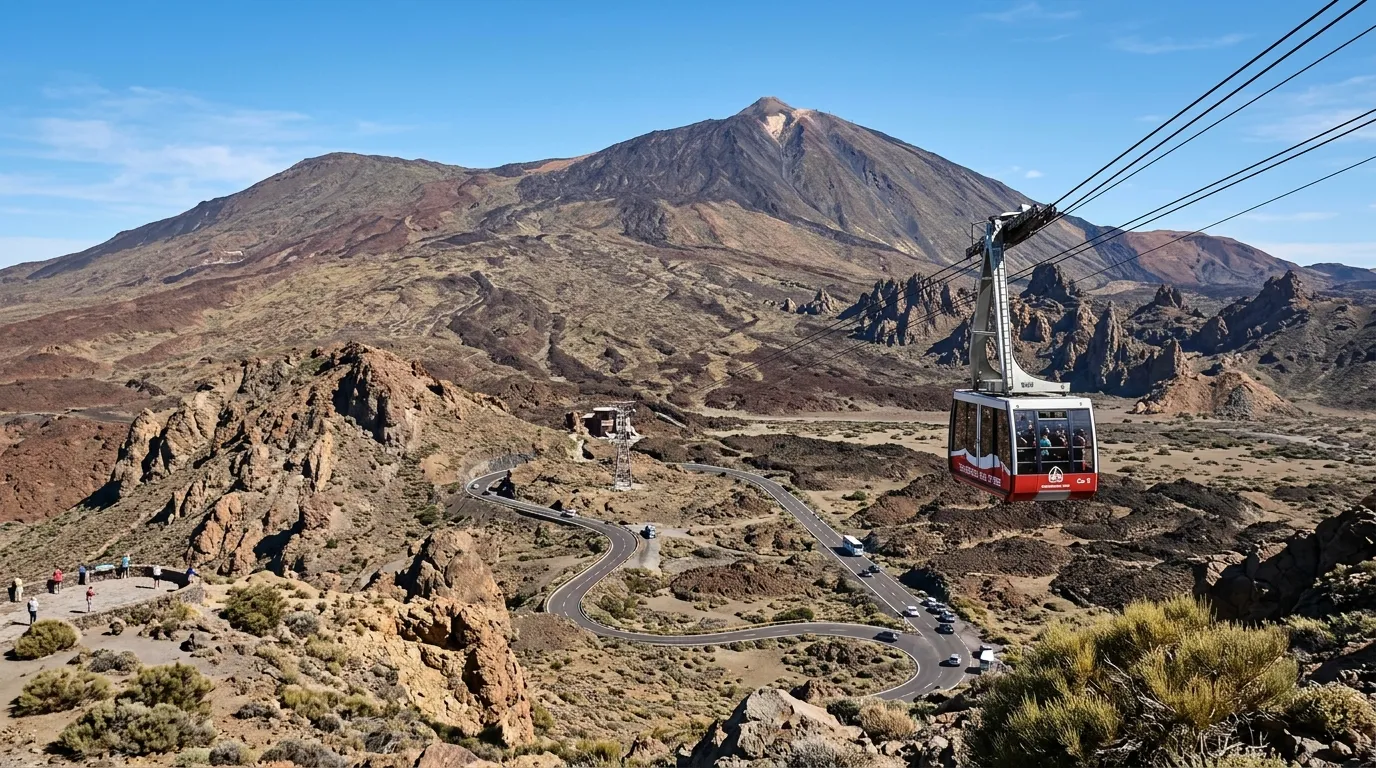
Teide National Park road winding through volcanic terrain toward the Teide cable car base station, getting to Teide from Tenerife airport, sparse vegetation and lava fields under clear sky

Teide National Park road winding through volcanic terrain toward the Teide cable car base station, getting to Teide from Tenerife airport, sparse vegetation and lava fields under clear sky

The deciding factor is usually your flight. If you land at TFS, take the TF-21; it is shorter, unquestionably more spectacular, and the logical choice for most visitors to Tenerife Stargazing. If you land at TFN, the TF-24 is your direct route, and you should use it rather than driving an extra hour across the island to pick up the southern road. If you are staying in the north (Puerto de la Cruz, La Orotava), the TF-24 also makes more sense regardless of which airport you flew into.

Car rental, fuel, and the road conditions you actually need to plan for

You need a rental car. There is no public bus service into Teide National Park at night, and the guided tours that include transport assemble at coastal hotels, not at the park entrance. Book your car from the airport where you land; rental desks at TFS and TFN are well-stocked with the usual international chains plus local operators like Cicar and AutoReisen, which consistently undercut the global brands on price and do not play the hard-sell insurance game.
A small hatchback is fine for the TF-21 and TF-24 in summer. Both roads are paved and maintained, and the gradients are manageable. In winter, roughly December through March, you want a car with winter tyres or chains if snow is forecast, and you should confirm with the rental desk that chains are included before you leave the lot. Snow is not a theoretical concern: the TF-21 closes several times most winters above 1,800 metres, and the TF-24 closes more often because it passes through the wetter northern slope. Check the Cabildo de Tenerife road-status website and the Teide webcams before you set out. If the road camera at the caldera rim shows snow on the asphalt, do not attempt the drive without chains; the park rangers will turn you around.
Fuel is the logistical trap most first-timers walk into. There are no service stations inside Teide National Park. The nearest reliable fuel stops are in Vilaflor (on the TF-21, about 15 km before the caldera rim) and La Orotava (on the TF-324, the northern approach road that feeds into the TF-21). Fill the tank in one of these towns before you enter the park. A round trip from TFS to the cable car base and back is roughly 95 kilometres, which most cars handle on half a tank, but you will burn more fuel climbing at low speed in low gears than you would on flat highway. If you plan to drive to the observatory as well (another 18 kilometres of winding mountain road from the caldera crossroads), top up accordingly.

0

Fuel stations inside Teide National Park. Fill up in Vilaflor (TF-21) or La Orotava (TF-324) before entering the park. The nearest reliable pump outside the caldera is roughly 15 km from the cable car base. If your fuel light comes on inside the park, you are already in trouble.
In the caldera itself, the roads are wide, well-marked, and generally free of potholes. The main hazard is ice on winter mornings: the caldera floor sits at 2,000-plus metres, and shaded sections of the TF-21 near the Parador can hold black ice until mid-morning. Drive slowly, use low gears on the descents to save your brakes, and pull into the designated miradores rather than stopping on the road shoulder — the tour coaches take the curves wide and you do not want to be the car they clip.

Park entry and parking: it is free, but getting a spot at the cable car is not

Teide National Park has no entry gates and no admission fee[4]. You drive in on the TF-21 or TF-24, cross an invisible boundary somewhere around 1,800 metres, and that is it: you are inside one of the world's most heavily protected dark-sky reserves without paying a cent. This is a genuine anomaly among major natural attractions, and it means the only logistical constraint at the park level is parking.
The cable car base station at kilometre 43 on the TF-21 has a dedicated car park with roughly 150 spaces. During the day it fills early, by 09:30 in summer and by 10:00 in the shoulder months, and once it is full, there is no overflow lot. The nearest alternative parking is at the Mirador de la Ruleta, roughly 2 kilometres back down the TF-21, which adds a 25-minute uphill walk on a narrow road shoulder shared with coach traffic. It is not dangerous, but it is not pleasant either, and it eats into your summit time.
For sunset stargazing, the parking dynamic shifts. The daytime crowd clears out by late afternoon, and spaces open up around 16:30 to 17:00. If you are booked on the sunset cable car (the last ascent, which runs in peak summer only), aim to arrive by 16:00 to secure a spot. The car park remains open until roughly one hour after the last cable car descent. The park itself has no closing time; you can stay at the caldera miradores all night. But the cable car parking lot is gated after hours, and you do not want to be the driver who returns from photographing Orion to find their rental car locked in.

Read next · Destination

Tenerife Stargazing

Tenerife stargazing guide: Teide National Park's UNESCO Bortle-2 skies, 83 constellations visible. Observatory visits from €21, Parador hotel, and best tours.

At the caldera-floor miradores, parking is informal, unpaved, and essentially unlimited: wide dirt pull-offs, not surfaced lots, that can turn muddy after rain or snowmelt. The main options are:
  • Boca Tauce
  • Llano de Ucanca
  • Minas de San José
In peak summer (July and August), even these informal spots fill by sunset at the popular viewpoints, so arrive before dusk if you plan to set up a telescope at a specific mirador.

Cable car: prices, hours, and the sunset service you need to book in advance

The Teleférico del Teide runs from the base station at 2,356 metres to the upper station at La Rambleta at 3,555 metres. The ride takes eight minutes each way in a cabin that holds roughly 30 passengers standing. It is not a scenic gondola — it is a steep, fast lift designed to get you from the caldera rim to the summit ridge in the shortest possible time, and the views through the windows are brief and disorienting. The value is not the ride itself; it is the 1,200 metres of elevation you skip, which would otherwise be a five-hour hike up Montaña Blanca.
A return ticket costs €42 per adult[1] for non-residents, or €10.50 for Canary Islands residents. Children aged 3–13 pay €21 (non-resident) or €5.25 (resident). The standard ticket gives you one hour at the upper station before you must take the descent cabin: enough to walk the two short signed trails to the Mirador de La Rambleta and Mirador de Pico Viejo, take your photos, and queue for the ride down. If you want more time at altitude, buy the ticket with no time restriction, which costs slightly more and is available at the ticket office.
The operating hours shift with the seasons, and the schedule is not a simple flat summer/winter split. From July through September the cable car runs extended hours, 09:00 to 18:40, with the last ascent at 17:40 and the last descent at 18:40. For the rest of the year, roughly October through June (including the spring shoulder months many visitors assume run on the longer summer schedule), it operates the shorter hours: 09:00 to 17:00, with the last ascent at 16:00. The cable car is suspended entirely on some winter days due to high wind or ice, and there is no fixed announcement schedule; check the Volcano Teide website on the morning of your visit.
The sunset service operates in peak summer, roughly July through September, and is a separate ticket, typically sold as a package that includes the ascent, a guided walk at the upper station, sunset viewing from the ridge, and the descent in darkness. This is the only way to be at the upper station after dark without a summit permit, and it is the closest a standard visitor gets to stargazing from 3,500 metres. Book it weeks ahead: it sells out on clear-sky days in July and August. The Teide Cable Car Sunset and Stargazing Tour bundles the sunset ascent with a telescope session at the base, and it is the most efficient way to combine altitude and guided observing in a single evening.
Timeline
  1. 09:00

    First ascent of the day

    Cabins run continuously from here. The base-station car park typically fills by 09:30 in summer.

  2. Jul–Sep: 17:40 · Oct–Jun: 16:00

    Last ascent window

    Last cabin up at 17:40 from July through September, 16:00 the rest of the year. The sunset service ascent departs in this window on peak-summer evenings.

  3. Jul–Sep: 18:40 · Oct–Jun: 17:00

    Final descents

    Last cabin down at 18:40 from July through September, 17:00 the rest of the year. You have roughly one hour at the upper station on a standard ticket before your return slot.

Tickets are available online at volcanoteide.com and at the base-station ticket office. Buy online. The ticket-office queue at 09:30 on a July morning can run to 45 minutes, and once the morning slots sell out, you are waiting until afternoon.

Summit permit: the paid pass you need to book months ahead

The cable car gets you to La Rambleta at 3,555 metres. To reach the actual summit, Pico del Teide at 3,718 metres and Spain's highest point, you need a separate summit access permit, which covers the final trail from La Rambleta to the crater rim. Since Tenerife introduced its summit eco-tax on 1 January 2026, the permit is no longer free: it costs €15 for independent hikers or €10 if you book through a guided tour[2], with only residents and children exempt. It remains limited to 200 people per day and is issued by the Parque Nacional del Teide through the online reservation system at TenerifeON.es.
There is no walk-up availability. The 200 daily slots are released in batches roughly four to six weeks ahead, and the system operates on a strict date-and-time-slot basis. For a new-moon weekend in June or July (check the Best Time for Stargazing in Tenerife for month-by-month clear-sky odds), permits sell out within hours of release. For a random Tuesday in April, you might find one a week ahead. The practical rule: if you know your travel dates, book the permit as soon as the window opens. Do not book flights and accommodation and then hope for a permit — the permit drives the schedule, not the other way round.
The permit covers a specific two-hour access window, typically morning (09:00–11:00 or 11:00–13:00). You present your reservation, printed or on your phone, at the checkpoint above the upper cable car station, where a ranger verifies it against the day's list. The final trail is a narrow, rocky footpath of roughly 600 metres with a 160-metre elevation gain, and it takes about 40 minutes each way at a steady pace. At the summit you find the sulphur fumaroles, the small crater, and on a clear day, a panorama that takes in:
  • Gran Canaria
  • La Gomera
  • La Palma
  • El Hierro
If you cannot get a permit, you are not out of luck for stargazing. The upper-station area at La Rambleta and the Mirador de Pico Viejo (3,555 metres) are open to cable-car ticket holders and deliver essentially the same sky quality as the summit. The extra 160 metres of altitude makes no meaningful difference to naked-eye observing. For astrophotographers, the cleaner southern horizon from the summit can help with low-altitude targets, but for the Milky Way core, which sits at 30 to 35 degrees above the southern horizon from this latitude, La Rambleta is indistinguishable from the summit.

Observatory visits: reservation-only, no night access, and why you still go

The Teide Observatory sits at kilometre 1 on the TF-514, a narrow spur road that branches off the TF-24 roughly 16 kilometres east of the caldera. It is a working research facility operated by the Instituto de Astrofísica de Canarias (IAC): not a visitor centre, and emphatically not a stargazing tour. Repeat that to yourself before you book: the observatory visit is a daytime guided tour of solar telescopes and research infrastructure. On the tour, you see:
  • The GREGOR solar telescope
  • The Vacuum Tower Telescope
  • The dome interiors of the working research domes
You do not look through an eyepiece at night, and there is no public night programme of any kind at the observatory.
Visits run April through November only. The observatory suspends public tours from December through March. Tours are conducted in small groups with an IAC guide, last approximately 90 minutes, and cost around €21 per adult. You book through the IAC website, and in summer you need to reserve at least two to three weeks ahead. There is no walk-in access — the observatory gate is locked, and you need your reservation confirmation to get through it.
Getting there requires your own transport. The observatory is not reachable by the cable car; you drive the TF-24 from the caldera roundabout (or from La Esperanza if you are coming up from TFN) and turn onto the TF-514. The spur road is steep, narrow, and has no lighting. Arrive 30 minutes before your scheduled tour time to park, check in, and adjust to the altitude: the observatory sits at 2,390 metres[3] and the air is noticeably thinner than at sea level. If you booked a morning tour, drive up early enough to see the sea of clouds that forms below the observatory at roughly 1,600 metres: on a clear day with a strong trade-wind inversion, the cloud deck stretches to the horizon like a white blanket, and the observatory domes sit above it in sharp, dry sunlight.
If your goal is actually looking at stars through a telescope, book a dedicated stargazing experience instead. The Teide Stargazing and Astronomy Tour runs guided night sessions from roadside caldera locations with large-aperture telescopes, and the Teide Observatory Guided Visit is the daytime science tour — two fundamentally different things that share the word "observatory" and nothing else. The daytime visit is genuinely interesting if you care about how professional solar physics works. If you just want to see Saturn's rings, skip the observatory and book a night tour.

Featured · Destination

Tenerife Stargazing

Tenerife stargazing guide: Teide National Park's UNESCO Bortle-2 skies, 83 constellations visible. Observatory visits from €21, Parador hotel, and best tours.