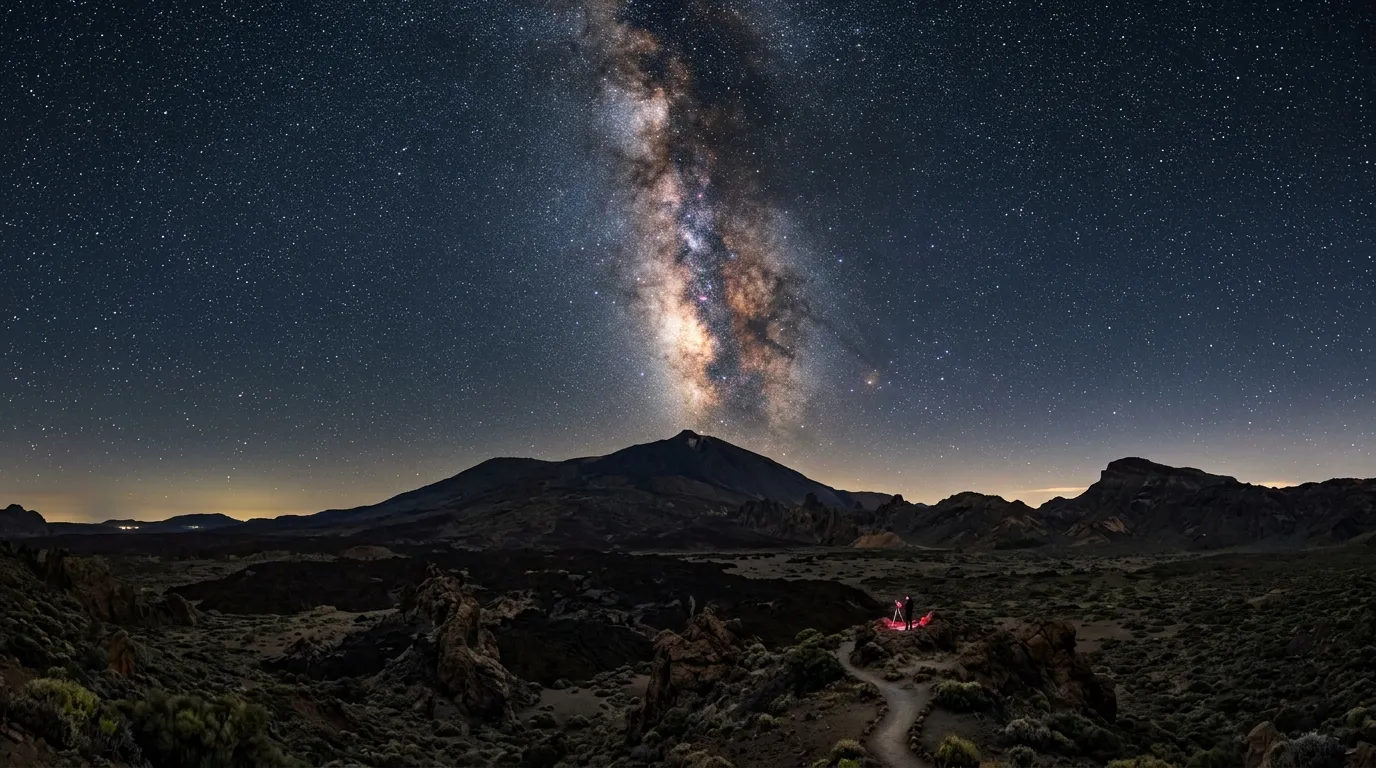
One or two nights: the high-stakes gamble
A single night at Tenerife Stargazing's high-altitude caldera is a bet, and the odds shift dramatically with the season. The IAC, which runs the observatory on the ridge above the caldera, puts the site's annual average at roughly 78% clear nights[1], one of the best figures for any observatory on Earth. That average is not spread evenly across the year: June through August is the driest, clearest stretch, when a one-night trip is about as safe a bet as astronomy allows anywhere; the shoulder months of April, May, September, and October run noticeably lower, and winter is when storm systems most often break the trade-wind inversion. Outside the summer peak, a single night is closer to a coin flip than a sure thing, and the winter months are the least reliable stretch of the year.
Two nights in peak summer nearly guarantee a clear session, even with conservative numbers. At a 90% per-night estimate, the chance of at least one clear night over two nights is 99%, and summer's real clear-night rate is likely higher than that floor. Outside the peak months, two nights still leave real risk: at a 50% per-night estimate for winter, there is a 25% chance both nights are cloudy. That feels tolerable when you live in Madrid and can rebook, but less so when you have flown from Chicago.
The bigger problem with short trips is zero moon flexibility. If your two nights land on the full moon, no amount of clear-sky luck rescues the view. The galactic core washes out to a pale smear and the faint dust lanes that define Teide astrophotography disappear. A 1–2 night trip only makes sense if you can deliberately pick new-moon dates in June, July, or August. If your travel dates are fixed, a short trip is always a dice roll, even when the weather cooperates.
Three nights: the minimum that actually works
Three nights is the baseline recommendation for anyone traveling to Tenerife specifically to stargaze. The math is straightforward, even with conservative numbers. If a single high-season night carries a 90% chance of being clear (a reasonable floor given Tenerife's roughly 78% annual average and June–July's much-better-than-average track record), the probability of three consecutive cloudy nights drops to (0.10)³, or one-tenth of one percent. That works out to a 99.9% chance of at least one clear session across the stay, and real summer odds are likely better than this floor. Either way, that is the difference between hoping and knowing.
Three nights also solves a practical rhythm that any astrophotographer recognises: night one is arrival and scouting — you drive the caldera, test which miradores face the right direction, and figure out where the wind is worst. Night two is your core session. Night three is the backup, or, if night two went well, a chance to shoot from a different location or at a different focal length. Without that third night, one mechanical failure or a single misjudged cloud bank wipes out the whole trip.
99.9%
The other advantage of three nights is that it spans roughly one-tenth of the lunar synodic cycle[2]. If you book around new moon, a three-night stay falls entirely within the dark window: the five nights either side of new moon when the sky is genuinely dark for deep-sky observing. A two-night trip can do the same, but you have no slack if your flight is delayed or the one clear night happens to be the one you are in transit.
For a first-time stargazing trip, three nights in May through September is the sweet spot. In peak summer you can drop to two with near-certainty, but three is what removes the anxiety and lets you enjoy the experience instead of checking satellite imagery every hour.
Five nights: what photographers and serious observers need
If you are bringing a star tracker, a modified camera body, and a list of specific compositions you want to nail, three nights is tight. Five nights is where an astrophotography trip stops feeling rushed. The extra two nights pay for themselves in ways that do not show up on a probability chart.
First, multiple clear nights let you shoot different targets. One night at the Llano de Ucanca mirador facing south for the core; another at the Roques de García for foreground interest; a third from the caldera rim for a panorama. On a three-night trip, one cloudy night reduces you to one shooting window. On a five-night trip, even two cloudy nights leave you three sessions.
Second, five nights gives you a calima buffer. Calima is the Saharan dust haze that occasionally blankets the Canary Islands, turning the sky milky and cutting transparency by a stop or more. It is unpredictable and can last 24 to 48 hours. On a short trip, a calima event is a trip-ender. With five nights, you wait it out.
Third, if you plan to hike to the Pico del Teide summit from Montaña Blanca, you need a summit permit: free for residents, but as of January 2026 non-residents pay an eco-tax that varies by trail and time slot, and the daily cap has risen to 300 people across three 100-person slots[3]. Either way, you need a full day for the ascent and descent plus the night for observing. That is one night committed to logistics, not photography. With five nights you can absorb it.
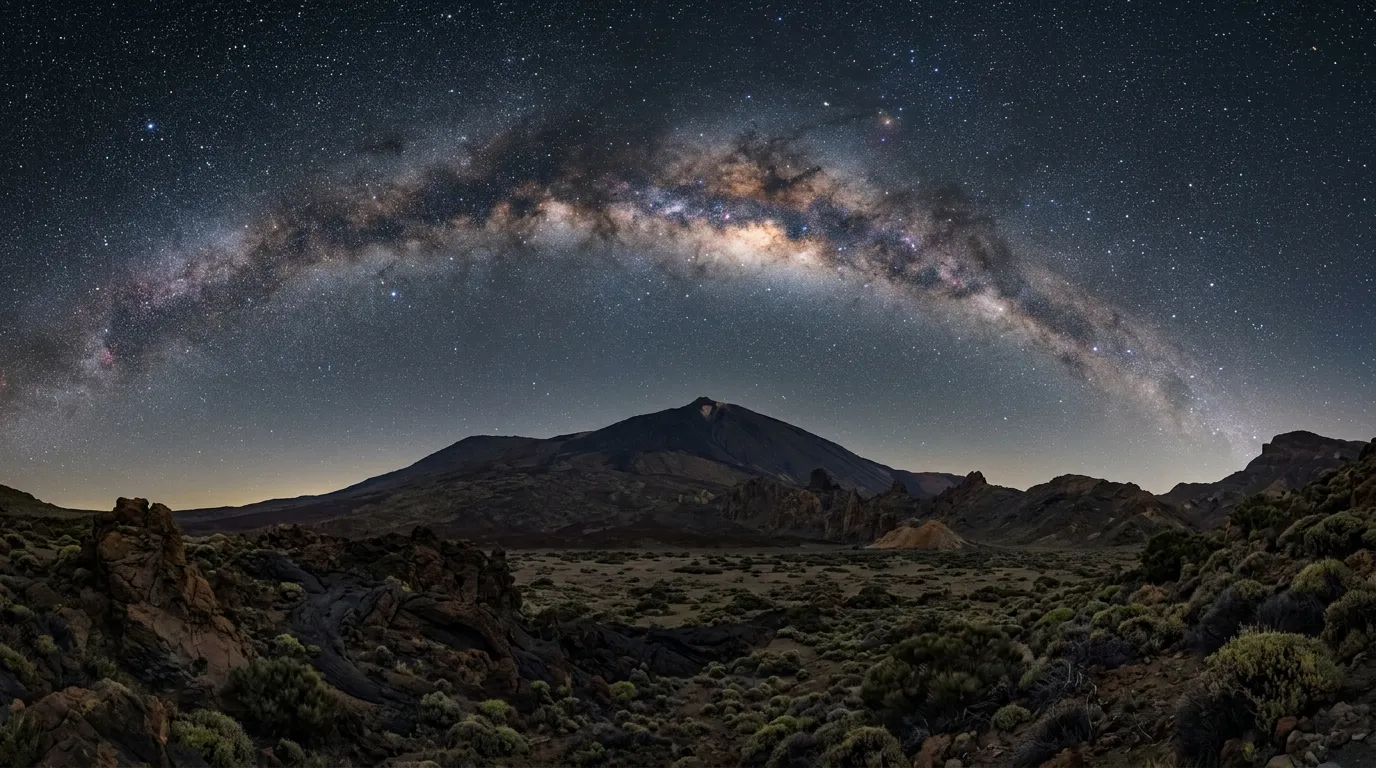
Featured · Destination
Tenerife Stargazing
Tenerife stargazing guide: Teide National Park's UNESCO Bortle-2 skies, 83 constellations visible. Observatory visits from €21, Parador hotel, and best tours.
The practical rhythm with five nights: one scouting night, two core shooting nights, one dedicated summit night, one backup or free night. If you book the Teide Stargazing & Astronomy Tour for one of those nights, it gives you access to equipment and local knowledge without committing every session to a group.
The moon is your real boss — plan around it
Ten nights under a full moon will not deliver what three nights under a new moon will. This is the most common planning error I see: travellers fixate on the number of nights and ignore the lunar phase, which dictates whether the sky is actually dark. A full moon at Teide is bright enough to read by. The Milky Way becomes a faint suggestion rather than a structured band, and deep-sky objects (nebulae, galaxies, globular clusters) vanish into the background glow.
The lunar synodic cycle runs roughly 29.5 days from new moon to new moon. For stargazing, the usable dark window is about ten nights per month: the five nights before new moon and the five after. The three nights immediately either side of new moon are the best of the best. Outside that window, a waxing crescent still leaves the second half of the night dark; a waning crescent gives you the first half. But the work you want to do (photographing the core near its highest galactic core altitude after midnight, spotting the Andromeda Galaxy naked-eye, scanning the Veil Nebula) happens within those ten nights.
Recommended tours
Tours are selected for quality, not commission. I earn a small fee if you book — at no extra cost to you.
How to plan: pick your new-moon dates first, then decide how many nights to book within that window. Open timeanddate.com, set the location to Santa Cruz de Tenerife, find the next new moon in your target month, and build your trip around it. A five-night trip anchored on new moon spans roughly half the lunar cycle — you will have genuinely dark skies for the full stay. The same five nights anchored on a full moon are a waste of Teide's dark sky, a Class 2 on the Bortle scale and about as good as it gets anywhere on Earth.
Read next · Article
Best Time for Stargazing in Tenerife
Tenerife stargazing peaks Jun-Jul with 99% clear skies. Trade winds, moon phase, and snow shape the real calendar. Month-by-month planning for the best windows.
For more on how the season interacts with lunar timing, see Best Time for Stargazing in Tenerife, which covers core visibility, weather, and moon-phase windows across the full year.
Getting there and getting around: transport eats your dark hours
The drive from Tenerife South Airport (TFS) to the Teide caldera is roughly 47 kilometres and takes 45 to 60 minutes via the TF-21 through Vilaflor[4]. That is the southern approach, the most direct and the one you want if you land in the afternoon and plan to be at altitude by sunset. The northern route via the TF-24 through La Esperanza is longer and more winding, but it passes through the Esperanza Forest, which has its own pull-offs that some astrophotographers use for wide-field shots framed by Canary pines.
On the mountain, the Teide Cable Car runs from the base station at 2,356 metres to the upper station at 3,555 metres[4]. A return ticket costs €42 for adults in 2026[5], with summer hours of 09:00 to 18:40 and the last ascent at 17:40. The cable car does not operate for public stargazing; it closes well before sunset, hours before astronomical twilight even ends and the sky reaches true darkness. If you want to observe from the upper station, you must ascend during operating hours, stay through sunset and into the night, and then hike down. That descent on an unlit trail at altitude is not trivial; do it only if you know the route and have the right gear.
If you plan to go beyond the cable-car upper station to the Pico del Teide summit itself, you need the summit access permit. Residents still get it free; non-residents pay an eco-tax that varies by trail and time slot, introduced in January 2026. The park now issues 300 per day[3] (three slots of 100) through the TenerifeON reservation system, and summer new-moon slots still sell out weeks in advance. Book this before you book your flight.
Where you sleep matters for efficiency. The Parador de Las Cañadas del Teide sits inside the caldera at 2,150 metres, so you walk out the door and you are already at altitude. It is the only bed inside the park, and it books out months ahead for summer new-moon dates. If the Parador is full, Vilaflor (1,400 metres, roughly 30 minutes' drive to the caldera) and La Orotava (390 metres, roughly 45 minutes) are the practical alternatives. The difference between staying at the Parador and driving up from the coast each night is about 90 minutes of round-trip driving, time you are not spending under the sky. On a three-night trip, that is nearly five hours of lost observing time. Factor lodging into your trip-length calculation.
Match your trip length to your goal: a decision framework
The table below distils everything into a simple cross-reference. Read the left column for your situation, then scan across to see what trip length, season, and moon strategy delivers.
| Trip length | Best months | Clear-session odds | Best use case | Moon flexibility |
|---|---|---|---|---|
| 1–2 nights | Jun–Jul only | High in Jun–Jul; no backup | Quick look while on the island | None: must pick new moon |
| 3 nights | May–Sep | ~99.9% cumulative (conservative est.) | First dedicated stargazing trip | Low: dark window essential |
| 5 nights | Apr–Oct | Near-certain + calima buffer | Astrophotography with own gear | Moderate: spans most of dark window |
| 7+ nights | Year-round (best Jun–Jul) | Certain in summer; good winter odds over a week | Project trip, multiple targets | High: can ride out a full moon |
- Quick look, already on the island for other reasons: One or two nights in June or July, timed for new moon. You are betting on high-season odds well above the island's roughly 78% annual average. Do not do this in winter.
- First dedicated stargazing trip: Three nights between May and September, anchored on new moon. This gives you the arrival-scout-shoot rhythm and near-certain clear skies.
- Astrophotography with your own gear: Five nights between April and October, new moon. You need the calima buffer, the multi-location sessions, and at least one backup night.
- Project trip, multiple targets, summit hike, deep-sky work: Seven nights or more, preferably in June or July. You can wait out a full moon phase, absorb a calima event, shoot from four or five different miradores, and schedule a summit permit night without stress.
The value of extra nights is not linear. The jump from one night to three is enormous; it moves you from gambling to planning. The jump from three to five is meaningful for photographers but marginal for visual observers. Beyond seven nights, you are deep in diminishing returns unless you have a specific project: a mosaic, a time-lapse, or a list of faint targets that each need their own clear window.