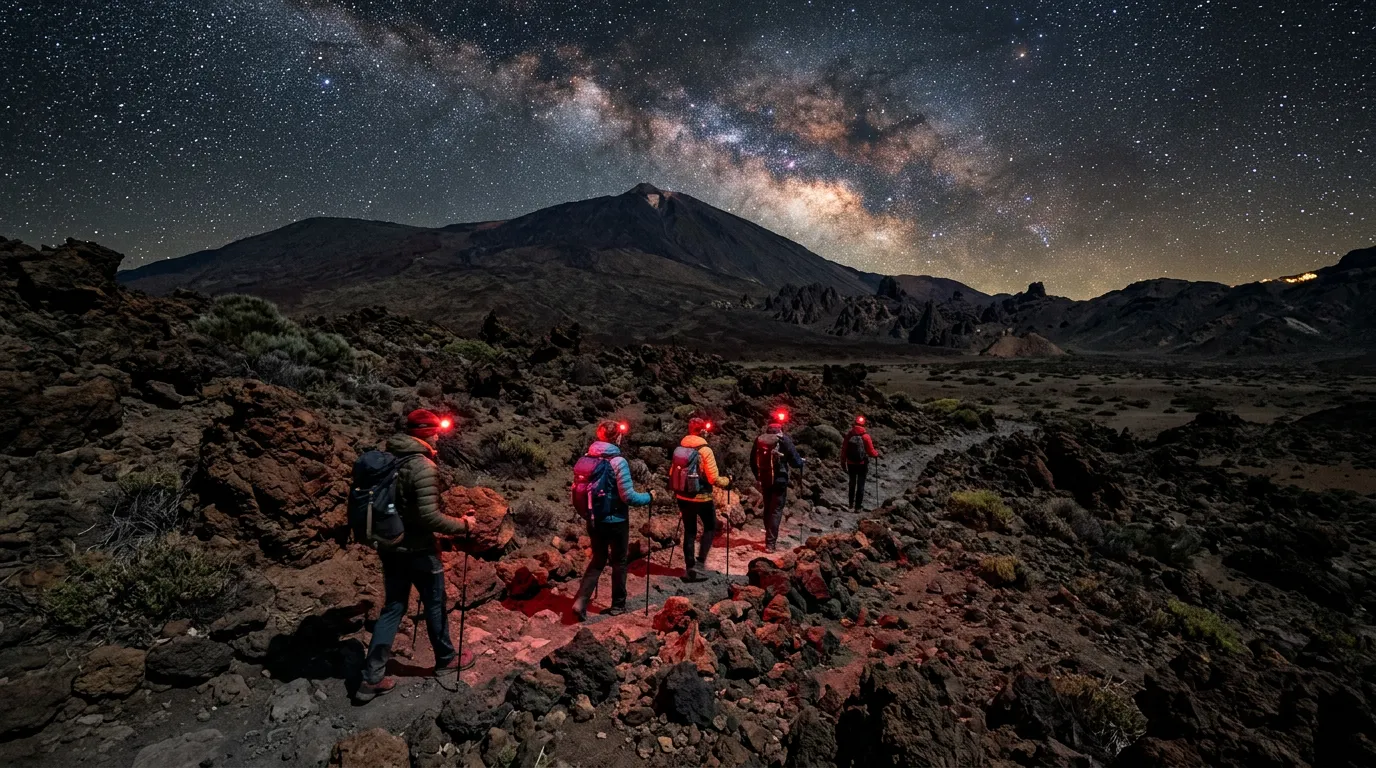
Mount Teide rises to 3,715 metres, the highest peak in Spain and the third-tallest volcano on Earth measured from its ocean floor. At night, from the Las Cañadas caldera, the sky overhead rates Bortle 2 on the standard dark-sky scale. The trade-wind inversion layer traps Atlantic cloud below 1,600 metres, so from the caldera floor at 2,000 metres upward you are standing in a dry, stable air column most nights of the year. 83 of the 88 modern constellations are visible from this latitude. The galactic core of the Milky Way arches overhead from March through October. This is not a hotel rooftop with a small refractor on Jupiter. The official park concessionaire, Volcano Teide, runs the only stargazing programme permitted inside park boundaries after sunset. Three tiers exist: a full Sunset & Stars experience with cable-car ascent (€182), a mid-range Night Tour (€77), and a compact one-hour Astronomical Observation at the base station (€42). All use Starlight-certified guides, the UNESCO-affiliated quality label for astrotourism, and long-range telescopes.
What the tour includes
The flagship Sunset & Stars experience packs the most value into a single evening. A coach picks you up from your hotel in the south Tenerife resort zone (Costa Adeje, Playa de las Américas, Los Cristianos) mid-afternoon. The drive climbs through pine forest into the Las Cañadas caldera, past the Roques de García and the Parador, to the cable-car lower station at 2,356 metres.
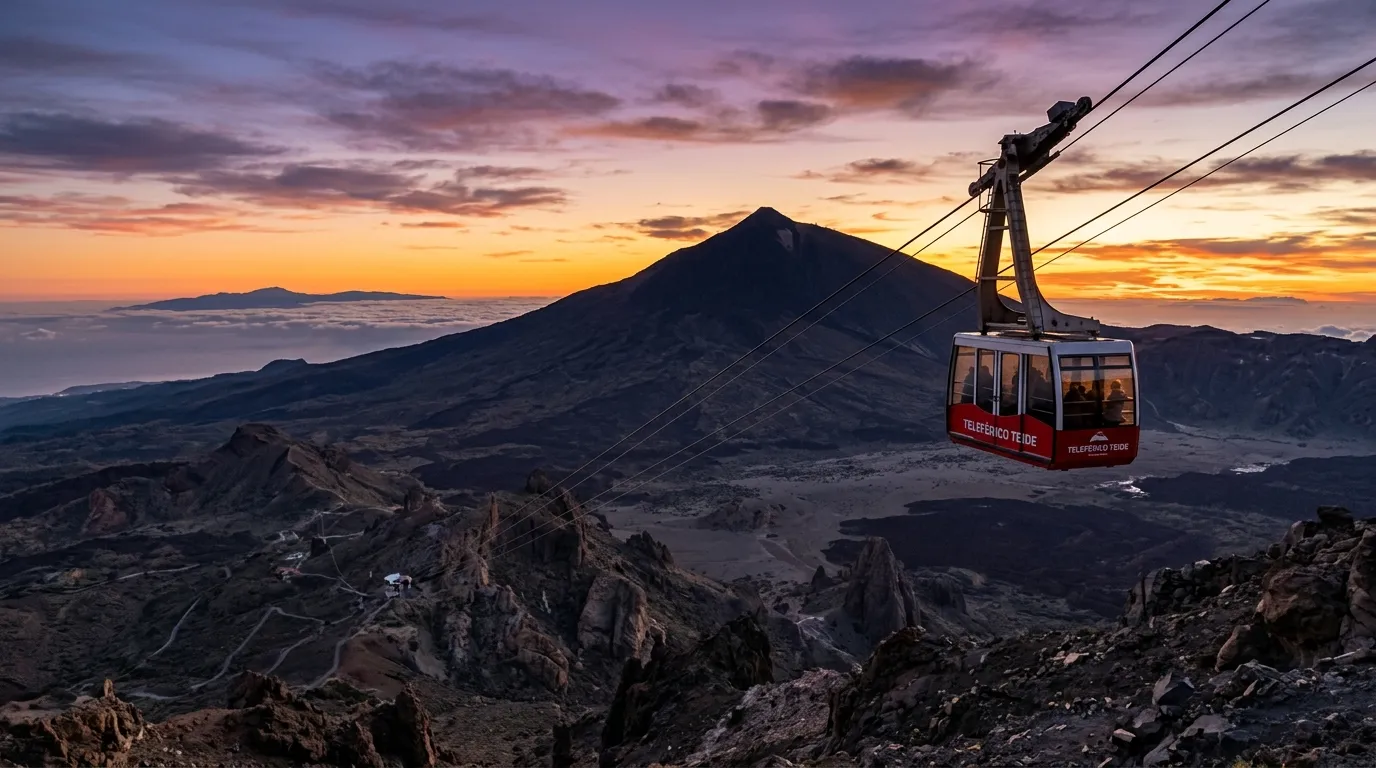
The cable car runs a dedicated sunset service: 90 seats maximum. That is the bottleneck that sells this tour out weeks ahead. The cabin lifts you to La Rambleta at 3,555 metres in eight minutes. From there, a short guided walk leads to the Pico Viejo viewpoint at roughly 3,100 metres. You watch the sun drop into the Atlantic from above the cloud inversion, the sky shifting through orange and violet as the shadow of Teide's cone stretches east across the caldera floor.
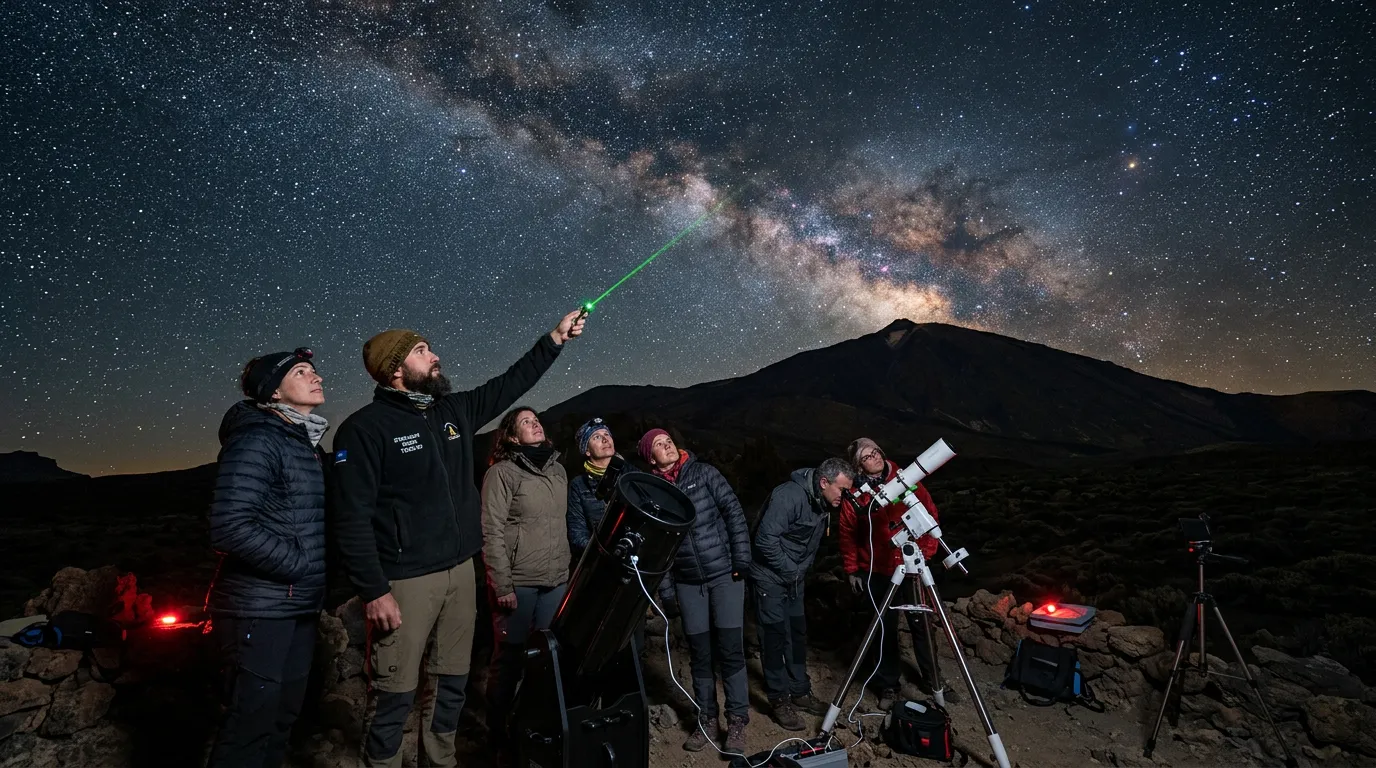
After sunset, the group descends to the stargazing station inside the caldera. Guides set up long-range telescopes, typically 200–300 mm aperture reflectors, and begin with a naked-eye orientation. They trace the constellations with a laser pointer: the North Star sits very low at 28°N latitude, the Big Dipper skims the northern horizon, and deep-sky objects invisible from most of Europe sit directly overhead. The telescope session runs 45–60 minutes for the flagship tier, targeting objects the guide selects for the night's conditions. The coach returns you to your hotel; the full experience runs roughly eight hours door-to-door.
The stargazing experience
Teide National Park holds Starlight Reserve status, and the numbers behind that certification matter. The sky measures Bortle 2; light pollution is functionally absent inside the caldera once day traffic leaves. The nearest town light dome, Vilaflor, sits 14 km south and its glow stays below the caldera rim. The limiting magnitude on a clear moonless night reaches 6.5–7.0: your naked eye can detect objects roughly 250 times fainter than under a city sky.
Through the telescopes, the guide rotates targets based on what is visible that night. In summer (June–August), the galactic core transits nearly overhead and you see the Sagittarius star cloud, the Lagoon Nebula, the Swan Nebula, and the dark dust lanes that split the Milky Way into fork shapes. Saturn's rings are a regular target when the planet is above the horizon. The Andromeda Galaxy hangs overhead in autumn and winter, visible to the naked eye as a faint smudge and resolved through the scope into its spiral structure. Globular clusters like M13 in Hercules appear as dense balls of several hundred thousand stars.
The guide does not just aim a telescope. A Starlight-certified guide translates what you are looking at: why this globular cluster is older than the Milky Way itself, how the light from Andromeda left its source 2.5 million years ago, what the Guanches, the pre-colonial Canary Islanders, read in these same stars. That translation layer is what distinguishes a guided session from putting your eye to a telescope alone. After the session the coach returns you to your hotel. The experience runs roughly eight hours door-to-door for the flagship tier.
Three tour tiers compared
Sunset & Stars, €182, 8 hours
The full package: hotel pickup, cable car at sunset, walk to Pico Viejo viewpoint, stargazing with long-range telescopes, and return transport. The only tier with the cable car. 90 seats sell out 2–3 weeks ahead in peak months (June–August and Christmas–New Year). If this is your one Teide stargazing night and you want the full arc, sunset above the clouds, the stars, and the cable car, this is the tier. Book it before you book your flights.
Night Tour, €77, 6.5 hours
Hotel pickup, transport to a stargazing station inside the caldera at roughly 2,100 metres, and a guided telescope session. You get the same Bortle 2 sky and Starlight-certified guide. What you skip: the cable car, the 3,500-metre altitude, and the extra time. If you have already ridden the cable car during the day, or if the sunset at altitude does not matter to you, this tier gives you the stargazing value at less than half the price. It also works as a backup when the cable-car tier is sold out.
Astronomical Observation, €42, 1 hour
A compact session at the cable-car lower station (2,356 m). No transport, no cable car. You drive yourself to the car park at km 43 on the TF-21 and join a group of 15–25 people for one hour of guided telescope observation. Useful if you are staying at the Parador de Las Cañadas nearby, have your own transport, and want a focused session without the logistics. The trade-off is real: two hours of driving each way from the south coast resorts makes this a long round trip for a one-hour experience. The price is right if you are already on the mountain.
Practical details
What to bring: Temperatures at 2,000–3,500 metres drop fast after dark, even in August. The caldera sits at alpine altitude; expect 5–10°C after sunset in summer and near freezing in winter. Pack a down or insulated jacket, a hat that covers your ears, gloves, and warm socks. Standing still for an hour at 2,100 metres in a light fleece is how people remember the cold more than the stars.
A red headlamp, red-only mode rather than a dimmed white beam, preserves your dark adaptation and keeps you from wrecking everyone's night vision when you move around the observing area. The guides sell basic ones, but sourcing your own before the trip is cheaper and more reliable.
Weather cancellations: The cable car closes when wind speed exceeds 55 km/h at the upper station. The operator cancels and refunds the Sunset & Stars tier automatically in that case. A calima, Saharan dust haze lifted by easterly winds, washes the sky to a pale grey. These events hit most often in February and March and can last 3–5 days. The operator cancels stargazing when a calima is active. Cloud is not a problem from the caldera: the inversion layer traps it below 1,600 metres on most nights. You stand above the cloud sea.
Tour timing through the year: The best months for Teide stargazing are June and July, when the galactic core transits overhead, skies are clearest, and nights are long. March–May and August–October are solid, with the Milky Way visible but lower. November–February means shorter nights and occasional summit snow; skies can be sharp after cold fronts pass, but the galactic core stays low in the evening.
Moon phase: All tiers cancel for roughly 3–5 days around the full moon. The Milky Way's core is invisible, and the sky is too bright for deep-sky observing. Check the lunar calendar before you book: arriving on a full moon and discovering every tour is dark is the most avoidable mistake on Teide.
Why Starlight-certified guides matter
Starlight certification is not a marketing sticker. It is a quality standard administered by the Starlight Foundation, created with the backing of UNESCO, UNWTO, and the Institute of Astrophysics of the Canary Islands (IAC). A Starlight-certified guide has passed training covering:
- Astronomical knowledge: constellation identification, celestial mechanics, deep-sky object cataloguing, seasonal sky changes
- Telescope operation: alignment, target acquisition, maintenance at altitude
- Interpretation: translating astronomical facts for a lay audience, connecting the night sky to local culture and history
- Environmental responsibility: light-pollution management, dark-sky preservation protocols
A Starlight guide can tell you why the Andromeda Galaxy appears as a faint smudge, what a globular cluster is made of, how the Guanches used the Pleiades to mark the agricultural calendar, and why the trade-wind inversion creates the stable air column you are standing under. A generic tour guide with a telescope and a laser pointer may or may not have any of that background. The label is the minimum bar, and it is the single biggest variable in whether you walk away with a night you remember or a cold hour you endured.
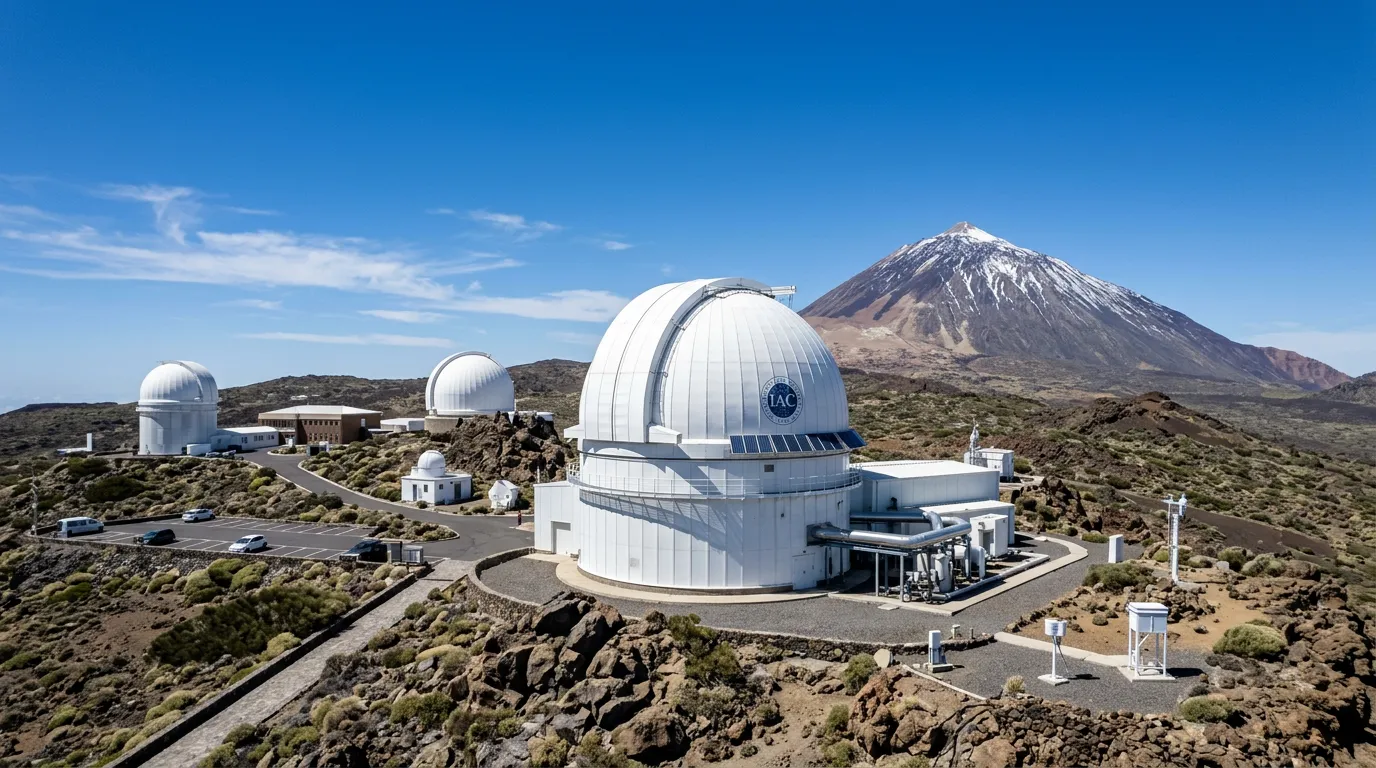
The Canary Islands collectively hold three Starlight Reserves: Tenerife, La Palma, and Fuerteventura, and the IAC's observatories on La Palma (Roque de los Muchachos) and Tenerife (Observatorio del Teide at Izaña) are among the world's most productive astronomical sites. The guide you get on this tour has trained within that ecosystem.