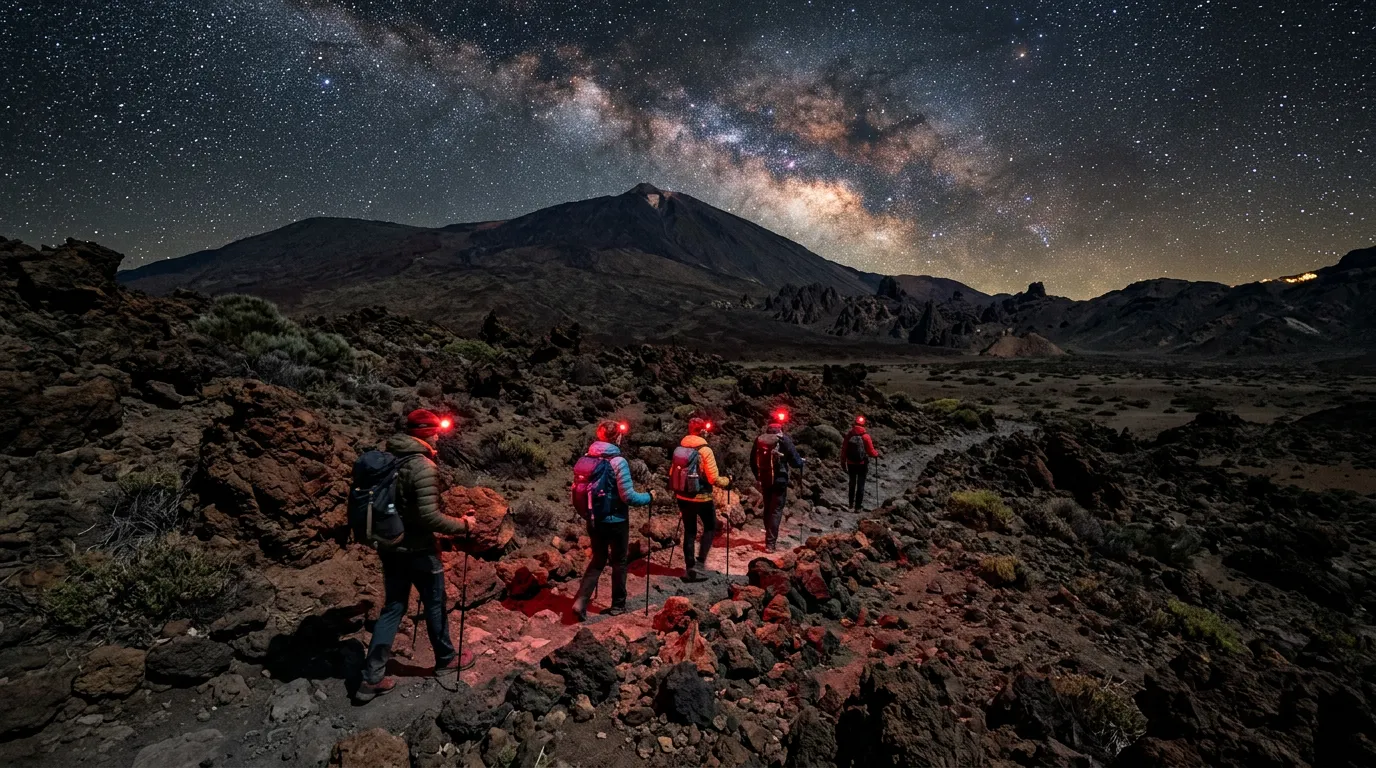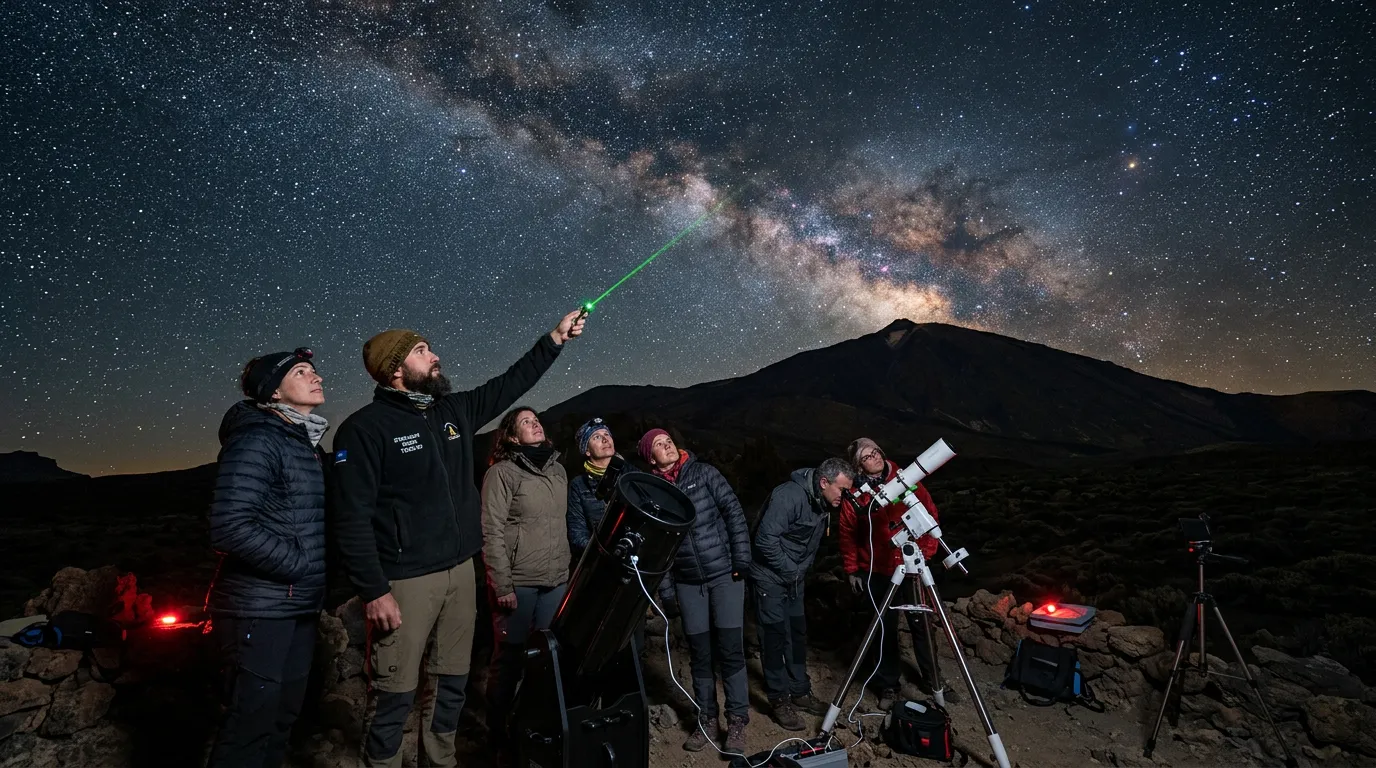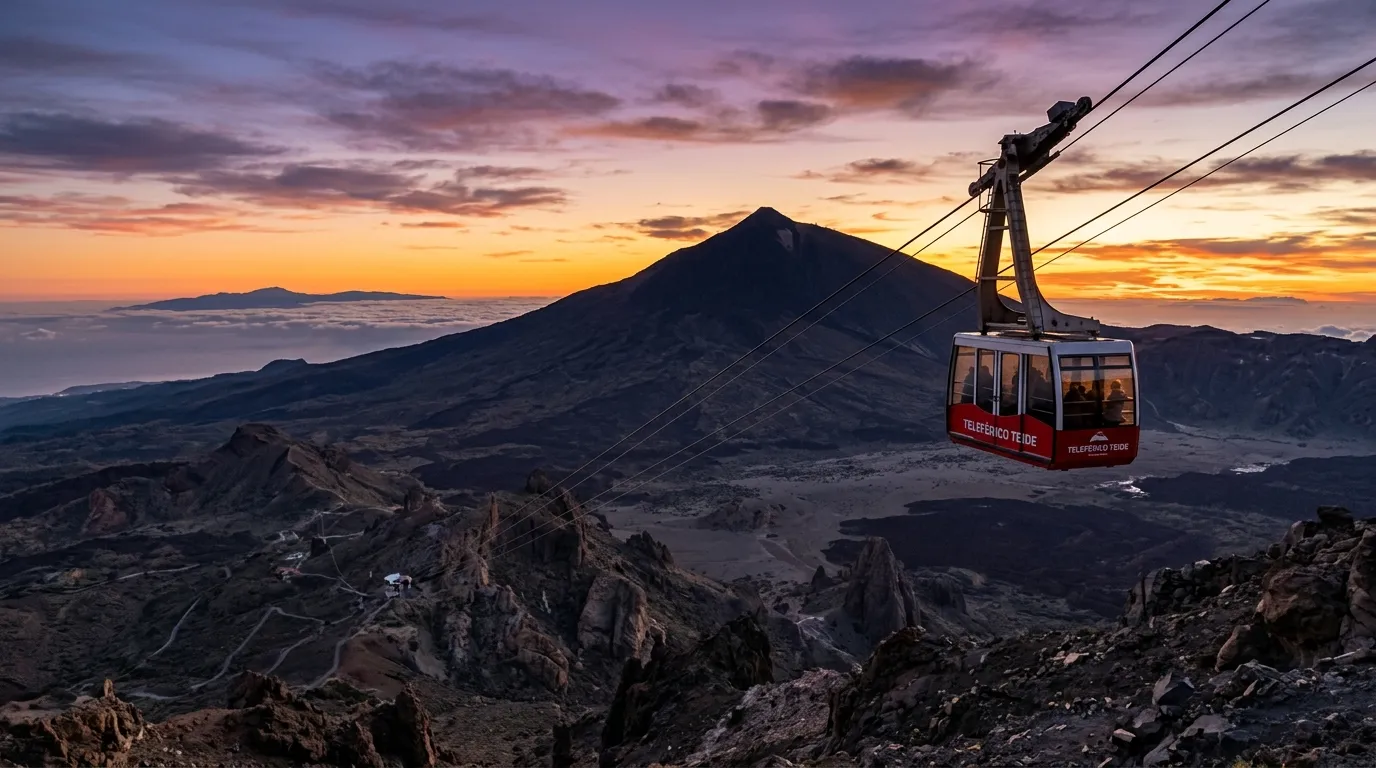
Stargazers at the Pico Viejo viewpoint at twilight, long-range telescopes silhouetted against the sunset sky over the Atlantic cloud inversion, Mount Teide's shadow stretching east across the Las Cañadas caldera
Guided Stargazing

Sunset above the clouds, then telescope stargazing at 3,555 m

8 hours including hotel transport from south Tenerife resorts
Sunset departure, timing shifts with the season (~15:00 winter, ~18:00 summer). Runs year-round, weather permitting. Cancels within a few days of full moon and during high wind (>55 km/h at the upper station) or calima dust events. The cable car sunset service runs after standard daytime operating hours.
Hotel pickup from Costa Adeje, Playa de las Américas, and Los Cristianos. Exact pickup time and location confirmed at booking; the time shifts seasonally with the sunset calendar. Self-drive is not an option for this tier; hotel transport is included and mandatory.
All activities

The Teide Cable Car Sunset & Stargazing Tour is the only experience on Tenerife that combines sunset from 3,555 metres with telescope stargazing on the same evening, operating inside Teide National Park, a UNESCO Starlight Reserve rated Bortle 2 on the dark-sky scale. Two things that normally require separate bookings, the cable car and a stargazing session, run back-to-back on a single ticket. The catch: 90 seats per evening. During June through August they sell out two to three weeks ahead of the departure date. If watching the sun sink into the Atlantic from above the trade-wind inversion while a Starlight-certified guide sets up long-range telescopes beside you sounds like your kind of evening, this is the tour. The booking window is already shrinking.

Afternoon to midnight: how the evening plays out

Hotel pickup from Costa Adeje, Playa de las Américas, or Los Cristianos happens mid-afternoon. The exact time shifts with the sunset calendar: roughly 15:00 in winter and 18:00 in summer. The coach climbs through the Corona Forestal pine belt into the Las Cañadas caldera, past the Roques de García formation and the Parador de las Cañadas at 2,150 metres. You reach the cable-car lower station at 2,356 metres roughly 90 minutes after pickup.

The cable car runs a dedicated sunset service outside standard daytime hours. The gondola lifts you to La Rambleta at 3,555 metres in eight minutes. No hiking to get there, no altitude grind: step out of the cabin and the air is thinner, colder, and noticeably drier. From the upper station, the guide leads a short walk, roughly 20 minutes on well-maintained volcanic trail, to the Pico Viejo viewpoint at approximately 3,100 metres. This west-facing perch looks over the caldera rim toward La Gomera and La Palma. The sun sets into the Atlantic from above the cloud inversion, an orange band widening across a white sea of trapped stratocumulus.

The temperature drops fast. At 3,100 metres after dark, expect 5–10°C in summer and near freezing in winter. The down jacket, hat and gloves you brought stop being optional around the time civil twilight fades. That twilight window, roughly 45 minutes after sunset, is when the sky transitions from pale blue through deep indigo to black. The guide begins the stargazing session as the first bright stars, Vega, Arcturus, Sirius depending on season, punch through. Long-range telescopes come out on sturdy equatorial mounts. The session runs 60–90 minutes: Orion in winter, the Milky Way's galactic core overhead in summer, Jupiter and Saturn when in opposition. The guide, Starlight-certified, can explain how M13 in Hercules is 12 billion years old, why the trade-wind inversion makes Teide's seeing so stable, and how to read the Bortle scale like a weather forecast.

The coach descends around 22:30–23:00, returning you to your hotel close to midnight.

What you need to know before you click book

Capacity is the bottleneck. The cable car runs one sunset departure per evening with 90 seats, and those seats do not scale. In June, July, and August, every seat sells out two to three weeks ahead of the departure date. During Christmas–New Year the same pattern holds. If Teide stargazing is a main reason you are flying to Tenerife, book the tour before you finalise flights. The fallback, the standard Teide Stargazing Night Tour at €77, uses the same Starlight-certified guides and telescopes, but observes from the caldera floor at 2,000 m, not from Pico Viejo at 3,100 m, and includes no cable car and no sunset at altitude. It is a fine Plan B. It is not the same experience.

Clothing is not a suggestion. At 3,100 metres after sunset, even in August, you are standing still for over an hour in single-digit temperatures. Bring a down or insulated jacket, a hat covering your ears, gloves, and warm socks. A red headlamp with a red-only mode preserves your night vision and everyone else's. The operator sells basic red torches but they are cheaper online before you travel.

Altitude is real. The cable car takes you from 2,356 m to 3,555 m in eight minutes, a rapid ascent that can trigger mild symptoms: light-headedness, shortness of breath, headache. Most people manage the Pico Viejo walk without issue, but anyone with respiratory or cardiac conditions should check with the operator. If you have never been above 3,000 metres before, spend the day prior at altitude, the Izaña viewpoint road above 2,300 m or the Parador restaurant at 2,150 m, to acclimatise.

Weather cancellations happen. The cable car closes when wind exceeds 55 km/h at the upper station. Calima, the Saharan dust haze most common in February and March, can scrub visibility for days. The operator refunds or rebooks automatically. Cloud is rarely the problem: the trade-wind inversion traps Atlantic clouds below 1,600 metres on most nights, so you observe above a cloud sea. All tours cancel within a few days of full moon. Check the lunar calendar before you book.

How this tour compares to standard Teide stargazing

The standard Teide stargazing programme runs three tiers, and this cable car sunset experience is the premium tier, branded as Sunset & Stars at €182. Here is what separates it from the other two:

  • €42 Observation tier: one hour at the base station at 2,356 m. No cable car, no sunset, no walk. Good for a quick telescope fix if you are self-driving and already staying at altitude.
  • €77 Night Tour: 6.5 hours, hotel pickup, Starlight guide, telescopes, but observes from the caldera floor at roughly 2,000 m after dark. No cable car, no sunset. Same dark Bortle 2 sky, lower altitude, half the price.
  • €182 Sunset & Stars (this tour): the only tier with cable car access, sunset at 3,100 m, and the Pico Viejo viewpoint. The summit air at 3,555 m sits above 99% of the atmosphere. The transparency gain over the caldera floor is real, especially for deep-sky objects and planetary detail. Whether that gain is worth double the Night Tour price depends on whether you want the sunset and the altitude premium, or just the dark sky.

If you have already done the cable car during the day, or Teide is one evening in a longer Tenerife stargazing trip, the Night Tour at €77 is the value pick. If this is your one shot at Teide, the evening you built the trip around, the cable car sunset experience is the one to book. The 90-seat cap means you book it early.
Highlights

  • Cable car ascent from 2,356 m to 3,555 m in eight minutes, the highest sunset viewpoint in Spain accessible by lift
  • Sunset from Pico Viejo viewpoint at 3,100 m, above the trade-wind cloud inversion with Atlantic views to La Gomera and La Palma
  • Telescope stargazing session with Starlight-certified guides under certified Bortle 2 skies inside Teide National Park
  • Only 90 seats per sunset departure, an exclusive high-altitude experience with no crowd
  • Hotel pickup and return from south Tenerife resorts: Costa Adeje, Playa de las Américas, Los Cristianos
  • Milky Way galactic core overhead June through October; Orion and winter constellations dominate November to March

Included

  • Hotel pickup and drop-off from south Tenerife resorts (Costa Adeje, Playa de las Américas, Los Cristianos)
  • Cable car ascent at sunset to La Rambleta at 3,555 m
  • Starlight-certified astronomy guide for the full evening
  • Guided walk to the Pico Viejo viewpoint at approximately 3,100 m
  • Long-range telescope observation session (60–90 minutes)
  • Constellation orientation with laser pointer and naked-eye guide

Not included

  • Food and drinks: pack water and a snack; no meal stop is included in the 8-hour itinerary
  • Warm clothing: bring your own insulated jacket, hat, gloves, and warm socks regardless of coastal temperature
  • Photography equipment or astrophotography instruction (available as a separate add-on from the operator; confirm at booking)
  • Gratuities

Practical information

Languages

English, Spanish, German (confirm at booking)

Group size

Max 90 per sunset departure (cable-car capacity)

Good to know before booking

  • Warm clothing is mandatory: at 3,100 m after dark, temperatures drop to 5–10°C in summer and near freezing in winter. Bring a down or insulated jacket, a hat covering your ears, gloves, and warm socks even in August
  • Book 2–3 weeks ahead in June, July, and August: only 90 seats per sunset departure, and they sell out consistently in peak months
  • Tours cancel in high wind (cable car closes above 55 km/h at the upper station) or during calima dust storms. The operator refunds or rebooks automatically
  • The walk to Pico Viejo involves roughly 20 minutes on volcanic trail at 3,100 m altitude. No minimum fitness is required, but anyone with respiratory or cardiac conditions should consult the operator before booking
  • All tours cancel within a few days of full moon; check the lunar calendar before booking flights or accommodation

Prices & Booking

From €182 approx.

From €182 per person

Sunset departure, timing shifts with the season (~15:00 winter, ~18:00 summer). Runs year-round, weather permitting. Cancels within a few days of full moon and during high wind (>55 km/h at the upper station) or calima dust events. The cable car sunset service runs after standard daytime operating hours.

An editorial guide to this experience. Book directly with the operator when you plan your trip.

Tags

stargazing astronomy dark sky teide tenerife canary islands starlight telescope milky way cable car sunset guided tour

Frequently asked questions

What is the difference between this cable car sunset tour and the standard Teide stargazing tour?

The standard Teide stargazing programme runs three tiers: a €42 Observation at the base station, a €77 Night Tour with hotel pickup but no cable car, and the €182 Sunset & Stars tier which is this tour. Only the Sunset & Stars tier includes the cable car ascent to 3,555 m and the sunset viewpoint at Pico Viejo (3,100 m). The €77 Night Tour gives you the same Bortle 2 sky and Starlight-certified guides from the caldera floor, but without the altitude premium or the sunset. If you want sunset above the trade-wind inversion followed by telescope stargazing, this is the only option.

How far ahead do I need to book the Teide cable car sunset tour?

At least 2–3 weeks ahead during June through August and Christmas–New Year. The 90-seat cable car capacity does not scale, and every seat sells out in peak months. If Teide stargazing is one of the main reasons you are flying to Tenerife, book the tour before you finalise flights. The Night Tour (€77) has more flexible availability but still fills during new-moon windows in summer.

Will I get altitude sickness at 3,555 metres on the cable car sunset tour?

The cable car ascends from 2,356 m to 3,555 m in eight minutes, which is a rapid gain. Some people experience mild symptoms: light-headedness, shortness of breath, or a slight headache. The guided walk to Pico Viejo is at roughly 3,100 m, and most people manage it without issue. If you have respiratory or cardiac conditions, or have never been above 3,000 m before, check with the operator. Spending the day before at altitude, the Parador restaurant at 2,150 m or the Izaña viewpoint road above 2,300 m, helps with acclimatisation.

What should I wear for the Teide cable car sunset stargazing tour?

More than you think. Even in August, at 3,100 m after dark, temperatures drop to 5–10°C. In winter expect near-freezing conditions. Bring a down or insulated jacket, a hat covering your ears, gloves, and warm socks. A red headlamp with a red-only mode preserves your night vision and prevents you from wrecking everyone else's dark adaptation with a phone torch. Standing still for an hour at altitude in a light fleece is how people remember the cold more than the stars.

What happens if the weather cancels the cable car sunset tour?

The operator cancels and refunds or rebooks if the cable car closes due to wind above 55 km/h at the upper station, or during a calima dust event. Calima, Saharan dust haze, is most common in February and March and can last 3–5 days. Cloud is rarely the issue: the trade-wind inversion traps Atlantic clouds below 1,600 m on most nights, so you observe above a cloud sea. Tours also cancel within a few days of full moon.

Is the sunset portion worthwhile even if clouds partially obscure it?

On most evenings, yes. The trade-wind inversion traps cloud below roughly 1,600 m, while the Pico Viejo viewpoint sits at 3,100 m. You are above the cloud ceiling the vast majority of nights. Even when high cirrus softens the sunset, the experience of watching dusk from above the inversion layer, with the Atlantic stretching west and Teide's shadow darkening the caldera behind you, carries its own weight. Partial cloud at 3,000+ m is qualitatively different from coastal overcast.

Can I bring my own camera or telescope on the cable car sunset tour?

You can bring a camera, and a DSLR or mirrorless body with a wide-aperture lens will produce good Milky Way shots from the viewpoint during the stargazing session. The operator does not provide tripods or astrophotography coaching on the standard Sunset & Stars tour; that is a separate add-on you need to request at booking. Bringing your own telescope is impractical; the group shares the guide's long-range instruments, and there is no space or time for personal setup at the Pico Viejo viewpoint.

Further reading

Sources