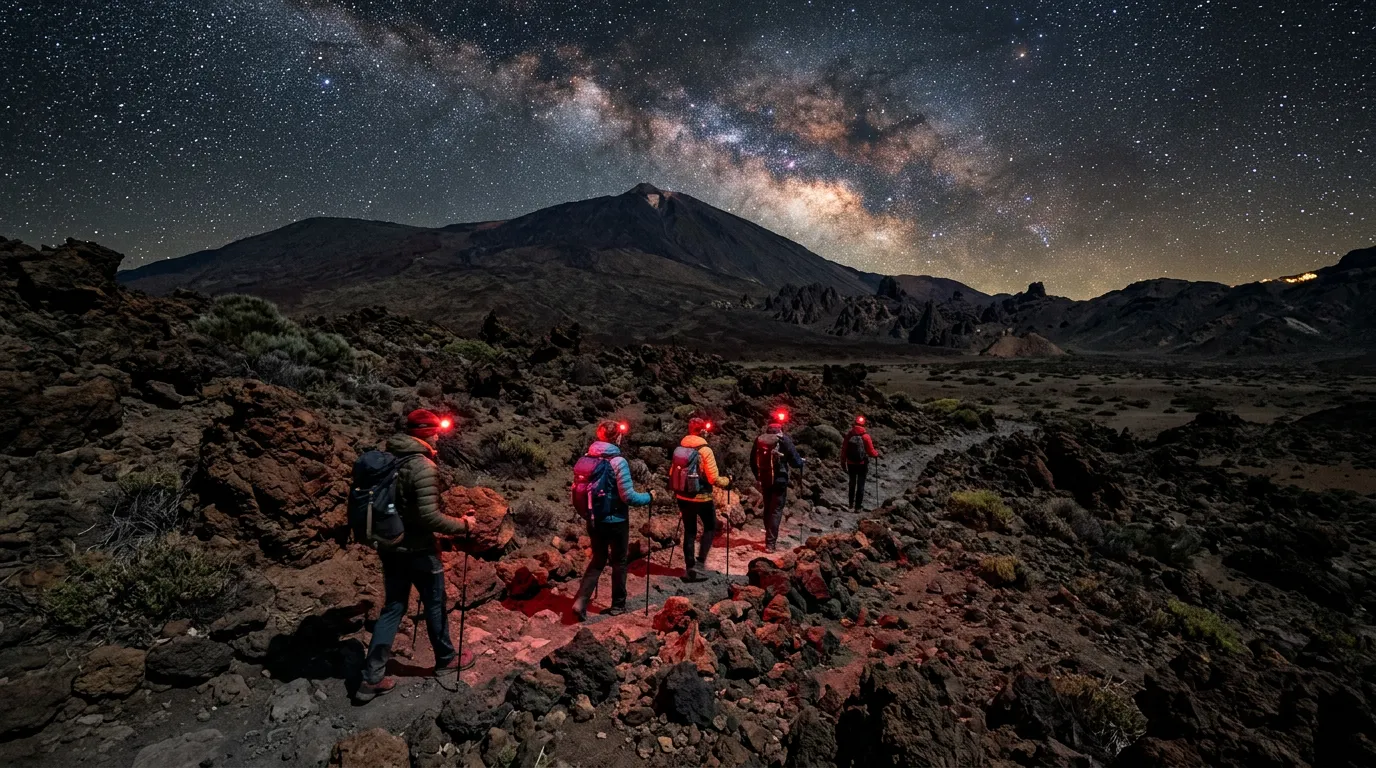
Hikers with red headlamps crossing the Las Cañadas caldera volcanic landscape at twilight, Mount Teide silhouetted dark against a deepening blue sky with first stars appearing
Guided Stargazing

Walk across an ancient volcanic caldera after dark, then look up

3–4 hours including hotel pickup, hike, and telescope session
Evening departures year-round, timed to sunset. Tours cancel for roughly 3–5 days around full moon. Best from May through October when the Milky Way galactic core transits overhead. Exact pickup time and meeting point confirmed at booking.
Hotel pickup from south Tenerife resorts (Costa Adeje, Playa de las Américas, Los Cristianos) for operators that include transport. Self-drivers meet at Mirador de las Narices del Teide or a designated caldera viewpoint along the TF-21 road. Exact meeting point and time confirmed at booking.
All activities

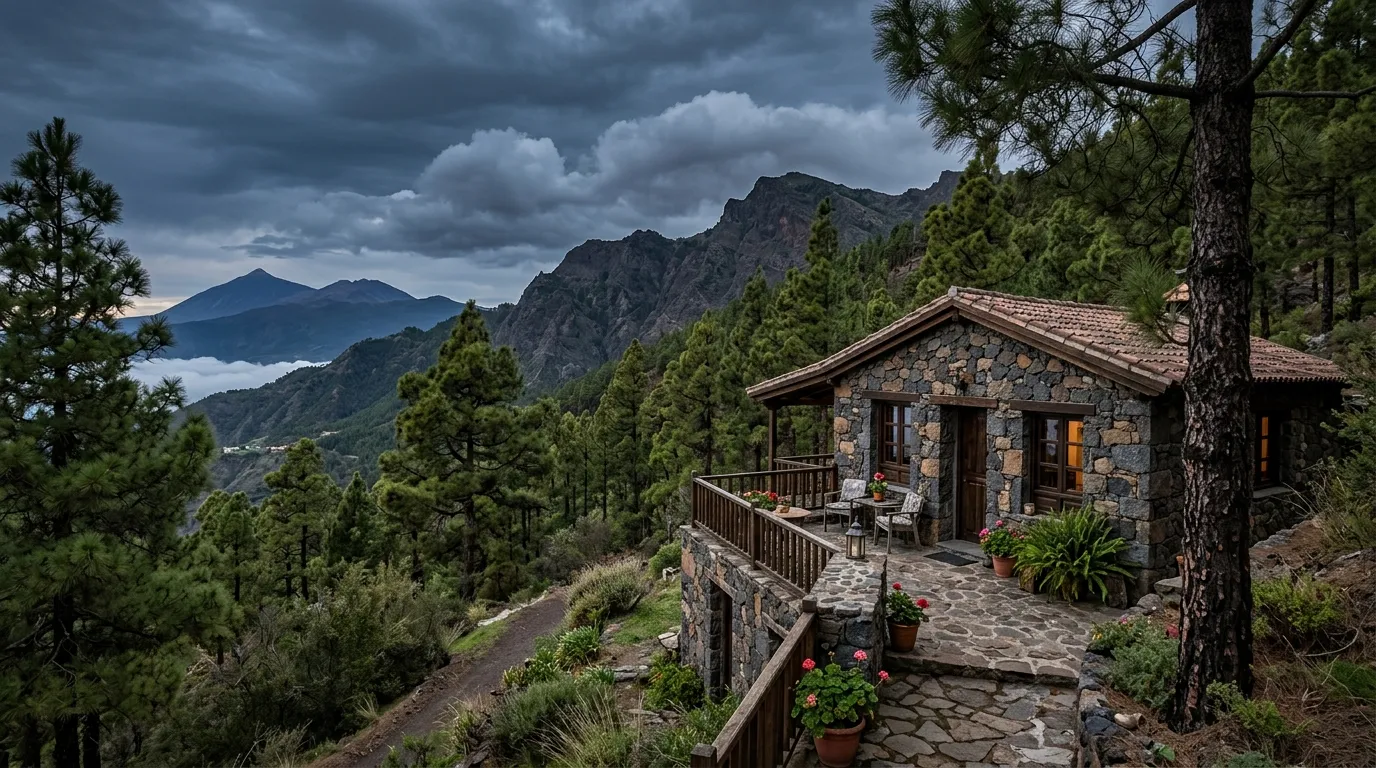
Las Cañadas del Teide is a 16-kilometre-wide volcanic caldera sitting at 2,000 metres on Tenerife. During the day, tour buses roll through it. After sunset, the road clears and the sky overhead rates Bortle 2 on the dark-sky scale, with effectively zero artificial light. A guided night hike across this terrain combines two things most stargazing tours keep separate: the physical experience of walking on an ancient volcanic floor after dark, and a proper telescope session under one of the clearest skies in Europe. You are not standing in a car park looking up. You are crossing lava flows and pumice plains, the silhouette of Mount Teide on one side and a 360° horizon on every other.

Walking the caldera after dark

The route starts around sunset at one of the caldera viewpoints, usually the Mirador de las Narices del Teide or the flats near the Roques de García. A guide leads a small group across volcanic terrain for roughly 4–6 kilometres over 90 minutes to two hours. The surface underfoot alternates between compacted pumice gravel, solidified aa lava (the rough, rubbly kind), and stretches of flat pahoehoe lava that cooled into smooth, rope-like folds. This is not a paved trail; sturdy hiking shoes with ankle support are essential, not trainers.

The altitude is the other factor. At 2,000–2,200 metres, you are breathing about 22% less oxygen than at sea level. Most people notice it on the first uphill stretch: your heart rate climbs faster than usual, your steps feel heavier. The guides pace the walk deliberately. This is not a fitness test, but if you struggle walking four flat kilometres at sea level, you will struggle here. The reward is the landscape itself. At dusk the caldera walls turn rust-red in the last light, the pumice fields glow pale in the twilight, and the temperature drops fast, from daytime warmth to single digits within an hour of sunset.

This route covers some of the same volcanic terrain described in our guide to the best stargazing spots in Tenerife, but you see it in darkness, which is a fundamentally different experience from a daytime drive-through.

The stargazing session

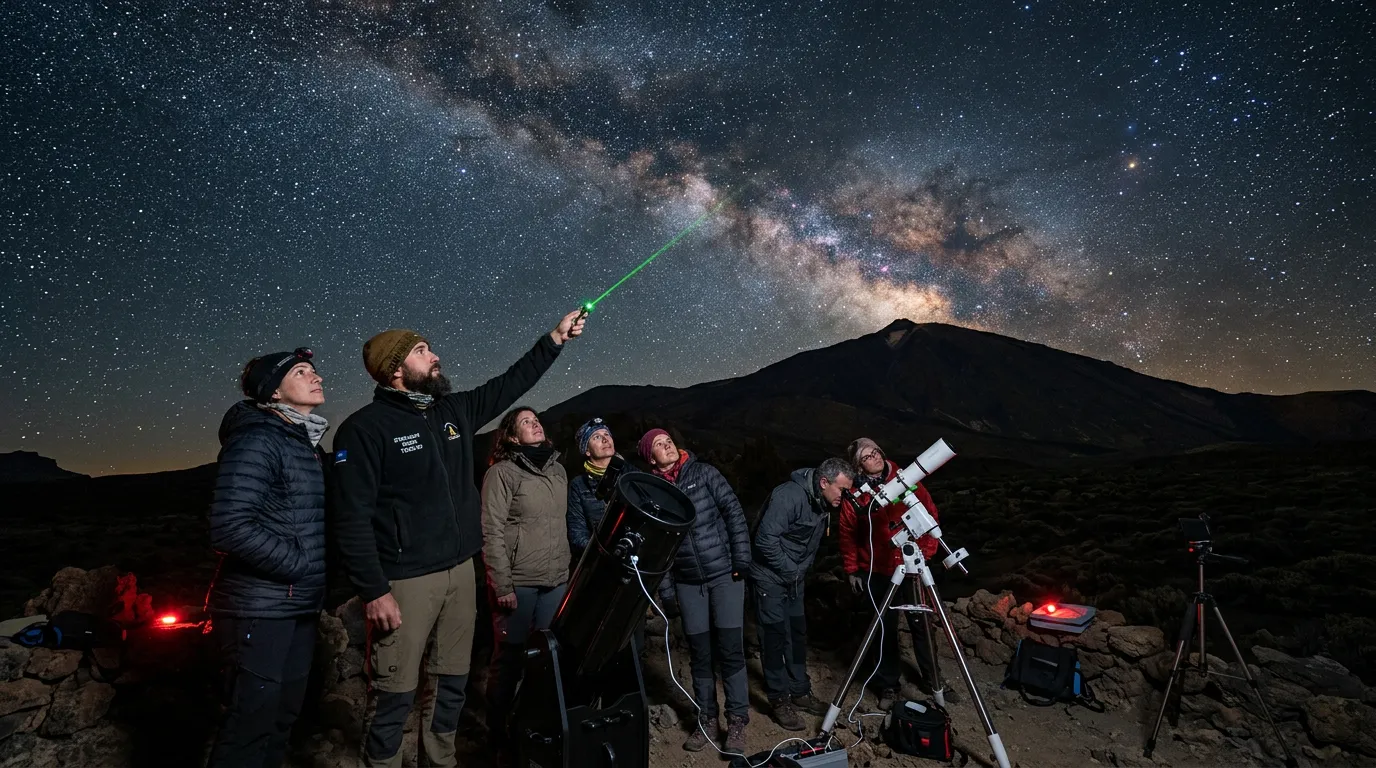
Once the group reaches a designated observation point, typically a flat, open section of the caldera floor with unobstructed sightlines, the guides set up long-range telescopes and begin the astronomy session. The caldera's 360° horizon means no mountain ridge or forest blocks any section of the sky. From 28° northern latitude, 83 of the 88 modern constellations are visible across the year. The Milky Way's galactic core transits nearly overhead from May through October.

A Starlight-certified guide does not just name objects. They explain how the trade-wind inversion, a layer of warm, dry air sitting above the Atlantic cloud bank, is the reason this specific spot delivers such stable atmospheric conditions for stargazing. They describe what a globular cluster like M13 actually is: a swarm of several hundred thousand stars older than the disc of the Milky Way itself. The telescopes are aimed at whatever the night offers, whether that is planets, the Orion Nebula, or the Andromeda Galaxy, while the guide traces constellations with a green laser pointer.

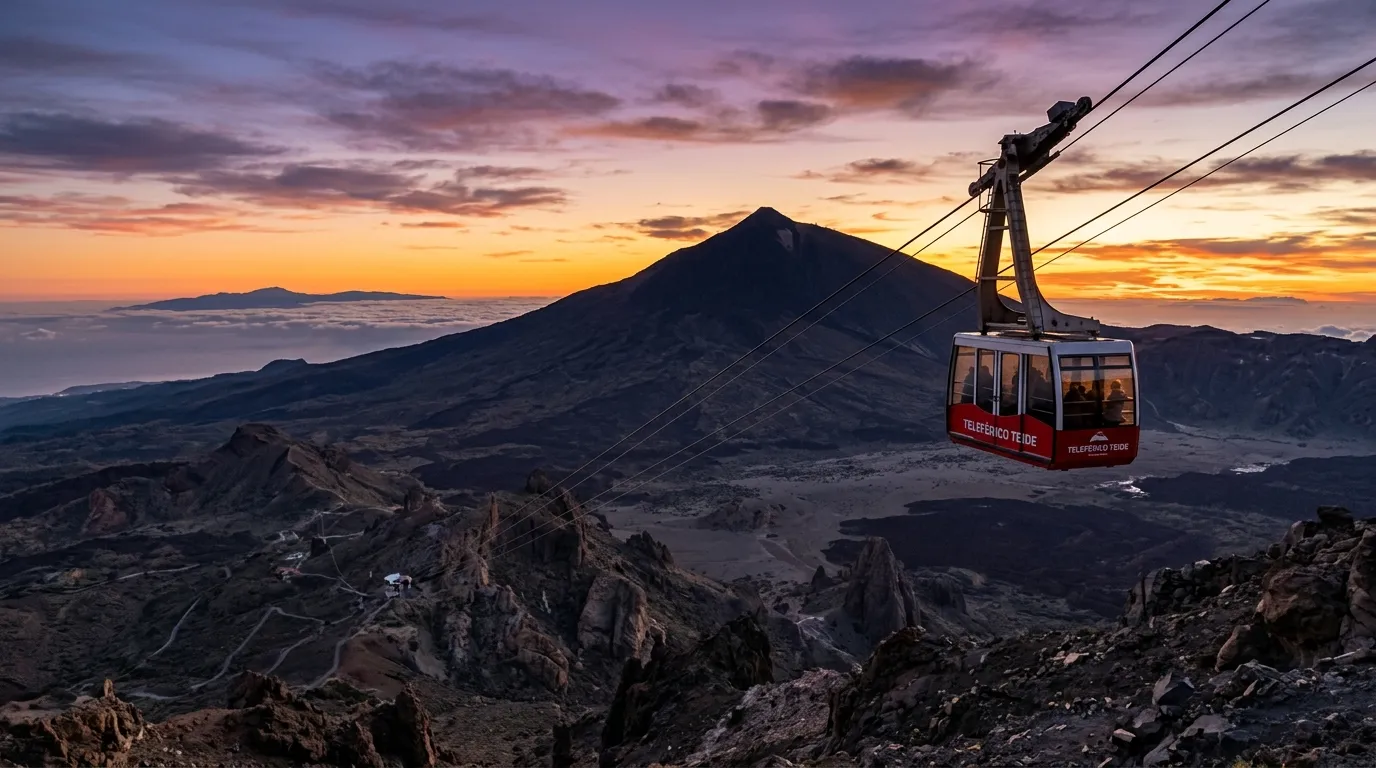
The session lasts roughly 45 minutes to an hour. You stand or sit on the volcanic ground; some operators provide folding stools, others do not. Dress for standing still at altitude in the dark. If hiking is not your thing, the Teide cable-car stargazing tour takes you to 3,555 metres on the cable car for a telescope session with zero walking required.

What to bring

Most mistakes on this tour are clothing mistakes. At 2,000 metres after dark, temperatures drop to 5–10°C in summer and near freezing in winter. Bring a down or insulated jacket, a hat that covers your ears, gloves, and warm socks even in August. Standing still for an hour at altitude in a light fleece is how people remember the cold more than the stars.

A red headlamp with a red-only mode is mandatory; white light from a phone torch destroys night vision for everyone in the group. Your eyes need about 20 minutes of total darkness for full dark adaptation, and the guides will ask you to switch white lights off from arrival. Carry at least one litre of water. Wear sturdy hiking shoes with ankle support: the volcanic rock is abrasive and uneven, and a twisted ankle five kilometres from the road is a serious problem at night.

Some operators offer hotel pickup from south Tenerife resorts; self-drivers meet at the caldera viewpoints along the TF-21 road. Check the lunar calendar before booking, since tours cancel near full moon and the Milky Way is invisible regardless. For a full rundown of what to pack, see our Tenerife stargazing gear guide.

For more on planning your trip, start with our Tenerife stargazing destination hub.
Highlights

  • Guided night walk across lava flows, pumice gravel, and volcanic plains of the Las Cañadas caldera at 2,000 m
  • Telescope observation session under certified Bortle 2 skies with zero artificial light inside Teide National Park
  • Starlight-certified guides using green laser pointers for constellation orientation and deep-sky interpretation
  • 360° unobstructed horizon from the caldera floor, with no mountain ridge or forest blocking any section of sky
  • Milky Way galactic core transiting nearly overhead from May through October
  • Small groups (8–15 participants) for personal guide attention and telescope access

Included

  • Guided night hike across Las Cañadas caldera (4–6 km, roughly 90 min–2 hr walking)
  • Starlight-certified astronomy guide with constellation and deep-sky interpretation
  • Long-range telescope observation session (roughly 45–60 min)
  • Laser-pointer constellation orientation and naked-eye sky tour
  • Hotel pickup and drop-off from south Tenerife resorts (operator-dependent; confirm at booking)

Not included

  • Food and drink: bring at least 1 litre of water and a snack
  • Hiking equipment: bring your own sturdy shoes; hiking poles are optional but recommended and rarely provided
  • Warm clothing: bring your own layers; limited rentals may be available but do not count on them
  • Astrophotography instruction or camera equipment (available as a separate add-on with some operators; ask at booking)

Practical information

Languages

English, Spanish, German (varies by operator, confirm at booking)

Group size

Typically 8–15 participants. Smaller groups mean more telescope time per person; confirm maximum group size with your operator before booking.

Good to know before booking

  • Moderate fitness: 4–6 km walk on uneven volcanic terrain at 2,000–2,200 m altitude. If you struggle walking four flat kilometres at sea level, this tour is not for you
  • Sturdy hiking shoes with ankle support are mandatory: trainers slip on loose pumice gravel and offer no protection on sharp aa lava
  • Warm clothing is not optional: after dark temperatures drop to 5–10°C in summer, near freezing in winter. Bring an insulated jacket, hat covering ears, gloves, and warm socks even in August
  • Red headlamp with red-only mode is required, since white light from a phone torch destroys dark adaptation for the entire group
  • Tours cancel within roughly 3–5 days of full moon: book within ±5 days of new moon for dark-sky conditions
  • Minimum age typically 12 years; check with your operator for younger children on private bookings

Prices & Booking

From €60 approx.

From €60–100 per person depending on group size and operator

Evening departures year-round, timed to sunset. Tours cancel for roughly 3–5 days around full moon. Best from May through October when the Milky Way galactic core transits overhead. Exact pickup time and meeting point confirmed at booking.

An editorial guide to this experience. Book directly with the operator when you plan your trip.

Tags

stargazing night hike hiking teide las canadas tenerife canary islands dark sky volcanic milky way guided tour starlight

Frequently asked questions

How fit do I need to be for the Las Cañadas night hike?

You walk 4–6 km on uneven volcanic terrain at 2,000–2,200 m altitude. The route includes stretches of loose pumice gravel and rough aa lava. Sturdy hiking shoes with ankle support are essential. If you can comfortably walk 6 km on a hilly trail at sea level, you should manage this, but the altitude adds noticeable strain. Anyone with respiratory or cardiac conditions should check with their operator before booking. This is not a sunset stroll; it is a real hike in the dark.

What is the difference between this night hike and the Teide cable car stargazing tour?

The cable car tour takes you to 3,555 m by lift for a telescope session, with zero walking required. Good if you want maximum altitude and minimum effort. This night hike keeps you on the caldera floor at 2,000 m and adds 4–6 km of walking across volcanic terrain before the telescopes come out. You trade altitude and convenience for the physical experience of crossing a lava field in the dark. The sky quality is identical at both altitudes (Bortle 2). Choose the cable car if you want sunset above the clouds; choose the hike if you want to walk on the volcano itself.

When is the best time of year to do the Las Cañadas night hike?

May through October, with June and July as the peak window. The Milky Way galactic core is overhead, the caldera floor is dry, and the trade-wind inversion is most stable. Nights are warm enough at 2,000 m that standing still for the telescope session is manageable in a jacket (5–10°C after dark). Bonus in late May and June: the endemic Teide violet and Teide white broom bloom on the pumice plains. You will not see them in the dark, but you cross them on the walk out at dusk. Avoid the full moon week each month; tours cancel automatically.

What happens if the weather cancels the tour?

The operator cancels and refunds or rebooks in two situations: heavy rain (rare in the caldera), or a calima dust event, Saharan haze that can blanket Tenerife for 3–5 days, most common in February and March. Cloud is rarely a problem because the trade-wind inversion traps it below 1,600 m, well under the caldera floor. High wind is less of a concern than on the cable car tour (no cable car to close), but a guide will not lead a hike in strong wind after dark.

What should I wear on the Las Cañadas night hike?

Sturdy hiking shoes with ankle support, not trainers. Warm socks and layers: a down or insulated jacket, a hat covering ears, and gloves, even in August. At 2,000 m after dark, temperatures drop to 5–10°C in summer and near freezing in winter. Standing still for the telescope session is when most people feel the cold. Bring a red headlamp with a red-only mode: white light destroys dark adaptation for the whole group. Carry at least one litre of water. Hiking poles help on loose pumice but are not required.

Do I need to bring my own telescope or binoculars?

No. The tour provides long-range telescopes and Starlight-certified guides who operate them. Binoculars are a nice personal add-on: a pair of 10×50s lets you scan the Milky Way on your own during the session, but the telescopes are the main event. If you bring binoculars, use the strap around your neck; dropping them on volcanic rock in the dark is a fast way to lose a lens.

How long is the hike and how much elevation gain is there?

The route covers roughly 4–6 km across the caldera floor with minimal elevation change, typically under 150 m of cumulative gain. The caldera floor is relatively flat; the challenge is the uneven volcanic surface and the altitude (2,000–2,200 m), not steep climbing. Total duration is 3–4 hours including the telescope session and transport.

Can children join the Las Cañadas night hike?

Most operators set a minimum age of 12. The combination of uneven terrain after dark, cold temperatures while stationary during the telescope session, and the need for dark-sky discipline (no white lights) makes this tour impractical for younger children. Check with your specific operator; some may accept younger children on a private booking with adjusted pacing.

Do the tours operate during a full moon?

No. All operators cancel for roughly 3–5 days around the full moon. A full moon rising over the caldera wall is bright enough to read a map; it washes out all but the brightest stars and makes the telescopes nearly useless. Target a window within ±5 days of new moon. June and July new-moon dates fill first; book 2–3 weeks ahead in peak summer.

Further reading

Sources