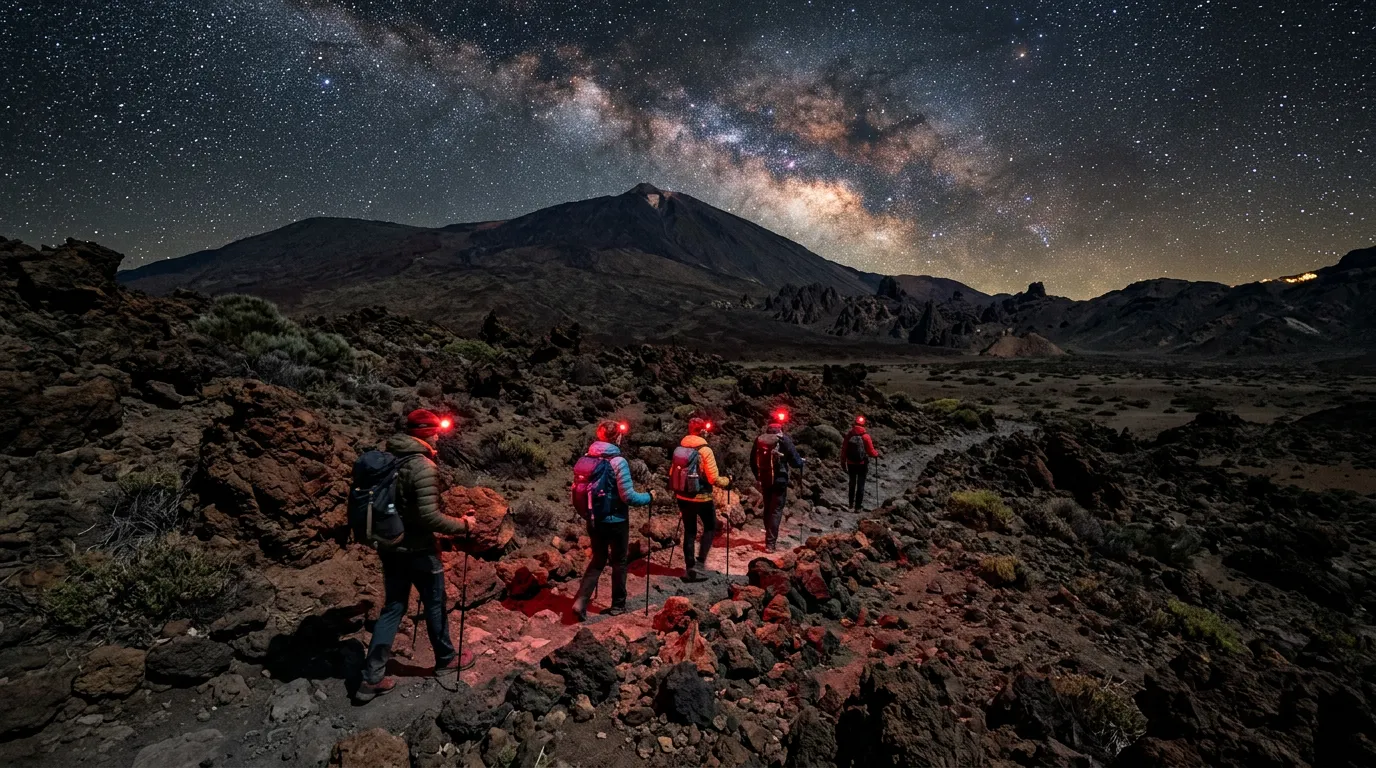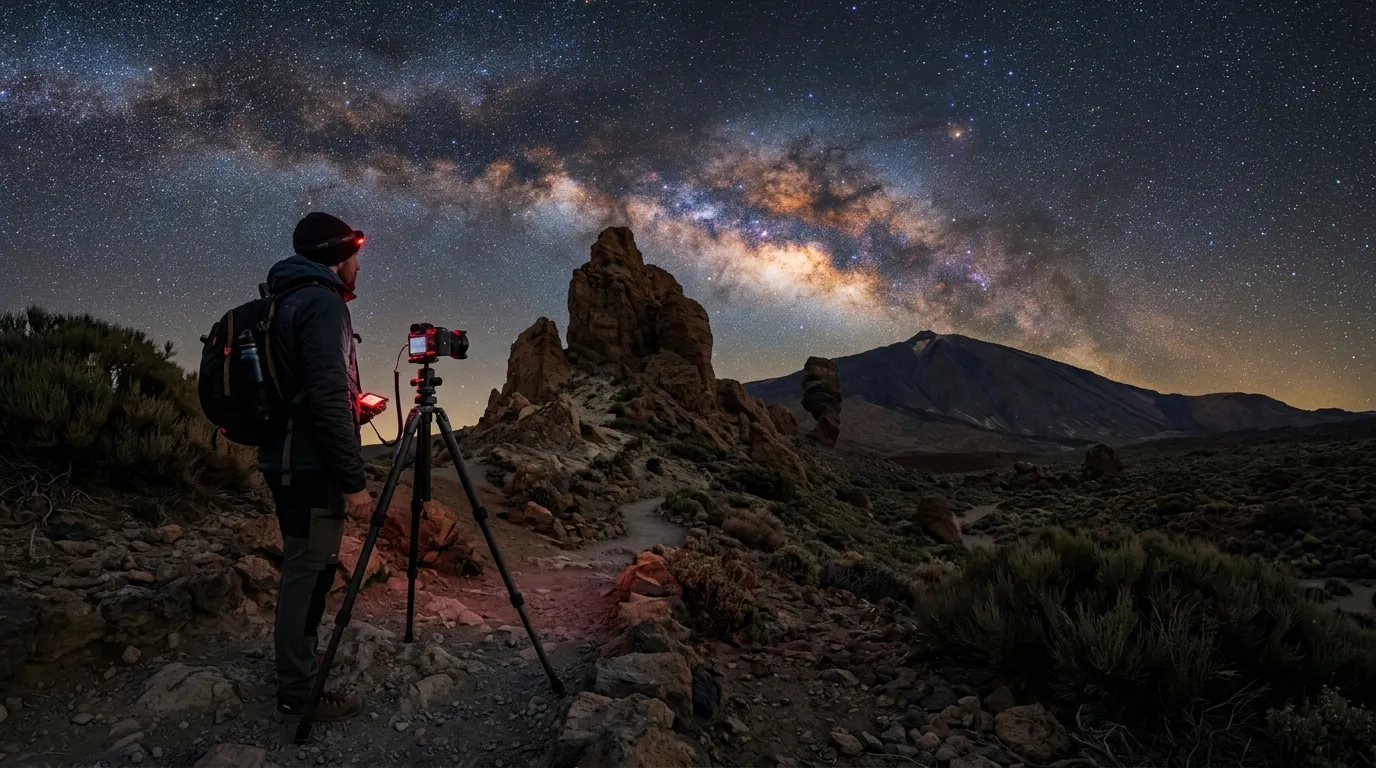
This is not a stargazing tour where you queue at someone else's eyepiece. A Tenerife astrophotography tour puts your camera in front of the Milky Way galactic core with a guide who earns their living shooting night skies, not reciting constellation facts to a coachload of 40. The group is small: 4 to 8 people typically, which means real one-on-one coaching rather than shouted instructions across a crowd. You come away with your own images, camera settings you understand, and enough technique to shoot dark skies on your next trip without a guide.
What you get: camera coaching under Bortle 2 skies
The guide walks you through manual camera settings specific to the conditions on Teide that night. You will set aperture, ISO, shutter speed, and white balance for the Milky Way, not generic values from a YouTube tutorial, but exposure tuned to the actual sky brightness, moon phase, and altitude. You learn how to focus sharply on stars (autofocus does not work in near-total darkness; there is a technique and it takes practice), compose with foreground landmarks to give your wide-field shots scale, and understand histogram reading for night exposures so you stop guessing whether the image is too dark or blown.
The guide does not take the photo for you. They stand beside you, check your LCD, and tell you what to adjust. If you have shot the Milky Way before, the coaching shifts: image stacking to reduce noise, star trail sequences composited from dozens of frames, and time-lapse if your camera supports it. Beginners and intermediates share the same small group; the guide splits attention rather than teaching to a single level.
The locations: Roques de García and Minas de San José
Foreground matters as much as sky in astrophotography, and the Las Cañadas caldera at 2,100 metres offers two distinct setups that most tourists never see after dark.
Roques de García is the iconic one. The eroded rock pillar of Roque Cinchado, the formation on half the postcards of Teide, becomes your foreground silhouette against the Milky Way. The rock formations at this site provide natural leading lines and frames within the frame. The guide knows exactly where to set up for the shot you want: Cinchado with the core rising behind it in early summer, or the full Teide cone framed between the rock towers when the core is lower in spring and autumn. This is the image most people come for, and the best stargazing spots on Tenerife almost all orbit around this one location.
Minas de San José, deeper inside the caldera, is the contrast shot. Black volcanic scree, abandoned pumice quarries, and an open western horizon with nothing between you and the Atlantic. The ground here looks like a monochrome photograph already. The guide picks whichever site offers the best composition for the date's galaxy position. The Milky Way core shifts through the season, and a shot framed over Cinchado in June will not work by late September. A guide who knows when to switch locations is worth the fee.
What you will actually photograph
The main target is the Milky Way galactic core, the bright, dusty band of the galaxy's centre that arches over Teide from March through October. You will set up for a single-exposure wide-field shot: one frame, correctly exposed, publishable straight from the camera. From there, depending on your camera and comfort, the guide introduces star trails, stacked frames that turn stars into concentric arcs around Polaris. If your body supports it, you can shoot a time-lapse sequence of the Milky Way rotating over Teide.
Teide's silhouette, the volcano cone itself, becomes a subject when framed against the core. The guide positions you so the cone either sits beneath the brightest section of the Milky Way or, later in the season, splits the arch as it descends toward the western horizon. The best time to stargaze on Tenerife runs March through October for exactly this reason: outside that window, the core is below the horizon and you are photographing constellations rather than the galaxy.
If you have a telephoto lens, the guide can help you capture a tighter composition: the Milky Way core filling the frame, or Teide's summit crater in silhouette with stars pinpricked behind it. Most people stick to wide-angle because it is the most forgiving and delivers the image they had in their head before booking.
Practical: camera gear, clothing, and weather backup
Camera requirements: a DSLR or mirrorless body with full manual control. The lens matters more than the body. A fast wide-angle lens (f/2.8 or wider, in the 14–24 mm range) captures significantly more light than a standard kit zoom at f/3.5–5.6. The difference between an f/1.4 prime and an f/5.6 kit lens at night is the difference between a clean, sharp Milky Way and a noisy image you will not show anyone. If you have a choice between bringing a better lens or a better body, bring the lens. The guide works with whatever you have, but they will be honest about what your gear can and cannot produce.
What to bring: two fully charged batteries (cold drains them faster than you expect, and there is no charging on the mountain), a remote shutter release or intervalometer if you own one, a red headlamp with a red-only mode (white light destroys your night vision and other people's shots), and warm clothing. Temperatures at 2,100 metres drop to 5–10°C after dark in summer and near freezing in shoulder months. Standing still for three hours at altitude in a light fleece is how people remember the cold more than the stars. A down jacket, hat, and gloves are not optional.
Tripods are typically provided; confirm at booking. If you own a sturdy tripod you trust, bring it. A flimsy travel tripod that wobbles in Teide's summit winds will ruin long exposures and there is no fixing it in post.
Weather and cancellations: Tenerife's trade-wind inversion traps Atlantic cloud below roughly 1,600 metres on most nights, so the caldera is often clear even when the coast is socked in. Tours cancel in high wind (park closures), during calima dust haze (Saharan dust, most common February–March and can last 3–5 days), and near full moon. Most operators refund or rebook automatically. If this tour is a primary reason for your trip, build in a buffer night. Conditions on Teide are reliable but not guaranteed, the same message the Teide stargazing astronomy tour operator gives telescope customers.
For photographers who want a more general stargazing evening with telescopes and constellation orientation rather than camera work, the standard Tenerife stargazing tours offer a different experience. This tour is for people who want to leave with their own images.