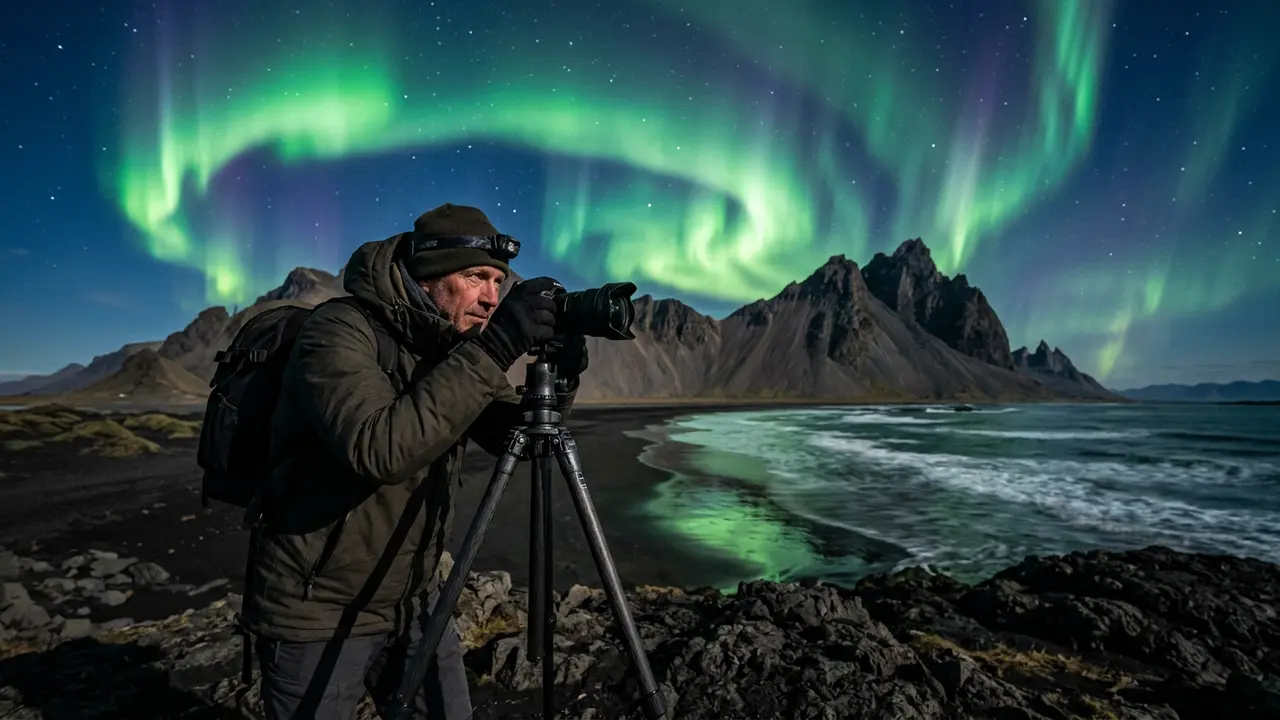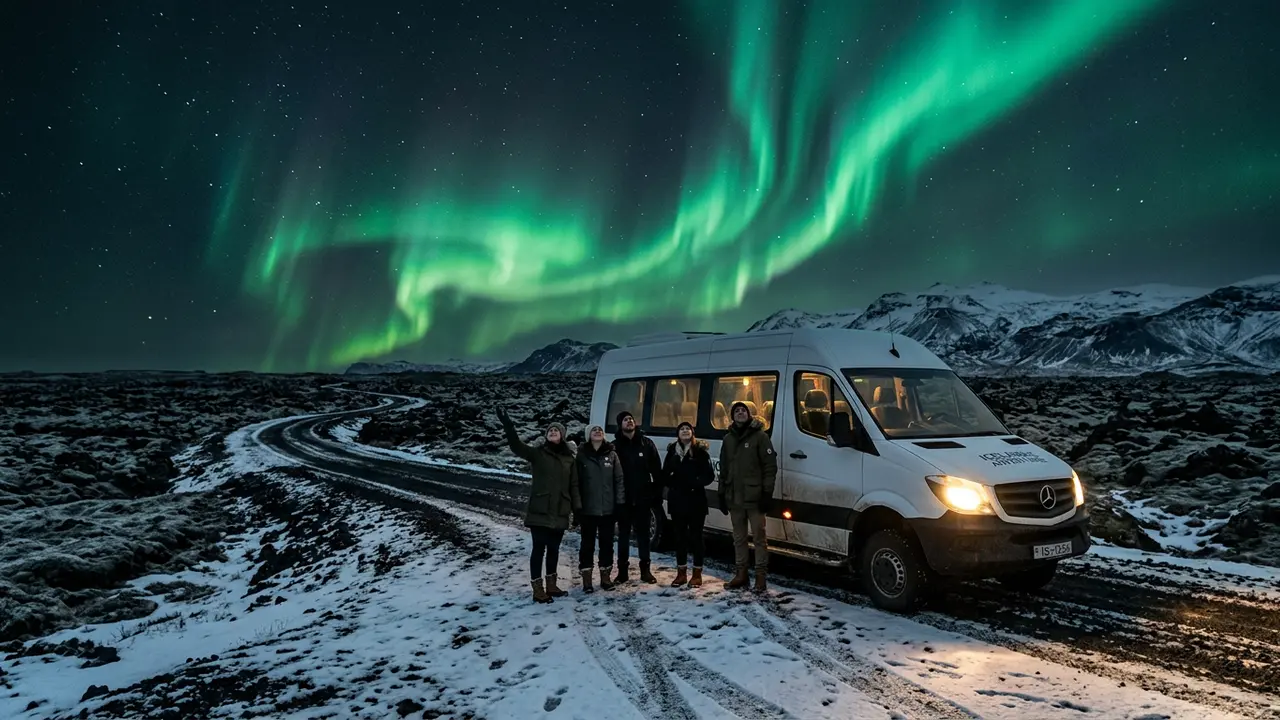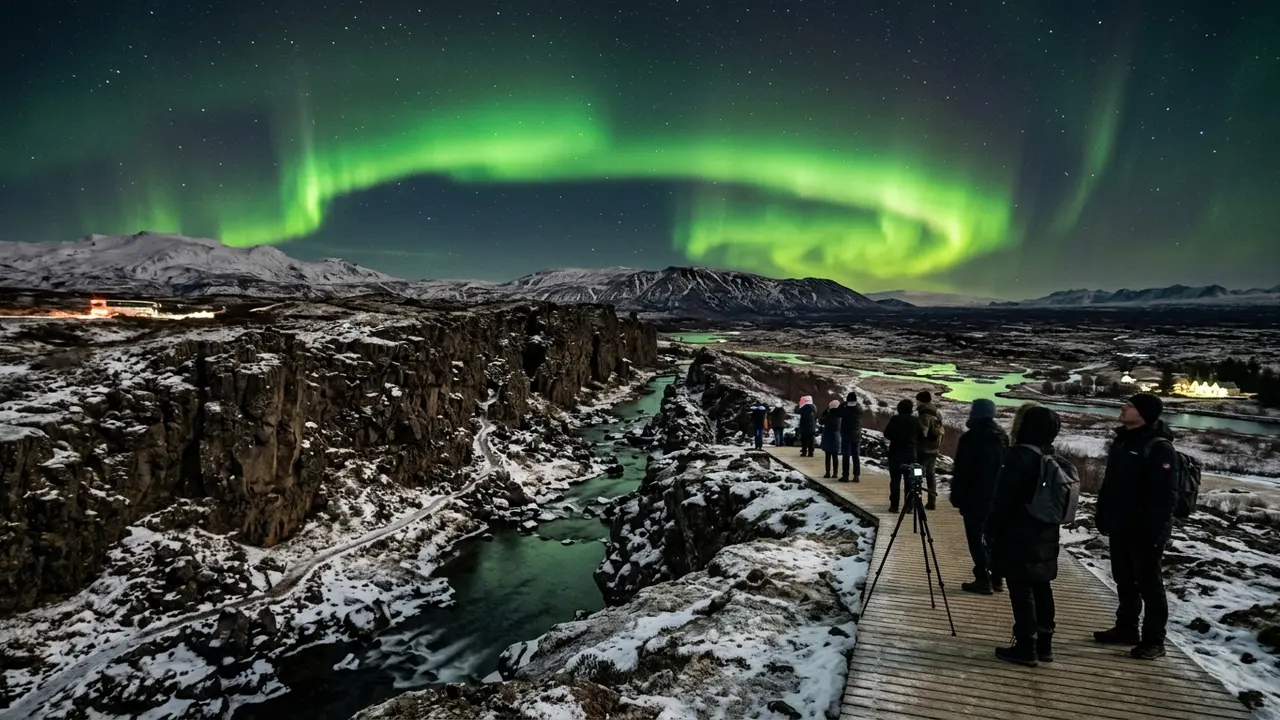
Iceland packs three of its most photographed landmarks and its most famous night-sky phenomenon into a single day that starts at noon and doesn't end until midnight. The Golden Circle is a 230 km loop from Reykjavik that hits Þingvellir National Park, the Geysir geothermal field, and Gullfoss waterfall before the group circles back for dinner and heads out again once the sky goes dark.
Þingvellir is the geological anchor. The park sits directly on the rift where the North American and Eurasian tectonic plates are pulling apart at roughly 2 cm a year; walk the fissure trail and you're standing in the gap between two continents, not a metaphor for one. At Geysir, the crowd waits on Strokkur, which erupts every eight to ten minutes and throws water up to 30 meters into the air, so you'll usually catch two or three eruptions if you stay through a full cycle. Gullfoss closes the daytime loop: the Hvítá River drops in two stages of about 32 meters each into a canyon deep enough that the spray reaches the viewing platforms in summer and freezes into ice sculptures by January.
How the day turns into a night hunt
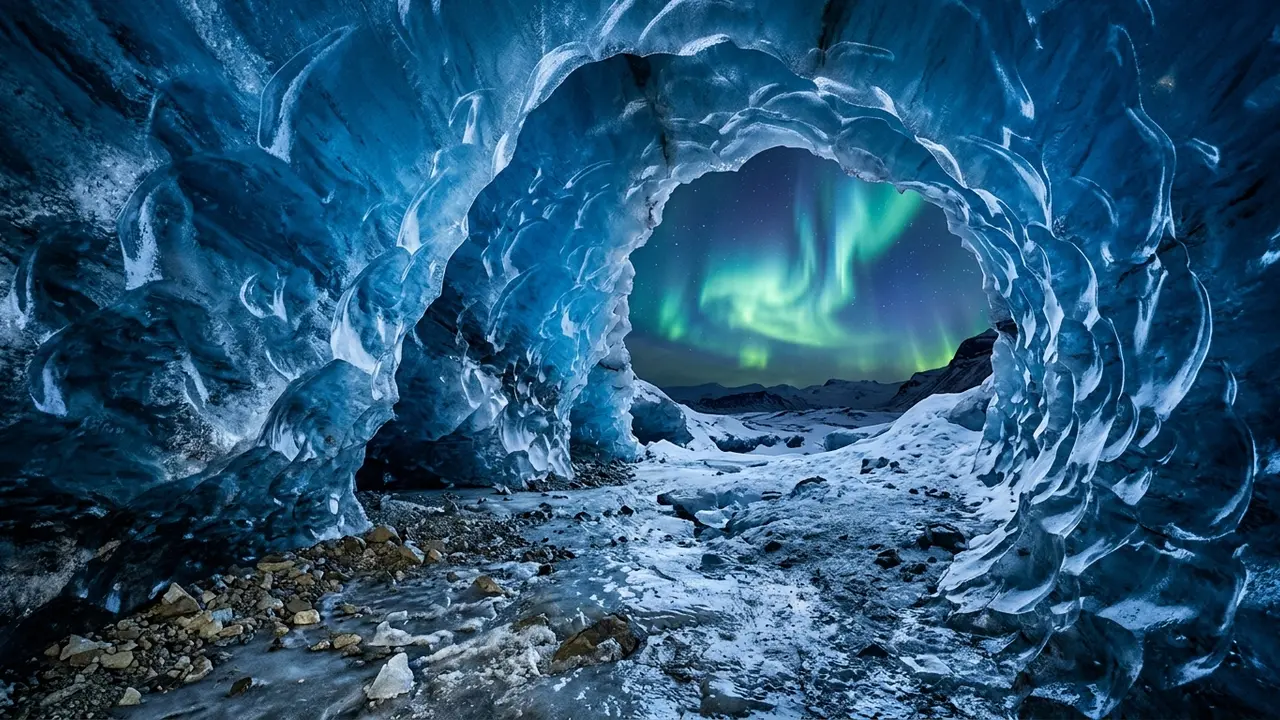
The daytime portion wraps by around 6:00 PM, with a dinner break in downtown Reykjavik before the second half begins. The aurora hunt departs around 8:30 PM and runs to roughly midnight, with guides tracking cloud cover and driving toward whatever patch of open sky the forecast points to that night — the same route-optimization logic used on dedicated chase tours, just added onto the back of a sightseeing day. Hot cocoa and a thermal blanket come standard for the outdoor stops, and most operators build in basic photography coaching: setting a slow shutter, bracing a phone or camera against the cold, and keeping the horizon level in the dark.
What the price actually buys
Combo tours run $100–$200 per person, and booking the Golden Circle and aurora portions together typically knocks a modest discount off doing them separately. What you're not buying is a guaranteed sighting. Geomagnetic activity and cloud cover are independent variables, and a clear forecast means nothing under an overcast sky. Most operators, Arctic Adventures among them, offer unlimited free re-tries on the aurora half if nothing shows, valid for up to three years with some providers. That matters more than it sounds: a single cloudy night doesn't waste the whole day, since the Golden Circle sightseeing already happened regardless of what the sky does later.
When to book it
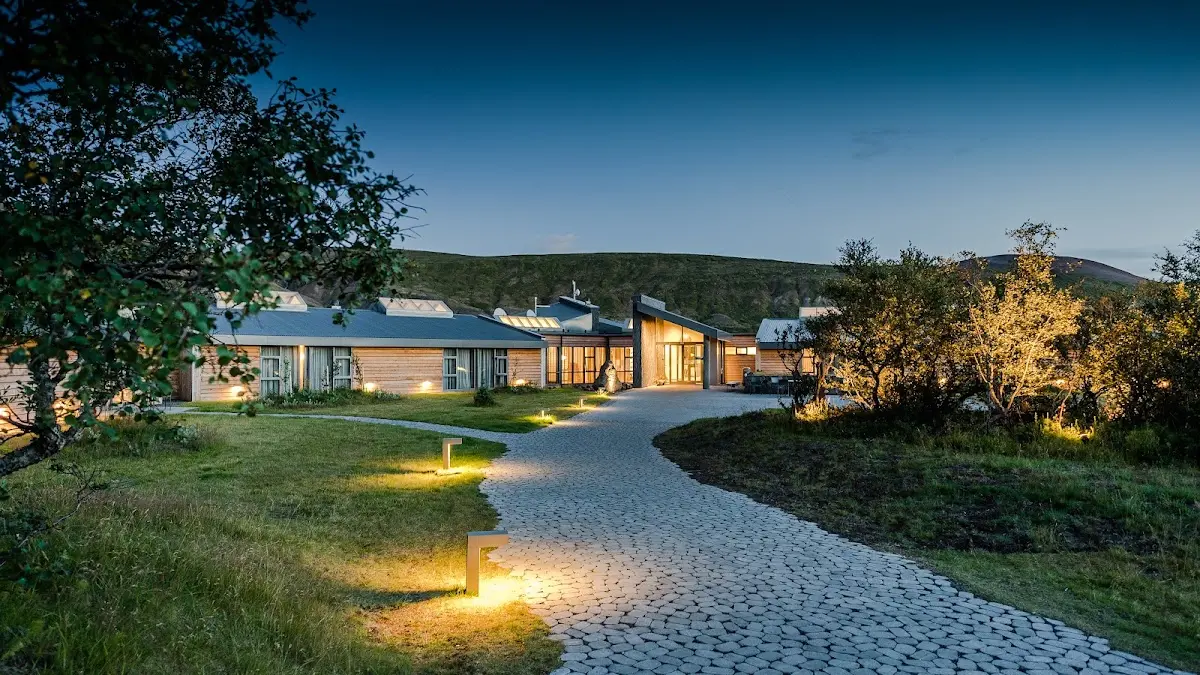
The season runs late August through mid-April, with October through March delivering the longest, darkest nights and the best odds of a clear-sky sighting. Groups run small, four to sixteen people in a minibus, though some operators scale up to 49-seat coaches for a lower per-person price if a bigger group doesn't bother you. Free cancellation applies up to 24 hours before departure. If you're building a longer trip, start with my guide to Northern Lights in Iceland for the full season breakdown, or see what to do in Iceland beyond the Northern Lights if the Golden Circle leaves you wanting more daytime ground to cover. If you'd rather stay near Þingvellir than drive back to Reykjavík after dark, the ION Adventure Hotel sits on this same Golden Circle route.