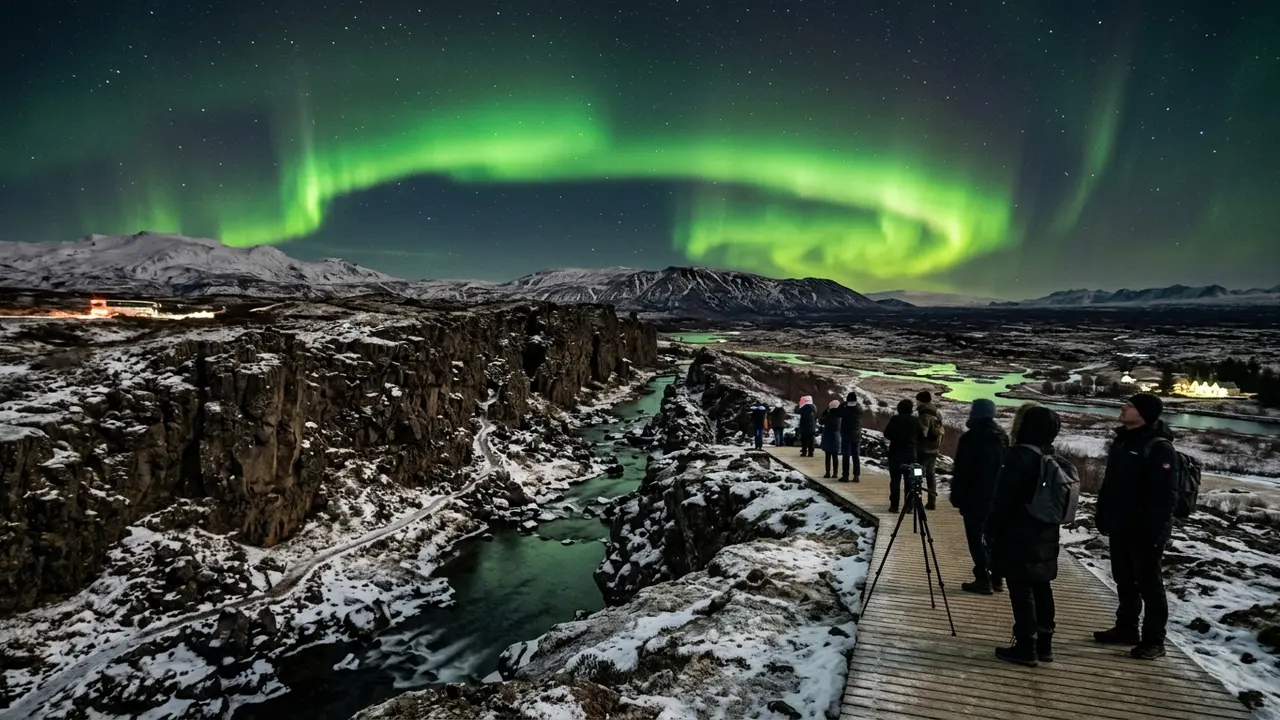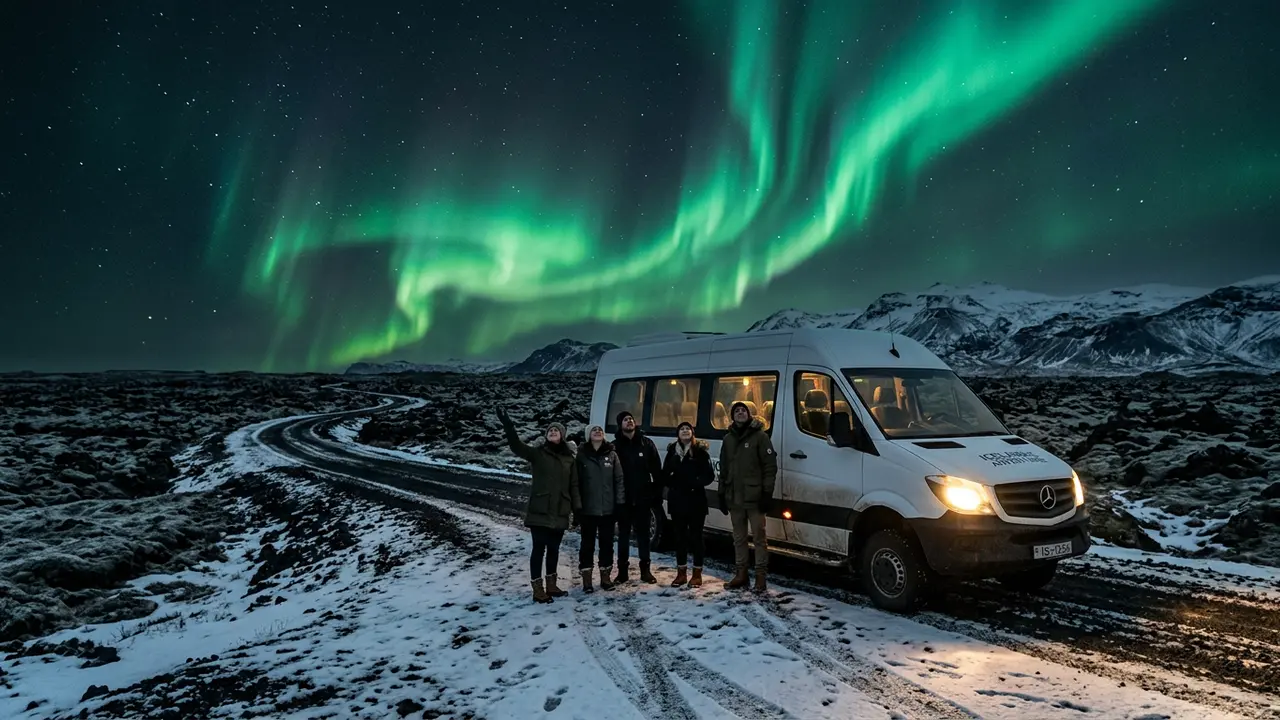
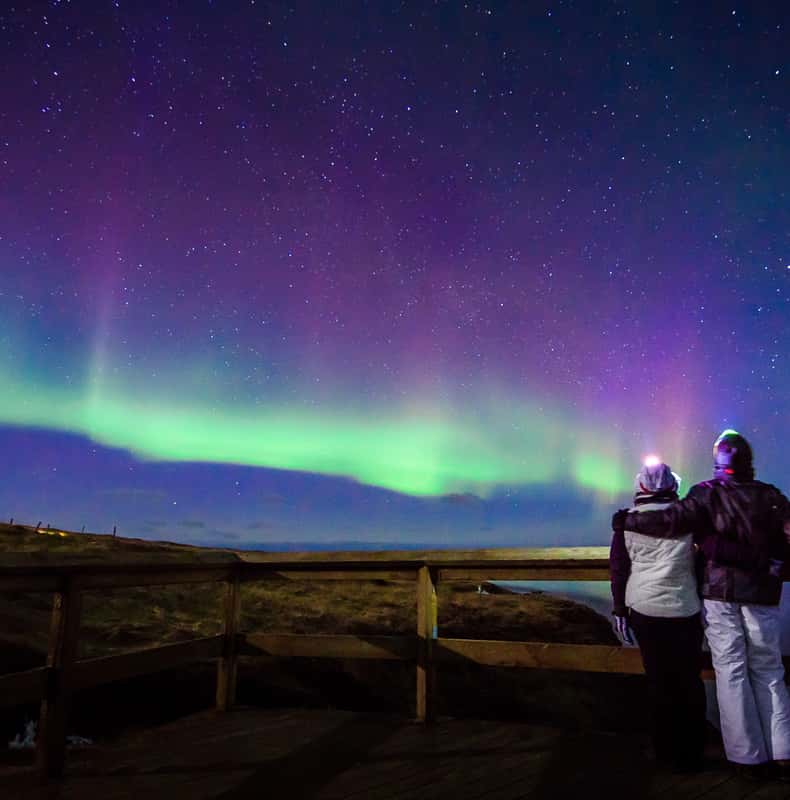
Small group minibus stopped on a dark Icelandic road as green aurora ripples over a snow-dusted lava field outside Reykjavik
Northern Lights

Four to five hours chasing clear sky across Iceland

4–5 hours
Nightly departures August–April, weather permitting. Typical departure 20:00–21:00 from Reykjavik; return between midnight and 02:00. Timing adjusts against real-time aurora forecast and cloud-cover data, and same-day cancellation is possible until 18:15 if conditions look unworkable.
Hotel pickup throughout Reykjavik — hotels, hostels, guesthouses, and private residences; your operator confirms the exact pickup time the evening before or the afternoon of the tour.
All activities

Iceland's high latitude, 64–67°N and just south of the Arctic Circle, keeps most of the country inside or near the aurora oval for eight months of the year, a wider seasonal window than almost anywhere else reachable on a direct flight from the US or EU. The trade-off is Iceland's other defining feature: Atlantic weather systems that roll in off the ocean and blanket the sky in cloud with little warning. A chase tour exists to solve exactly that problem, and this is the anchor version: a small-group minibus that a guide routes toward whatever patch of open sky the live cloud maps and the Kp index say is clearest that night.

Minibus, jeep, or boat: choosing a chase format

Reykjavik's tour market runs at least four formats, and the differences are more than marketing. The minibus chase (8–16 people) is the standard: enough range to cover 100–200 km of road network in a night, cheap enough to book on short notice, flexible enough for a guide to double back if the first route clouds over. 4x4 Super Jeep tours trade group size for terrain access: smaller groups, rougher back roads, sometimes a shorter drive to genuinely dark sky away from Reykjavik's light pollution. Boat tours work the opposite angle, no roads at all, just Faxaflói Bay, useful on nights when coastal cloud sits thinner over water than over the highlands. Premium small-group tours push toward the most remote sites, aimed at photographers willing to pay more and travel farther. For a first Iceland aurora attempt with one evening to spend, the minibus format is the sensible default. It's the version built to adapt mid-tour, and it's what most operators run as their flagship.

What's included, and Iceland's better rebooking policy

Standard inclusions across most Reykjavik operators: a professional English-speaking guide who reads live weather and cloud-cover data, hot chocolate and Icelandic chocolate treats, wool blankets, free hotel pickup across the city, covering hotels, hostels, guesthouses, and private residences, and photos your guide takes of you under the display, since a phone camera at −10°C rarely produces anything worth keeping. What separates the Iceland standard from Tromsø's version of the same tour: free rebooking valid for up to three years if the tour runs its full course and no aurora appears. It isn't a refund, and it isn't a guarantee. Solar activity and cloud cover are two variables no operator can predict days out, but the free rebook turns a no-show night into another attempt, any time within three years, at no extra charge. Operators also build in an earlier safety net: tours can be cancelled until 18:15 on the day if the forecast shows thick, unbroken cloud, with a full refund or a next-night reschedule rather than a wasted evening on the road.

Season, temperature, and what to bring

The season runs August through April, with December through February delivering the darkest, longest nights; the trade-off is that midwinter Atlantic storms bring the heaviest cloud cover of the year. Shoulder months, September–October and March–April, sacrifice some darkness for calmer coastal weather and, per several operators, an uptick in geomagnetic activity near the equinoxes. Checking an aurora forecast the afternoon of your tour (vedur.is or a forecast app) won't change the guide's routing, but it tells you whether to expect a quiet night before you even get in the minibus. Outside the vehicle, expect −5°C to −15°C during a 4–5 hour tour with several outdoor stops; wool blankets and hot drinks help inside the minibus, but they don't substitute for real thermal layers underneath your coat. Pack for standing still in the cold and looking up, not for walking.

For the full season breakdown and where to base your trip beyond this one night, see Iceland's northern lights.
Highlights

  • Real-time weather and cloud-cover tracking — guides route the minibus toward whatever patch of open sky the forecast shows, not a fixed viewing spot
  • Small groups of 8–16 passengers in a heated minibus, more mobile than a 28-person coach without sacrificing every seat's view
  • Free rebooking valid for up to three years if the tour runs and the aurora doesn't appear, a better safety net than Tromsø's no-guarantee standard
  • Hot chocolate, Icelandic chocolate treats, and wool blankets included for a 4–5 hour night outside Reykjavik
  • Free hotel pickup across Reykjavik: hotels, hostels, guesthouses, and private residences

Included

  • Professional English-speaking guide with aurora-tracking expertise
  • Real-time weather tracking and dynamic route optimization
  • Hot chocolate and Icelandic chocolate treats
  • Wool blankets for Arctic conditions
  • Professional photography of guests during the tour
  • Hotel pickup and drop-off throughout Reykjavik
  • Free WiFi on the vehicle

Not included

  • Meals beyond hot chocolate and treats
  • Personal photography equipment rental
  • Thermal suit rental (optional add-on with some operators)

Practical information

Languages

English

Group size

8–16 people per minibus; some operators run larger coach groups up to 28

Good to know before booking

  • Dress in wool or synthetic thermal base layers under a warm outer coat — outdoor stops run −5°C to −15°C and the group stands still scanning the sky
  • Free cancellation up to 24 hours before the tour; same-day cancellation is possible until 18:15 if forecasts turn unfavorable, with a full refund or free reschedule
  • Book ahead for the December–February peak; shoulder-season nights (September–October, March–April) hold more last-minute availability
  • Bring a red-light headlamp if you have one — white light from a phone screen wrecks the 20–30 minutes your eyes need to start picking up faint aurora

Prices & Booking

From €110 approx.

From $120 USD per person (approx. ISK 16,500)

Nightly departures August–April, weather permitting. Typical departure 20:00–21:00 from Reykjavik; return between midnight and 02:00. Timing adjusts against real-time aurora forecast and cloud-cover data, and same-day cancellation is possible until 18:15 if conditions look unworkable.

An editorial guide to this experience. Book directly with the operator when you plan your trip.

Tags

aurora northern lights iceland reykjavik guided tour aurora chasing minibus tour small group winter arctic

Frequently asked questions

What is the best time to see the northern lights in Iceland?

The season runs August through April. December through February delivers the longest, darkest nights, but Atlantic storm systems also bring the heaviest cloud cover of the year. Many experienced guides point to September–October and March–April instead: shorter nights, but calmer coastal weather and a seasonal uptick in geomagnetic activity near the equinoxes.

Is there a guarantee to see the northern lights on an Iceland chase tour?

No standard chase tour guarantees a sighting — weather and solar activity are independent variables no guide controls. What most Reykjavik operators do offer is a free rebooking valid for up to three years if the tour runs and the aurora doesn't appear, plus a same-day cancellation option, usually until 18:15, if the forecast already looks unworkable.

How long does a northern lights tour from Reykjavik last?

Standard chase tours run 4–5 hours, departing Reykjavik in the early evening and returning between midnight and 2am. The exact timing shifts night to night depending on where the guide finds clear sky.

What's the difference between a minibus and a 4x4 Super Jeep aurora tour?

A minibus tour (8–16 people) covers more ground on paved roads and costs less; it's the standard, flexible option most first-time visitors book. A 4x4 Super Jeep tour trades group size and price for terrain access, reaching rougher back roads and sometimes darker sky, farther from Reykjavik's light pollution, in a smaller group.

What should I bring on a northern lights tour in Iceland?

Wool or synthetic thermal base layers under a warm coat — outdoor stops run −5°C to −15°C and you'll be standing still. Most operators provide wool blankets and hot drinks, but those don't replace real layers. A red-light headlamp is useful if you have one; avoid using your phone's white flashlight once the group is outside.

Further reading

Sources