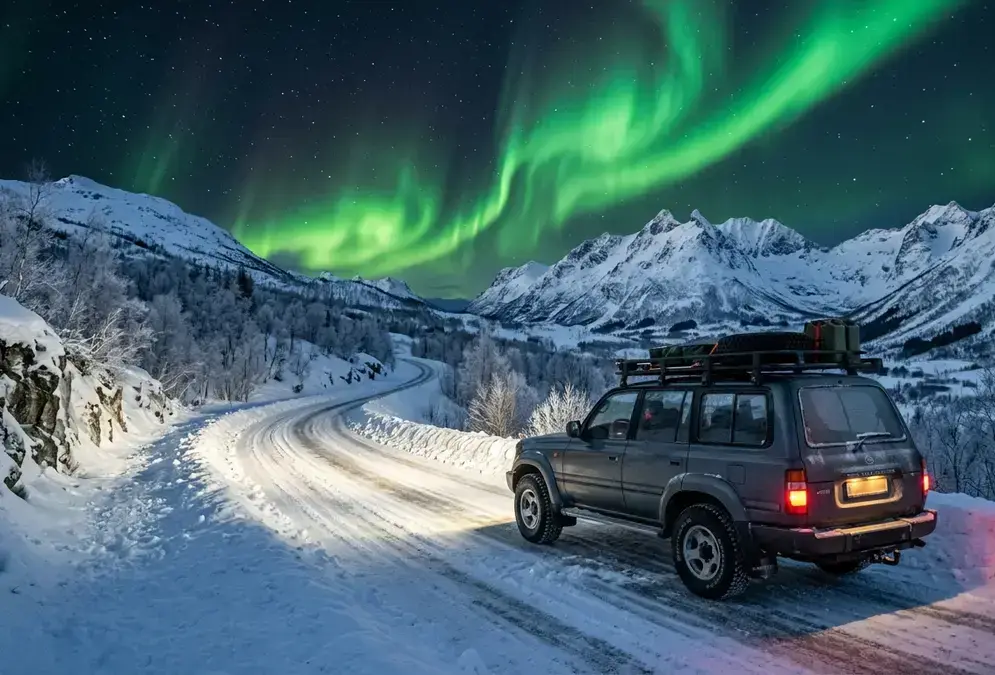

Getting around by bus: what Tromsø's network covers
Tromsø's public bus network is run by Troms Fylkestrafikk (TFF), which operates 28 routes across the municipality[1]. The routes most useful for visitors are lines 24, 26, 40, and 42, connecting the city centre, the Tromsøbrua bridge crossing, the airport corridor, and residential areas north and east of the harbour.
Tickets are bought through the Svipper app, TFF's official mobile ticketing system[2]. You can pay on board on some routes, but the app gives a small fare discount and saves fumbling for Norwegian cash while standing in -10°C. Single fares are priced by zone, and the Svipper app shows the exact amount before you board.
28 bus routes
Weekday buses operate from 7am to 11pm, with reduced frequency on Sundays and some Friday/Saturday late-night services added. The network handles winter conditions reliably: drivers are experienced with local ice, and buses run on studded tyres throughout the season. Heavy snowfall occasionally causes short delays, but outright cancellations are rare.
One note about the Tromsøbrua bridge: it is technically open to pedestrians and cyclists. In summer that crossing makes sense. In January or February, when the wind comes off the fjord, it is genuinely hostile. The bus across the bridge is the practical choice. For northern lights viewing in Tromsø, the bus network reaches city-side spots but not the dark-sky sites east and south of the city where tour operators work.
Renting a car: winter tyre laws and Arctic driving
If you want to reach Sommarøy, the Lyngen Alps, or the remote glass lodges scattered along the fjord valleys, a rental car is not optional. Driving in Arctic Norway in winter has legal requirements that differ from most of Europe, and rental companies absorb most of the burden, but it is worth knowing what the law requires.
Winter tyres are required whenever road conditions call for them, not on a fixed calendar date[3]. In the far north, that condition is met early: expect winter tyres to be standard practice from early October through the season. For rental cars, you do not arrange this separately: all Norwegian rental fleets fit winter tyres as standard during the cold-weather season. You collect a car already compliant.
Featured · Destination
Northern Lights in Tromsø
At 69.6°N inside the auroral oval, Tromsø sees aurora at Kp 2. Peak season November–February. Best viewing spots, tour advice, and aurora forecast strategy.
Studded tyres do carry a fixed legal window in this region: October 16 to April 30, in Nordland, Troms, and Finnmark, with a minimum legal tread depth of 3mm[4]. Rental cars in this window come fitted with either studded or non-studded winter tyres depending on fleet availability. Both options handle Tromsø roads adequately under normal conditions. Snow chains come in the boot of most rental cars and are rarely needed on main roads, though they help on steeper fjord-side tracks approaching lodges.
Two distances define the car's value for aurora hunters: Sommarøy sits roughly 60km west of Tromsø city, about 50 minutes in good conditions. The Lyngen Alps and Aurora Fjord Cabins lie around 90km east along the E8 and E6, roughly 90 minutes in dry winter conditions; allow two hours after heavy snowfall.
Reindeer cross unlit rural roads at night with no warning. Reduce speed significantly outside the city, use low beam in fog and falling snow, and check Statens vegvesen (the Norwegian roads authority) for mountain road closures before heading toward the fjord valleys.
Taxis and Bolt: on-demand transport in the city
Two services cover on-demand transport: Tromsø Taxi and Bolt. On nights when a good forecast window opens at short notice, both are worth having loaded on your phone.
Tromsø Taxi is the city's established service, the reliable option for airport transfers and pre-planned rides[5]. Pre-booking 30 to 60 minutes in advance is recommended when you need a specific pickup time. On peak aurora nights in January and February, demand spikes and walk-up waits can stretch. The app and the phone line both take pre-orders.
Bolt arrived in Norway in 2021 and operates 24 hours a day in Tromsø[6]. Its app works identically to Bolt elsewhere: request a driver, track the pickup, pay by card. Pricing is competitive with Tromsø Taxi for standard city trips. For rides toward remote aurora sites an hour outside the city, the fare estimate climbs quickly; check it before confirming.
Neither service covers the distant fjord-valley locations where the best aurora views sit, at least not economically for more than one or two people. For the key dark-sky spots within 30 minutes of the city, the guide to where to actually stand lists the locations that local guides use on active nights.
| Transport | Cost & flexibility | Aurora range | Best for |
|---|---|---|---|
| City bus (TFF) | ~40–50 NOK / trip, fixed routes only | City centre only | Cable car, waterfront, evening meals |
| Taxi or Bolt | 200–500 NOK / trip, on-demand anywhere | City + up to 40 km | Late-night, small groups |
| Rental car | from 600 NOK / day, full access any road | 60–90 km radius | Sommarøy, Lyngen Alps, remote lodges |
| Guided aurora tour | 900–1,500 NOK / night, fixed and guide-led | 30–60 km dark sites | First-timers, no winter-drive experience |
Ferries: island routes and the Lyngen crossing
Tromsø has a ferry network worth knowing about for two reasons: reaching the outer archipelago islands, and an alternative approach to the Lyngen peninsula.
Ferries depart from Prostneset Terminal in the city centre[7], with services running to Skjervøy, Lyngen, Finnsnes, Harstad, and Senja. Winter schedules run less frequently than summer, and some routes drop to two or three daily departures. Checking Norled or Troms og Finnmark Kollektivtrafikk (TFK) websites before planning an excursion is essential.
Vengsøy and Rebbenesøy sit west of Tromsø in the outer archipelago, facing an open Barents Sea horizon to the north, though they're reached on a separate route from Finnkroken, not Prostneset; the crossing runs roughly 1 hour 28 minutes each way. On a clear night with a strong Kp reading, that unbroken dark horizon makes both islands genuinely interesting for aurora photography. The practical complication: getting around the island once you arrive still requires either a car on the ferry or a prearranged pickup. Not all routes carry vehicles; check ferry schedules and vehicle restrictions before booking.
The Lyngen crossing gives an alternative for visitors without a car who want to reach the peninsula. It is slower and more involved than driving the E8, but it works for people who have arranged accommodation at a lodge offering prearranged transfers from the ferry landing, such as Malangen Resort.
Tromsø Airport transfers
Tromsø Airport Langnes sits roughly 5km northwest of the city centre[7]. Three options cover the transfer, each with different trade-offs on timing and reliability.
The Flybussen runs a fixed route from the terminal to central Tromsø, stopping at the main hotels and the city bus terminal. Journey time is 15 to 20 minutes under normal conditions. Frequency drops on evening services, so check the last departure time before relying on it for a late arrival.
Taxis are always available outside arrivals, day and night. A ride to the city centre is metered; the Tromsø Taxi app shows a fare estimate before you book, which avoids surprises on late-night runs. Pre-ordering gives a fixed-price option and guarantees a car is waiting when you land, which is worth doing on late winter evenings when the taxi rank is busy. Bolt works from the designated pickup zone outside arrivals and typically has drivers available within five to fifteen minutes outside peak arrival times.
For visitors staying at a lodge outside the city, most operators include an airport pickup service as part of the booking. Confirming this before arrival avoids the car rental versus taxi decision on the day you land, when you're likely tired and carrying heavy gear. Whether to self-drive or rely on lodge transfers for your aurora trip is a real planning decision; do you need a tour for Tromsø northern lights covers the comparison in detail.
Read next · Lodge
Malangen Resort
Fjord-side lodge 60 km south of Tromsø, under the auroral oval. Waterfront cabins, Camp Nikka dark-sky site, fjord sauna. Couples rated 9.2/10 on Booking.com.
Aurora hunting: matching transport to the destination
The practical transport question on an aurora night is not which mode is cheapest. It is which mode gets you to a dark enough sky, at the right time, with enough flexibility to react when cloud cover moves.
City-centre viewing works on high-activity nights (Kp 4 and above) from any park or elevated point that faces north away from the main streetlights. The Fjellheisen cable car to the Storsteinen summit is reachable by bus and gives genuine elevation above the city grid. On clear nights with strong aurora, it is one of Tromsø's most accessible spots without a car.
Guided night tours solve the mobility problem directly. Most operators position their groups in fjord valleys 30 to 60km east of Tromsø, chasing clear-sky gaps that frequently open inland when coastal cloud sits over the harbour. A good guide drives, reads the forecast in real time, and repositions during the night. This matters far more than any fixed viewing location. If aurora hunting is your primary reason for visiting and you're staying three nights or fewer, booking at least one guided tour is the single most reliable thing you can do.
Recommended tours
Tours are selected for quality, not commission. I earn a small fee if you book — at no extra cost to you.

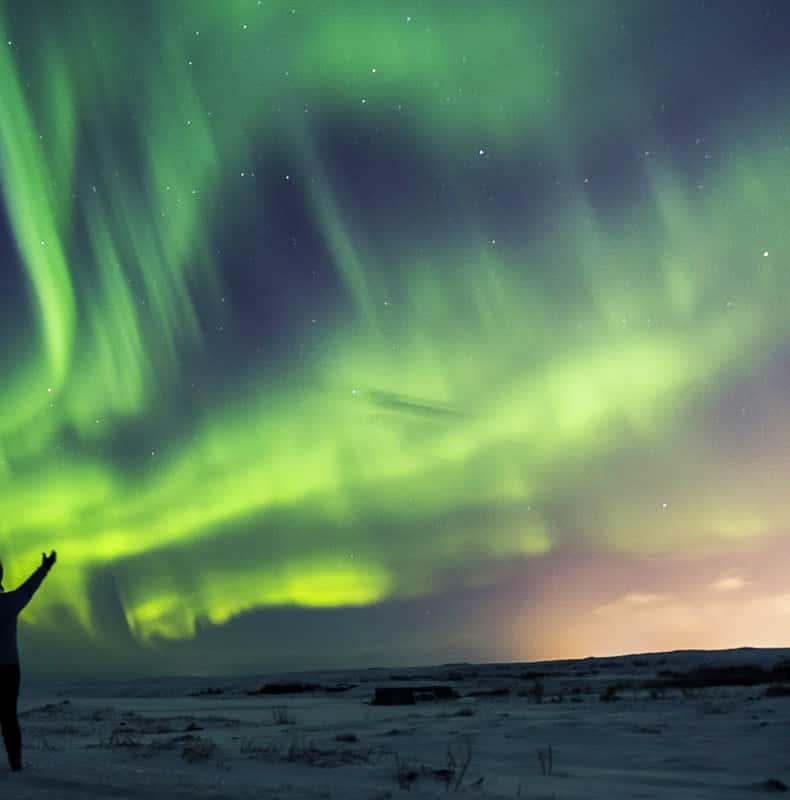


Self-driving opens the same location flexibility but requires confidence on winter roads at night, a working knowledge of where to go, and a real-time weather tool. The Yr app (Norwegian national forecast) shows cloud cover at hourly intervals and is what local guides actually use. Learning to read it before you land saves time on the night itself. If you're comfortable on snow and ice, a rental car for three to five days often costs less than multiple guided tours and gives substantially more flexibility for daylight excursions.
Remote lodges handle transport as part of their offer. Most provide airport pickups, run their own aurora excursions, and operate from genuinely dark-sky territory 60 to 90km from the city. The trade-off is the per-night rate. Transport, guiding, and dark-sky access come bundled. For a three-night dedicated trip, the total often compares favourably to city accommodation plus two guided tours plus a rental car.