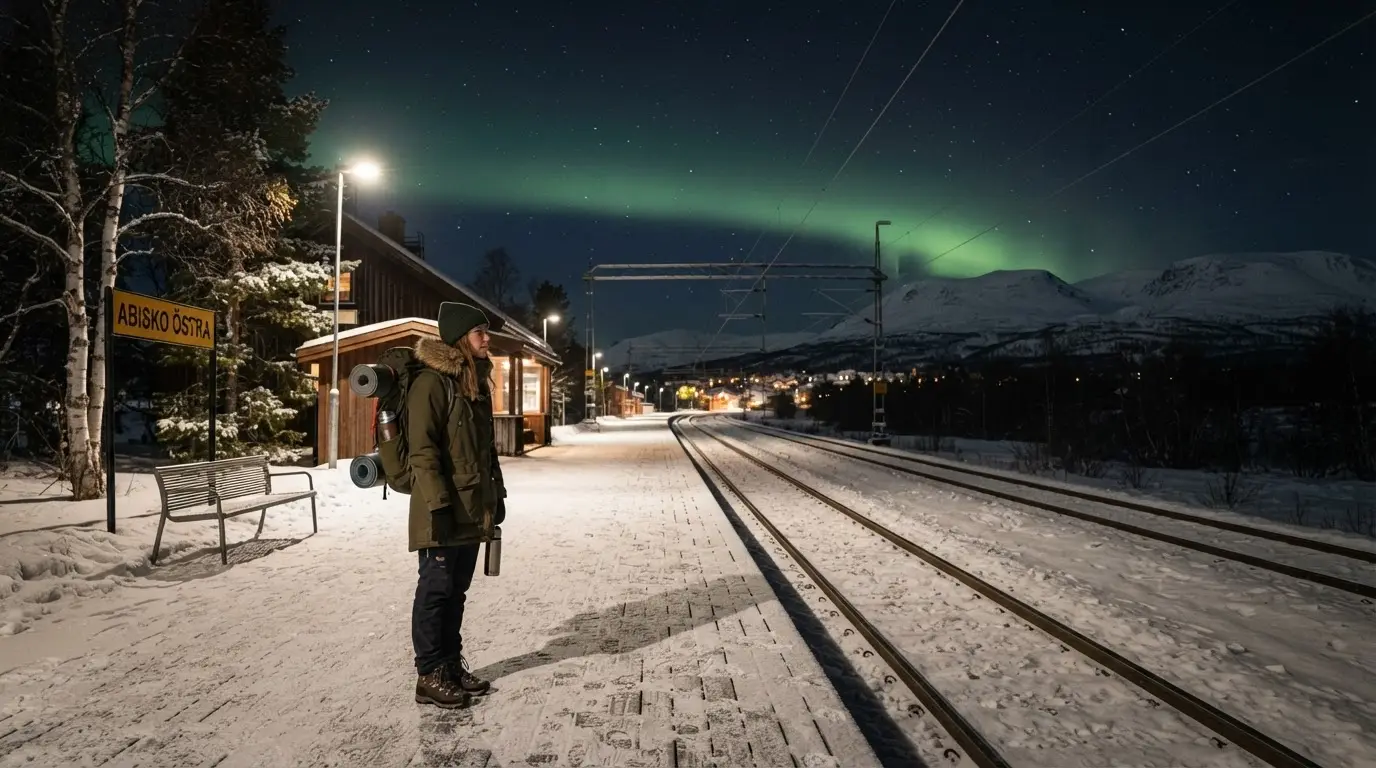

Tromsø, Abisko, and Levi: the car-free basics at a glance
Rent a car in the Arctic in winter and you're managing black ice, whiteout, and studded-tire logistics on top of aurora forecasting. Skip it, and each of these three bases substitutes something different for the car: Tromsø substitutes buses and a paid aurora chase-tour industry, Abisko substitutes a single long train ride and a microclimate that does some of the chasing for you, and Finnish Lapland substitutes a rail network built to hand off to a bus.
| What matters | Tromsø | Abisko | Levi / Finnish Lapland |
|---|---|---|---|
| Nearest airport & transfer | Tromsø Airport: ~10 min by taxi or bus | No airport in the village; reached by train | Kittilä Airport: ~15 km, airport bus, taxi or minibus |
| Reach the base without flying | Bus and taxi only; no train in either airport's own listing | Overnight sleeper direct from Stockholm | Night train plus a connecting bus matched to arrivals |
| In-town aurora walkability | One published self-guided walking route; not aurora-specific | STF hostel sits at the start of the Kungsleden trail | No official walkability data found; verify locally |
| Solo tour price baseline | From 2,200 NOK per adult, one listed operator | No official minibus tour price found | No official per-person tour price found |
None of the three is the wrong choice for a solo traveler. The differences are in how much you pay for mobility, how much of your trip depends on someone else driving you somewhere, and how much of it official sources actually document. Abisko vs Tromsø for stargazing covers the sky-quality side of that trade-off in full; this piece is about getting there, and getting around, without ever renting a car.
Getting there and around without a car
Tromsø Airport sits close to downtown. Visit Tromsø lists the Flybussen airport express, city bus routes 24, 26, 40 and 42, or a taxi that takes around ten minutes[4][5]. Avinor's own public-transport page for the airport names only the Flybussen and routes 40 and 42[6], a narrower list than Visit Tromsø's, and no train appears in either one. Once you're in town, city buses run every day, and the easiest way to pay is the Svipper app, since cash isn't accepted on board[7]. Getting around Tromsø in winter has the fuller route map.
Abisko has no airport of its own; reaching it by air still means a transfer from Kiruna, not a flight into the village itself. The route that matters more for going car-free is Vy's overnight sleeper, which departs Stockholm at 6 p.m. daily and arrives to a sunrise the next morning[1]. If weather disrupts the line, Vy runs a replacement bus service instead[8].
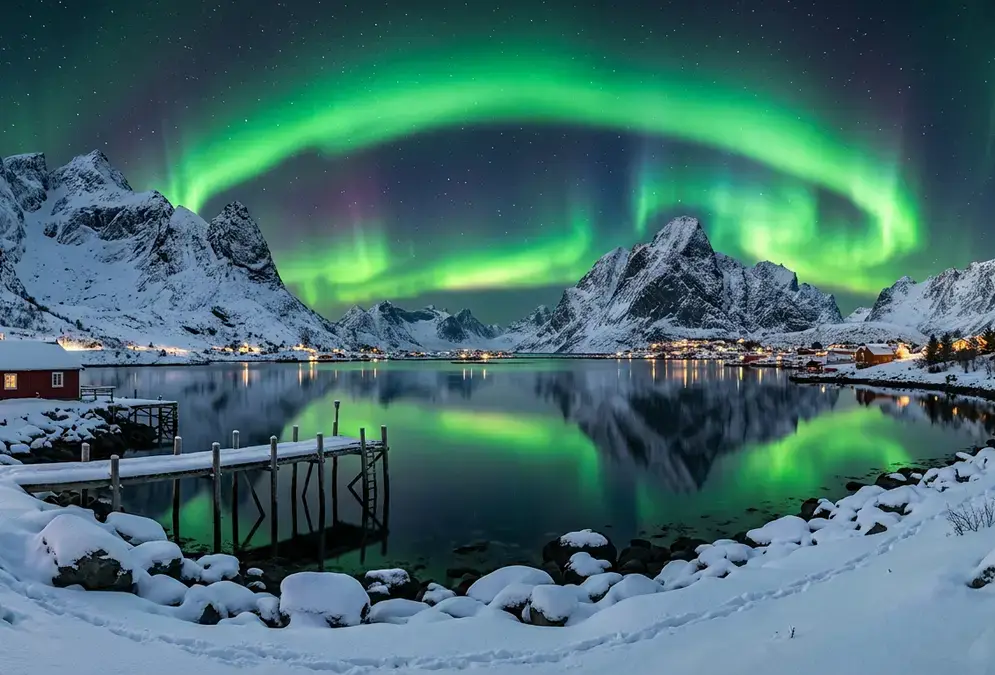
Featured · Destination
Northern Lights in Tromsø
At 69.6°N inside the auroral oval, Tromsø sees aurora at Kp 2. Peak season November–February. Best viewing spots, tour advice, and aurora forecast strategy.
Finnish Lapland runs a similar idea through VR's own trip planner. Book a ticket toward Levi and the system offers bus connections timed to match the trains, sold together as one purchase[9]. From Rovaniemi station it's about 230 km to Levi, a connecting bus ride just over three hours[3]; the shorter route via Kolari cuts the distance to about 80 km, and a connecting bus meets every arriving train there[10]. VR markets the whole approach as a way to reach Lapland's resorts without spending several hours in a car[11].
Which town do you actually need to leave to see the sky
Tromsø's own aurora-tour community is candid about this: downtown isn't the best place to watch from, and seeing anything usually means booking a tour or driving out yourself[14]. What the city does offer on foot is a published self-guided walking route past the cathedral, harbor, Polar Museum, and old town[15], plus a roughly 20-minute walk across Tromsø Bridge to the Arctic Cathedral[16]. Tromsø city centre vs outside for aurora goes deeper on exactly where those city lights stop mattering.
Abisko flips the walkability problem. The STF Abisko Turiststation sits at the start of the Kungsleden trail[17], and one guest review calls it "the ideal location for watching the Northern Lights"[18]. Abisko's reputation also rests on what's known locally as the blue hole, a microclimate reputed to keep skies clearer here than along the coast[19][20].
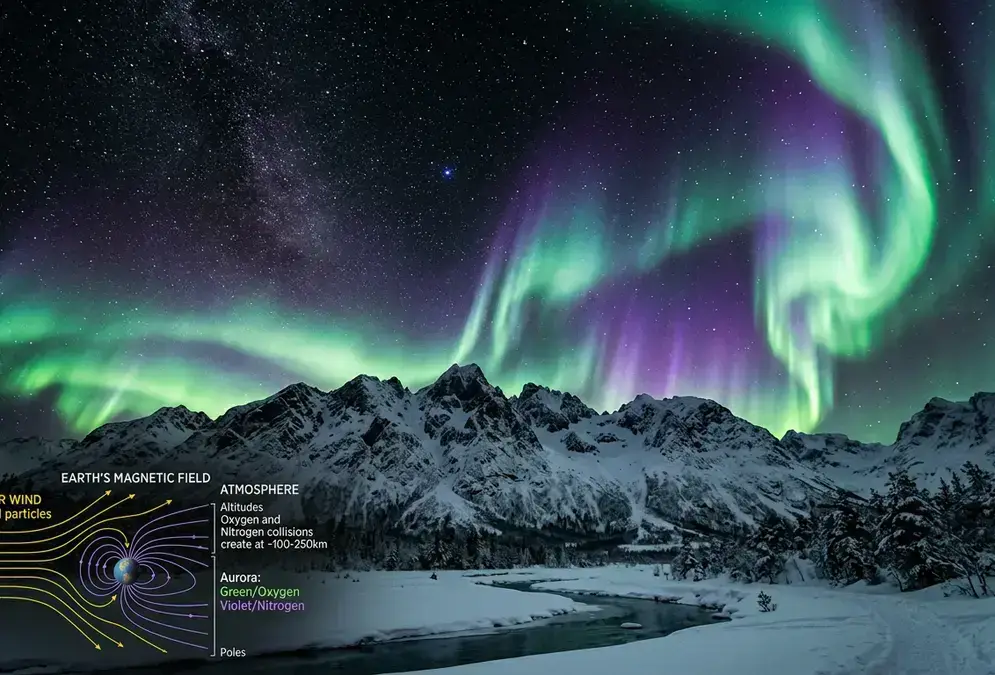
Featured · Article
What Causes the Northern Lights? The Science Explained
Solar wind collides with Earth's magnetic field, funneling charged particles toward the poles, where they excite oxygen and nitrogen into glowing color.
Levi's own walkability for aurora viewing isn't something the sources checked for this piece spell out. The village center is compact enough to cover on foot for everyday errands, but treat any specific claim about watching the aurora from inside town as unverified until you check with Levi's own tourism office.
Tour dependency and the real solo cost
Tromsø runs on paid mobility. One Visit Tromsø-listed aurora tour starts at 2,200 NOK per adult in low season[2], priced per person rather than per room, which avoids the single-supplement penalty that couples-focused package tours often apply to solo travelers.
Bring your passport
One Visit Tromsø aurora tour explicitly tells guests to bring a passport, since the route may travel as far as Finland chasing a gap in the clouds[21].
Abisko and Levi don't publish an equivalent solo tour price among the sources checked here. That's worth flagging rather than guessing: if a fixed per-person aurora tour cost matters to your decision, confirm current rates directly with STF Abisko or Levi's own tourism office before booking.
Do you need a tour to see northern lights in Tromsø? argues the tour-or-DIY question in full for that one city, which is the only one of the three with enough public pricing data to settle it properly.
The verdict, by traveler type
Weigh what each destination actually asks of you:
- Tromsø: the most tour operators and city amenities of the three, but you pay per outing for the mobility a car would otherwise give you
- Abisko: a single long train journey, then very little further transport cost, plus a microclimate that's statistically kinder to your odds than chasing gaps in coastal cloud[19][20]
- Levi: the simplest flight-in logistics of the three, with fewer confirmed specifics on tour cost or in-town walkability than the other two
I've priced my own trip north more than once and keep landing on the same number: eight nights minimum, my own rule against ever gambling on one night applied to myself. I still haven't booked it, because I'd rather wait for the season's forecast to firm up than commit to a plan built on this year's average.
How many days in Tromsø for northern lights? breaks that margin down properly if eight nights sounds like a lot for a first trip. Finnish Lapland vs Norway northern lights is worth reading next if Levi's data gaps above are the deciding factor for you.