
Why this decision starts with your rental contract, not your driving nerve
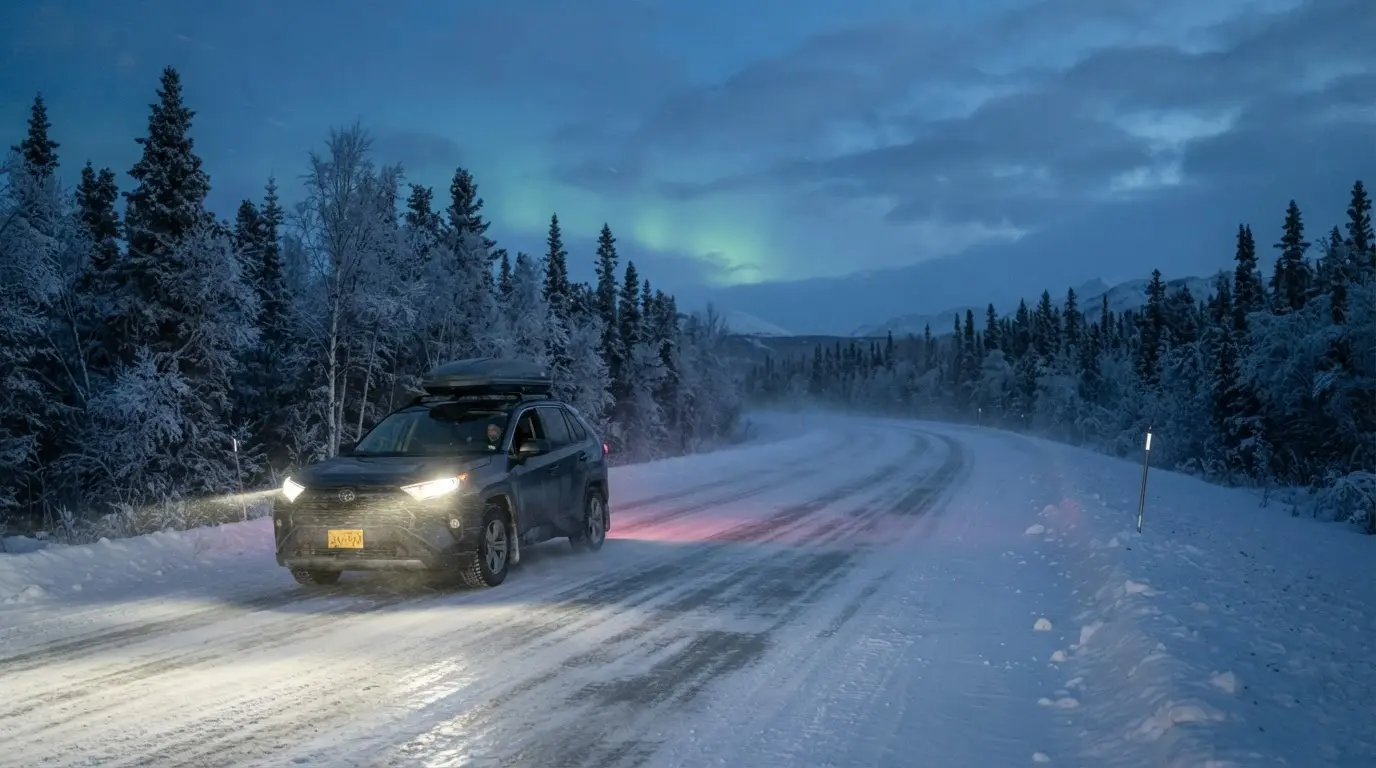
Most self-drive aurora guides open with winter driving tips: studded tires, block heaters, following distance on ice. Those matter, but they assume you're legally allowed to take a rental car where the aurora spots actually are. Often you aren't. The Fairbanks branches of Alamo, Enterprise, and National won't let their vehicles past Fox[4], the small community just north of town where several popular self-drive Fairbanks northern lights lodges and viewing pull-offs sit.
That's not a forum rumor. Alaska's Department of Transportation backs it from the rental-company side too: many agencies either bar Dalton Highway travel outright or exclude damage there from coverage[5]. Read your rental agreement's fine print before you plan a route around it, not after.
Featured · Destination
Fairbanks Northern Lights
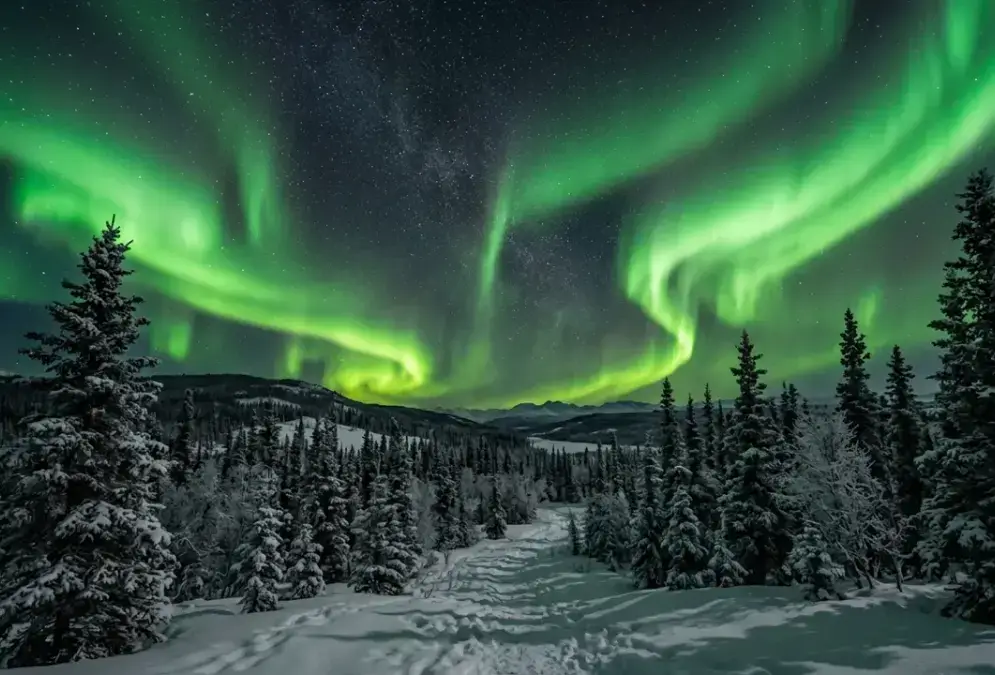
Fairbanks sits directly under the auroral oval at 64.8°N. Aurora season runs Aug 21–Apr 21, peaking Feb–Mar, with roughly 90% odds if you stay 3+ nights.
Even a rental company that allows the drive north changes its terms for winter. From October through April, the self-drive option at one Fairbanks aurora lodge requires an AWD or 4WD vehicle[6] — a sedan from the airport counter doesn't qualify, winter tires or not. Studded tires are legal in Alaska only from September 15 to May 1[2]; ask at pickup whether yours are fitted, don't assume it. For everyday transport around town rather than the aurora drive itself, getting around Fairbanks in winter covers buses, taxis, and walkability separately.
The 511 gap: why an evening road check might already be stale
Say the rental issue doesn't apply to you. You've got a real 4WD SUV from a company that allows Fox and beyond. The next hazard isn't the road surface, it's the information about the road surface. The Elliott Highway is paved and dependable as far as its junction with the Dalton Highway, 73 miles north of Fox[3], but the final 80 miles to Manley Hot Springs are gravel, and winter turns that stretch into ice overflow, crosswinds, and drifting snow[7].
Past the Dalton cutoff you're also off the grid: there's no cell coverage on the Elliott Highway north of Wickersham Dome, and traffic beyond that point can be sparse enough that a breakdown might sit unnoticed for a while[8]. Alaska's own guidance for this stretch is blunt — carry emergency supplies and enough fuel for 400 miles before you start[9]. Pair whatever road check you run with the night's actual Fairbanks aurora forecast; a clear road and a clouded-out sky both waste the drive.
Here's the fact that should change your evening plans more than anything above: Alaska's official 511 traveler-information system isn't a live feed. Winter road reports are refreshed by 8 a.m. on weekdays, and on weekends only if conditions turn bad[10]. There's no overnight desk behind it — the staff who enter that data work standard weekday hours, with no 24/7 operations center[11]. The system's own definitions page says as much: its observations 'are not real-time,' especially after business hours end[12]. Check 511 at 9 p.m. before a chase and you may be reading a report that's already 13 hours old.
511 isn't live data
Treat Alaska's 511 report as a morning snapshot, not a real-time feed, especially at night. If conditions look marginal on a stale report, build in a turnaround point and don't push further than you can reverse out of in the dark.
What a guided tour buys that a rental car can't
A guided aurora tour trades the rental-contract problem for someone else's vehicle and someone else's judgment call about whether tonight is worth the drive. Reputable operators carry satellite phones and run vehicles that are winterized for exactly this kind of driving, not a fleet sedan with a stronger heater[13]. That matters most if something goes wrong: a guide carries recovery gear and a plan; a solo self-driver has a phone with no signal past Wickersham Dome.
One Fairbanks-based aurora guide says pulling stranded self-drive tourists out of ditches is routine enough that he's lost count[14]. That's one operator's account, not a universal statistic, but it lines up with everything else here — a rental agreement that closes off the best routes, a road-condition system that's hours behind, and a highway with no cell service past a certain point add up to a specific kind of risk, not a hypothetical one. It's a fair question to ask directly: is a Fairbanks aurora tour worth it for your trip, or does DIY still make more sense once you've weighed the rest of this article?
Guided tours also solve a problem self-drive can't: knowing where to go on a given night. Wickersham Dome, a well-known Elliott Highway pull-off, runs about 10–20°F warmer than the valley floor around Fairbanks[15], and the same wind that keeps it milder also strips the snow off its trees — the kind of local detail a guide knows and a first-timer with a rental car and a map doesn't.
Featured · Article
What Causes the Northern Lights? The Science Explained
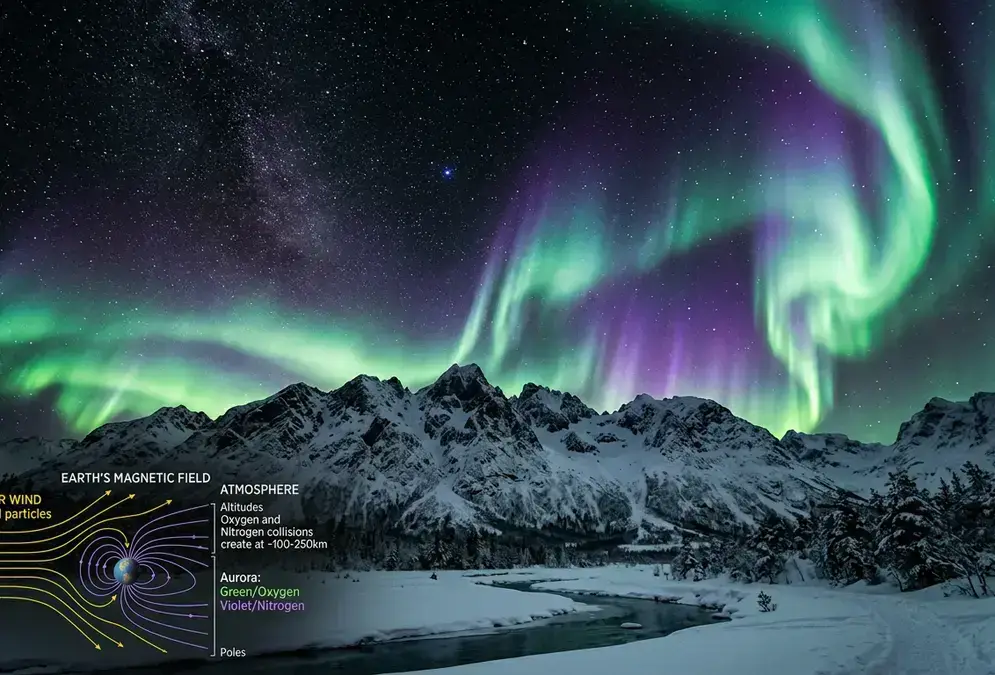
Solar wind collides with Earth's magnetic field, funneling charged particles toward the poles, where they excite oxygen and nitrogen into glowing color.
The cost math: one lodge's two-tier pricing, and what tours actually run
Numbers make the trade-off concrete. One Fairbanks-area aurora lodge charges $45 per person to drive yourself to the identical evening that costs $115 per person with hotel pickup included[1]. That's not a discount for roughing it — it's the price of someone else doing the driving, the road check, and carrying the liability.
Zoom out from that one lodge and the guided-tour market runs wider: independent pricing guidance puts a typical small-group tour at $200–$400 per person per night, with private tours reaching $500[16]. Compare that against the full self-drive math: a capable winter rental, fuel, a complete cold-weather clothing set for every traveler, and the time cost of checking road conditions yourself. The $45[1] lodge rate then looks like the exception, not the baseline.
| Factor | Self-drive | Guided tour |
|---|---|---|
| Winter vehicle | AWD/4WD required; major rental brands barred north of Fox | Winterized vehicle included |
| Road-condition data | Alaska 511, refreshed once each morning | Guide checks conditions as you go |
| Typical price | $45+ per person, plus rental, fuel, and gear | $115-$400+ per person, most costs included |
| If you get stuck | No cell service past Wickersham Dome | Guide carries recovery gear and a satellite phone |
The honest comparison isn't $45[1] against $200. It's $45[1]-plus-everything-a-lodge-doesn't-mention against $115-to-$400 with the driving, the road check, and the recovery plan already built in. Price the self-drive option completely, vehicle upgrade included, before calling it the budget choice; the full Fairbanks aurora trip cost breakdown walks through every line item.
Wildlife, timing, and the decision that's actually yours
Add wildlife to the risk column. Moose-vehicle crashes happen more often on Alaska's roads, per mile driven, than almost anywhere else[17], and winter is the peak season for them: moose use plowed roads to save energy, and drivers have less daylight to spot them. Statewide, at least 800 moose-related crashes are estimated each year[18], and Alaska State Troopers logged about 520 wildlife-involved crashes in 2023 alone[19]. None of that is specific to the Elliott or Dalton, but it's a real baseline for driving unfamiliar roads in the dark while looking up instead of at the shoulder.
Timing works against the self-driver in a smaller way too. February through April is generally considered peak aurora-chasing season around Fairbanks[20] — also the window when every other chaser is out on the same roads, at the same late hours, in the same conditions. A guided operator plans around that; a solo driver has to notice it alone. Once you've decided, the best aurora viewing spots near Fairbanks guide covers where to actually park.
None of this makes self-drive the wrong call. It only works in a specific order:
- Check your rental agreement for the Fox boundary and any Dalton Highway exclusion before you book.
- Treat 511 as a morning snapshot, not a live feed, especially after dark.
- Price a genuinely capable winter vehicle — AWD/4WD, not winter tires on a sedan.
- Compare that total against a guided rate, not against the cheapest rental you can find.
Skip the order and the driving skill everyone worries about was never the deciding factor at all.