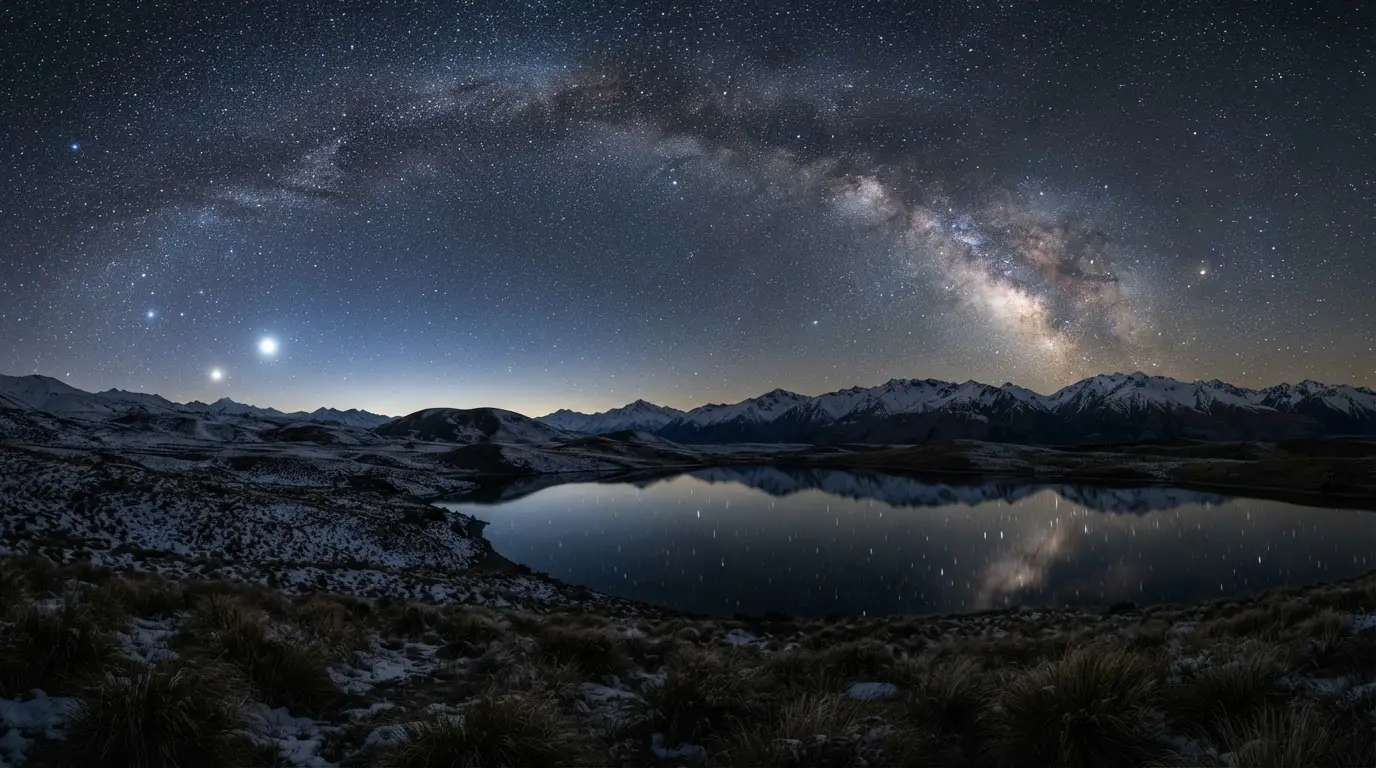

What Ngāi Tahu sky knowledge is, and what it isn't
Māori astronomy, tātai arorangi, travelled with the voyagers. One speaker in a Science Learning Hub video says that on arrival "we then modified our knowledge of the stars to fit our local environment"[6]. That sentence is the key to this article: what you hear at Takapō is the local version, not a generic Pacific or pan-Māori one.
It was never a separate subject called astronomy. It was carried in pūrākau (stories), waiata (songs) and whakataukī (proverbs)[7], which helps explain why one star can be a weather forecast, a calendar and a family story at once. The line below, from 2025 Te Ao Māori News coverage, is the best short statement of how the sky and the land relate.
“That pūrākau, that mātauraka was held up there in the stars until our people arrived in this huge land, and what they did then was, they re-transferred those pūrākau to the whenua here.[9]”
Regional variation is real. Whānui (Vega) is "the father of the kūmara" in that same video[8], a standard teaching example, but it is a general Māori one and I won't present it as a Te Manahuna story. From here, a claim is tied to Ngāi Tahu only where a source says so.
The mountain's own creation story is a separate subject, and I keep it out of this piece.
Puaka: the South Island's frost and winter star
Puanga is Rigel. In Te Waipounamu, the South Island, it is Puaka[5], and the spelling is the point: Ngāi Tahu, also written Kāi Tahu, use k where other dialects use ng[10]. When a source at Takapō says Puaka, it is speaking Ngāi Tahu. Puanga is the same star in other dialects.
Victoria Campbell, quoted by 1News on how Kāi Tahu read the star, gave the working rules:
For Kāi Tahu, she said, Puaka is a revered star tied to weather, season and kai[13]. That triple is why I read it as a calendar entry rather than a legend: a star you can check against the horizon before the weather turns.
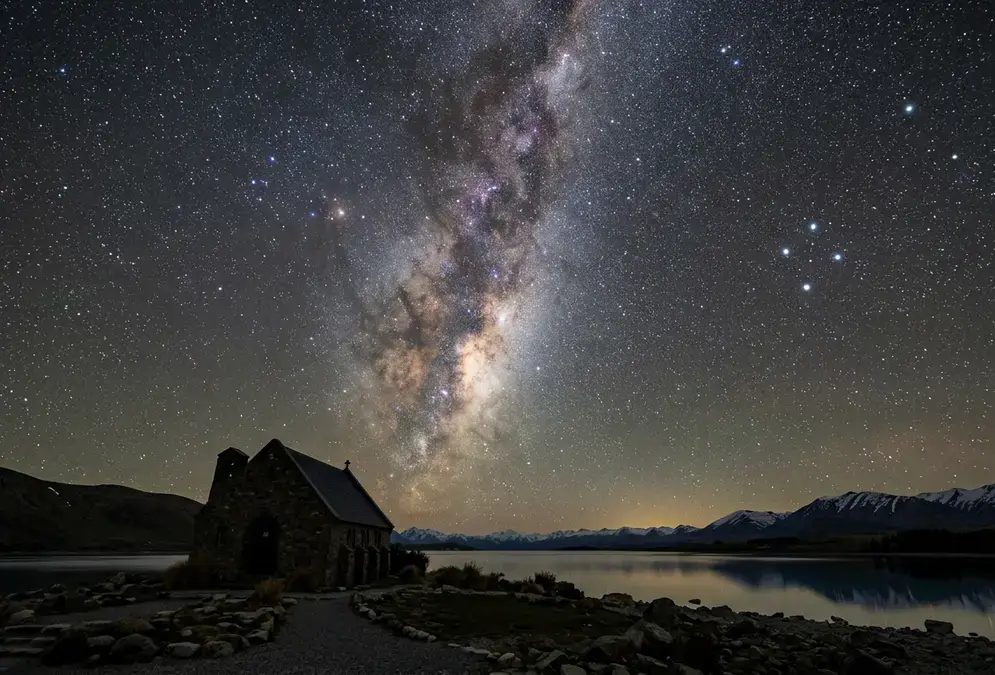
Featured · Destination
Aoraki Mackenzie Stargazing
Aoraki Mackenzie is one of only four Gold Tier Dark Sky Reserves on Earth: Bortle 2 skies over Lake Tekapo, the Southern Cross, and Mount John Observatory tour.
Matariki is the Pleiades, and Ngāi Tahu also mark it. 1News reports that Matariki and Puaka form part of a greater constellation from a Māori perspective[14].
Two more terms turn up in every account. The maramataka is the Māori lunar calendar, and Rehua is Antares[15]. Te Karaka adds that Rehua is the deity associated with all knowledge[16]. Tewera Kingi, quoted by Te Ao Māori News in 2019, spoke of "the sacred journey of the dead, to Puanga, to the star Rehua as well"[17]. That is not a weather rule. It is the part of this lore to listen to rather than repeat.
Te Manahuna, tuna and the dark of the moon
Te Manahuna has long been a seasonal hub for Ngāi Tahu, a place for mahinga kai (food gathering), trade and whānau journeys across Te Waipounamu[18]. The sky was part of the logistics. Campbell links stars, seasons, mahika kai and tuna (eel) practice[19]. Mahinga kai and mahika kai are one term in two dialect forms.
The sharpest example is not from the basin at all. The Science Learning Hub video has speakers from the Ngāi Tahu hapū Taumutu and Wairewa timing tuna gathering by the Moon, by the hinapōuri, the dark nights, and by the constellations that guide mahinga kai[20]. I use it to show how the system works, not as a record of Te Manahuna.
Te Karaka, Ngāi Tahu's magazine, records a guide tying one constellation's appearance to the tuna being plentiful and ready to harvest[21]. It does not name the constellation, and neither will I.
The dark of the moon is also when a stargazer's window opens, so the old and new calendars agree. The best time for stargazing at Aoraki Mackenzie works through moon phase and season for planning.
Mount John, above Lake Takapō, is Ōtehīwāi, an ancestral mountain[22]. The Mt John observatory guide covers the practical side of visiting it.
Meeting it at Takapō
Ngāi Tahu's stake in the operator, then called Earth & Sky, arrived in 2016[2], four years after the reserve was designated[4]. So the iwi layer is a later addition to a sky-quality story, which is worth knowing when you judge how central it is to a given tour. In Te Ao Māori News's 2019 coverage, a speaker described the result as a story that blends Ngāi Tahu astronomy stories with traditional astronomy and science[24].
The reserve behind it covers Aoraki / Mt Cook National Park and the Mackenzie Basin[25]. DarkSky International lists it at 4,367 km²[3], designated in 2012[4]. Its profile says the reserve seeks to honour the Māori star-lore history by keeping the night sky a protected part of the cultural landscape[26]. That is a stated aim, not a measurement, and I can't tell you from here how it works on the ground.
A caution on my own sources: the 2025 and 2019 pieces are told largely through people at the operator, so they are partly promotional. Te Karaka, Ngāi Tahu's own magazine, gives firmer footing. Its feature on the project names a mana whenua working party of rūnanga members nominated from Arowhenua, Waihao and Moeraki[27]. Dr Rangi Mātāmua, who consulted on the star lore, says the risings he calculated fell into "complete sync" with what they described[28].
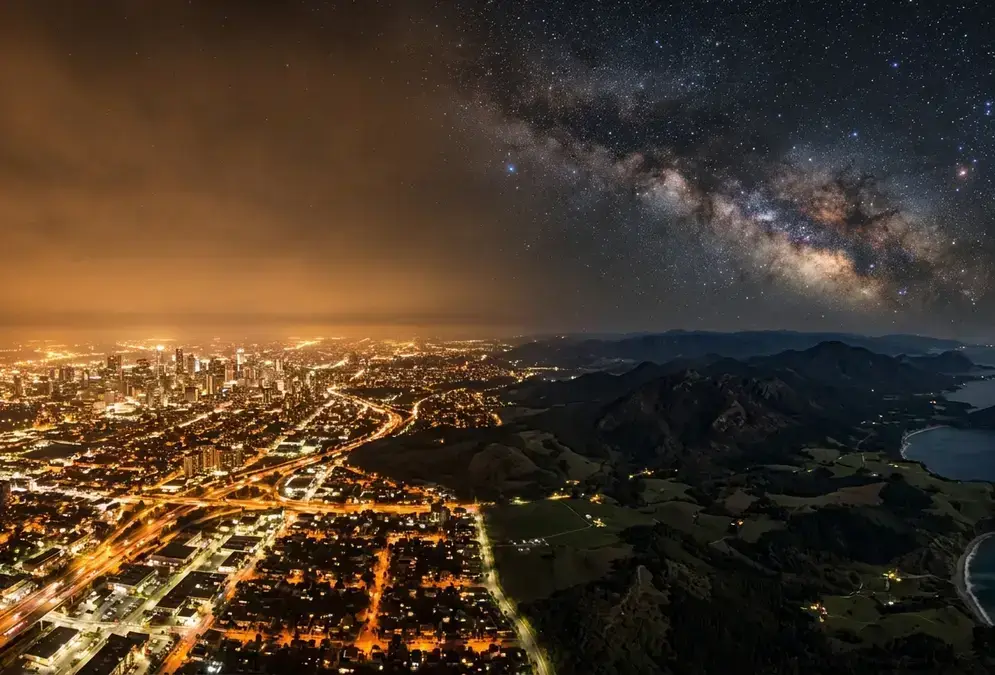
Featured · Article
What Is Light Pollution? Definition, Types, and Solutions
Light pollution is artificial light brightening the night sky, affecting 80% of the world. Learn the 4 types, wildlife and health effects, and how to fix it.
For planning, the Aoraki Mackenzie stargazing destination page lists what is bookable. I can't tell which tours include Ngāi Tahu storytelling, so ask before you book.
How to listen without borrowing
A few habits keep a visit honest, whichever tour you take:
- Ask whose story it is: Ngāi Tahu, another iwi, or Māori generally.
- Use the regional forms the sources use: Aoraki, Takapō, Te Manahuna, Puaka.
- Pick a dark-moon night, so the stories and the sky are both at their best.
- Treat the journey-of-the-dead material as something you hear, not something you retell.
The discipline travels. My piece on Stoney Nakoda star knowledge near Jasper reached the same finding: the published record is narrower than the marketing, and saying so is part of respecting it. On the night itself, dark sky etiquette covers lights and manners.
What I can't give you is the lore told by its holders. Take the names and the habit of attribution, and let the iwi voices at Takapō do the rest.