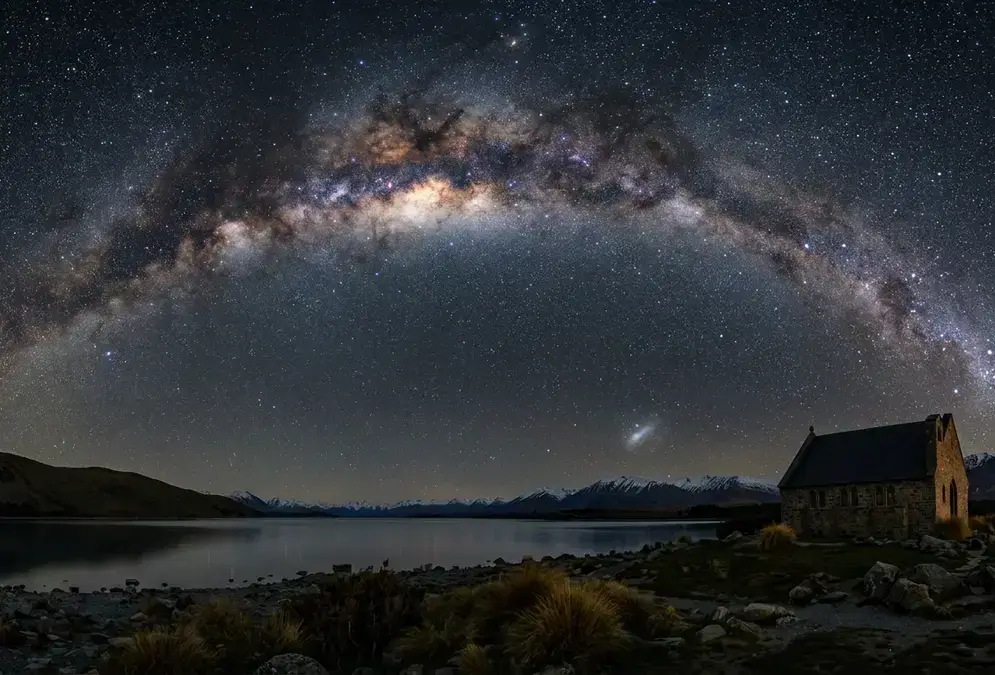

The southern sky is a different sky entirely
Most stargazing advice assumes a Northern Hemisphere sky: Polaris fixed overhead, the Big Dipper wheeling around it, a faint summer smear of Milky Way low on the horizon. None of that holds at Aoraki Mackenzie. Stand at Lake Tekapo on a clear night and the sky reorganizes itself around objects a stargazer in Chicago or Berlin will never see from home, not because of some trick of timing but because those objects sit permanently below their horizon.
Aoraki Mackenzie is a Gold Tier International Dark Sky Reserve, the largest dark-sky reserve anywhere in the Southern Hemisphere[1], and that rating matters for a specific reason here: every object in this guide needs real darkness to show its actual structure rather than a washed-out smudge. A Bortle 2 sky doesn't just make the Magellanic Clouds, the Southern Cross, Omega Centauri, and the galactic core visible. It makes them look like what they are.
Four things set this sky apart from anything visible north of the equator:
- Two satellite galaxies of the Milky Way, bright enough to see without a telescope
- The smallest constellation in the sky, and one of the easiest to find
- The richest globular cluster visible from Earth, an ancient swarm of stars dense enough to look like a single fuzzy star
- A galactic core that climbs directly overhead instead of skimming the horizon
Each one gets its own section below: what it actually is, when it's up, and what changes once you're looking at it through Aoraki Mackenzie's dark sky instead of a suburban one.
The Magellanic Clouds: two galaxies visible without a telescope
The Large Magellanic Cloud sits roughly 160,000 light-years away, and its smaller companion, the Small Magellanic Cloud, sits further out at around 200,000 light-years; neither is a star or a nebula, whatever their soft, cloud-like appearance suggests, but two entire satellite galaxies orbiting the Milky Way, the largest such galaxies it has, bright enough to see with the naked eye and visible every single night of the year from this latitude since both are circumpolar here[2].
Look south of the Southern Cross on any clear, moonless night at Aoraki Mackenzie and you'll find them: two faint, detached patches of light that look like someone tore a small piece off the main band of the Milky Way and set it down on its own. Binoculars resolve real texture in both clouds under Aoraki Mackenzie's Bortle 2 sky, faint knots and clumps the naked eye can only guess at, so if you're carrying even a small pair, use them here before anywhere else on the list.
160,000 vs 200,000 light-years
The Southern Cross and the dark patch beside it
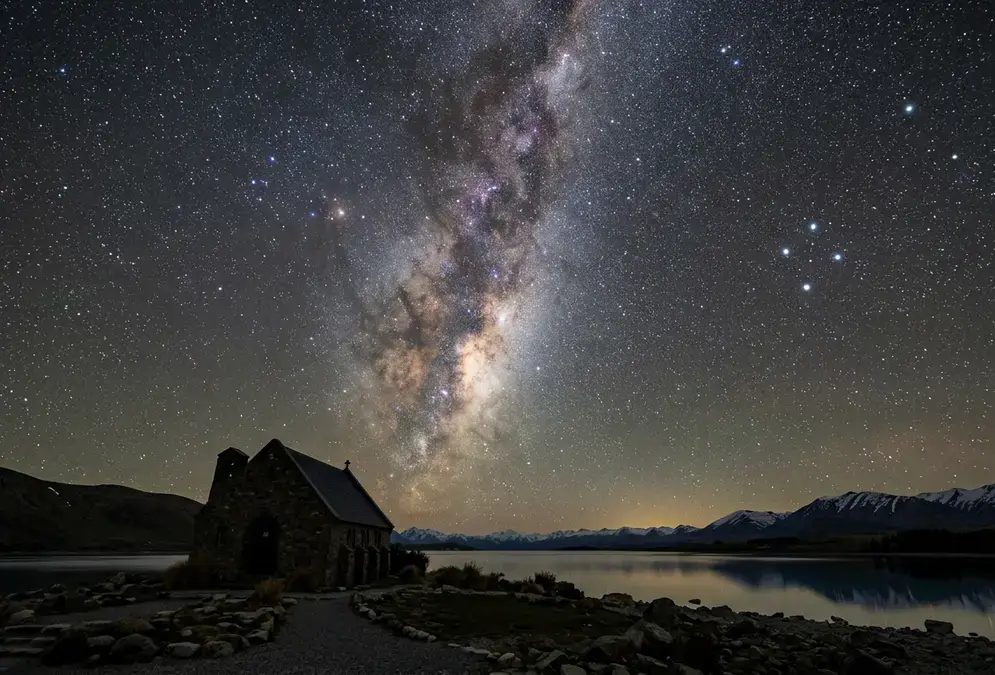
Crux, the Southern Cross, is the smallest of all 88 modern constellations, yet it's one of the easiest to spot: each of its four main stars is bright enough that the shape reads instantly against the rest of the sky[3]. It's also circumpolar from Aoraki Mackenzie, up every night of the year regardless of season, the one object in this guide that never asks you to check a calendar first.
The Southern Cross does real work beyond looking good in photos. In the Southern Hemisphere it's used for navigation the way Polaris is used up north: extend the long axis of the cross roughly four and a half times and you land close to the south celestial pole[4]. It's a trick sailors and Pacific navigators have relied on for centuries, and it still works exactly the same way standing on the Lake Tekapo shoreline tonight.
Just to the southeast of the Cross sits something you won't find on a star chart the usual way: the Coalsack Nebula, a dark patch spanning roughly 7 by 5 degrees of sky[5], big enough to read as a genuine gap in the Milky Way's glow rather than a smudge. It isn't glowing gas lit from within, the way most photographed nebulae are. It's cold dust blocking the light of everything behind it, and under Aoraki Mackenzie's dark sky it looks less like an absence and more like a hole cut clean out of the galaxy.
Omega Centauri: the globular cluster that outshines every other one in the sky
Omega Centauri is the largest and brightest globular cluster in the Milky Way, sitting in the constellation Centaurus roughly 17,000 light-years from Earth[6]. To the naked eye it reads as a fuzzy, slightly-too-bright star, easy to miss if you don't know to look for it. Through even a modest telescope, that fuzz resolves into individual points of light: an estimated 10 million stars packed into a sphere about 150 light-years across[7], one of the densest concentrations of stars visible from Earth.
Recommended tours
Tours are selected for quality, not commission. I earn a small fee if you book — at no extra cost to you.



Timing matters more here than for the Southern Cross or the Magellanic Clouds. Omega Centauri is at its best during the austral autumn, roughly March through May[8], well before Aoraki Mackenzie's June-to-August winter season even begins. By June the cluster has already slipped past its peak and keeps sliding lower toward the horizon earlier in the night as winter deepens. If seeing Omega Centauri specifically is the point of the trip, lean toward those autumn shoulder months rather than assuming any winter date works equally well.
Featured · Destination
Aoraki Mackenzie Stargazing
Aoraki Mackenzie is one of only four Gold Tier Dark Sky Reserves on Earth: Bortle 2 skies over Lake Tekapo, the Southern Cross, and Mount John Observatory tour.
Aoraki Mackenzie's own public stargazing programme runs telescope sessions from Mount John Observatory specifically because objects like this reward magnification so directly: a cluster that's a smudge to the naked eye becomes a genuine field of stars the moment real aperture gets involved. Basing yourself close enough to make a late session easy is worth the planning, and Lake Tekapo Lodge puts you within walking distance of the shoreline for whatever the sky does after the tour ends.
Why the galactic core looks different from the other side of the world
Season decides one thing at Aoraki Mackenzie and geography decides another, and it's easy to conflate the two. New Zealand's winter, June through August, brings colder, typically drier air and earlier nightfall, extending the dark hours available for any kind of observation[9]. That's the seasonal half of the story.
The geographic half is bigger. From the Southern Hemisphere, the galactic core, the dense, dust-choked hub of the Milky Way, sits dramatically higher in the sky and noticeably brighter than it ever appears from Europe or North America[10]. From up north, the core skims low along the southern horizon, fighting through the thickest slab of atmosphere on the way up and whatever light pollution sits along that skyline. From Aoraki Mackenzie during winter, it climbs close to directly overhead. You're not craning your neck at a horizon glow. You're looking straight up into the brightest, most crowded part of our own galaxy.
| Aspect | Northern Hemisphere view | Aoraki Mackenzie view |
|---|---|---|
| Galactic core position | Low on the horizon, through thick atmosphere | Close to directly overhead in winter |
| Southern Cross | Never rises | Circumpolar, up every night of the year |
| Magellanic Clouds | Never rise | Circumpolar, visible year-round |
| Omega Centauri | Low or absent depending on latitude | High and well-placed March through May |
None of this is about better equipment or technique. It's about standing in a different place on the planet, at the right time of year, under a sky dark enough to actually show the difference, with moon phase mattering as much as the month. For the exact dates to build a trip around, Best Time for Stargazing at Aoraki Mackenzie works through the full calendar.
Planning a night under the southern sky
None of the objects in this guide require specialist equipment. The Magellanic Clouds and the Southern Cross are naked-eye sights on any clear night, Omega Centauri rewards a modest telescope or a Dark Sky Project session at Mount John, and the galactic core simply requires being here in the right season. What all of them need in common is a dark, moonless sky, so check the lunar calendar before the travel calendar, whichever month you land in.
If Aoraki Mackenzie isn't the only Southern Hemisphere sky under consideration, it's worth being clear about what makes it different from Atacama: Atacama earns its reputation from bone-dry, high-altitude desert, while this reserve earns its from an alpine lake district that simply never lost its dark sky to development, with a working public observatory built directly into the visit. Aoraki Mackenzie is one of the Gold Tier reserves profiled in best dark sky parks in the world, and this list of southern-only objects is the reason it holds its place there.
Wherever you base yourself, book at least two nights: cloud cover cancels a real share of stargazing sessions here depending on season, and a single evening is closer to a coin flip than a plan. A room with the sky built into it, rather than a hotel that treats the reserve as background scenery, makes the difference between a trip built around a checklist and one built around actually seeing everything on it.
Read next · Lodge
Galaxy Boutique Hotel
At Galaxy Boutique Hotel, skylights above the bed frame the Milky Way in the only Dark Sky Reserve south of the equator. Lake Tekapo, no telescope required.