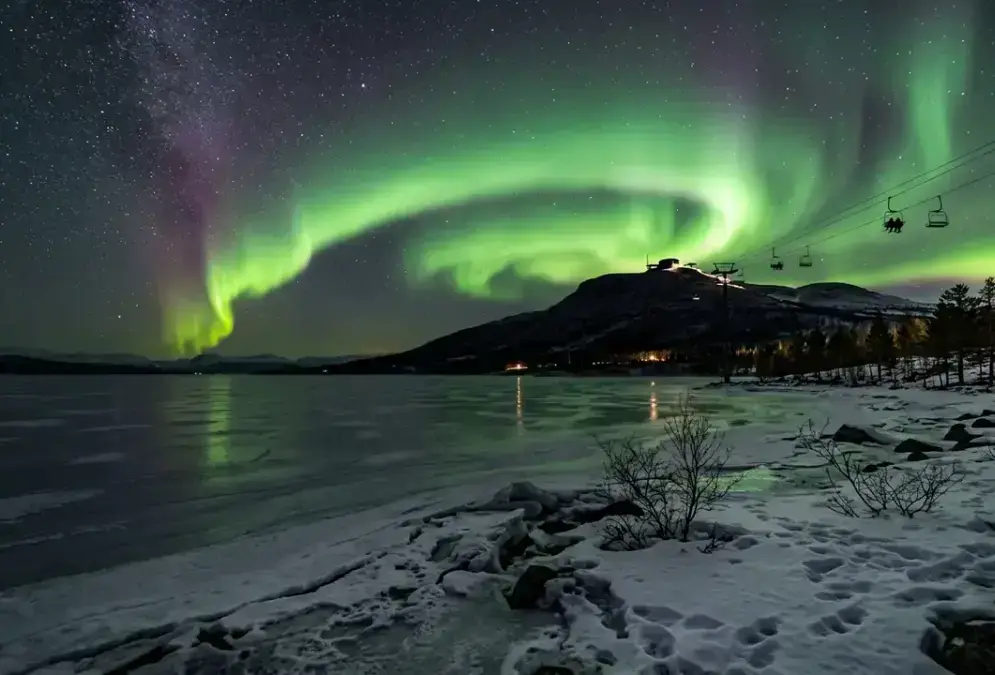

Why Abisko's blue hole determines where you should stand
Every stargazing spot on this list sits inside the same weather anomaly: a reliable break in the clouds that locals and aurora guides call the blue hole. Atlantic weather rolling in off the ocean crashes into the mountains on the Norwegian side of the border before it reaches Abisko, tearing a patch of open sky roughly 10 to 20 square kilometres wide that sits almost precisely over the village and the national park around it[1]. Rain and snow fall on the Norwegian slopes; the sky over Abisko, more often than not, stays clear.
That's the reason four specific spots are worth naming rather than lumping them into one generic 'go to Abisko and look up' recommendation. Aurora Sky Station, the Torneträsk lakeshore, the Abisko canyon trail, and the grounds at STF Abisko Turiststation all sit under the same patch of clear sky, but they differ enough in elevation, cost, walking distance, and shelter from wind that picking the right one for a specific night, rather than defaulting to whichever is best-known, changes what you actually see.
Rain and snow fall on the Norwegian slopes; the sky over Abisko, more often than not, stays clear.
This piece sticks to the ground-level map. The rain-shadow physics behind why the blue hole forms, and how reliably it holds up against the rest of Swedish Lapland's weather, is its own subject; what matters here is knowing where to stand once you've arrived, and on which kind of night.
Aurora Sky Station: the panoramic option on Mt Nuolja's shoulder
The best-known of the four is also the only one you don't reach on foot. A chairlift ride of about 30 minutes carries visitors from STF Abisko Turiststation up Mt Nuolja (Njulla) to Aurora Sky Station, a purpose-built viewing facility at 900 metres, still 264 metres below Njulla's own true summit at 1,164 metres[2]. STF (Svenska Turistföreningen), the nonprofit that runs both the tourist station and the Sky Station, frames that elevation modestly: you're 'higher up, closer to the sky,' which it credits for better viewing conditions, not a guarantee of sitting above the region's cloud layer.
There's no maintained public trail up to the station as a stargazing alternative to the chairlift. Official materials describe the lift, not a walk-up route, so budget for the ticket rather than planning around hiking up on a clear-forecast night. Once you're there, the appeal is the panorama and the amenities built around a long, cold wait:
1,164 m
- An outdoor viewing terrace
- An indoor lounge with a fireplace
- A café
- A small northern-lights exhibition
- Evening talks on how the aurora actually forms
None of that changes the physics of the sky above you, but it changes how comfortably you can stay out under it for three or four hours, which for most first-time visitors matters more than a few hundred extra metres of elevation. Dress like you're settling in for an overnight watch, not an evening event: even with the fireplace lounge available, most of the actual viewing happens outdoors on the terrace, where temperatures drop hard once the sun is gone.
Book the Aurora Sky Station night visit ahead of a forecast-favourable night rather than assuming you can walk up on a whim. The operation caps nightly capacity, and slots on clear-sky evenings sell out fast during peak season.
Torneträsk lakeshore: the open horizon you can walk to
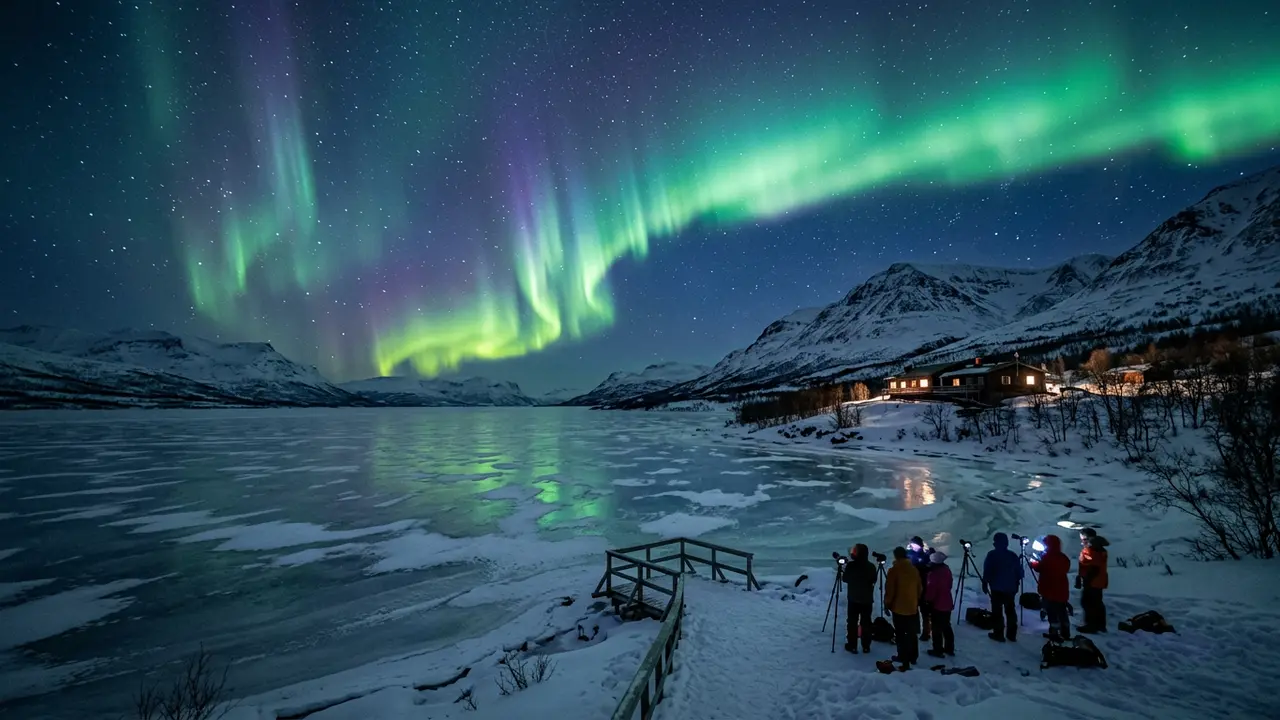
For a free alternative to the chairlift, walk down from STF Abisko Turiststation to the shore of Lake Torneträsk, inside Abisko National Park. The lake gives you what the forest and the village buildings don't: an open, unobstructed horizon with nothing between you and the northern sky, and a flat foreground that works for wide-angle framing without a single tree branch cutting into the shot.
The aurora season here runs August through April, with the highest chances from mid-November through mid-March[3], a window that overlaps with Abisko's own brief polar night, the short winter stretch when the sun never clears the horizon at all. For most of that season, Torneträsk is frozen solid. That matters for how you plan around this spot: the water-reflecting-the-aurora image that shows up in a lot of Lapland marketing only really applies during the brief unfrozen window in early autumn, roughly late August into September, before ice sets in and holds through spring. Visit any later in the season expecting a mirror-still lake and you'll find ice instead, a legitimate photography surface, just not a reflective one.
On the ice itself: some visitors do walk out onto the frozen lake for a clearer view or a different composition, but there's no official ice-thickness guidance or safety sign-off for this stretch of shoreline, and conditions vary year to year and month to month. Stay on the marked shoreline and any clearly trodden routes near it rather than testing the ice on your own judgment. A slightly wider photo angle isn't worth the risk on a lake this size and this cold.
Featured · Destination
Abisko Stargazing
Abisko's rain-shadow microclimate keeps skies clear when nearby Arctic spots cloud over. Aurora season, the Sky Station, ICEHOTEL, and getting there by train.
Abisko canyon: the sheltered option on a brutal night
The Abiskojåkka canyon trail, a short loop along the frozen river with lookout points over the gorge[4], is a genuinely nice walk close to the village, but it's worth being honest about what it is: a scenic hiking route with windbreak rest areas along the way, not a spot with any documented stargazing advantage over the lakeshore or the Sky Station.
What it does offer is real wind shelter. On a clear night that's also brutally windy, an exposed lakeshore or an open mountain terrace can turn a 45-minute stargazing session into a 10-minute one, and the canyon's rock walls cut that wind in a way the other three spots can't. If the forecast reads clear-but-gusty rather than clear-and-calm, this is the spot that keeps you outside longer, even if the sky view itself isn't as wide open.
Treat it as a fallback for cold, windy conditions, not a first choice. On a calm, clear night, the lakeshore or the Sky Station's open horizon shows you more sky than the canyon walls will let through.
STF Abisko Turiststation grounds: the no-effort option
If neither a chairlift ticket nor a walk down to the lake appeals on a specific night, the ground right outside STF Abisko Turiststation works too. The aurora doesn't care how high up you're standing; the aurora oval is hundreds of kilometres wide, and the geomagnetic activity driving it plays out at roughly the same intensity whether you're watching from 900 metres up Nuolja or from the station's own front steps. What changes with elevation is the panorama and the distance from any stray light, not the fundamental chance of seeing anything at all.
That makes the station grounds the practical default on a night when you're not committed to a specific plan: no lift ticket, no walk in the cold and dark, just steps outside the door of the trailhead lodge itself, if that's where you're staying. It's the least dramatic of the four spots, and also the one most people actually use on a random clear hour at 11pm, when getting dressed for a lakeshore walk feels like too much effort.
Choosing between the four spots, and when to go
None of these four named spots beats the others outright, and treating this as a ranked list would be dishonest. Each trades convenience for something else:
Recommended tours
Tours are selected for quality, not commission. I earn a small fee if you book — at no extra cost to you.


- Aurora Sky Station — the best panorama and the most comfortable long wait, at the cost of a ticket and a fixed chairlift schedule
- Torneträsk lakeshore — free, open-horizon, and walkable, with a real ice-season caveat and no official ice-safety guidance
- Abisko canyon — the wind-shelter option for a brutal-but-clear night, not a superior sky view
- STF station grounds — zero effort, the same aurora chance as anywhere else nearby, just a smaller panorama
| Spot | Access | Cost | Best for |
|---|---|---|---|
| Aurora Sky Station | 30-min chairlift up Mt Nuolja | Paid ticket | Panorama, long comfortable sessions |
| Torneträsk lakeshore | Short walk from STF station | Free | Open horizon, wide-angle photography |
| Abisko canyon | Short walk from the village | Free | Shelter on a windy clear night |
| STF station grounds | Steps from the door | Free | Zero-effort default |
Weather, not ambition, should usually decide which one you pick on a given night. Abisko's location backs that approach: the region records some of the lowest precipitation totals anywhere in Sweden or the wider Scandinavian region[5], which is the whole reason this blue hole is worth building a trip around rather than picking a bigger-name Arctic destination on reputation alone. But 'usually clear' isn't 'always clear,' and a single night rarely goes exactly to plan.
Give yourself several nights rather than betting on one, check a same-night forecast before committing to the chairlift over the free lakeshore walk, and read up on how to interpret that forecast before you travel. Kp index explains what the geomagnetic number in every forecast app actually means, and the best aurora forecast apps covers which tools are worth checking against each other rather than trusting blind.