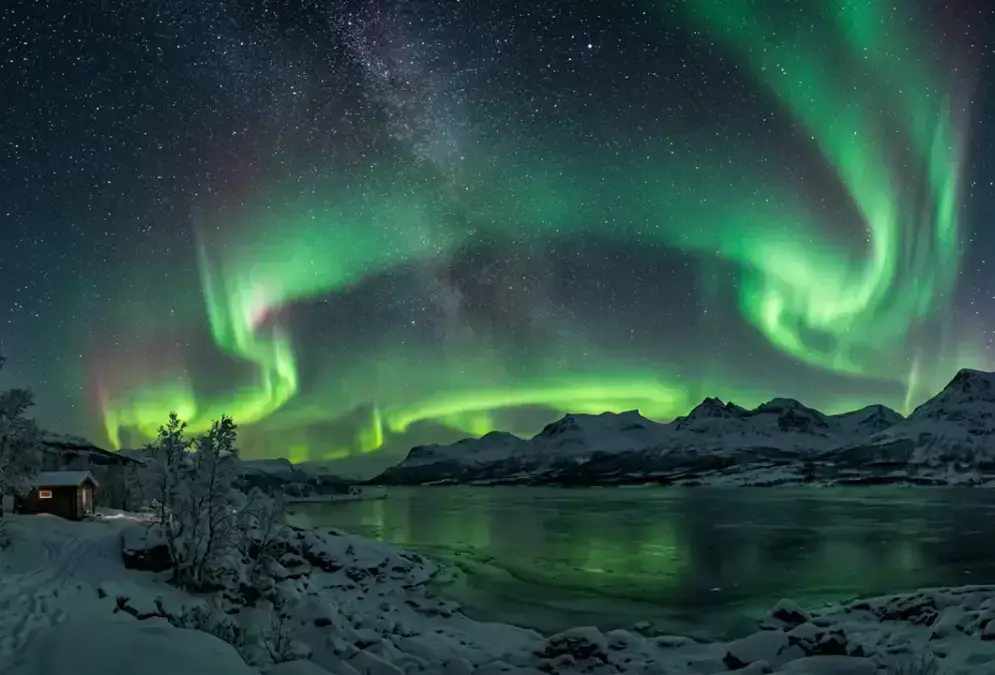

The 'blue hole': why Abisko's sky clears when the coast doesn't
Abisko National Park sits well inside the Arctic Circle, in Norrbotten County, on the northern shore of Lake Torneträsk. That location alone wouldn't make it a stargazing destination. What does is a nickname locals and the Svenska Turistföreningen (STF) use for the valley: the 'blue hole', because "the sky here is often clear even when it is cloudy nearby, and the dark months are many"[1].
The mechanism behind the nickname is a real microclimate, not marketing. A stable, jet-stream-driven wind moves in from the Arctic Ocean and crosses the mountains separating Abisko from the Norwegian coast[2], and that pattern holds a pocket of clear sky over the valley on nights when Tromsø, roughly 144 km northwest across the border[8], sits under cloud. Locals and aurora guides describe Abisko as clearer than Tromsø on any given winter night. No verified figure backs an exact percentage, so treat any specific number you see quoted online with suspicion, but the underlying mechanism, mountains blocking Atlantic moisture before it reaches the valley, is genuinely documented.
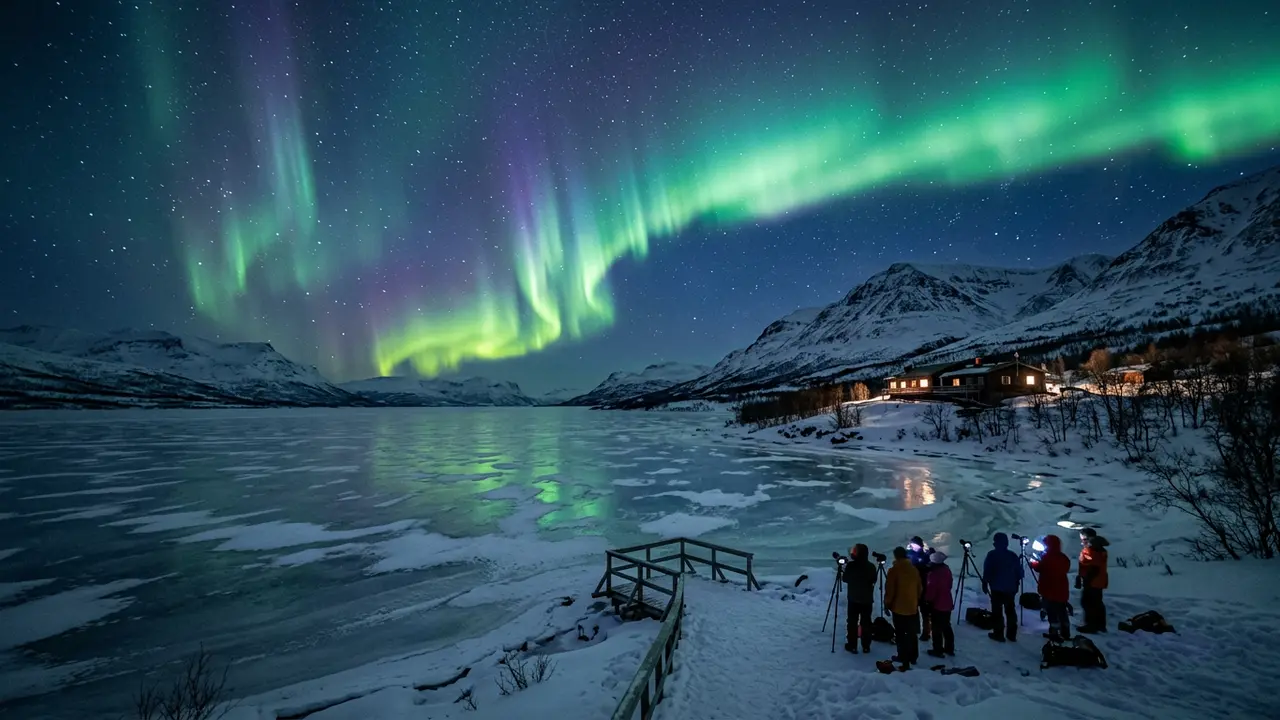
Featured · Destination
Abisko Stargazing
Abisko's rain-shadow microclimate keeps skies clear when nearby Arctic spots cloud over. Aurora season, the Sky Station, ICEHOTEL, and getting there by train.
None of this makes Abisko immune to cloud. It tilts the odds further in a stargazer's favor than most Arctic aurora destinations manage, which is exactly why the Aurora Sky Station, the mountain-top viewing platform covered later in this guide, built its whole pitch around the same microclimate.
The season: late August through April, with one obvious peak
STF states it plainly: the northern lights can be seen from August to April, with the highest chances from mid-November to mid-March[3]. That's a wider window than most Arctic aurora destinations claim, and it tracks almost exactly how much darkness Abisko gets each month rather than any special behavior in the aurora itself.
Late August and September open the season as real darkness returns after the summer's midnight sun, which runs roughly mid-May to mid-July here and leaves no true night sky at all[4]. By October, nights are properly dark and long enough for a full viewing session. By December and January, near-round-the-clock darkness stacks the odds about as high as anywhere on Earth gets them.
| Window | Darkness | Aurora chance | Trade-off |
|---|---|---|---|
| Late Aug-Sept | Returns after midnight sun ends | Building, below peak | Mild temperatures, early booking |
| Late Sept-Oct / late Mar-Apr | Long, properly dark nights | Equinox-boosted (Russell-McPherron) | Moderate cold, modest geomagnetic edge |
| Mid-Nov to mid-March | Longest of the year, true polar night for several weeks | Highest, per STF | Genuine Arctic cold, heaviest gear needed |
The trade-off across this whole window is comfort, not sky quality. Early-season September nights are cool but manageable in a warm jacket. Deep-winter viewing means genuine Arctic cold, and building a trip here means picking a spot on that trade-off rather than assuming one month wins outright. The moon-phase side of that decision, independent of season entirely, is explained in when to stargaze.
Deep winter (mid-November to mid-March): the darkest window, and a real polar night
Deep winter is where STF's own numbers point: the highest chances of the whole season, driven by the longest run of darkness Abisko gets all year. Part of that darkness is a genuine polar night, despite what some cautious travel copy implies.
At Abisko's latitude, roughly 68.35°N, the sun doesn't clear the horizon at all for a real stretch each winter, commonly cited as running from around December 7 to January 7[5]. Even during that stretch, some indirect twilight glow still reaches the valley around midday, a pale blue half-light rather than full darkness, but that's an additional detail, not proof the sun is technically rising. A sun that never clears the horizon is polar night by the standard definition, full stop.
~Dec 7-Jan 7
This distinction matters for two places Abisko often gets compared to. Tromsø, Norway sits further north still and gets a longer polar night, roughly seven weeks against Abisko's several. Fairbanks, Alaska sits far enough south that it gets ordinary, if brief, sunrises and sunsets right through the December solstice and has no true polar night at all. Abisko's version is real, just shorter than Tromsø's, worth knowing before building a trip around exactly how dark deep winter here actually gets.
The equinox effect: why some aurora hunters don't wait for solstice
Deep winter wins on raw hours of darkness, but a smaller, well-documented pattern in aurora science favors the shoulder seasons instead. Geomagnetic activity runs statistically higher near the spring and autumn equinoxes than near the solstices, a pattern known as the Russell-McPherron effect. The mechanism comes down to how Earth's magnetic field lines up with the solar wind around the equinoxes, a geometry that makes it easier for solar particles to connect with the planet's magnetosphere and trigger a substorm. For the fuller mechanics of what actually drives a display once conditions line up, this guide to the aurora's underlying physics covers the solar-wind side of the equation in more depth.
None of this means equinox nights beat deep winter outright. It means late September and late March, both already inside Abisko's dark-enough window, get a small geomagnetic tailwind on top of the darkness they already have. That's one reason experienced aurora photographers build trips around the shoulder seasons rather than assuming solstice darkness alone settles the question. Stack a new-moon night on top of an equinox week, and darkness, geomagnetic timing, and moonlight all start pulling in the same direction at once.
Getting up the mountain and into the park: Aurora Sky Station and the Malmbanan
Most of what decides a good Abisko night happens above the valley floor, which is exactly what the Aurora Sky Station exists for. A chairlift ride of about 30 minutes carries visitors up Mount Njullá (Nuolja) to the station itself, which sits at 900 metres above sea level[6], well above the haze that can sit in the valley even on a night when the blue hole is otherwise doing its job. The mountain's own summit climbs further still, to 1,164 metres[6].
Getting to Abisko in the first place means flying into Kiruna, then continuing by road or by the Malmbanan, the Iron Ore Line railway connecting Narvik on the Norwegian coast with Kiruna and Luleå in Sweden[7]. Kiruna Airport is the nearest air gateway, and Abisko itself sits directly on that rail line, which makes it one of the more straightforward Arctic aurora destinations to reach without renting a car.
Recommended tours
Tours are selected for quality, not commission. I earn a small fee if you book — at no extra cost to you.
None of the logistics matter if the sky above the chairlift turns out to be the same cloud sitting over the valley. Checking a forecast built specifically for aurora, rather than a general seven-day weather app, before committing to the ride up the mountain is worth the extra five minutes it takes.
Putting it together: picking your window
Three windows compete for a stargazer's calendar in Abisko, and none of them is the wrong answer. Late August into September opens the season with mild temperatures and returning darkness. The equinox weeks in late September and late March add a modest geomagnetic edge on top of whatever the season is already doing. Mid-November through mid-March delivers the deepest, longest darkness of the year, plus STF's own highest-chance rating, at the cost of genuine Arctic cold and a real stretch of polar night in place of any daylight at all.
Whichever window you pick, check the new-moon dates for your actual travel dates before locking in flights. A bright moon washes out faint aurora and the Milky Way regardless of how good the season otherwise is, and that's exactly as true in Abisko as it is everywhere else covered on this site. For the mechanics behind reading a forecast once you're on the ground, the Kp index explains the geomagnetic scale most aurora apps are built around, and the best aurora forecast apps covers which tools are actually worth checking before committing to a night on the mountain.