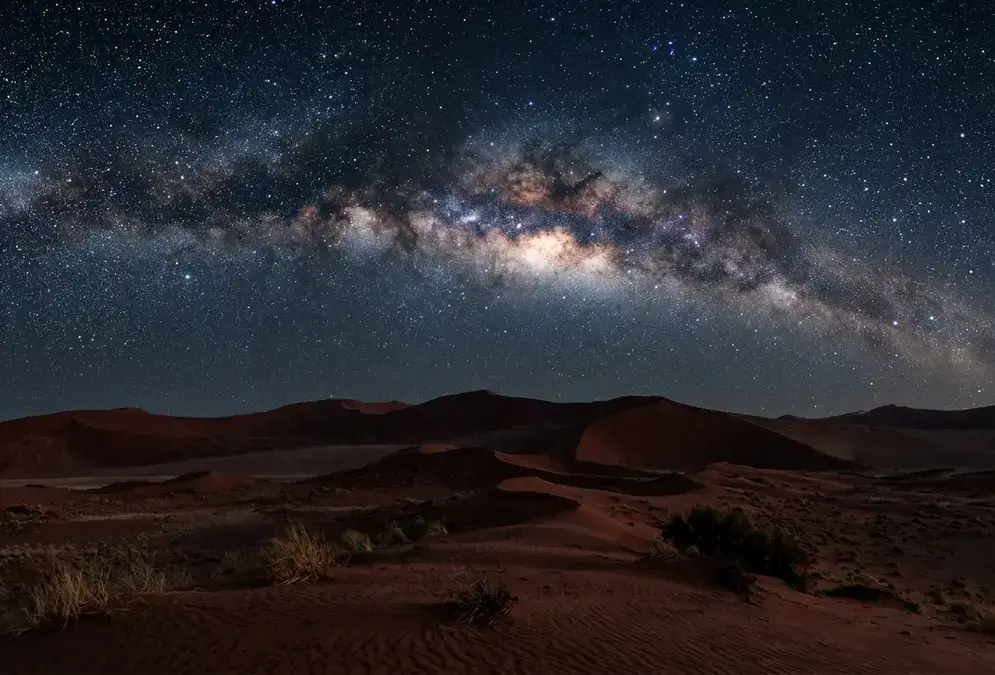

The wet season (November-April): greener, cloudier, but rarely truly dark
November through April is Namibia's wet season, and at NamibRand that mostly means occasional rain and passing cloud rather than a washed-out sky every night. The wettest, hottest stretch begins in November, builds through January, and runs into April, with daytime highs in January and February climbing to 30-35°C and desert peaks pushing past 40°C[2]. Afternoon storms roll through on some evenings, and a run of cloudy nights is a real possibility in a way it simply isn't from May to October.
What doesn't change is the darkness itself. NamibRand's reserve status isn't a lucky accident of aridity; it's actively managed. The reserve enforces maximum brightness limits on outdoor lighting and restricts vehicle headlights across the property[1]. That means a clear night in December is close to as dark as a clear night in July, even if clear nights come around less often during the rains. The wet season also greens the desert, filling grass across the dunes and drawing wildlife down from the escarpment, a genuine trade if landscape and game-viewing matter to your trip as much as the sky does.
| Factor | Dry season (May-Oct) | Wet season (Nov-Apr) |
|---|---|---|
| Rainfall | Little to none | Wettest Jan-Feb, building from Nov |
| Humidity | Low year-round | Higher, especially Jan-Feb |
| Daytime temps | 23-27°C (May) to 21-25°C (Jul-Aug) | 30-35°C, desert peaks 40°C+ |
| Sky darkness | Consistently clear | Still dark on clear nights, more cloud risk |
| Landscape | Dry, gold-toned dunes | Greener, more wildlife activity |
Treat the wet season as the scenery-and-budget option, not the reliable-sky option. If your travel dates only work in December or February, you can still have an extraordinary night. You just can't count on it the way a June or August visitor can.
Why the desert amplifies the sky's clarity
NamibRand earned Gold Tier status from the International Dark Sky Association, now DarkSky International, in May 2012: the first reserve in Africa and the first in any developing nation to reach that tier, and only the second place anywhere on Earth designated Gold Tier specifically because of how dark its skies are[1]. That darkness comes from two things working together rather than one: an empty landscape with essentially no artificial light for hundreds of kilometres, and an atmosphere that isn't fighting the view.
Dry air is the mechanism most stargazers never think about until they've stood under it. Water vapour in the atmosphere scatters and absorbs starlight before it reaches your eyes, part of why a humid coastal sky rarely looks as sharp as a desert one even on a technically clear night. NamibRand's near-zero humidity through the dry season, combined with its isolation from any significant light source, is the general reason its skies read as unusually transparent and not just unusually dark. That's standard atmospheric physics rather than anything unique to this one reserve, but it happens to work in NamibRand's favour for roughly six months of the year.
Featured · Destination
NamibRand Nature Reserve
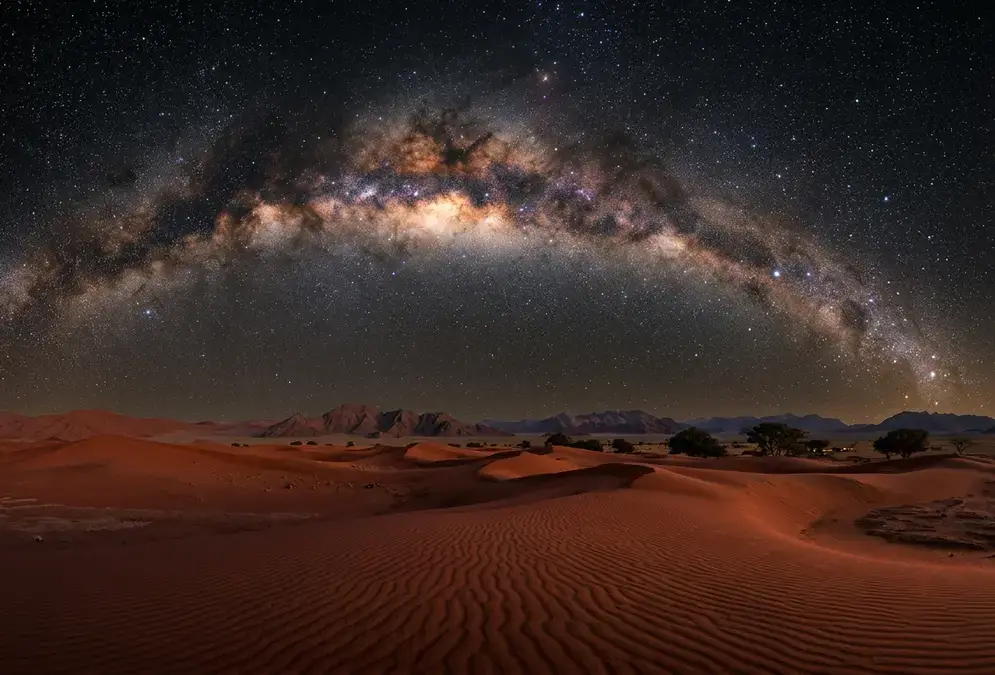
NamibRand is Africa's only Gold Tier Dark Sky Reserve: extreme Namib Desert isolation, the Southern Cross, Magellanic Clouds, and luxury safari lodges.
The darkest sky I've personally stood under was here, and what did it wasn't a Bortle number or an SQM reading. It was the horizon: no glow in any direction, nothing to give the eye a reference point for where the dark ended. That's harder to convey in a spec sheet than it is to just notice once you're standing in it.
None of that would matter without deliberate rules to back it up. NamibRand's own management plan enforces the lighting limits described above specifically to protect this natural clarity, treating the reserve's darkness as something to be actively defended, not just enjoyed as a lucky accident of geography.
The southern-hemisphere galactic-core calendar: what's overhead each month
NamibRand spans the southern reaches of the Namib Desert, well clear of the tropics, which puts the reserve in a strong position for the Southern Hemisphere's Milky Way season. That season runs from late January through late November, with the galactic core itself best positioned from late February through late October[3], a window that lines up closely with the dry season described above.
Recommended tours
Tours are selected for quality, not commission. I earn a small fee if you book — at no extra cost to you.
Inside that stretch, the core climbs highest and stays visible longest during the middle months, roughly June through August, the same run of weeks that also delivers the driest, clearest air of the year. Earlier in the season (March-April) and later (September-October), the core is still up for a solid portion of the night, just for a shorter window before it sets.
At this latitude, the Magellanic Clouds, two small satellite galaxies of the Milky Way, sit close enough to the southern celestial pole that they're visible on most clear nights rather than confined to one season, and the Southern Cross is up for the greater part of the year too. Neither needs the same careful timing the galactic core does; they're a reliable bonus on almost any dark, clear night at NamibRand, whatever month you land in.
If a camera is coming with you, how to photograph the Milky Way breaks down galactic-core timing and camera settings device by device, whether you're shooting on a phone, a DSLR, or a smart telescope.
New-moon planning: the variable that matters more than the season
Season decides whether the galactic core is up at all. The moon decides whether you can actually see it once it is. Regardless of which month you land in, the single best predictor of a good night at NamibRand is how close you are to new moon: new-moon nights, roughly midnight to 5am, give the darkest sky of the lunar cycle, and once the moon's illumination climbs much past about 30%, it's usually enough to wash out the Milky Way's faint dust lanes and dimmer detail[3].
Season decides whether the galactic core is up at all. The moon decides whether you can actually see it once it is.
That means checking moonrise and moonset times, not just the phase itself, especially around full moon. A full moon that sets before midnight still leaves several hours of genuinely dark sky before dawn; a first-quarter moon that doesn't set until 2am can eat into an evening session more than the phase alone suggests. Build the itinerary around the new-moon window first, then fit the season around it, rather than the other way round.
Under a genuinely dark, moonless sky, look also for the faint cone of zodiacal light rising along the ecliptic before dawn or after dusk, a phenomenon that needs the same near-zero light pollution NamibRand already has, and give your eyes time once astronomical twilight fully ends before judging how dark the sky really is.
In practice, a few nights either side of new moon, in any month from May to October, is the tightest combination available: dry-season clarity, strong galactic-core positioning, and a moonless sky. Land outside that window in the same season and you'll still get a clear night. You'll just be sharing it with more moonlight than you'd like. For the same logic applied to any dark-sky destination, not just this one, when to stargaze walks through how moon phase, season, and local weather forecasts fit together.
Putting it together: picking your exact week
Start with the season, then narrow to the moon. If dates are flexible, aim for May through October, ideally June through August if the galactic core is the priority and cold nights aren't a dealbreaker, or May and September if milder evenings matter more than squeezing out every last degree of sky quality.
Once a month is set, check that month's new-moon date and build the stargazing nights around it: the days immediately before and after new moon give the darkest sky with the least planning risk. A trip that happens to straddle full moon isn't wasted; it's just better suited to naked-eye orientation and planet-watching than deep Milky Way photography.
A short checklist before locking in dates:
- Season first: May-October for reliable clear skies; November-April only if scenery and wildlife matter as much as the sky
- Moon second: check the new-moon date for the chosen month and centre three to four nights around it
- Temperature: pack proper layers even in the hot months, since desert nights run cold whatever the daytime high says
- Backup nights: build at least two nights into any stargazing-focused stay, since a single scheduled evening is closer to a coin flip than a guarantee
None of this needs specialist gear to get right, just the sequence: season, then moon, then pack for the swing between them. Get those three in order and the reserve does the rest. Once on the ground, dark sky etiquette around red light and noise applies here as much as anywhere else on this list of destinations.