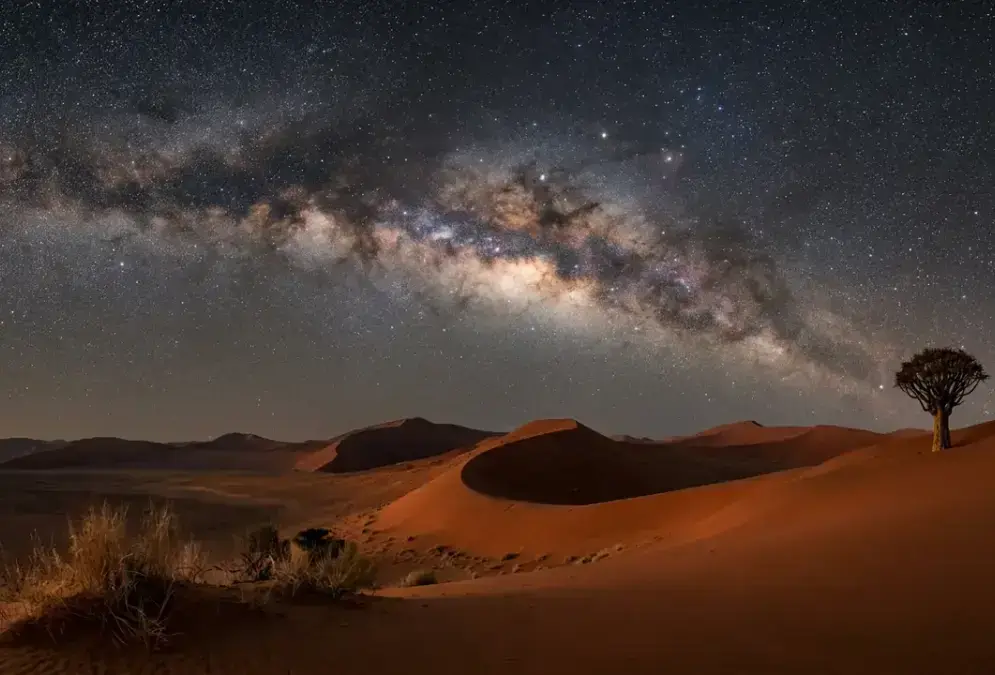

Why the Namib Desert's isolation makes this one of Earth's darkest skies
NamibRand Nature Reserve earned Gold Tier status, DarkSky International's strictest classification for an International Dark Sky Reserve, in May 2012[1]. It remains Africa's only reserve at that tier, and the reason has nothing to do with a mountain summit or a lake catching starlight on its surface. It comes down to what surrounds the reserve: essentially nothing.
NamibRand's own materials put the nearest neighboring communities at roughly 60 miles, about 100 kilometers, away in every direction[2]. There's no ridge glow from a town leaking over the horizon, no distant streetlight bleeding into a long exposure. Add the Namib Desert's near-total absence of atmospheric moisture, air dry enough that it rarely produces the haze that mutes a night sky even in genuinely rural places elsewhere, and you get a specific kind of darkness: not thin air at altitude, not a still lake, just empty ground in every direction and dry air overhead. For lodging, seasons, and the full reserve profile, see NamibRand Nature Reserve.
The Magellanic Clouds: two galaxies within naked-eye reach
The Large Magellanic Cloud sits roughly 160,000 light-years from Earth, one of the closest galaxies to our own[3], and it's bright enough to see without a telescope on any clear night from the Namib. Its smaller companion, the Small Magellanic Cloud, sits farther out and fainter, but still resolves as a distinct patch of light once your eyes have had ten or fifteen minutes to adjust.
Neither is a nebula or a star cluster, whatever their soft, cloud-like look suggests. Both are entire satellite galaxies orbiting the Milky Way, and from NamibRand's latitude they sit low in the southern sky year-round rather than skimming a horizon glow the way they would from a site with any real light pollution to the south. Binoculars resolve genuine texture in both clouds under this sky, faint knots and clumps of stars the naked eye can only guess at. If you're carrying even a compact pair on a Namibia trip, this is where to use them first; stargazing gear for beginners breaks down which spec actually matters for a first pair.
160,000 ly
The Southern Cross over the Namib, and why it isn't circumpolar here
Crux, the Southern Cross, only becomes truly circumpolar, meaning it never dips below the horizon, from around latitude 34°S and farther south: Cape Town, Adelaide, Buenos Aires[4]. NamibRand sits well north of that line, so the honest version of the claim you'll see repeated online is more modest: the Cross is visible for most of the year and easy to find on any clear night, but it does sit low, and briefly out of easy view, at certain hours rather than staying fixed overhead the way it does from higher southern latitudes.
That's a minor asterisk on an otherwise reliable sight. Four bright stars, unmistakable once you've spotted them once, mark the smallest of the 88 modern constellations. Pacific navigators and southern-hemisphere sailors have used its long axis to point toward the south celestial pole for centuries, and the trick works exactly the same way from a dune in the Namib as it does from a boat deck.
Featured · Destination
NamibRand Nature Reserve
NamibRand is Africa's only Gold Tier Dark Sky Reserve: extreme Namib Desert isolation, the Southern Cross, Magellanic Clouds, and luxury safari lodges.
Reorienting to a southern sky took me longer than I expected on my own trip here. The familiar Northern Hemisphere anchors just aren't there, and learning to find the pole off Crux instead of Polaris is a genuine adjustment, not something that clicks on the first night.
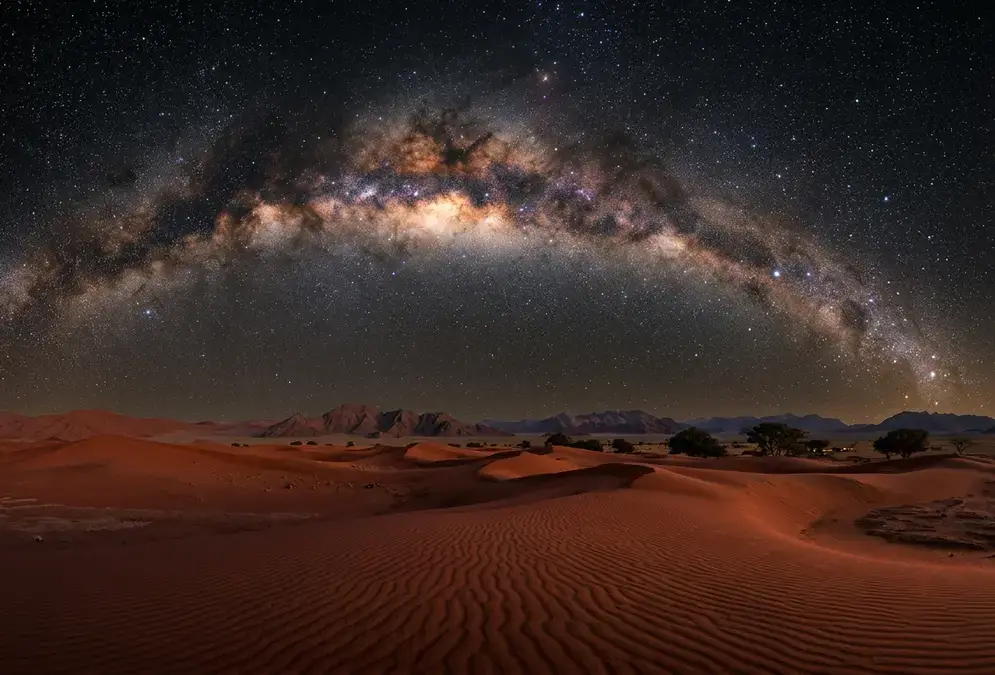
The galactic core: when austral winter puts the Milky Way overhead
In the Southern Hemisphere, the Milky Way's galactic core, the dense, dust-choked bulge at the center of our galaxy, is visible roughly February through October, with June and July, the heart of austral winter, offering the longest and highest views of the year[5]. That's a wide window compared to most Northern Hemisphere dark-sky sites, where the core barely clears the horizon for a few weeks each summer.
None of that requires special equipment. It requires being on the right side of the planet at the right time of year, under a sky dry enough that dust and haze aren't stealing the fainter structure before it reaches your eyes. Namibia's dry season, roughly May through October, overlaps most of that window, which is the rare case where the best astronomical timing and the easiest travel season point at exactly the same months.
Naked-eye Milky Way structure and the rare zodiacal light
On a moonless night at NamibRand, DarkSky International describes what's visible without any equipment at all: thousands of individual stars, the full arc of the Milky Way, both Magellanic Clouds, and the zodiacal light, a faint cone of sunlight scattered off interplanetary dust that's rare enough most stargazers never see it[6].
Zodiacal light shows up along the ecliptic, the path the sun and planets trace across the sky, usually as a soft pyramid of light rising from the horizon before dawn or after dusk. It needs exactly the conditions the Namib supplies without much effort: no moon, no artificial light anywhere near the horizon, and air clean enough that the faint glow doesn't get lost in scattered light from somewhere else. Most dark-sky destinations advertise it. Few actually deliver it on a given night. NamibRand's isolation is the reason it shows up here more reliably than almost anywhere else on a stargazing traveler's list.
“On moonless nights, with the naked eye, thousands of individual stars can be seen, as can the Milky Way. Also visible are the Magellanic Clouds and the seldom seen zodiacal light.”
Planning a night under the Namib sky
None of what's covered here needs a telescope. The Magellanic Clouds, the Southern Cross, and the naked-eye Milky Way are all visible with nothing more than dark-adapted eyes and a clear night, and a modest pair of binoculars sharpens all three considerably. What decides whether a specific night pays off is timing, not gear:
Recommended tours
Tours are selected for quality, not commission. I earn a small fee if you book — at no extra cost to you.

- Moon phase matters more than the calendar. A bright moon washes out the Magellanic Clouds and the zodiacal light before either has a chance to register.
- Season narrows the galactic core's best window to February through October, peaking in June and July.
- Cloud cover is rare here but not impossible. Namibia's wet season, November through April, brings brief afternoon storms, mostly January to March.
If a desert isn't the only southern sky under consideration, it's worth knowing what makes this one different from the alternatives. Southern Sky Stargazing Guide: Aoraki Mackenzie covers the same category of circumpolar southern objects from an alpine lake reserve, where altitude and a still lake surface do the work isolation does here. Why Is the Atacama Desert the Driest on Earth? explains a different desert's mechanism, driven by a mountain rain shadow and a cold ocean current rather than sheer distance from any settlement. NamibRand's darkness owes nothing to either of those forces. It owes everything to empty ground.
Getting there
Hosea Kutako International Airport in Windhoek is the usual gateway, and reaching a NamibRand lodge from there takes real commitment either way: several hours of self-drive on tarred and gravel roads, or roughly an hour by charter flight to a private airstrip near the reserve. Astrophotographers packing a camera body and a tripod get more out of this sky than most reserves reward equally well; how to photograph the Milky Way covers exposure settings suited to skies this dark.
What to bring
Desert nights swing hard here regardless of season: daytime heat gives way to temperatures that can drop to freezing after dark. Pack real layers, not a single fleece, and bring a red-light headlamp to protect night vision on any walk back from a dune-top viewing spot.