
Why NamibRand's best stargazing spots are lodges, not landmarks
Ask a guide in Aoraki Mackenzie or Chile's Atacama for the best stargazing spot and you get a landmark: a lakeside chapel, a mountain observatory, a named lookout. Ask the same question inside NamibRand Nature Reserve and the honest answer is different: there isn't one. NamibRand has no public viewpoint, no visitor center deck, and no single lookout that every guide sends you to.
That gap is a function of how the reserve works, not a hole in the marketing. NamibRand earned Gold Tier status from the International Dark-Sky Association in May 2012[1], the strictest category the designation offers, and it did so as a private conservation project rather than a national park with a visitor center. It was also the first Dark Sky Reserve in Africa and in any developing nation, and only the second reserve on Earth to reach Gold Tier at the time[2].
A consortium of lodge partners funds the reserve and enforces its lighting rules as a condition of operating inside it, which means the four properties below aren't simply near the dark sky. They're the reason it stays dark. So this list runs by lodge, not by lookout: a dune-top Star Bed, the reserve's one dedicated observatory, a private star-gazer room built into every chalet, and a working farmhouse under the identical sky. The NamibRand Nature Reserve hub covers the wider reserve, seasonal calendar, and access logistics in more depth than this list needs to.
Wolwedans Dune Camp: sleeping on top of a 250-metre dune
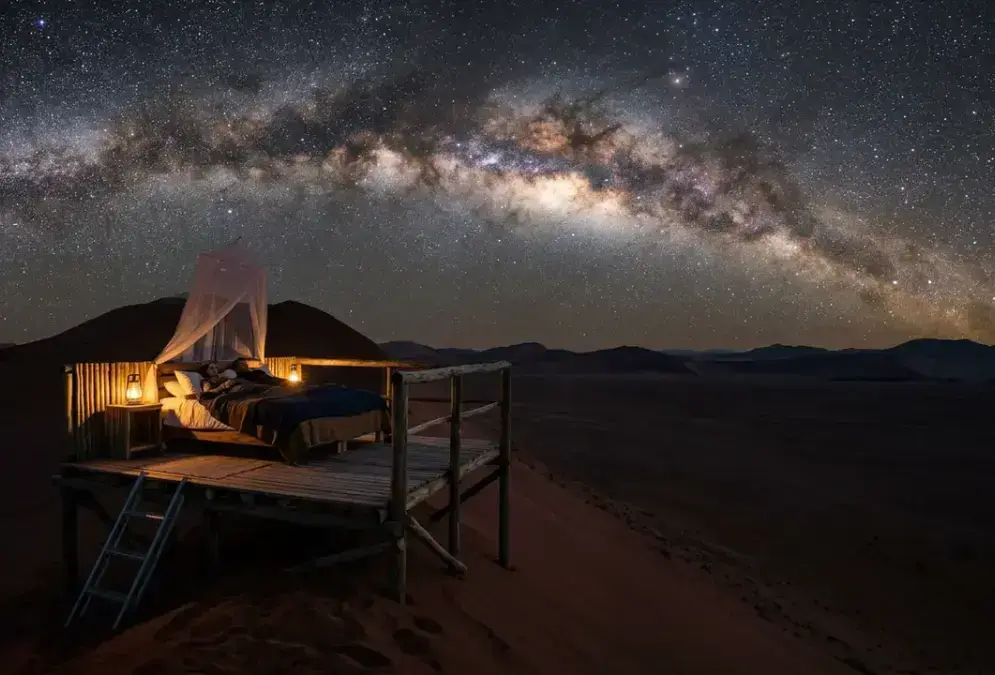
Wolwedans Dune Camp sits on the edge of a dune roughly 250 metres high, with Star Beds, open-air sleeping decks on private decks in every room at Dune Camp and the Mountain View Suite, free from light pollution and angled at nothing but sky[3]. Wolwedans is one of the original land partners whose farm purchases in the early 1990s became NamibRand itself, and Dune Camp is the operator's answer to the question of where to actually sleep under that sky.
The camp's stargazing offer isn't a scheduled session with a guide. Wolwedans markets the programme as officially recognised by the International Dark-Sky Association, positioning it as one of the best stargazing bases in Africa[4]. On a reserve where the nearest town is measured in hours rather than blocks, that recognition reads as accurate rather than a brochure line.
Featured · Destination
NamibRand Nature Reserve
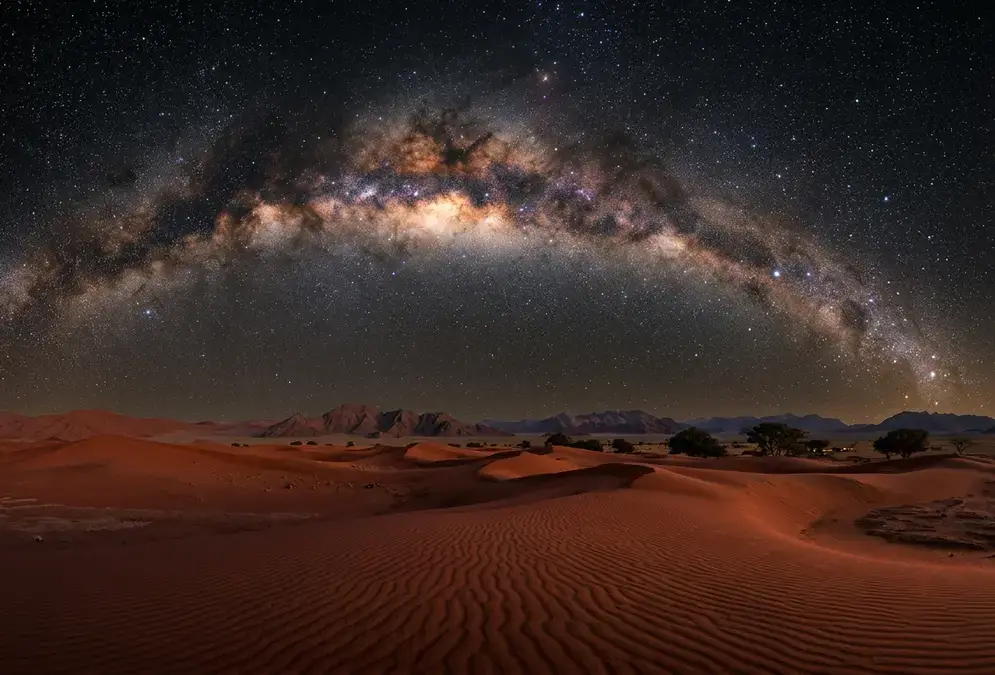
NamibRand is Africa's only Gold Tier Dark Sky Reserve: extreme Namib Desert isolation, the Southern Cross, Magellanic Clouds, and luxury safari lodges.
What you don't get here is a telescope or an astronomer walking you through the constellations. The Star Bed is naked-eye stargazing, on a deck built for exactly that and nothing else. Anyone who wants the observatory version of this trip should look one lodge down this list, to &Beyond Sossusvlei Desert Lodge.
&Beyond Sossusvlei Desert Lodge: the reserve's only observatory
This private Sossusvlei property borders NamibRand rather than sitting inside its official boundary, and it's the one property on this list built around real astronomy hardware. Guests can join a visiting astronomer at the lodge's dedicated observatory, equipped with a Celestron CPC 1100 GPS (XLT) computerised telescope, for a guided walk through the constellations, the Milky Way, and the visible planets[5].
That's the trade this lodge makes against Wolwedans Dune Camp: less naked-eye dune romance, more structured astronomy. A telescope this size resolves detail an open deck never will, Saturn's rings, the cloud bands on Jupiter, star clusters that are just a smudge to the naked eye. Sessions depend on the visiting astronomer's schedule though, so ask at booking which dates during your stay have one on-site rather than assuming it runs every night.
None of this replaces the sky itself. On nights without a session, the same Gold Tier dark that earned NamibRand its designation sits directly overhead, and the lodge's glass-fronted suites mean a fair share of guests do their stargazing from bed rather than the observatory deck at all.
less naked-eye dune romance, more structured astronomy
Kwessi Dunes: a private star-gazer room in every chalet
Kwessi Dunes solves the stargazing problem a third way. Instead of one shared deck or one lodge-wide observatory, every one of its twelve chalets has its own separate open-air 'star-gazer room' built onto the back of the unit, a four-poster bed with nothing overhead but sky[6]. There's no deck to book, no session schedule, and no other guest's tripod in the frame.
Recommended tours
Tours are selected for quality, not commission. I earn a small fee if you book — at no extra cost to you.
That privacy is the whole pitch. Cloud rolls in, you're back in the enclosed bedroom in under a minute; clear night, you fall asleep watching the same Milky Way that earned this reserve its Gold Tier status in the first place. It's a quieter, more private version of what Wolwedans Dune Camp offers on a shared dune face, minus the 250-metre elevation and minus a resident astronomer.
12
The trade-off is exclusivity at a price. Twelve chalets is a small inventory for a lodge this well known, and rates sit in the same all-inclusive luxury tier as the other properties on this list[8]. Anyone comparing all four side by side should check the planning section below before locking in dates, since none of these bookings shift easily on short notice and moon phase matters more than the calendar month.
NamibRand Family Hideout: the same Gold Tier sky, no facility required
Not every stargazing base inside this reserve runs at luxury-lodge prices. NamibRand Family Hideout is a self-catering, three-bedroom farmhouse on the farm Stellarine, with two private campsites about a kilometre from the house, roughly 110 km south of Sossusvlei[7]. There's no Star Bed, no skylight, and no observatory here.
What it does have is the same reserve, the same Gold Tier certification, and the same sky as the three properties above it. Guests who've stayed there single out the stargazing specifically in their reviews, without a single mention of a built-in facility, because the point is that none is needed. Flush toilets and solar-heated showers cover the practical side; the rest is a fold-out chair and a clear night.
This is the honest fallback for anyone priced out of Wolwedans, &Beyond, or Kwessi Dunes: fewer amenities, no dedicated stargazing architecture, and a fraction of the cost, under a sky that doesn't care what you paid to look up at it.
Read next · Guide
Best Stargazing Lodges in NamibRand
Four NamibRand lodges ranked by dark-sky access, star-bed facilities, exclusivity, and booking path — from an astronomer-led observatory to a family farmhouse.
Planning your NamibRand stargazing trip: timing, booking, and gear
None of the four spots above are walk-up options. Every one of them sits inside a private reserve accessible only as an overnight lodge guest, so the planning question isn't which dune to drive to, it's which lodge to book and when. Moon phase matters more than month: a full moon washes out the Magellanic Clouds and the finer structure in the Milky Way at every property on this list, dune-top Star Bed or star-gazer room alike.
Time it right and the reward is worth the remoteness. On moonless nights, NamibRand's isolation is extreme enough that thousands of individual stars, the Milky Way, the Magellanic Clouds, and the rarely visible zodiacal light are all visible without a telescope[1]. May through October, Namibia's dry season, gives the most reliable run of clear nights; the wet season (November through April) still holds up better than most travelers expect, since the desert's aridity keeps sustained cloud cover rare even when a storm rolls through.
Whichever lodge you pick, book the stay itself well ahead. None of these four properties list on a standard OTA the way a city hotel does, and availability at twelve chalets or eleven suites disappears fast in the June to August peak.
| Lodge | Signature stargazing feature | Setting | Booking path |
|---|---|---|---|
| Wolwedans Dune Camp | Star Bed on a 250 m dune | Naked-eye, dune-top | Direct via wolwedans.com or a safari agent |
| &Beyond Sossusvlei Desert Lodge | Dedicated observatory, Celestron CPC 1100 GPS telescope | Guided, bordering the reserve | Direct via andbeyond.com or a luxury safari specialist |
| Kwessi Dunes | Private star-gazer room in every chalet | Naked-eye, self-contained | Direct via kwessidunes.com or Natural Selection |
| NamibRand Family Hideout | None built in, open sky only | Naked-eye, budget farmhouse | Direct via listing agents (info-namibia.com, namibweb.com) |
Booking a lodge, not a ticket
There's no day-visitor access and no gate to buy a ticket at. Reservations run direct through each lodge's own booking team or a specialist Namibia safari agent, not through a general travel site. Build in a few extra days for a direct-booking back-and-forth rather than expecting an instant confirmation, and confirm current rates directly, since none of these four properties publish a single fixed nightly price that holds across every season.
What to pack for a desert sky
Layers matter more than the season. Namibia's daytime desert heat and near-freezing desert nights sit inside the same 24 hours at every lodge on this list, dry season or wet. A red-light headlamp protects night vision on the walk between a chalet's star-gazer room and the main lodge, and binoculars resolve real structure in the Magellanic Clouds that the naked eye can only guess at.