
What International Dark Sky Reserve certification actually requires

An International Dark Sky Reserve is DarkSky International's designation for a large protected landscape, not a single park boundary: a dark core area supported by a populated periphery that helps protect it. Reserves earn the designation across different levels of darkness and legal protection, and for years the organization ranked its most prized reserves under a three-tier system, Bronze, Silver, and Gold, with Gold Tier reserved for skies dark enough to show the full range of natural night-sky phenomena with nothing washing it out.
What separated Gold Tier from the tiers below it wasn't a marketing label. It was measurable sky quality: certification required a visual limiting magnitude (the faintest star visible to the naked eye) of +6.8 or better under clear skies, one of the strictest thresholds the program has ever set, alongside a complete absence of lighting on any tower or building inside the reserve boundary, and skies dark enough to reveal aurora, airglow, the Milky Way, zodiacal light, and faint meteors[1].
Reserves don't earn that rating simply by being remote. They earn it by proving, night after night, that the darkness holds up against an outside body's measurement. For a wider view of how other certified reserves and parks compare, Best Dark Sky Parks in the World covers a dozen of them across every inhabited continent. NamibRand is the case study worth understanding for what the certification process actually looks like on the ground, starting long before any telescope was ever pointed at its sky.

+6.8

The visual limiting magnitude threshold Gold Tier certification requires under clear skies, one of the strictest sky-quality bars DarkSky International has ever set.

From overgrazed farmland to a single wildlife corridor: NamibRand's origin story

NamibRand didn't begin as a conservation project. In 1984, farmer Albi Brückner bought Farm Gorassis, one of many struggling livestock farms scattered across the southern Namib, at a moment when sheep farming was failing region-wide and decades of hunting had already shot the wildlife out of the land. Most of his neighbors were looking for a buyer and an exit; Brückner saw an opening to do something else with the same overgrazed ground[2].
What followed took most of a decade, farm by farm rather than all at once:
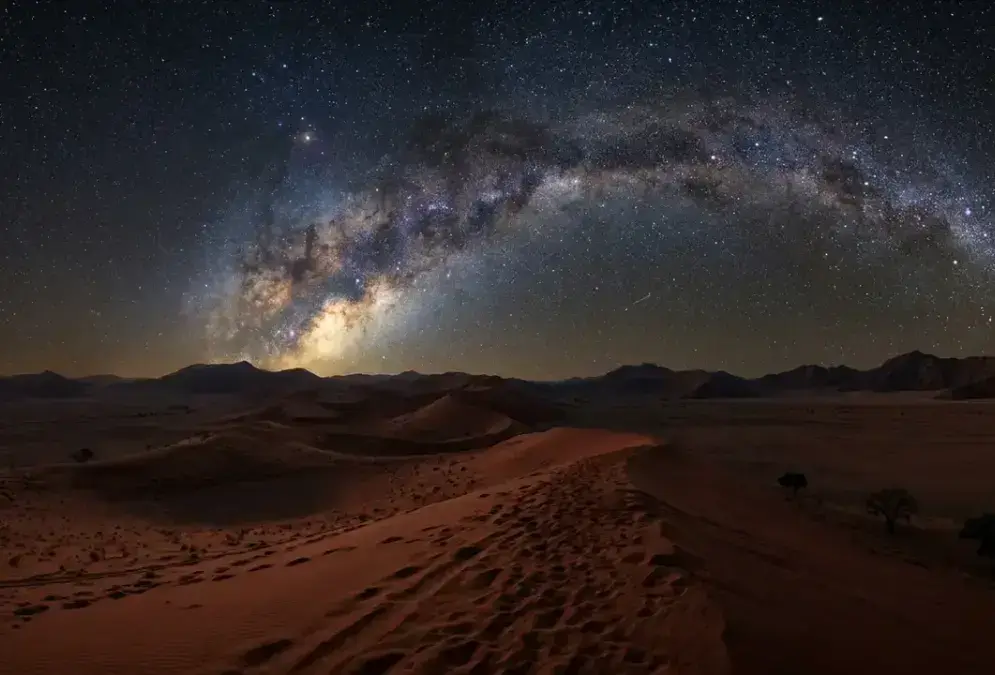
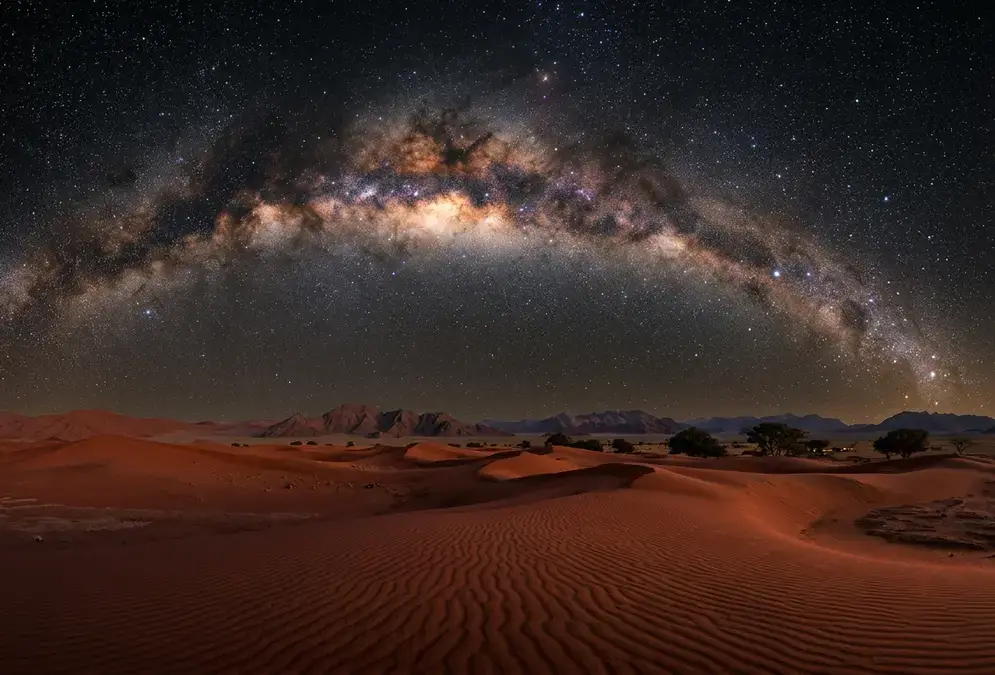
Wide-angle night photo of the Milky Way over red dunes in NamibRand Nature Reserve, illustrating Namib Desert dark sky conservation in Africa's only Gold Tier International Dark Sky Reserve

Wide-angle night photo of the Milky Way over red dunes in NamibRand Nature Reserve, illustrating Namib Desert dark sky conservation in Africa's only Gold Tier International Dark Sky Reserve

  • Adjoining properties were bought out one at a time and folded together rather than developed
  • 17 former livestock farms ended up consolidated into one continuous, fence-free stretch of desert
  • Wildlife absent for a generation, oryx, springbok, zebra among them, began moving freely again through the reconnected habitat
  • In 1992, the consolidated land was formally registered as a non-profit private nature reserve, with every landowner signing a shared constitution setting the ground aside for conservation permanently
  • What exists today covers more than 214,000 hectares, reversed from decades of soil exhaustion caused by overgrazing, unsustainable farming, and large-scale hunting[3]
Timeline
  1. 1984

    Farm Gorassis purchased

    Albi Brückner buys the first of what will become 17 consolidated farms, at a moment when sheep farming and wildlife were both collapsing across the southern Namib.

  2. 1992

    NamibRand registered as a non-profit reserve

    Consolidated landowners sign a shared constitution, setting the combined farms aside permanently for conservation.

  3. 2012

    Gold Tier International Dark Sky Reserve

    DarkSky International inscribes NamibRand at Gold Tier, its strictest category, making it the first reserve of any kind in Africa or in any developing nation.

That transformation, from a scatter of failing farms to a single legally protected reserve, is what made a dark-sky designation possible twenty years later. You can't certify a sky over land that's still fenced, grazed, and lit the way a working farm needs to be.

The private reserve model: funding wildlife and dark skies together
NamibRand pays for its own protection instead of relying on state park funding, and that's a deliberate design choice, not an accident of geography. The reserve funds its conservation work through low-impact ecotourism: five tourism concessions operate inside the boundary, and each pays a daily, per-bed conservation levy back to NamibRand Nature Reserve, keeping the whole operation financially self-sustaining without a government appropriations line[4].
The arrangement flips the usual dark-sky story. Most certified parks and reserves worldwide are public land, protected by an agency whose conservation mandate predates any interest in astrotourism. NamibRand's wildlife corridor and its night sky are protected by the same private mechanism at the same time: a non-profit conservation trust, funded by lodge guests who never see a line item for it on their bill. Every landowner and concessionaire operating inside the boundary answers to that same founding constitution, which is also why NamibRand can hold to lighting standards that a multi-stakeholder public park would struggle to coordinate. There's no separate authority to negotiate with; protecting the wildlife and protecting the sky both run through the same trust and the same handful of landowner partners.

Featured · Destination

NamibRand Nature Reserve

NamibRand is Africa's only Gold Tier Dark Sky Reserve: extreme Namib Desert isolation, the Southern Cross, Magellanic Clouds, and luxury safari lodges.

Becoming Africa's first Gold Tier reserve

In May 2012, DarkSky International's advisory board (then the International Dark-Sky Association) endorsed NamibRand for inscription as an International Dark Sky Reserve at the Gold Tier, the strictest category the organization offered at the time. The designation carried a double first: NamibRand became the first Dark Sky Reserve in Africa and the first in any developing nation, and it held up in large part because of pure isolation. The reserve's nearest neighboring communities lie roughly 60 miles away, small and far enough off that NamibRand's measured sky ranked among the darkest yet recorded anywhere[5].
Distance alone doesn't guarantee a Gold Tier rating, though. NamibRand also had to demonstrate a working commitment to darkness inside its own boundary, which meant confronting whatever artificial light already existed there before certification could go through.

Lighting discipline in practice: what Gold Tier looks like on the ground

Gold Tier certification isn't a one-time inspection. Reserves have to keep proving the sky stays dark, which means dealing with whatever artificial light already exists inside the boundary. NamibRand's own materials describe a straightforward two-part approach: eliminate as many outdoor lights as possible, and shield whatever has to stay so its light doesn't escape upward into the sky[6]. Shielding stops sky glow at the fixture—one of the four types of light pollution—and a fully shielded fixture pointed entirely at the ground produces virtually zero upward light even at full brightness."
That's a description of practice, not a legal document. Dark-sky reserves typically rely on some mix of formal lighting ordinances and voluntary compliance agreed to by member properties, and the exact split between the two isn't always public information. What's clear at NamibRand is that every lodge and landowner inside the boundary operates under the same conservation constitution that funds the reserve, so shielded, downward-facing fixtures and minimal outdoor lighting aren't a choice any single property could quietly opt out of. Whether that commitment is written into a codified lighting ordinance or upheld as an informal, universally adopted standard among partners is a detail no public source confirms either way, worth knowing before assuming NamibRand's rules work exactly like a municipal lighting code somewhere else.

Where NamibRand's certification stands today, and why the model matters beyond Namibia

NamibRand's Gold Tier badge is a real designation, but it belongs to a system DarkSky International has since retired. Places certified after 2018 no longer receive a Bronze, Silver, or Gold Tier label at all, even when their measured sky quality would qualify under the old rules; the tier system was mostly used for earlier certifications like NamibRand's[7]. That doesn't downgrade what NamibRand earned in 2012. It means the label reflects an older certification framework rather than the standard DarkSky International uses for new reserves today.
What isn't publicly confirmed is whether NamibRand's designation has been formally reviewed or reissued under the newer criteria since 2018. The honest answer: treat NamibRand as Gold Tier certified as of its original 2012 award, and don't assume a specific current re-certification status one way or the other without checking DarkSky International's own places directory directly.
None of that changes what the reserve demonstrates on the ground. A private consortium of landowners took overgrazed sheep farms, tore down the fences between them, and built a funding model that pays for wildlife and darkness at the same time, without waiting on a national parks budget to do either. That's the part of NamibRand's story worth exporting to other dark-sky projects, tier label or not. For travelers weighing an actual visit, Best Stargazing Lodges in NamibRand covers the four properties that sit inside the reserve boundary today.