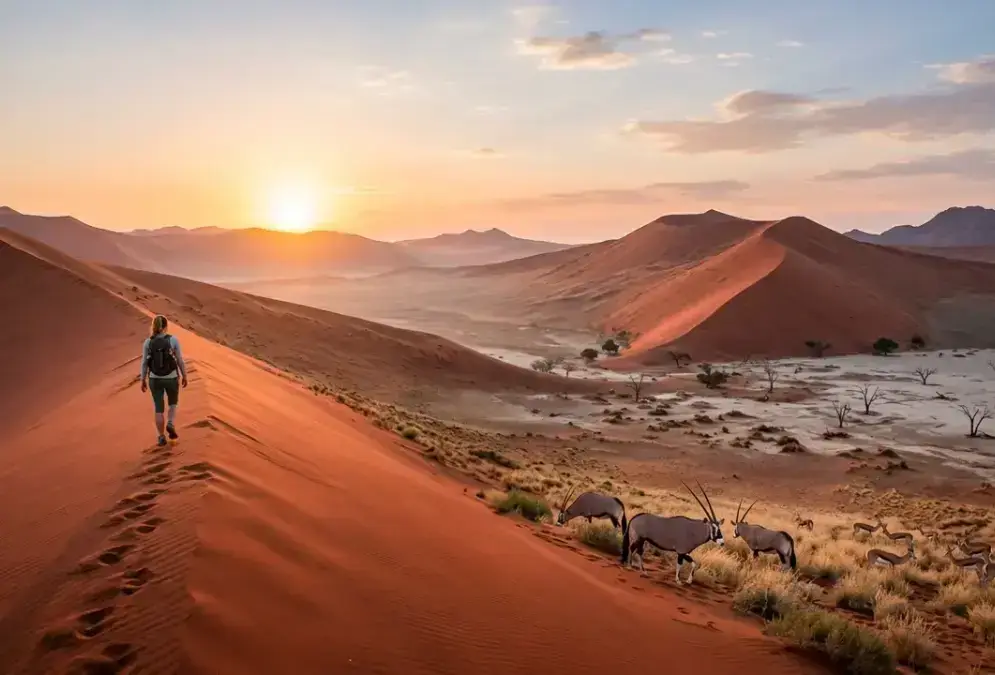

Sossusvlei and Deadvlei: the dunes and the ghost forest next door
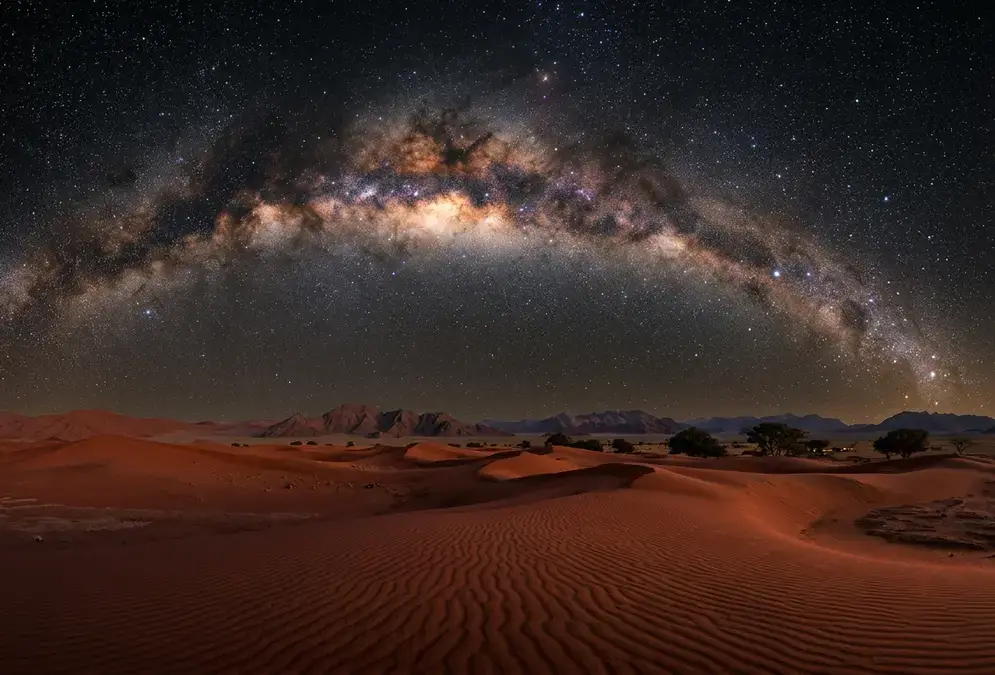
NamibRand Nature Reserve earns its Gold Tier dark-sky reputation after dark, but the reserve it borders looks just as strange by day. NamibRand shares its northern edge with Namib-Naukluft National Park, which covers nearly 50,000 square kilometres and is Namibia's largest protected area[1]. Inside that park sits the country's single most photographed landscape: Sossusvlei, a salt-and-clay pan ringed by some of the tallest dunes on the planet.
Most NamibRand lodges treat a Sossusvlei run as a built-in half-day rather than a separate trip. Sossusvlei Desert Lodge, inside the reserve itself, sits about half an hour's drive from Sesriem, the gate that controls access to the pan[2], close enough to fold into a dawn departure without cutting into the previous night's stargazing.
Walk another 15 minutes past Sossusvlei and you reach Deadvlei, a bone-white clay pan studded with skeletal camelthorn trees that have stood, unrotted, for roughly 900 years[3]. A shifting dune sealed the pan off from the floodwater that once fed it, and the desert air is too dry for the dead wood to decompose. Black trunks against white clay against orange dune against blue sky: it photographs exactly as well at 7am as every image online promises, before the light flattens and the tour buses arrive.
Go at first light. The Sesriem gate opens at sunrise so the dunes catch low sun before the heat builds, and the same view at 7am and at 10am reads like two different places. For the reserve's own after-dark numbers and lodge access, see NamibRand Nature Reserve, and for a packaged version of this exact day paired with guided night skies, see the Sossusvlei safari and stargazing combo tour.
Climbing Dune 45 and Big Daddy: two very different mornings
Dune 45 and Big Daddy get lumped together in almost every travel write-up, but they reward two different kinds of morning.
Dune 45 sits, unsurprisingly, 45 kilometres past Sesriem on the road to Sossusvlei, rises about 80 metres, and is built from sand roughly 5 million years old[4]. It's the dune in most sunrise photos of Namibia, mainly because it's the first one the road passes and the easiest to climb before breakfast: 20 to 40 minutes up a knife-edge ridge, with the desert floor peeling into long shadow on either side.
Big Daddy, between Sossusvlei and Deadvlei, is the bigger commitment. At around 325 metres it's the tallest dune in the area, and most visitors need 45 minutes to an hour to reach the crest, depending on fitness and how much sand slides back under each step[5]. The real payoff is the descent: run, slide, or half-fall down the dune's steep face into Deadvlei below, and the climb that took an hour to make takes only 10 to 15 minutes to undo.
Neither dune needs a guide, a permit, or gear beyond real shoes and more water than seems necessary. Both punish laziness about timing. Start after 9am in the dry season and the sand is already hot enough to feel through boot soles.
| Dune | Height | Location | Climb time to summit |
|---|---|---|---|
| Dune 45 | ~80 m | 45 km past Sesriem | 20–40 minutes |
| Big Daddy | ~325 m | Between Sossusvlei and Deadvlei | 45 minutes–1 hour |
Desert-adapted wildlife roaming free across NamibRand
NamibRand's dark sky gets the headlines, but its daytime wildlife is a large part of why the reserve exists at all. The 200,000-hectare property was pieced together from 17 former livestock farms, and when the fences between them came down in the early 1990s, animals started moving across the land the way they had before ranching split it up[6].
That freedom shows in the numbers. NamibRand's own surveys count roughly 3,200 oryx (gemsbok) and more than 12,400 springbok across the reserve, alongside kudu, Hartmann's and Burchell's zebra, giraffe, klipspringer, and predators including leopard and brown hyena[7]. None of it is fenced in or fed. A morning game drive, or even a walk out from the lodge deck, can turn up a line of oryx cresting a dune ridge, backlit and entirely indifferent to the vehicle.
- Oryx are the reserve's signature animal, built to survive on moisture from plants alone, and visible year-round
- Springbok move in loose herds and are the most numerous sighting on most days
- Zebra, giraffe, and kudu turn up less predictably, often near the reserve's sparse waterholes
- Leopard and brown hyena are present but genuinely elusive; don't plan a visit around seeing either
3,200 oryx
Guides run most game drives at dawn or dusk, the same hours the animals themselves move most, which means the best wildlife-watching window and the best dune-climbing light are usually the same two hours of the day. The Namib Desert Sky Safari pairs this same daytime wildlife circuit with a beginner-friendly evening sky orientation for travelers who'd rather not plan the two halves of the day separately.
Namib-Naukluft National Park: the desert beyond the reserve's own boundary
NamibRand's border with Namib-Naukluft National Park matters for more than day-trip logistics. The two protected areas function almost as one continuous stretch of desert rather than separate destinations with a fence between them, and the reserve's Gold Tier dark-sky status leans directly on the park's own emptiness: no towns, no highways, no light domes bleeding over the horizon from either side of the shared boundary.
By day, the park is the reason a NamibRand stay works as more than a stargazing stopover. Beyond Sossusvlei and Deadvlei, its dune fields and gravel plains stretch west toward the wider Namib Sand Sea, and on toward the Atlantic coast. Most NamibRand-based travelers never see that far edge; a realistic day covers the eastern dune corridor around Sesriem and calls it done.
What the park adds to a NamibRand trip isn't a longer checklist so much as scale. NamibRand alone already reads as vast from a lodge deck. Add the national park next door, and the emptiness stops sounding like marketing copy and starts feeling like plain geography, one of the driest, least populated stretches of protected land in Africa, and one the reserve itself has worked to keep that way: NamibRand holds Africa's first Wilderness Quiet Park designation from Quiet Parks International, on top of its Gold Tier dark-sky status[8].
Featured · Destination
NamibRand Nature Reserve
NamibRand is Africa's only Gold Tier Dark Sky Reserve: extreme Namib Desert isolation, the Southern Cross, Magellanic Clouds, and luxury safari lodges.
Dawn balloon flights over the Namib dune sea
For a different view over the same dunes, Namib Sky Adventures flies hot-air balloon trips over the Namib Desert from a base near Sesriem, launching at dawn for the calmest air and clearest light of the day[9]. From altitude, Sossusvlei's ochre dunes flatten into a single rippled surface, and Deadvlei's dead trees show up as a scatter of black pinpricks against white clay, a scale the ground-level view never quite delivers.
Dawn isn't a scenic choice so much as the only window calm enough to fly in reliably. A launch that slips past sunrise by even 30 minutes can be scrubbed, and wind, not crowds or bookings, is what actually cancels a flight here.
Not every NamibRand stay includes ballooning, and it isn't cheap. Treat it as an optional splurge on top of the dune walks and game drives rather than a default inclusion, and confirm current availability and pricing directly with your lodge before counting on it.
Dawn isn't a scenic choice so much as the only window calm enough to fly in reliably.
Lodge wellness and planning a full day beyond the telescope
Between the dune walks, the game drives, and a stargazing session that starts once dinner service winds down, most NamibRand itineraries build in real recovery time, and the lodges plan around it. Spa treatments, plunge pools, and shaded decks are standard at the reserve's higher-end properties, less an indulgence than a practical answer to desert heat: mornings start early to beat the sun, afternoons run hot enough that a shaded rest earns its place on the schedule, and the wellness offering mostly exists to fill the gap between an early game drive and the evening's astronomy.
Building a full day beyond the telescope isn't complicated once you accept the trade-off at the centre of it: NamibRand rewards early starts and quiet middays over a packed schedule. A workable rhythm looks something like this:
Recommended tours
Tours are selected for quality, not commission. I earn a small fee if you book — at no extra cost to you.
- Dawn: a dune walk, a balloon flight, or a game drive while the light is low and the air is cool
- Midday: retreat to the lodge, a spa treatment, or simply shade and a pool through the hottest hours
- Late afternoon: a second, shorter walk or drive once the heat breaks
- After dark: the reason most visitors booked the trip in the first place
For the lodges that build stargazing decks and observatory sessions directly into that rhythm, Best Stargazing Lodges in NamibRand breaks down which properties pair the daytime activities above with the strongest after-dark facilities, and what each one actually costs to book.