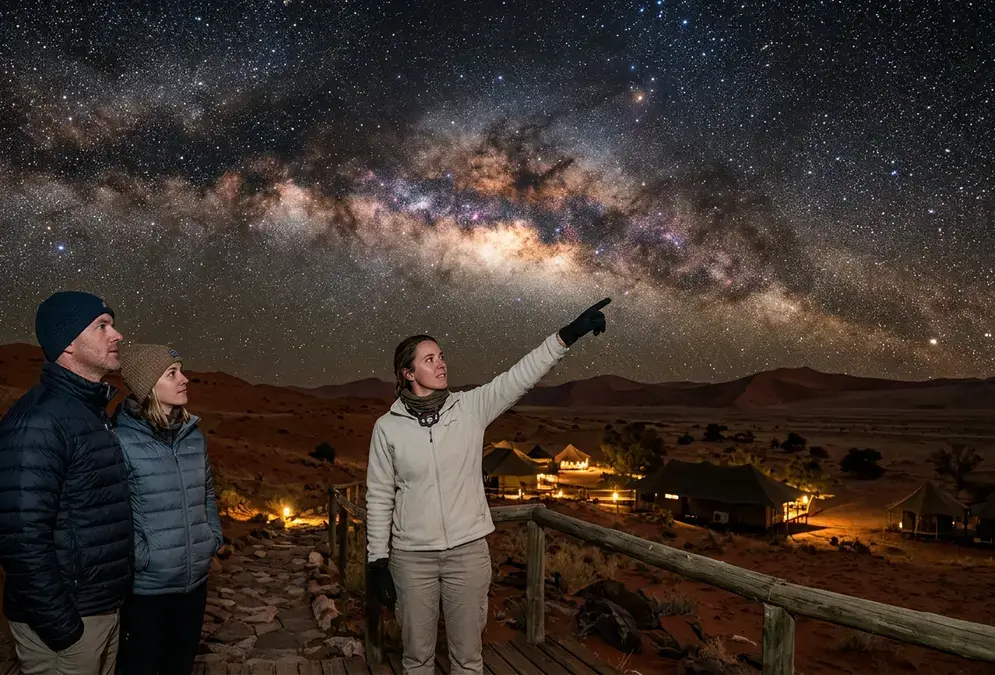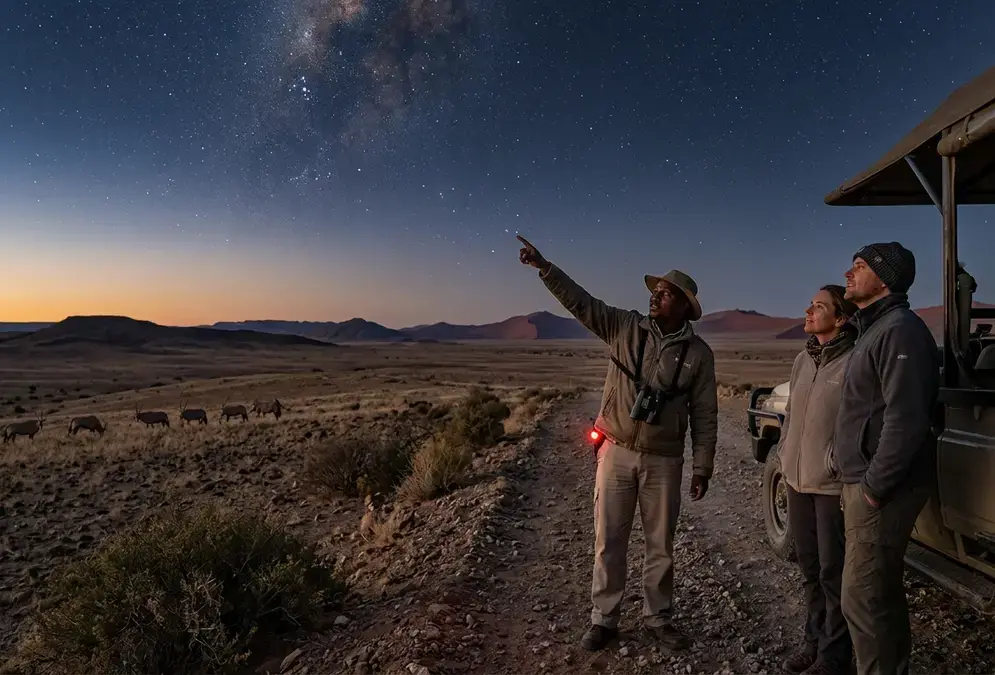
Safari guide pointing out the Southern Cross to guests at dusk over the Namib Desert plains in NamibRand Nature Reserve, oryx grazing in the distance
Night-Sky Experience

Wildlife by day, beginner stargazing by night in NamibRand

Full day, roughly 7–9 hours including the evening sky session
Available most of the year through NamibRand lodges; May–October (the dry season) gives the clearest skies and the most concentrated wildlife around remaining water. Exact start times are set by each lodge — expect an early-morning or late-afternoon game drive followed by a sky orientation around dusk.
Lodge-based departure inside NamibRand Nature Reserve — confirm the exact pickup point with your accommodation at booking
All activities

Most stargazing-and-safari combinations in Namibia lean toward one or the other: a wildlife lodge that turns the lights off at 9pm, or an astronomy-focused stay that treats the daytime hours as a rest between telescope sessions. The Namib Desert Sky Safari is built for the traveler planning their first trip to either, wildlife and stars in the same full day, with the night-sky portion pitched at people who don't yet know a globular cluster from a galaxy. It runs inside NamibRand Nature Reserve, Africa's only Gold Tier International Dark Sky Reserve, so the sky above the evening session is doing genuine, measured-dark work rather than just looking impressive in a brochure photo.

What the day actually looks like

The safari runs roughly 7 to 9 hours, split cleanly in two. The morning or late-afternoon block is a conventional open-vehicle game drive across NamibRand's gravel plains and dune fringes, terrain that hides desert-adapted animals in plain sight if you don't know what to look for. A midday break gives the heat somewhere to go: dry-season temperatures climb into the high 20s and low 30s°C by early afternoon. As dusk comes on, the same guide who spent the day pointing out animal tracks switches to pointing out constellations, and the group settles in for the evening sky orientation once the last color drains out of the horizon.

The wildlife: desert-adapted, not just present

NamibRand's animals aren't passing through the desert, they're built for it. On a typical day you can expect to see:

  • Oryx (gemsbok), Namibia's national animal, able to raise its own body temperature rather than sweat away scarce water
  • Springbok, recognizable by the pronking leaps that give the species its name
  • Kudu, with tightly spiraled horns that make them one of the desert's more striking silhouettes
  • Burchell's zebra, grazing in small family groups near what little vegetation the gravel plains support
  • Ostrich, the desert's biggest resident bird, often visible from a long way off across open ground

None of it is guaranteed; this is a nature reserve, not a zoo, and a guide reading tracks and behavior is doing real work to put you in front of these animals rather than just driving a fixed loop.

The night sky session: orientation, not an exam

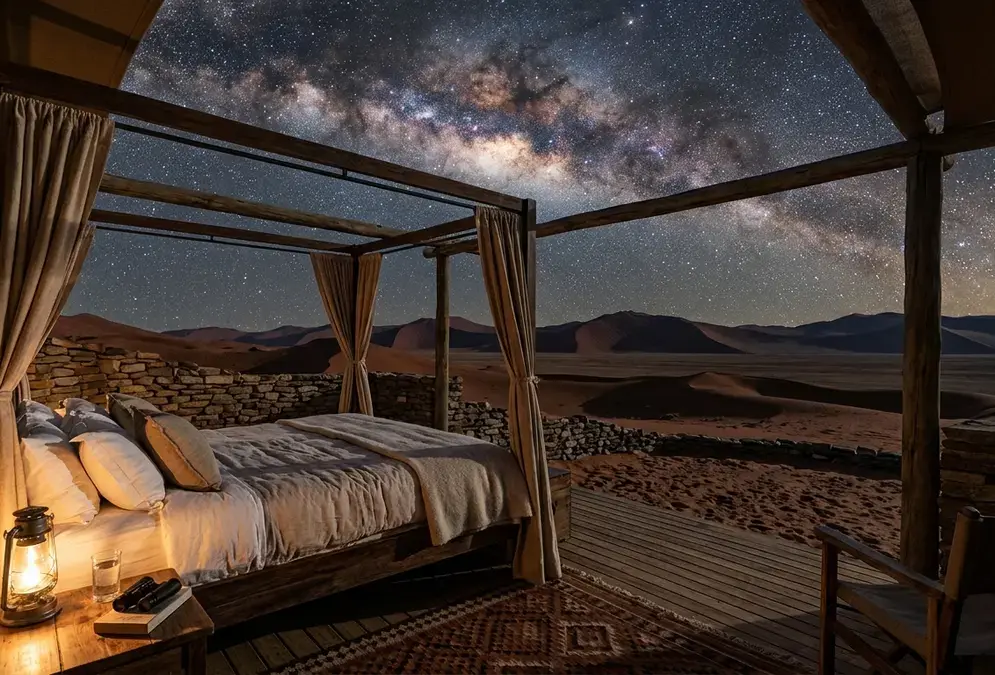
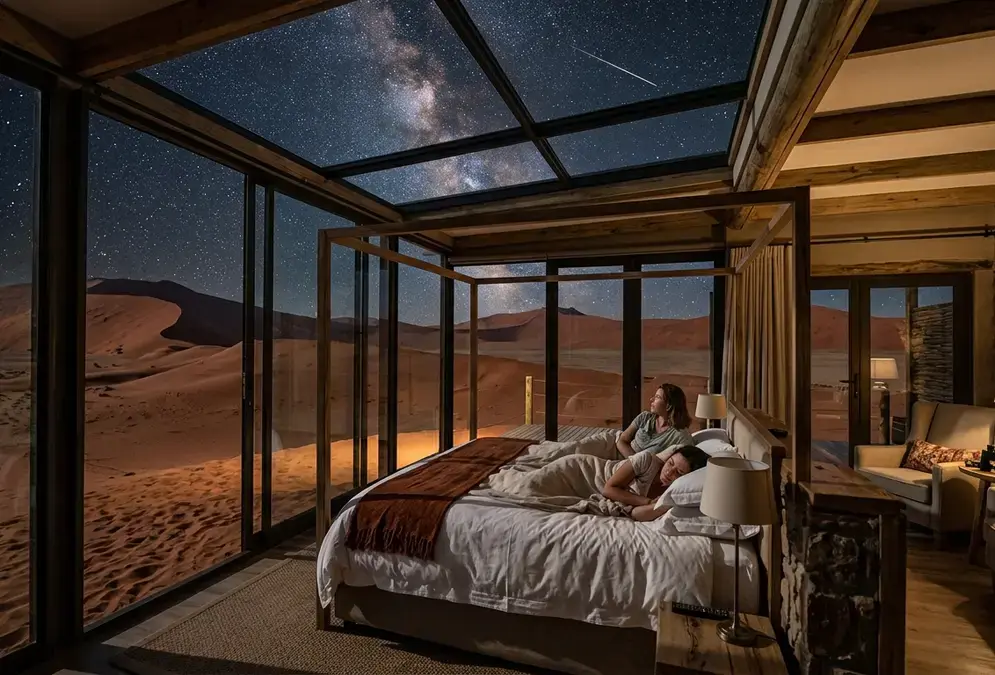
This is the point of difference from a dedicated astrophotography tour. There's no telescope to operate and no technical vocabulary required going in. The guide talks the group through the naked-eye sky: the Southern Cross, low and unmistakable once you've been shown where to look; the Large and Small Magellanic Clouds, two companion galaxies visible without any equipment from this latitude and invisible from most of the Northern Hemisphere; and the Milky Way's galactic core, which climbs high overhead through the reserve's dry season rather than skimming the horizon. On a clear night, Jupiter and Saturn are both realistic naked-eye or binocular targets. Some lodges inside the reserve, Wolwedans among them, train their guides specifically in this material, and a few properties go further still: Kwessi Dunes builds a "star gazer" room, open directly to the sky, into every unit, in case the outdoor session leaves you wanting more before bed. First-timers who want the fuller beginner rundown before booking can check the NamibRand stargazing FAQ for cost, access, and safety basics.

When to go

May through October, Namibia's dry season, is the safer bet. Skies stay reliably clear night after night, wildlife concentrates more predictably around the reserve's remaining water sources, and evening temperatures, while cold (5 to 15°C after dark), are at least a known quantity. The wet season (November–April) still works for the sky, since Namibia's aridity keeps sustained cloud cover rare even outside the dry months, but afternoon thunderstorms between January and March can complicate a game drive more than a stargazing session.

Price, booking, and what to bring

No single published rate covers every NamibRand lodge running this itinerary. As a working benchmark, a comparable full-day wildlife-and-stargazing safari in the reserve runs roughly USD 150 to 250 per person, usually folded into the lodge's nightly rate rather than sold as a standalone add-on. Confirm the actual figure directly with your lodge or a specialist Namibia operator, Wolwedans Collection, Natural Selection Safaris, and TerraFauna Journeys all run itineraries here, before you book.

Pack for two different days inside one: sunscreen, a hat, and water for the daytime drive, then a genuine jacket, not just a fleece, for the evening session. Open-sided safari vehicles have unpadded bench seating and no weather protection, so dress for the temperature you'll actually be sitting in, not the one on the midday forecast.
Highlights

  • Full-day desert wildlife viewing: oryx, springbok, kudu, Burchell's zebra, and ostrich
  • Beginner-friendly evening sky orientation — constellations, planets, and the Milky Way, no prior astronomy knowledge needed
  • Set inside NamibRand Nature Reserve, Africa's only Gold Tier International Dark Sky Reserve
  • Guides trained in both desert ecology and basic astronomy
  • Realistic naked-eye or binocular views of Jupiter and Saturn, the Southern Cross, and the Magellanic Clouds

Included

  • Guide with wildlife and basic astronomy knowledge
  • Full-day open-vehicle game drive
  • Evening sky orientation session
  • Refreshments during the tour

Not included

  • Transport to NamibRand itself (fly-in or self-drive from Windhoek)
  • Warm clothing for the evening session
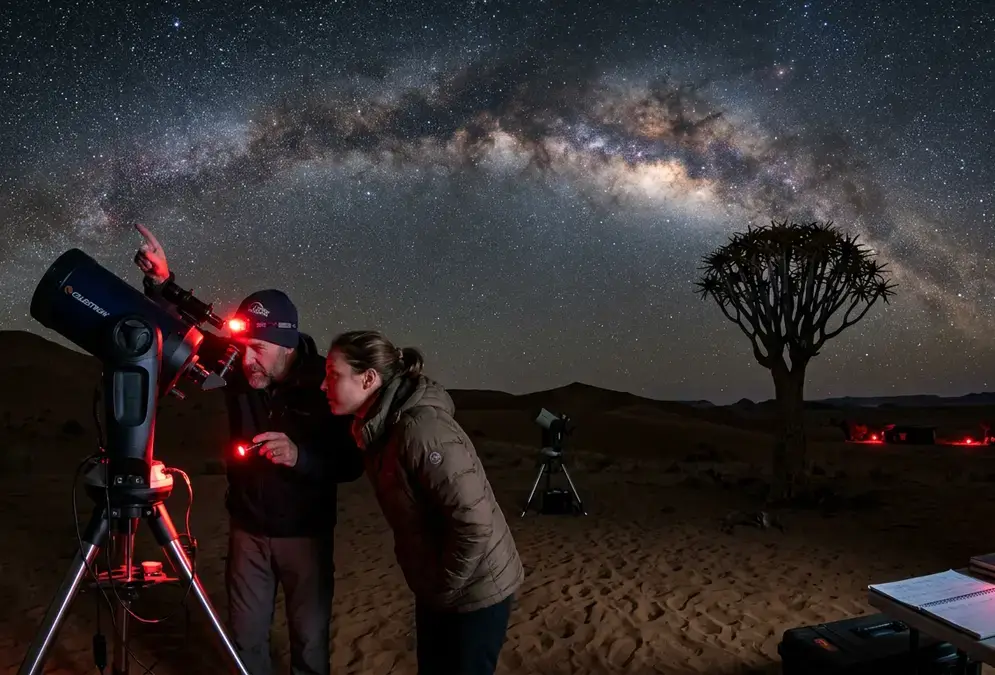
  • Telescope or astrophotography equipment — this is a naked-eye orientation, not a telescope-based tour
  • Personal expenses and gratuities

Practical information

Group size

Typically 4–8 guests per open-sided safari vehicle; lodge-dependent — ask at booking if you want a smaller or private group

Accessibility

Not wheelchair accessible. Open-air or soft-top safari vehicles with unpadded bench seating are typical; discuss mobility needs with your lodge or operator before booking.

Good to know before booking

  • Comfortable with a full day outdoors, including sun exposure and an open-vehicle game drive on unpadded bench seating
  • Warm layers for the evening sky session — dry-season desert nights (May–Oct) drop to 5–15°C even after a hot day
  • Sunscreen, a hat, and water for the daytime portion
  • No astronomy background needed — the evening session is built for first-timers

Prices & Booking

No single published rate covers every NamibRand lodge running this itinerary. As a working benchmark, a comparable full-day wildlife-and-stargazing safari in the reserve runs roughly USD 150–250 per person, usually folded into the lodge's nightly rate rather than sold as a standalone add-on. Confirm the current figure directly with your lodge or a specialist Namibia operator at booking.

Available most of the year through NamibRand lodges; May–October (the dry season) gives the clearest skies and the most concentrated wildlife around remaining water. Exact start times are set by each lodge — expect an early-morning or late-afternoon game drive followed by a sky orientation around dusk.

An editorial guide to this experience. Book directly with the operator when you plan your trip.

Tags

stargazing safari wildlife namibia namib desert dark sky beginner friendly gold tier guided tour

Frequently asked questions

What's the best time of year for the Namib Desert Sky Safari?

May through October, Namibia's dry season, is the safer bet: skies stay reliably clear night after night and wildlife concentrates more predictably around the reserve's remaining water sources. The wet season (November–April) still works for stargazing since the desert's aridity keeps sustained cloud cover rare, but afternoon thunderstorms between January and March can complicate the daytime game drive.

What wildlife will I see on this safari?

Expect desert-adapted species rather than the big-game lineup of a savanna safari: oryx (gemsbok), springbok, kudu, Burchell's zebra, and ostrich are all regular sightings in NamibRand. Nothing is guaranteed — it's a nature reserve, not a zoo — but guides read tracks and behavior to put you in front of animals rather than driving a fixed loop.

Do I need any astronomy experience for the night sky portion?

No. The evening session is a beginner-pitched orientation, not a technical astronomy session — there's no telescope to operate and no vocabulary required going in. The guide walks the group through naked-eye targets like the Southern Cross, the Large and Small Magellanic Clouds, and the Milky Way's galactic core, with Jupiter and Saturn realistic bonus sightings on a clear night.

What should I bring for the cool desert evenings?

A genuine jacket, not just a fleece — dry-season nights drop to 5–15°C after dark, and open-sided safari vehicles offer no shelter from the cold. Bring sunscreen, a hat, and water for the daytime portion of the safari, since the same day swings from a hot midday game drive to a cold evening sky session.

How much does the Namib Desert Sky Safari cost?

No single published rate covers every NamibRand lodge running this itinerary. As a working benchmark, a comparable full-day wildlife-and-stargazing safari in the reserve runs roughly USD 150–250 per person, usually folded into the lodge's nightly rate rather than sold as a standalone add-on. Confirm the current figure directly with your lodge or a specialist Namibia operator at booking.

Where does the safari depart from?

Departure is lodge-based inside NamibRand Nature Reserve — there's no separate meeting point to find, since the safari is arranged through wherever you're staying. Confirm the exact pickup time and location with your accommodation when you book.

Further reading

Sources

More tours to explore

NamibRand Astrophotography Experience
Astrophotography
Info & booking via operator

NamibRand Astrophotography Experience

Guided astrophotography session in NamibRand's Gold-Tier Dark Sky Reserve: Celestron telescope, dune foregrounds, visiting astronomer. Best skies May–Sept.

Duration: 2–3 hours, run as an evening activity after dinner Price: Lodge-arranged: included with select andBeyond Sossusvlei Desert Lodge packages, or bookable as an add-on activity through the lodge. No standalone public price is listed — confirm cost and availability when you book your stay.
Explore
NamibRand Guided Stargazing Experience
Guided Stargazing

NamibRand Guided Stargazing Experience

Evening stargazing at NamibRand's Gold Tier Dark Sky Reserve, included at Wolwedans, &Beyond, and Kwessi Dunes lodges, not a standalone tour; ask your lodge.

Duration: About 2 hours per evening session; timing set by each lodge's own programme Price: Not sold as a stand-alone ticket. Stargazing is bundled into the nightly rate at NamibRand lodges — Wolwedans Dune Camp runs roughly USD 800–1,500 per person per night, all-inclusive — or offered as a bundled evening activity elsewhere. Confirm what's included when you book your stay
Explore
Sossusvlei Safari & Stargazing Combo Tour
Night-Sky Experience

Sossusvlei Safari & Stargazing Combo Tour

The 3-day Sossusvlei combo pairs Big Daddy dune climbs and Deadvlei's ancient trees by day with guided stargazing under NamibRand's Gold Tier sky at night.

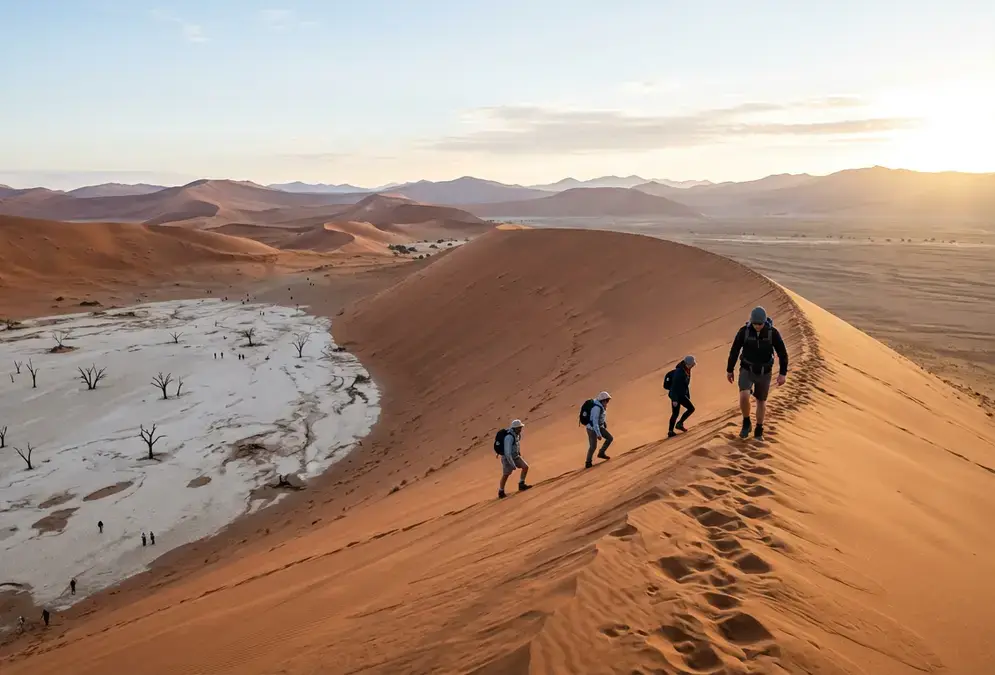
Duration: 3 days, 2 nights — a full day of dune exploration at the centre, guided stargazing after dark both evenings Price: From approximately ZAR 13,750 per person (roughly USD 750–850 depending on the exchange rate) — the ZAR/USD rate moves, so confirm the current total in your booking currency before paying a deposit
Explore