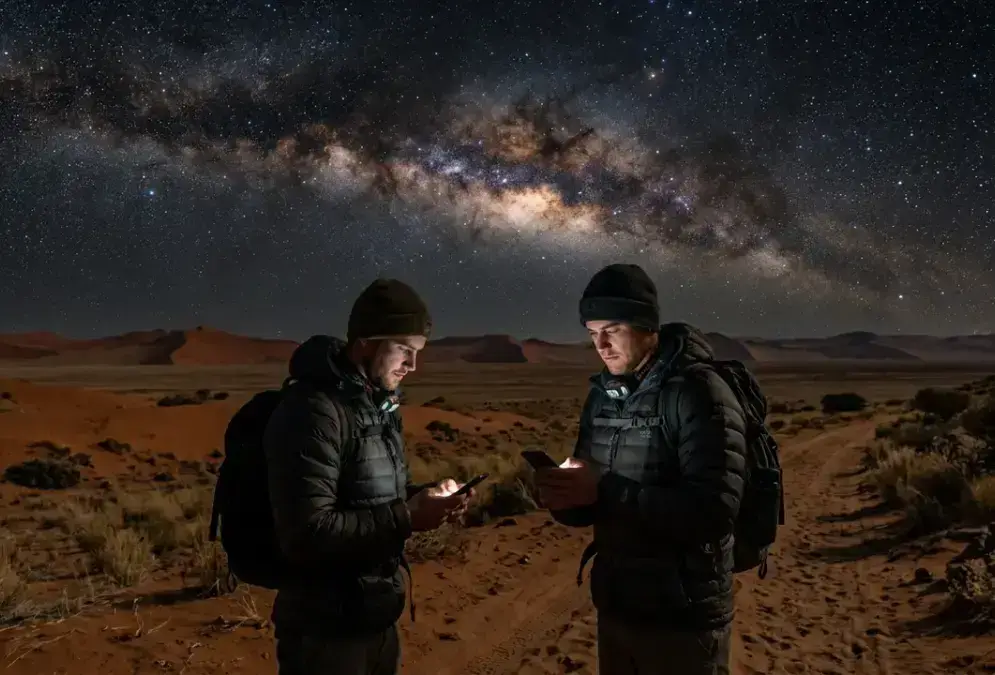

Why there's no live NamibRand stargazing forecast tool
Type "NamibRand stargazing forecast" into a search bar expecting a live radar page or a Kp-index-style dashboard, and you'll come up empty. No dedicated instrument feeds a public forecast for this specific reserve the way an observatory town might run one. What NamibRand actually has is simpler, and arguably more useful for trip planning: two variables that decide almost everything, plus a handful of general-purpose tools that cover the rest.
NamibRand Nature Reserve earned Gold Tier International Dark Sky Reserve status in May 2012, the first such designation in Africa and in any developing nation[1]. That credential is about darkness, not weather. It says nothing about whether a given week on your travel dates will be clear, and that's the gap this guide fills.
The first variable worth checking is which half of the year you're visiting. NamibRand runs on a southern-hemisphere calendar split into a dry season and a wet season, and that split does more forecasting work here than any cloud app could. The second is the moon. New-moon nights produce the darkest sky no matter the month, and no forecast tool changes that math.
One thing worth saying directly, since some readers land here from an aurora search: NamibRand has nothing to do with aurora forecasting. NamibRand's low latitude means aurora activity isn't something to plan around here. What follows is a cloud-and-moon problem, not a cloud-and-solar-activity problem, genuinely different math from what an aurora-chasing trip requires. For the reserve's full profile and lodge options, see NamibRand Nature Reserve.
Dry season versus wet season: the real cloud-cover risk
NamibRand's forecasting problem is almost entirely seasonal, blunt enough to plan around without checking anything day to day. The dry season, roughly May through October, is the reliable window: low humidity and largely cloudless skies. The wet season, October/November through April, brings more rainfall and cloud cover, though even then the reserve's near-total absence of light pollution means a genuinely dark sky is still possible whenever a gap opens up[2].
That's a different failure mode than a lot of other dark-sky destinations get. Somewhere with real ambient light, a wet season means more cloud and more glow bouncing off the underside of it. At NamibRand, cloud either blocks the sky outright or it doesn't. There's no orange haze waiting underneath to spoil a middling night.
| Season | Months | Cloud risk | Trade-off |
|---|---|---|---|
| Dry season | May - October | Low, largely cloudless | Best odds, peak lodge rates |
| Wet season | October/November - April | Higher, more rain and cloud | Lower rates, thinner crowds, still low light pollution |
Practically, the dry season is the safer bet for a first trip, especially a short one. The wet season is a reasonable gamble for travelers who already have flexibility, a longer stay, or a pull toward lower rates and thinner crowds outside peak months. The best time for stargazing in NamibRand article breaks the calendar down further, month by month, alongside the galactic-core visibility window.
Moon phase: the variable that beats the calendar
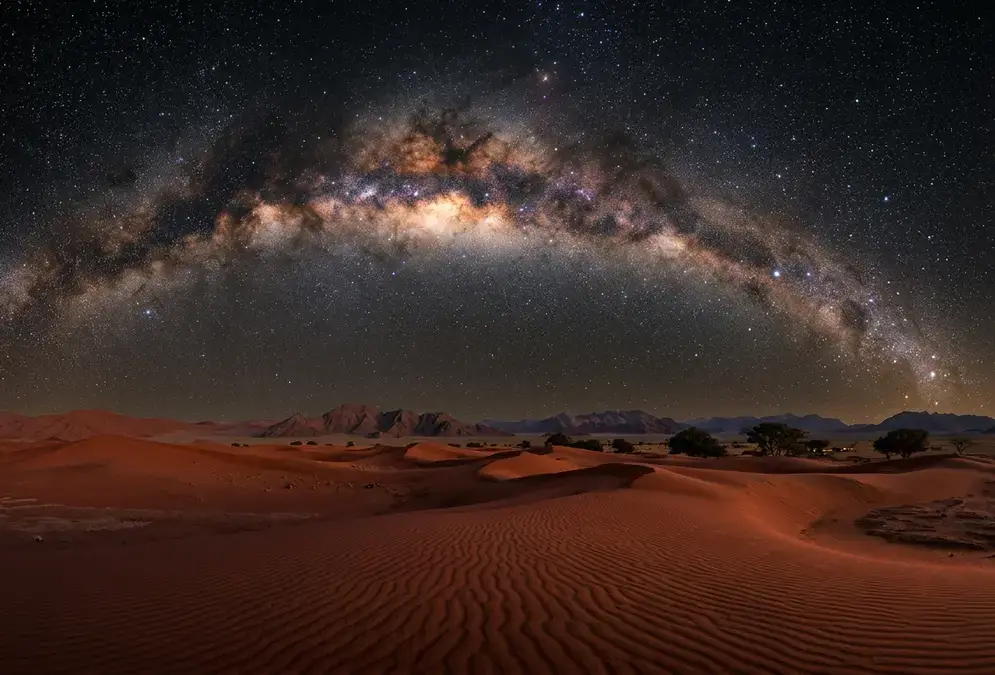
Even a perfect dry-season, cloudless night gets undone by one thing the season can't fix: a bright moon. New-moon periods produce the darkest background sky and the most vivid naked-eye Milky Way, which is why serious stargazing trips get timed around the lunar calendar rather than the season alone[2]. A full moon over NamibRand still shows plenty: the desert horizon, the brightest stars, the Southern Cross depending on the month. What it washes out is the fainter detail people fly this far to see, the dust lanes threading the galactic core, the soft glow of the Magellanic Clouds, and the kind of naked-eye zodiacal light that only shows up once real darkness sets in.
On a genuinely moonless night, the payoff is dramatic enough that the reserve's own dark-sky profile felt the need to describe it in detail rather than just measure it.
“On moonless nights, with the naked eye, thousands of individual stars can be seen, as can the Milky Way. Also visible are the Magellanic Clouds and the seldom seen zodiacal light[1]”
Build a trip around the days either side of new moon, and the season becomes secondary, still worth checking, but no longer the variable that makes or breaks the night. Treat the lunar calendar as the first thing you check, not an afterthought once flights are already booked.
General weather tools that actually cover this part of Namibia
NamibRand is remote enough that plenty of well-known astronomy weather sites are worth double-checking before you trust them here. Windy.com is the one general-purpose tool confirmed to reach this corner of the Namib: it's a free, worldwide spot-forecast service built on multiple global weather models, including ECMWF, GFS, NAM, WRF, and NEMS, and its coverage extends to remote Namibia[3]. Set the location to the reserve's coordinates, roughly -24.9, 15.9, and check the cloud, humidity, and dew-point layers a few days out. It isn't astronomy-specific, no seeing forecast, no dust-transparency index, but for the one variable that actually matters here, cloud, it's a genuinely usable tool.
Two astronomy-built alternatives are worth a mention, with a caveat attached to both. ClearOutside is a purpose-built astronomy forecast tool, widely used at better-known dark-sky sites, but its actual data resolution over southern Namibia specifically hasn't been confirmed this far south. Astrospheric makes similar global-model claims, and its coverage over this part of the continent is unconfirmed too. Both are worth a quick look before a trip, since they're free and load instantly, but treat whatever they show for these coordinates as a supplementary check rather than a confirmed, high-resolution read. Windy is the tool to trust first; the other two are worth checking, not worth relying on.
5 models
None of these substitute for a local read. That's what the next section covers.
How lodges read the sky for their own guests
Lodges bordering the reserve don't wait on outside forecasts either. NamibRand's own reserve management runs a Unihedron Sky Quality Meter (SQM) at Keerweder, an instrument that records night-sky brightness every five minutes from sunset to sunrise, with summaries published on the reserve's website[4]. It's the closest thing NamibRand has to an official, instrument-based sky-condition readout, though it measures darkness, not cloud, so it tells you how good the sky is capable of being on a given night, not whether tonight's clouds will get in the way. The reserve's own instrument is just one read of a sky that shifts night to night, so a visitor's meter turning up a different number doesn't mean either device is wrong: the moon's position and the Milky Way's own glow near the zenith, both covered in why one instrument's reading rarely matches another's, can move the figure around on any given night.
Some lodges bordering the reserve, among them Sossusvlei Desert Lodge, run astronomer-guided stargazing programmes, though these typically operate on a voluntary, consultant basis and are subject to change at short notice[5]. Treat a lodge astronomer as a bonus if the schedule lines up, not a guarantee baked into the room rate. Specific equipment and named astronomers get repeated across travel coverage of individual lodges; confirm directly with the property before booking around any one detail.
Artificial light itself is treated as a conservation issue here, not just an astronomy amenity. Every reserve lighting fixture has to comply with shielding and brightness standards set by the reserve's dark-sky management plan, because unshielded light affects nocturnal and diurnal wildlife as much as it affects the view[4]. That's why sky darkness itself is rarely the variable a returning guest asks about. Cloud and moon are the two questions lodge staff actually field, night after night, and they'll generally tell you straight if the coming nights look thin.
Turning all this into a pre-trip checklist
Put the pieces together and a NamibRand trip stops being a guess. None of what follows requires a subscription or a login, just checking the right thing at the right time before you commit.
Recommended tours
Tours are selected for quality, not commission. I earn a small fee if you book — at no extra cost to you.
Two to three months out, pick the season deliberately rather than defaulting to whenever flights are cheapest. Dry season, if this is a first trip built specifically around the sky. Wet season, if you're chasing lower lodge rates and can live with a somewhat lower likelihood of a clear run of nights.
Featured · Destination
NamibRand Nature Reserve
NamibRand is Africa's only Gold Tier Dark Sky Reserve: extreme Namib Desert isolation, the Southern Cross, Magellanic Clouds, and luxury safari lodges.
As soon as dates firm up, check the lunar calendar before locking anything else in. A trip that lands on or near new moon outperforms a dry-season full-moon trip on the metric that actually matters: what you'll see once you're standing under it. The When to Stargaze guide covers the broader framework for cross-referencing moon phase against season anywhere in the world, not just here.
A week or so out, open Windy.com, set it to the reserve's coordinates, and start tracking the cloud and humidity layers for your arrival window. The night you arrive, ask the lodge directly. Staff who watch the sky over that property every night of the year read it faster than any app, and they'll tell you plainly if the coming nights look thin.
What to pack for a NamibRand night
Layers, non-negotiably. Desert days and near-freezing desert nights sit inside the same 24 hours here regardless of season. A red-light headlamp protects night vision at properties with no ambient light to speak of, and binoculars resolve real structure in the Magellanic Clouds that the naked eye can only guess at. The Stargazing Gear for Beginners guide breaks down what's actually worth buying before a first trip like this one.
How many nights to build in
Two nights minimum, three if the schedule allows. A single overnight leaves no room for one cloudy or moon-bright night to wreck the only chance you had. Lodges price by the night and most build a game drive or two around the stargazing anyway, so the extra night rarely feels wasted even if the sky cooperates from the first evening.