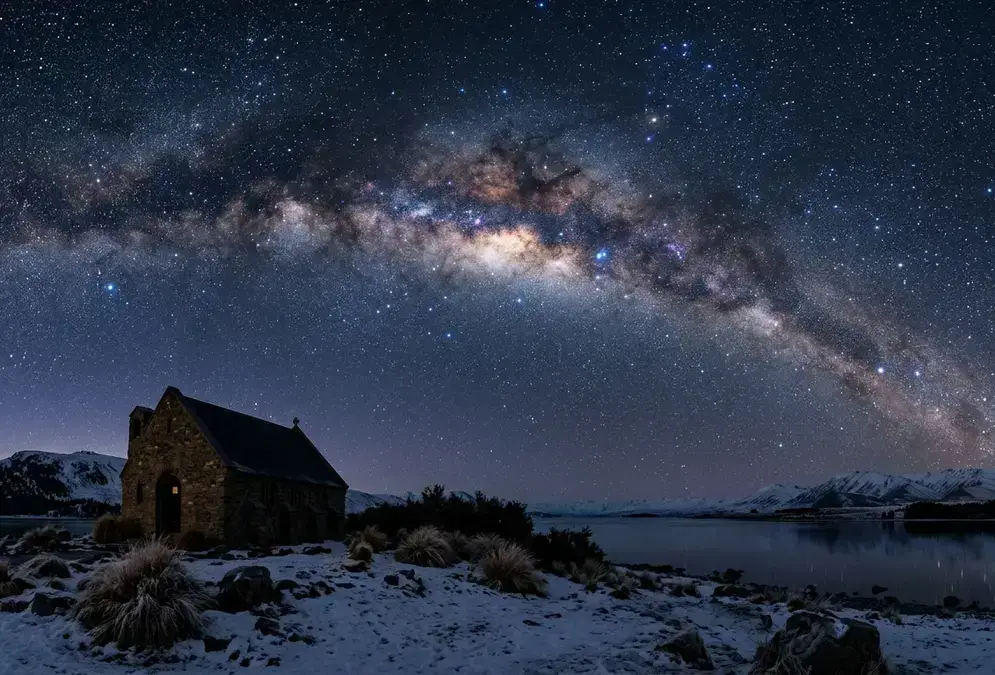

Aoraki Mackenzie's Gold Tier sky doesn't change with the season, but your night does
Most dark-sky travel guides give the same advice no matter which hemisphere you're reading from: go in winter, avoid the moon, pack warm layers. That holds true at Aoraki Mackenzie, but not for the reason a Tromsø or Lapland guide would give you. This reserve holds Gold Tier status, the highest classification the International Dark-Sky Association awards, one of only a handful of Gold Tier reserves on Earth[1]. That rating doesn't reset month to month. What changes across the year is how long the darkness lasts each night, and whether the galactic core, the bright, dust-choked hub of the Milky Way, is even in the sky at all.
Here's the part that trips up readers used to Northern Hemisphere guides: New Zealand's seasons run inverted. Winter at Aoraki Mackenzie falls in June, July, and August, not December, the opposite of what a Tromsø, Iceland, or Lapland guide trains you to expect, where January is peak darkness and July barely gets dark at all. Carry that assumption south and you'll book the wrong months entirely, arriving in what you think is the depth of winter and finding a short-night summer instead.
The rest of this guide splits the year into three honest windows: winter (June through August), by far the darkest and driest; the shoulder months of autumn (March through May), an underused near-match for winter; and summer (December through February), the easiest season to travel in and the weakest for the Milky Way itself. For the basics of this reserve beyond timing, from getting to Lake Tekapo to where to stay, see Aoraki Mackenzie stargazing.
New Zealand's winter (June-August): the longest, driest, darkest nights of the year
Winter here means cold, dry, and dark, in roughly that order of importance for a stargazing trip. From June through August, nights fall earlier and last longer than at any other point in the year, and June alone delivers up to 15 hours of darkness. The cold, dry air that settles over the Mackenzie Basin during these months dramatically raises the odds of a genuinely clear sky rather than a hazy one[2]. That's a meaningful stretch measured against Northern Hemisphere expectations: a Tromsø trip in July gets almost no darkness at all, while an Aoraki Mackenzie trip in July gets nearly a full night of it.
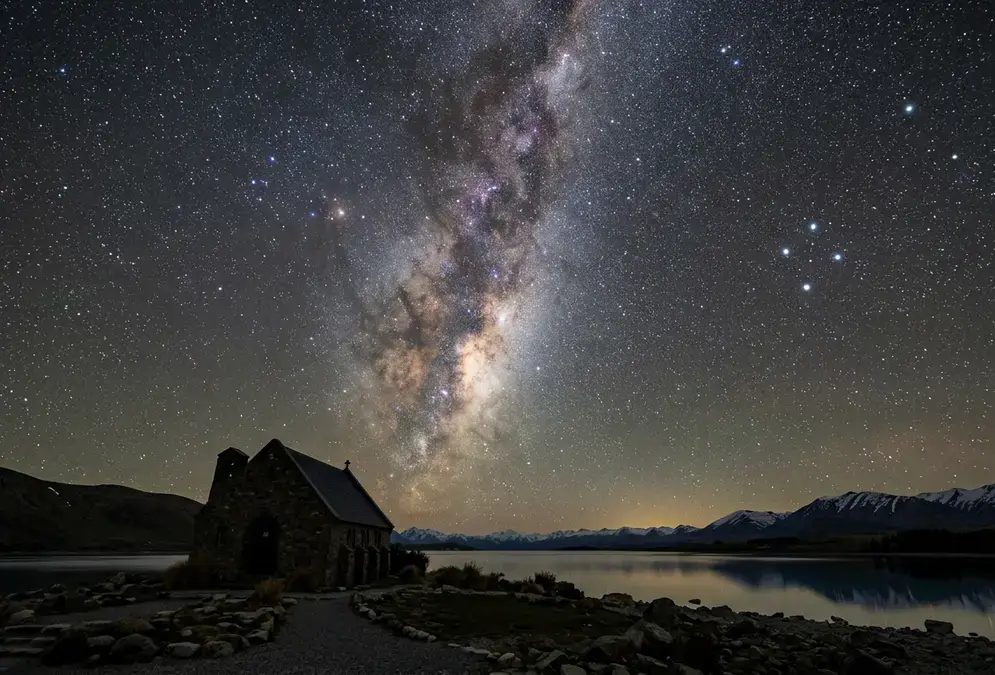
The payoff for the cold is direct. Through the winter months, the galactic core sits directly overhead rather than skimming the horizon the way it does for most of the year from Northern Hemisphere latitudes[3]. There's no narrow hour to plan a session around and no alarm to set for a specific moment. It's up there for most of the night, so one long session covers the whole show instead of a rushed hour before it sets.
Featured · Destination
Aoraki Mackenzie Stargazing
Aoraki Mackenzie is one of only four Gold Tier Dark Sky Reserves on Earth: Bortle 2 skies over Lake Tekapo, the Southern Cross, and Mount John Observatory tour.
The trade-off is real and worth packing for. Alpine lake country gets properly cold once the sun goes down, colder again after midnight, so layered clothing, not just a jacket, matters as much as picking the right month. Build a backup night or two into the itinerary as well; a single clear evening is never guaranteed, whatever the season.
The galactic core's real calendar: why it vanishes from summer evenings entirely
Season decides how long the darkness lasts. A separate calendar decides whether the galactic core is even in the sky to begin with. At Aoraki Mackenzie, the core is not visible in the evening sky during summer months at all; viewers looking up in December, January, or February see only the fainter outer edge of the galaxy, without the dense, dramatic structure that defines the winter Milky Way[4]. That's a genuinely different problem than short nights. Even on a perfectly clear December evening, the single most photographed feature of the southern sky simply isn't up there to see.
Autumn, March through May, doesn't get nearly as much attention as winter in most planning guides, and that's a gap worth closing. It's one of the most rewarding stretches of the year to look up, with enhanced atmospheric transparency and Milky Way visibility that starts earlier in the evening than it does at the height of summer[2]. For travelers whose dates are flexible, autumn often ends up the more comfortable trade: enough darkness and transparency to be worth the trip, without June's coldest overnight temperatures.
| Season | Darkness window | Galactic core visibility | Best for |
|---|---|---|---|
| Winter (Jun-Aug) | Longest of the year, up to 15h in June | Overhead most of the night | Astrophotography, the darkest possible sky |
| Autumn (Mar-May) | Moderate, full dark falls earlier | Rising earlier in the evening, strong but not all-night | Real darkness without deep winter cold |
| Summer (Dec-Feb) | Shortest of the year, only a few true-dark hours | Not visible in the evening sky at all | Warmer nights, easier logistics |
New Zealand's own dark-sky guidance backs up the overall pattern: the broadest window for moonless, clear-night viewing with the darkest skies and best Milky Way visibility runs from March through October[5], a stretch that covers both winter's peak and the autumn and spring shoulders on either side of it. December through February sits outside that window entirely, and that's the honest reason to treat it as the season of last resort for anyone chasing the Milky Way specifically. Aoraki Mackenzie is one of a short list of Gold Tier reserves profiled in best dark sky parks in the world, and this Southern Hemisphere entry earns its place for reasons no Northern Hemisphere park can match.
Southern summer (December-February): the easiest season, the weakest sky
Summer at Aoraki Mackenzie runs December through February, and it flips the trade-off completely. Nights are short: true astronomical darkness lasts only a few hours in the middle of the night even at the height of summer, and temperatures are far milder for anyone unused to standing outside for hours[4]. That last part is a real selling point. Standing at a lake shore at 1am in January is a different experience entirely from doing the same in July.
What summer doesn't offer is the reserve's signature view. The galactic core simply isn't part of the evening sky during these months, so anyone building a trip specifically around photographing or seeing the Milky Way's dense central band is better served picking a different season entirely. Summer is also peak tourist season across the Mackenzie Basin and the wider South Island: accommodation costs more, and Dark Sky Project's tours tend to book out faster than they do the rest of the year.
None of that rules summer out. It's the right call if stargazing is one part of a longer South Island itinerary rather than the entire reason for the trip, and the Magellanic Clouds and Southern Cross are up there regardless of month, as the closing section below covers.
New-moon windows and cloud cover: the two variables season can't fix
Pick the right season and you can still lose the night to two things that have nothing to do with the calendar month. New Zealand's own tourism guidance narrows the timing further: plan around the new-moon window, the week before and after, for the darkest possible skies, and build at least three to four nights into the itinerary, since Mackenzie Basin weather doesn't always cooperate with a single scheduled evening[6]. That's a small enough window to plan around a single international trip, and specific enough that checking it before you book flights is worth the ten minutes it takes.
Cloud cover is the harder variable to plan around months in advance. Cloud cover cancels a meaningful share of stargazing tours at Lake Tekapo, and how often depends heavily on the season[7]. That's not a reason to skip the trip. It's a reason to book more than one night and treat the first clear evening as a bonus rather than the only chance you get.
3-4 nights
Once you're on the ground, two tools do the actual forecasting work. Dark Sky Project runs a weather portal built specifically for checking stargazing conditions around Lake Tekapo[8], and Yr.no publishes a detailed hourly forecast for Mount John Observatory itself, breaking down cloud cover at different altitudes and atmospheric stability[9]. Check either one the afternoon of your planned session, not two days out; conditions in the Mackenzie Basin shift fast. The same four-variable logic, moon phase, season, transparency, and same-day forecast, applies to any dark-sky destination, not only this one; best time to stargaze works through the full mechanics.
Southern Cross, Magellanic Clouds, and Mount John Observatory: what's there no matter which month you pick
Two things are visible from Aoraki Mackenzie regardless of season, and neither exists from Europe or North America: the Southern Cross, the sky's most recognized shape, is circumpolar here, never setting below the horizon on any night of the year, and the Large and Small Magellanic Clouds, two dwarf galaxies orbiting the Milky Way, appear to the naked eye as faint, detached patches of light distinct from the main band of the galaxy[3]. Neither depends on hitting the right season the way the galactic core does.
Mount John Observatory, on the summit above Lake Tekapo, is New Zealand's largest professional research observatory and the southernmost facility of its kind anywhere in the world[10]. Dark Sky Project runs public stargazing sessions from the observatory, including a guided session inside the dome using a research-grade telescope, as of 2026[11]; confirm current tour names, pricing, and booking details before you travel, since operators revise offerings from year to year.
Recommended tours
Tours are selected for quality, not commission. I earn a small fee if you book — at no extra cost to you.
If Aoraki Mackenzie isn't the only Southern Hemisphere sky you're weighing, it's worth knowing it isn't interchangeable with Atacama. Atacama earns its reputation from a bone-dry, high-altitude desert; Aoraki Mackenzie earns its from an alpine lake district that simply never lost its dark sky to development, with a working public observatory built right into the trip. Both are worth very different visits, and this reserve is also one of the more remote stops on any dark-sky itinerary: most travelers are looking at a long-haul flight into New Zealand and a further drive before they see a single star, a real commitment next to the shorter hop to Tromsø or Iceland.
Whichever window you pick, winter's long dark nights, autumn's milder middle ground, or summer's easier logistics, the Southern Cross and the Magellanic Clouds will be overhead regardless, and that's the one piece of this sky no calendar can take away.