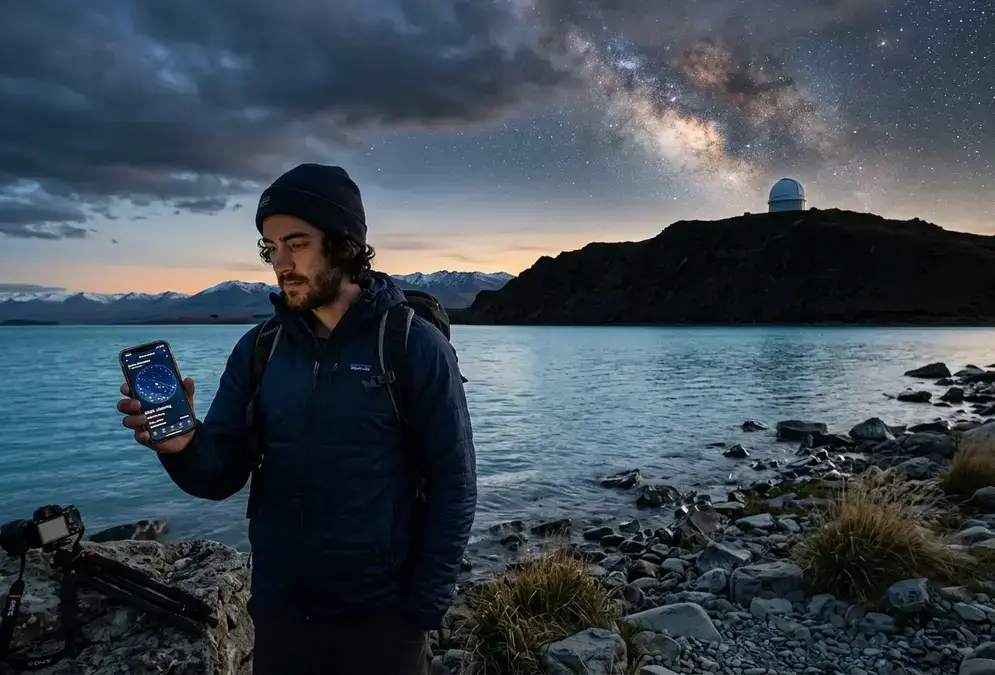

Why an Aoraki Mackenzie stargazing forecast means more than a Tekapo weather app
Search «Lake Tekapo weather» and the result is a seven-day icon strip for the township: sun, cloud, a chance of rain, nothing you can actually plan a specific night around. Aoraki Mackenzie is one of the first Gold Tier Dark Sky Reserves in the world, the highest classification the International Dark-Sky Association awards[1], and that rating says nothing about tonight specifically. A Gold Tier sky sitting under total cloud cover is still just cloud cover, whatever the reserve's credentials say on paper.
A genuine Aoraki Mackenzie stargazing forecast has to answer three separate questions, not one: how much cloud sits over the actual viewing site, whether the moon is bright enough to wash out the Milky Way's finer structure, and how long true darkness actually lasts once the sun clears the horizon. The seasonal question, New Zealand's winter against its summer, is a different one entirely, and Best Time for Stargazing at Aoraki Mackenzie already covers it in full. This guide sticks to the narrower, more useful question travelers actually face on the ground: given tonight's real conditions, is it worth the drive out to Lake Tekapo, or up the access road to Mount John.
None of the tools below need anything more technical than a phone browser and a few spare minutes the afternoon before you go. What they do need is knowing which page to open, since a generic search buries the operator-run and observatory-specific pages several results down behind holiday-planning listicles and app-store weather widgets that have never heard of the Mackenzie Basin.
Dark Sky Project's own weather portal: the fastest first check
Dark Sky Project, the company running the Summit Experience tours from Mount John Observatory, publishes its own weather portal built specifically for checking stargazing conditions around Lake Tekapo[2], rather than leaving visitors to guess from a generic town forecast built for hikers and farmers. Tekapo Stargazing, a separate Tekapo-based operator, runs a comparable weather-report page of its own[3], and the two are worth checking side by side rather than trusting either in isolation.
Checking both takes under a minute, and either beats trusting a phone's default weather icon, which is built for the valley floor rather than the exposed summit above it. Neither portal replaces the hourly, altitude-specific detail covered in the next section, but they're the fastest way to rule an evening in or out before committing to the drive from Christchurch or Queenstown.
Featured · Destination
Aoraki Mackenzie Stargazing
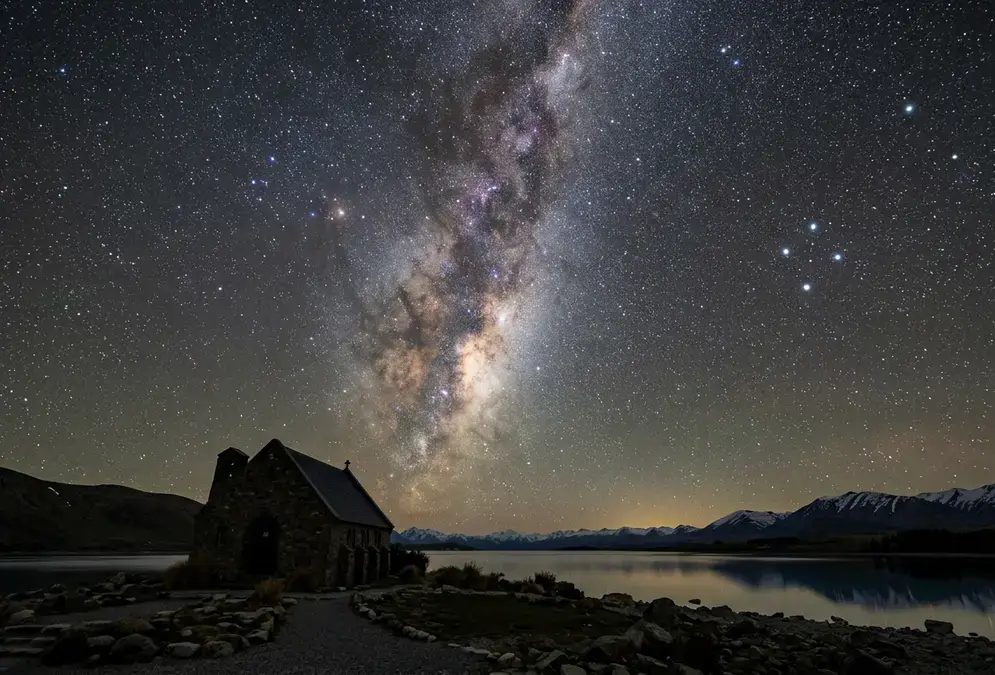
Aoraki Mackenzie is one of only four Gold Tier Dark Sky Reserves on Earth: Bortle 2 skies over Lake Tekapo, the Southern Cross, and Mount John Observatory tour.
Treat a disagreement between the two pages as a signal to dig further rather than a reason to pick whichever one you saw first. Tour operators watching their own bookings tend to build in a bit of caution; an independent stargazer parked at a Lake Tekapo shoreline pull-off can afford to wait an hour and watch the sky itself in a way a booked group tour can't.
Reading Yr.no's hourly forecast for Mount John Observatory
Yr.no, the Norwegian Meteorological Institute's public forecast service, publishes a detailed hourly forecast specifically for Mount John Observatory[4], rather than for the town of Lake Tekapo below it. That distinction genuinely matters: the observatory's summit sits at 1,029 metres[12], and a forecast built for the township doesn't automatically describe conditions at the altitude where the telescope dome and most guided tours actually operate.
The page breaks cloud cover down hour by hour and layers in wind speed and temperature readings for the summit itself, not the valley floor. Even in the warmest months, temperatures up at Mount John sit around 10°C, and wind makes it feel colder still[6], which is worth remembering when you're packing for what looks like a mild Tekapo evening from the township forecast alone — see Aoraki Mackenzie stargazing gear for what actually holds up at that altitude.
Cloud cover, not distance from town or altitude, decides most cancelled evenings at Lake Tekapo. It's the single biggest reason a same-day hourly check matters more than a forecast glanced at five days out. Conditions in the Mackenzie Basin can shift inside a single afternoon, turning a promising morning into a washed-out night by the time a tour actually departs.
Read the hourly figures the way you'd read any percentage-based cloud forecast: anything consistently under 20 to 30 percent cloud across your planned viewing window is a genuine green light, and a jump partway through the evening is worth watching rather than dismissing. The page updates through the day, so a check made at breakfast is a starting estimate, not the final word by the time the sun goes down.
New-moon windows and nautical twilight: the timing math no cloud forecast fixes
Cloud cover and altitude explain most of the picture, but the moon runs on its own calendar entirely, and no weather portal factors it in. New Zealand's own tourism guidance recommends planning specifically around the new-moon window, the week either side of it, for the darkest possible skies[8]. A bright moon erases fine detail in the Magellanic Clouds and mutes the Milky Way's structure no matter how clear the cloud forecast reads that night.
Timing inside the night matters almost as much as the date on the calendar. Dark Sky Project's Summit Experience tours depart once the sun sits 8 degrees below the horizon, the point marking the end of nautical twilight and the true start of proper stargazing darkness[9]. Checking sunset time alone leaves you standing under a still-lit sky for the better part of an hour before a tour actually begins; check twilight timing specifically if you're stargazing independently rather than on a booked tour.
Recommended tours
Tours are selected for quality, not commission. I earn a small fee if you book — at no extra cost to you.
Put the two together and the planning sequence becomes fairly simple: pick your travel dates around a new-moon window weeks in advance, then leave the cloud-cover and hourly checks for the days immediately before you go. One is a booking-time decision. The other is a same-day one. Conflating them is the single most common way travelers end up under a technically clear but moon-washed sky.
| Tool | What it checks | Check it when |
|---|---|---|
| Dark Sky Project weather portal | Lake Tekapo conditions, the operator's own go/no-go read | The afternoon of your trip |
| Yr.no hourly forecast | Mount John Observatory summit cloud cover, wind, and temperature | Same day, hour by hour |
| New-moon calendar | Moon phase and brightness, independent of weather entirely | When you book your travel dates |
Booking window, cancellation policy, and the Alternative Weather Experience
Dark Sky Project recommends booking the Summit Experience roughly 76 days ahead of a planned trip, with free cancellation available up to 24 hours before scheduled departure[10]. That cancellation window is generous enough to hold a booking through the genuine uncertainty of a forecast that's still a week or two out, then release it if conditions turn against you closer to the actual date.
A cancelled outdoor session isn't necessarily a wasted evening either. Dark Sky Project runs an indoor Alternative Weather Experience on nights when cloud, wind, or other conditions rule out the outdoor tour[11], using much of the same guiding and content without access to the telescope dome itself. It's a genuine fallback built into the operation, not a refund-only policy, and it's worth knowing about before writing off a marginal-looking night as a total loss.
None of this replaces buffer nights in the itinerary. Pair the booking flexibility with at least two nights based around Aoraki Mackenzie Stargazing rather than one, and treat a single clear evening as the plan's actual anchor rather than assuming the arrival date will deliver it — see how many days to plan for Aoraki Mackenzie stargazing for the fuller reasoning behind that buffer.
Putting the forecast together before you drive to Tekapo
Turn all of this into one practical routine the afternoon of a planned night out:
- Check Dark Sky Project's weather portal and Tekapo Stargazing's page for Lake Tekapo, and cross-reference the two rather than trusting one alone.
- Check Yr.no's hourly Mount John Observatory forecast for the summit specifically, not the township below it.
- Confirm the new-moon window when you pick your travel dates, not the night before; moon phase is a booking-time decision, not a same-day one.
- Check twilight timing, not sunset, if you're stargazing independently rather than on a guided tour.
- Hold the Summit Experience booking through free cancellation up to 24 hours out, and treat the Alternative Weather Experience as a real fallback rather than a reason to skip booking at all.
- Book at least two nights, ideally near a tour's departure point, at somewhere like this Tekapo hotel, so one cancelled evening doesn't end the trip's chances. If you'd rather book a guided session than go it alone, the Southern Sky Guided Tour is a beginner-friendly option departing near Lake Tekapo.
Read next · Tour
Southern Sky Guided Tour: Learn the Southern Hemisphere Night Sky
Beginner-friendly guided stargazing in Aoraki Mackenzie Dark Sky Reserve: naked-eye orientation, telescope views, Southern Cross, Magellanic Clouds. From $57.
Aoraki Mackenzie is among the most remote clusters covered in this guide: most travelers are looking at a long-haul flight into New Zealand and a multi-hour drive before a single one of these checks even matters. Getting the forecast habit right once you land is what turns that real travel commitment into an actual clear night under a Gold Tier sky, rather than a wasted evening standing under cloud that a five-minute check the afternoon before would have caught.