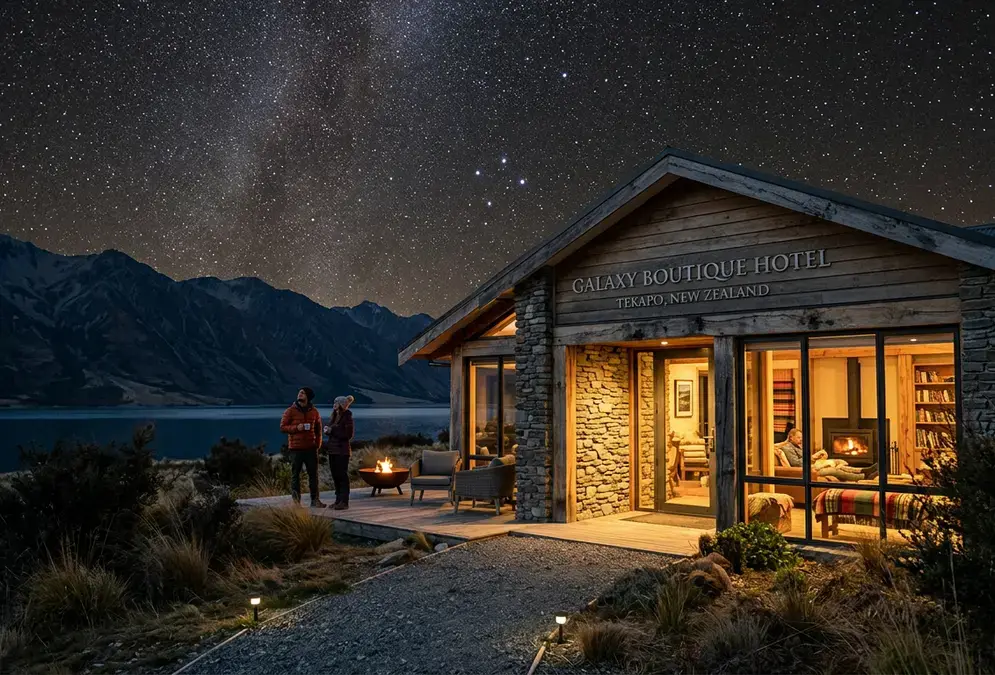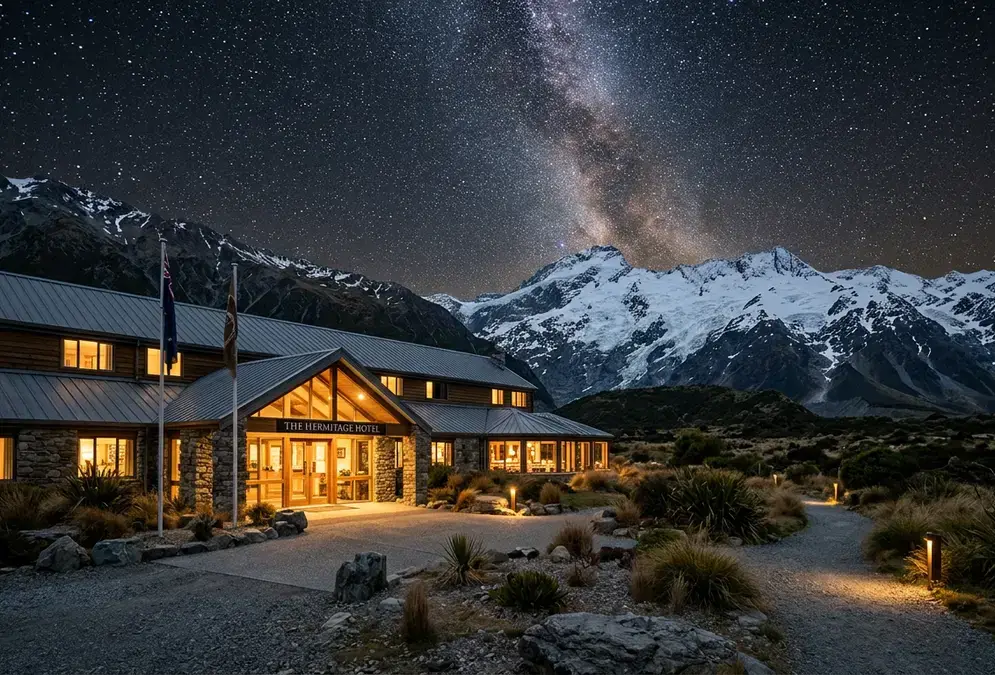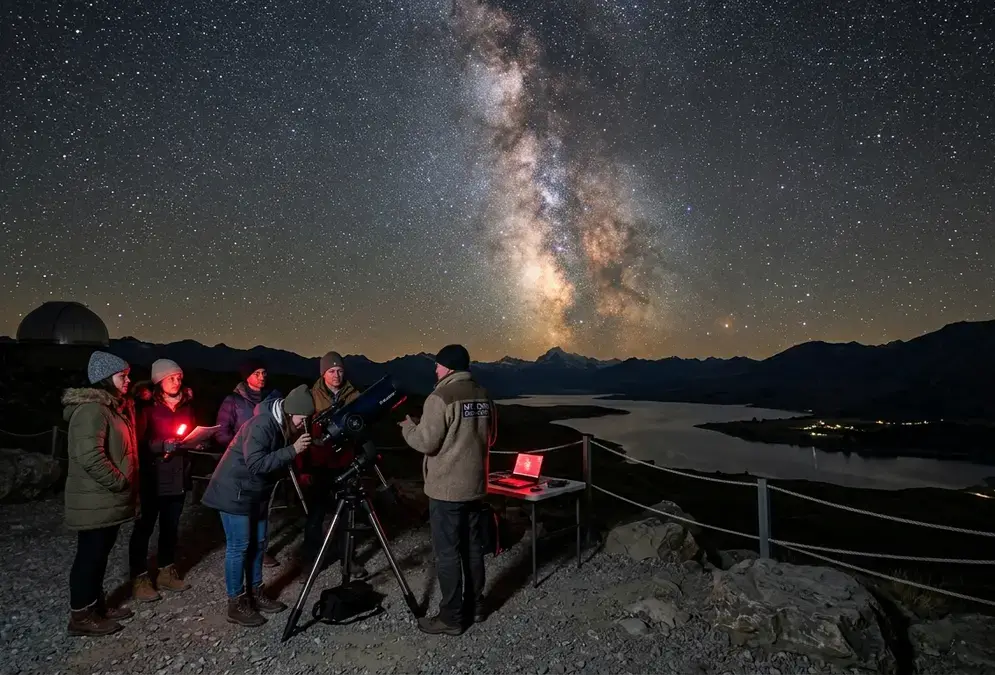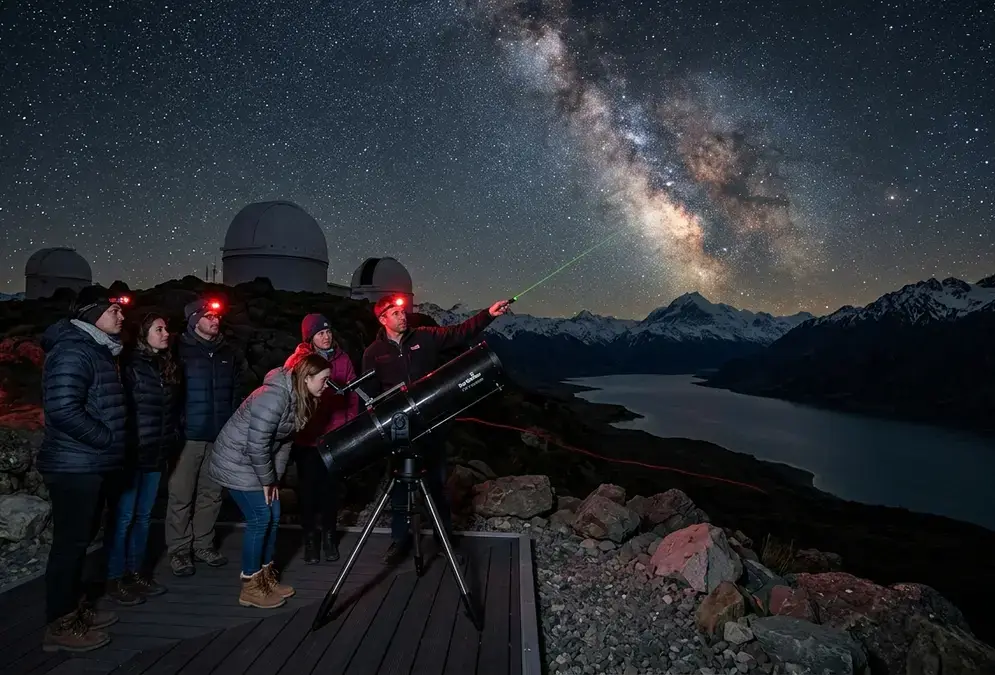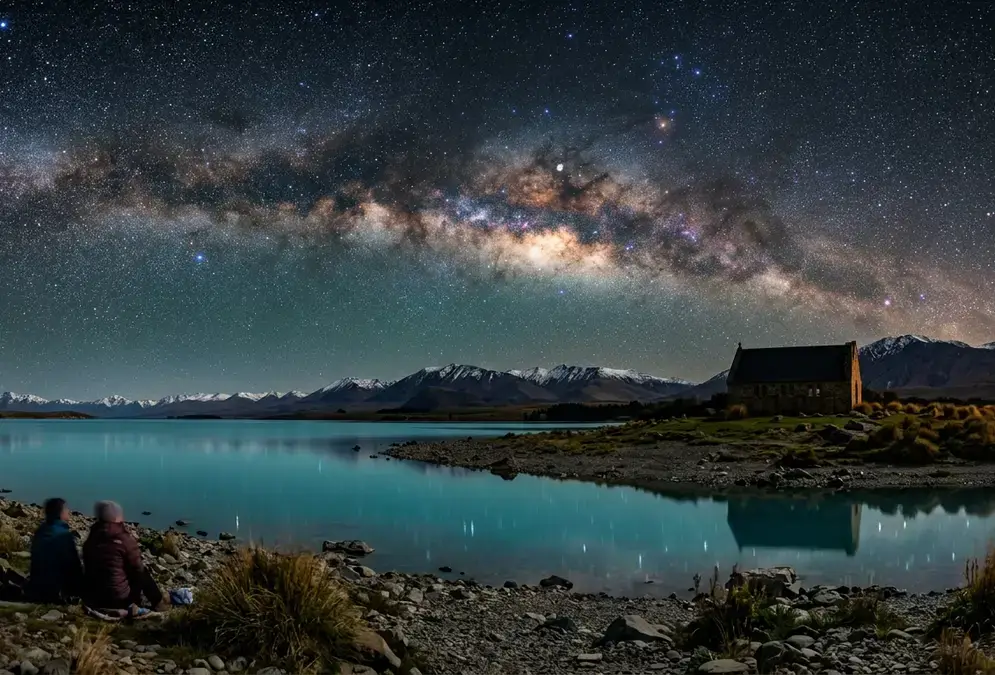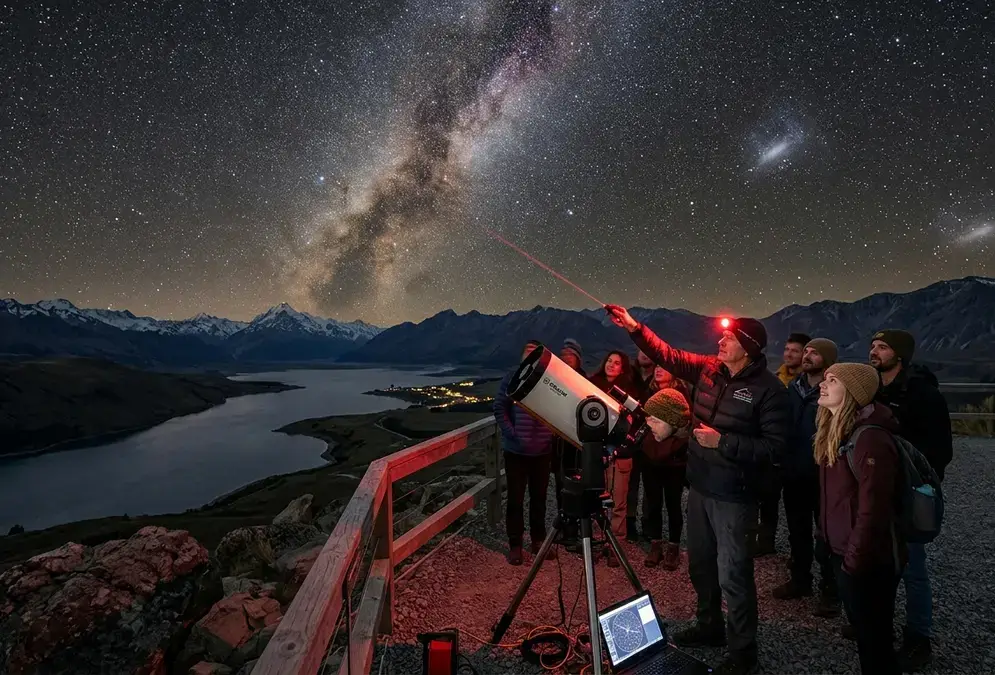
Small guided group looking through telescopes at the Southern Cross and Milky Way above Lake Tekapo in the Aoraki Mackenzie Dark Sky Reserve
Guided Stargazing Free

75 minutes learning a sky the Northern Hemisphere never sees

75 minutes
Nightly, weather permitting, year-round. Start times shift with the season, with later departures in New Zealand summer (December–February) and earlier ones in winter (June–August) when darkness falls sooner.
Within the Aoraki Mackenzie International Dark Sky Reserve, near Lake Tekapo; exact meeting point confirmed at booking
All activities

You don't need a telescope to notice something is wrong with the sky in the Mackenzie Basin. The Big Dipper isn't there. Orion is upside down. And low in the south, four stars in a tight cross-shape sit in a spot your northern-hemisphere instincts have no name for. That disorientation is the entire point of a guided southern sky tour: someone who actually knows this sky stands next to you with a laser pointer and rebuilds your mental map from scratch, then hands you a telescope to go looking at what's actually up there.

Mt Cook Stargazing Experience: the beginner anchor tour

The most accessible option in the Aoraki Mackenzie International Dark Sky Reserve is the Mt Cook Stargazing Experience, a 75-minute session led by a guide with working astronomy knowledge, not a script read off a card. It starts with naked-eye orientation: the guide traces the Southern Cross, points out the Pointer stars that lead your eye to it, and locates the Magellanic Clouds hanging low in the dark. Then the group moves to the telescopes for closer looks at the Milky Way's star clouds, distant galaxies, star clusters, and whichever planets are up that night.

At $57 USD starting price, it's the cheapest structured entry point into the reserve's stargazing scene, and it's listed on GetYourGuide with free cancellation up to 24 hours out, which helps given how often cloud cover reshuffles Mackenzie Basin plans. You leave with a free digital photo of your group under the stars, which sounds like a gimmick until you realise most phone cameras can't capture anything at Bortle 2 without a tripod and a 20-second exposure.

What you'll actually see that you can't see at home

This is where a guide earns their fee. The Southern Cross (Crux) is circumpolar from Lake Tekapo, meaning it never sets, but it's also small and easy to mistake for the nearby False Cross if nobody points out the difference. The Large and Small Magellanic Clouds are companion galaxies to the Milky Way, roughly 170,000 and 200,000 light years away, visible to the naked eye as faint smudges that look almost like detached wisps of cloud, hence the name. Neither ever clears the horizon from Europe or the continental United States, which is why most visitors have never seen them before this trip.

Through the telescope, the guide typically targets Omega Centauri, the sky's largest globular cluster at roughly 100,000 stars, along with visible planets and whatever deep-sky objects the night's conditions favour. None of this requires prior astronomy knowledge. The naked-eye segment exists specifically so first-timers have their bearings before a telescope eyepiece throws unfamiliar magnified detail at them.

Other operators if Mt Cook is booked out

Mt Cook Stargazing Experience isn't the only option in the reserve, and knowing the alternatives is worth it during peak season when the popular slots sell out fast.

  • Astro Tekapo's Astro Experience: a 90-minute session at their lakefront site, capped at roughly 10 guests, with powerful telescopes and a more intimate group size. Direct booking only (not on GetYourGuide); a mobile observatory option can visit your accommodation.
  • Tekapo Stargazing's Scope at the Stars Tour: a 60-minute, telescope-focused session at $129 NZD adult ($119 senior/student, $84 child, $359 family). No dedicated naked-eye segment, so it suits visitors who already know the constellations and want more time at the eyepiece.
  • Tekapo Stargazing's Soak in the Stars Tour: the same telescope format extended to 90 minutes and paired with hot pool access, at $179 NZD adult ($159 senior/student, $115 child, $499 family). A good pick if you want to warm up after standing in the cold for an hour.

Beginners and families are generally better served by Mt Cook's naked-eye-plus-telescope structure at the lower price point; the Tekapo Stargazing tours reward people who already know roughly what they're looking for.

When to book: New Zealand's inverted season

If you've read any stargazing advice written for the Northern Hemisphere, set it aside. New Zealand's dark-sky calendar runs backwards. June through August is New Zealand winter, and it delivers the longest nights and the driest, clearest alpine air of the year, the opposite of what "winter" implies everywhere north of the equator. December through February is southern summer: shorter nights, but the galactic core still climbs high once darkness falls, and it's also peak booking season, so tours and accommodation sell out faster and cost more.

Moon phase matters more than the season you pick. A full moon washes out the Magellanic Clouds' fine detail and dims Omega Centauri to a grainy smudge regardless of how clear the sky is; check the lunar calendar before locking in a date, whichever month you travel.

Booking and what to bring

Book the Mt Cook Stargazing Experience through GetYourGuide in advance, particularly for December–February travel when demand peaks. The tour departs from within the Aoraki Mackenzie Dark Sky Reserve near Lake Tekapo; exact meeting point details are confirmed at booking. Dress warmer than the daytime temperature suggests; you'll stand largely still for over an hour, and post-sunset temperatures in the Mackenzie Basin drop fast even outside winter. A red-light headlamp, not your phone's white torch, protects the roughly 20 minutes of dark adaptation your eyes need to start picking up the Magellanic Clouds properly.
Highlights

  • Naked-eye orientation to the Southern Cross, Pointer stars, and Magellanic Clouds
  • Telescope viewing of the Milky Way, star clusters, galaxies, and visible planets
  • Expert astronomy guide, not a scripted walkthrough
  • Free digital group photo under the stars
  • Located inside the Aoraki Mackenzie Gold Tier Dark Sky Reserve
  • Free cancellation up to 24 hours before departure

Included

  • Naked-eye southern sky orientation with guide narration
  • Guided telescope viewing session
  • Expert astronomy guide
  • Free digital photo of your group under the stars

Not included

  • Hotel pickup and drop-off
  • Warm clothing or blankets (bring your own layers)
  • Personal photography equipment

Practical information

Languages

English

Group size

Small groups

Good to know before booking

  • Dress in warm layers; temperatures drop quickly after dark even outside NZ winter
  • Book in advance for December–February travel, when tours and accommodation sell out fastest
  • Check the lunar calendar; a full moon washes out the Magellanic Clouds and dims Omega Centauri regardless of season
  • No physical fitness requirements; suitable for beginners and families

Prices & Booking

From $57 USD per person (Mt Cook Stargazing Experience, GetYourGuide); free cancellation up to 24 hours before departure

Nightly, weather permitting, year-round. Start times shift with the season, with later departures in New Zealand summer (December–February) and earlier ones in winter (June–August) when darkness falls sooner.

An editorial guide to this experience. Book directly with the operator when you plan your trip.

Tags

stargazing guided tour new zealand lake tekapo aoraki mackenzie southern cross magellanic clouds beginner friendly south island

Frequently asked questions

What is the Southern Sky Guided Tour in Lake Tekapo?

It's a beginner-friendly, 75-minute guided stargazing session run as the Mt Cook Stargazing Experience inside the Aoraki Mackenzie International Dark Sky Reserve. A guide walks you through naked-eye orientation to southern constellations like the Southern Cross and Magellanic Clouds, then leads telescope viewing of the Milky Way, star clusters, galaxies, and visible planets. Starting price is $57 USD per person.

What will I see on a southern sky stargazing tour that I can't see from the Northern Hemisphere?

The Southern Cross, which is circumpolar here and never sets, plus the Large and Small Magellanic Clouds, two companion galaxies to the Milky Way visible to the naked eye as faint smudges. None of these clear the horizon from Europe or the continental United States. Through the telescope, guides typically target Omega Centauri, the sky's largest globular cluster, along with whichever planets are up that night.

Do I need any astronomy knowledge before booking this tour?

No. The tour is built for first-timers: it opens with a naked-eye orientation specifically so you have your bearings before the telescope segment introduces magnified, unfamiliar detail. Guides explain what you're looking at and why it matters rather than assuming prior knowledge.

When is the best time to book a stargazing tour in Lake Tekapo?

June through August, New Zealand's winter, delivers the longest and driest nights with the galactic core highest overhead, the reverse of Northern Hemisphere seasonal logic. March through October gives the broadest window of moonless, clear viewing generally. December through February still works and has a still-high galactic core after dark, but it's shorter nights, more crowds, and higher prices. Whichever month you choose, check the moon phase before locking in a date.

What is the difference between the Mt Cook Stargazing Experience and other Tekapo tours?

Mt Cook Stargazing Experience combines naked-eye orientation and telescope viewing in 75 minutes at $57 USD, the most affordable structured option, and it's bookable on GetYourGuide with free cancellation. Astro Tekapo runs a 90-minute session capped at roughly 10 guests, direct-booking only. Tekapo Stargazing's Scope at the Stars ($129 NZD) and Soak in the Stars ($179 NZD, with hot pool access) tours are telescope-focused without a dedicated naked-eye segment, better suited to visitors who already know the sky.

What should I wear on a Lake Tekapo stargazing tour?

Warmer layers than the daytime temperature suggests. You'll stand largely still for over an hour, and temperatures in the Mackenzie Basin drop quickly after dark in any season. A hat, gloves, and an insulated jacket are worth packing even outside New Zealand winter. Bring a red-light headlamp rather than relying on your phone's white torch; it protects the roughly 20 minutes of dark adaptation your eyes need.

Is the southern sky tour suitable for families and beginners?

Yes. The Mt Cook Stargazing Experience has no physical fitness requirements, runs a manageable 75 minutes, and structures the session around first-timers with a naked-eye orientation before the telescopes come out. Families comparing options should note that Tekapo Stargazing's tours list separate child and family pricing if a longer, telescope-only format suits better.

Further reading

Sources