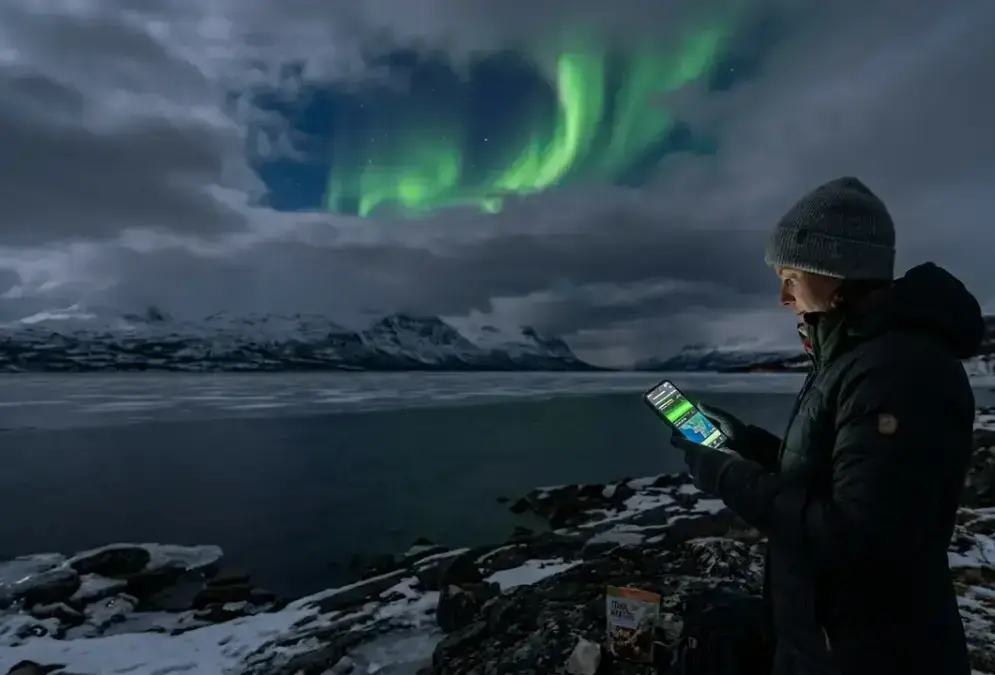

Why the Kiruna forecast lies to you about Abisko's sky
Open a weather app, search for Kiruna or the wider Norrbotten region, see a wall of cloud icons, and cancel the night. That single habit, trusting a regional forecast over Abisko's own sky, costs first-time visitors more clear-sky nights than actual bad weather ever does.
Abisko sits inside a real meteorological quirk that local guides and tour operators call the blue hole. Prevailing westerly winds off the Arctic Ocean crash into the mountains along the Norwegian border, and the peaks tear a rain-shadow gap directly above the village, commonly reported by aurora tour operators as roughly 10 to 20 square kilometers[1]. That figure comes from guides working the ground here, not a published meteorological survey, but it lines up with what visitors to Abisko stargazing actually see, season after season.
What makes the effect dangerous for planning is how hyperlocal it is. Conditions thirty minutes apart can differ completely: it can be snowing hard in Kiruna town while the sky over Abisko sits open and calm[2]. A regional forecast built for an entire county averages that difference clean away, which means the single most useful habit you can build before a night out here is to stop reading forecasts written for anywhere but Abisko itself.
The blue hole also isn't equally reliable year-round. Aurora season runs roughly late August through April, and the effect holds most consistently during the darkest stretch, mid-November through mid-March, once the polar night has properly settled in and the westerly airflow that carves the gap is at its most consistent. Nights near the September and March equinoxes get flagged by local guides for stronger, more active displays on top of the usual clear-sky odds, though that's a general seasonal pattern worth pairing with a same-week check rather than a reason to book blind around it.
Staying mobile beats trusting a single forecast number
The hyperlocal weather up here has a practical consequence that matters more than any single forecast reading: staying mobile beats staying informed. One aurora guide service working the Kiruna-Abisko corridor puts the idea plainly[3], and it's worth taking seriously before you plan a whole night around one fixed spot.
A forecast tells you the odds for a wide tile of sky. It doesn't tell you whether the specific patch above your lodge, the chairlift up to Aurora Sky Station, or a pull-off five minutes down the road is the one sitting inside tonight's blue hole. Treat the forecast as a starting point for where to be, not a verdict on whether to go outside at all.
“In the Arctic, the difference between a disappointing night in the lobby and a night under the dancing lights is almost always mobility.”
On a marginal night, that difference shows up literally in the ride up. Cloud can sit solid over the valley floor at the lower chairlift station, thick enough that the forecast on your phone looks like a lost cause, and thin to a ragged, star-flecked gap by the time the chair reaches the upper platform. That gap doesn't show up on a forecast tile built for a whole municipality. It shows up once you're already standing in it, which is the entire argument for treating cloud cover as something to verify in person rather than settle from a sofa an hour's drive away.
Two layers, not one: cloud cover and geomagnetic timing
A workable Abisko routine actually tracks two separate questions, and mixing them up is the second most common planning mistake after trusting a regional cloud map. The first question: is the cloud cover over Abisko specifically clear enough to see anything at all. The second: is aurora activity strong enough tonight, at this latitude, to be visible even through a clear sky.
The second question, the Kp index, the solar wind's Bz orientation, the shape of tonight's auroral oval, is its own subject, and this piece won't re-explain it. Read how the Kp index works for predicting the northern lights first if you haven't already; everything below assumes you know roughly what a Kp 3 night looks like compared to a Kp 6 night from a latitude like Abisko's.
Featured · Destination
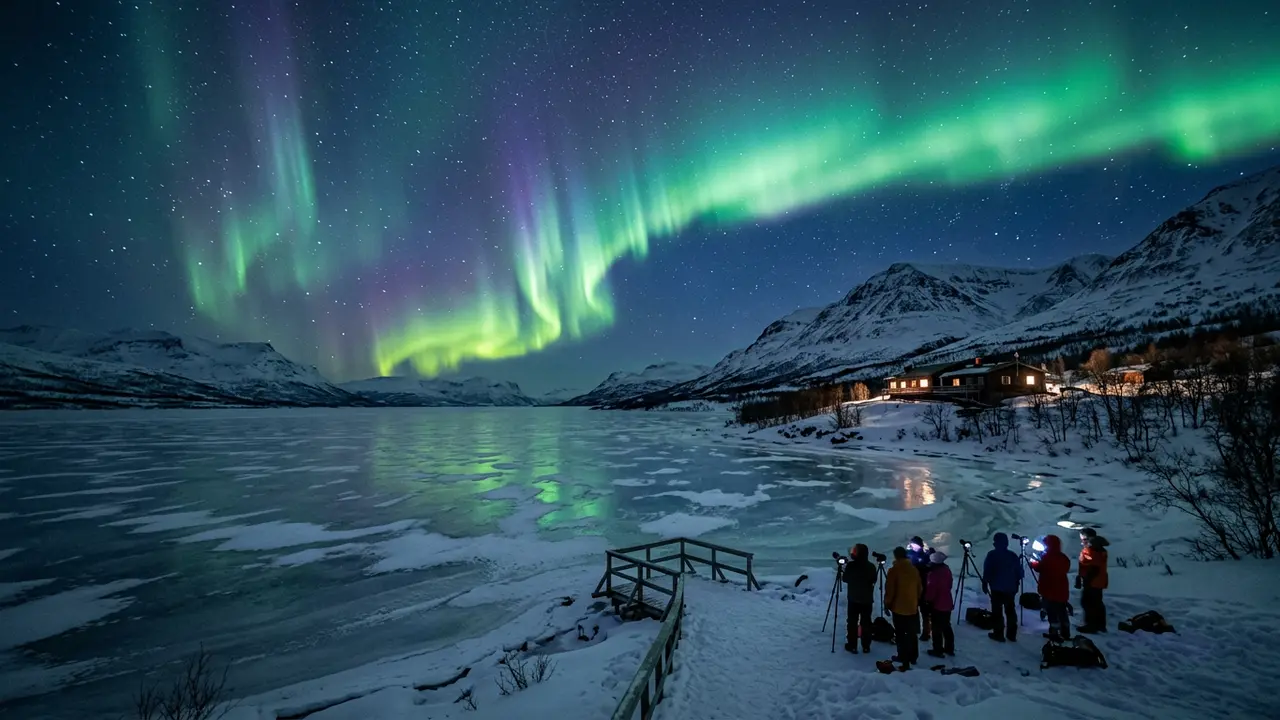
Abisko Stargazing
Abisko's rain-shadow microclimate keeps skies clear when nearby Arctic spots cloud over. Aurora season, the Sky Station, ICEHOTEL, and getting there by train.
What a general aurora explainer can't give you is the first question: reading cloud cover for one specific patch of sky rather than a 200km-wide regional tile. That's genuinely Abisko's own problem to solve, and it's the rest of this article.
Getting the order right changes how a trip actually gets planned. Most visitors check the Kp index first, out of habit, since that's the number every aurora headline leads with, then get discouraged by a quiet Kp 2 night and stay in. Abisko flips that priority: check whether the blue hole is open first, because a quiet geomagnetic night under a genuinely clear sky here still beats a strong storm buried under solid cloud down the road.
The tool stack that actually works for Abisko's microclimate
Generic weather-app icons, the little sun-and-cloud glyphs most phones ship with by default, average conditions across a wide tile and miss a gap as small as the blue hole entirely. Local guides recommend specific national services instead:
- Yr.no, run by NRK and the Norwegian Meteorological Institute, is the one guides mention first. It gives Abisko a 10-day daily forecast with highs, lows, precipitation, and wind, though it doesn't surface a raw cloud-cover percentage on its standard table[4]; read the qualitative fair, cloudy, and rain labels day by day instead of hunting for a number that isn't there.
- SMHI, Sweden's own meteorological institute, is worth cross-checking against Yr.no rather than trusting either alone. When the two disagree on a borderline night, that disagreement is itself useful information.
- NOAA's Space Weather Prediction Center covers the geomagnetic layer: a planetary Kp chart built from a global network of magnetometers, updated every minute[5], plus an experimental 30-minute-ahead aurora-oval forecast known as OVATION[6], short enough to actually act on before you get dressed.
- The Swedish Institute of Space Physics (IRF), based in Kiruna, publishes real-time geomagnetic and sky-camera data that local guides use to reposition guests before a display peaks[7], rather than waiting on a forecast written hours earlier.
| Tool | What it tells you | How often to check |
|---|---|---|
| Yr.no | Hyperlocal cloud cover and precipitation for Abisko specifically | Once in the afternoon, again after dark |
| SMHI | A second opinion on cloud cover when Yr.no reads borderline | Same two checks as Yr.no, side by side |
| NOAA SWPC (Kp + OVATION) | Geomagnetic activity and a 30-minute aurora-oval forecast | Every 30 to 60 minutes once skies clear |
| IRF real-time data | On-the-ground confirmation guides use to reposition | Only once you're already outside under clear sky |
None of these tools replace each other. Yr.no and SMHI answer the cloud question; NOAA and IRF answer the aurora-activity question. Checking only one half of that pair is how a genuinely clear night gets missed, or a cloudy-looking one gets written off far too early.
The failure mode runs both directions. Skip the geomagnetic layer on a night when Yr.no shows a clean forecast and the Kp chart sits low, and you can spend three hours outside under a genuinely clear, genuinely quiet sky watching nothing happen. Skip the cloud layer on a night with strong geomagnetic numbers, and you'll stare at solid overcast wondering why the display everyone's posting about isn't visible from where you're standing. A five-minute check across all four sources before committing to a plan costs less time than either mistake.
A nightly checking routine, step by step
Put the two layers together and the routine looks like this:
- Afternoon: check Yr.no and SMHI for tonight's cloud-cover window over Abisko itself, not Kiruna or the region as a whole.
- Early evening: once it's properly dark, check NOAA's Kp chart and the 30-minute OVATION forecast.
- After the first clear break: step outside and look. Once you're under open sky, what you can actually see outranks what the screen said an hour ago.
- Every 30 to 60 minutes: if cloud is patchy, recheck Yr.no's daily forecast rather than trusting the first read of the evening.
- Stay mobile: if the sky over the lodge looks grey, the chairlift up to Aurora Sky Station or a short walk toward open ground can put you inside the blue hole while a single-point forecast still reads cloudy.
None of these steps takes more than a couple of minutes, and together they replace the one habit that costs visitors the most clear nights: checking a single regional forecast once, in the afternoon, and treating it as final.
A concrete version of the routine: Yr.no shows scattered cloud for 9pm sliding to clear by midnight, SMHI roughly agrees, and the Kp chart is sitting quiet in the 2 to 3 range. That's not a night to write off. It's a night to go outside around 10pm, check whether the sky over the lodge or the chairlift looks anything like the forecast, and stay mobile toward whichever direction the cloud is thinning if it isn't clear yet where you're standing.
When the blue hole doesn't save you
The blue hole isn't a guarantee, and treating it like one is how careful visitors still end up disappointed. A genuinely large weather system, a full Atlantic front pushing through rather than the routine westerly flow, can close the gap for a night or longer. On those nights, no amount of app-checking discipline fixes a solid, region-wide overcast, and the honest move is to accept the loss and try again the next night.
What the blue hole reliably does is turn the borderline nights, the ones a generic regional forecast would write off completely, into a real chance. That's the whole case for building a checking routine around Abisko specifically instead of trusting whatever cloud icon your phone shows for the wider region. For pairing an app with that routine, best aurora forecast apps walks through the wider toolkit.
Read next · Guide
Best Aurora Forecast Apps for Chasing the Northern Lights
My Aurora Forecast, SpaceWeatherLive, Glendale, Hello Aurora, and AuroraWatch UK compared: what each shows, what's free, and who each app actually suits best.
Build a trip around several nights rather than one, precisely because no forecast, blue hole included, promises a specific evening. Local guides say this often enough that it's worth repeating: stack the odds across three or four nights instead of betting everything on the one you booked in advance, and the checking routine above stops feeling like extra work and starts being the reason one of those nights actually pays off.