What the Guide Actually Teaches
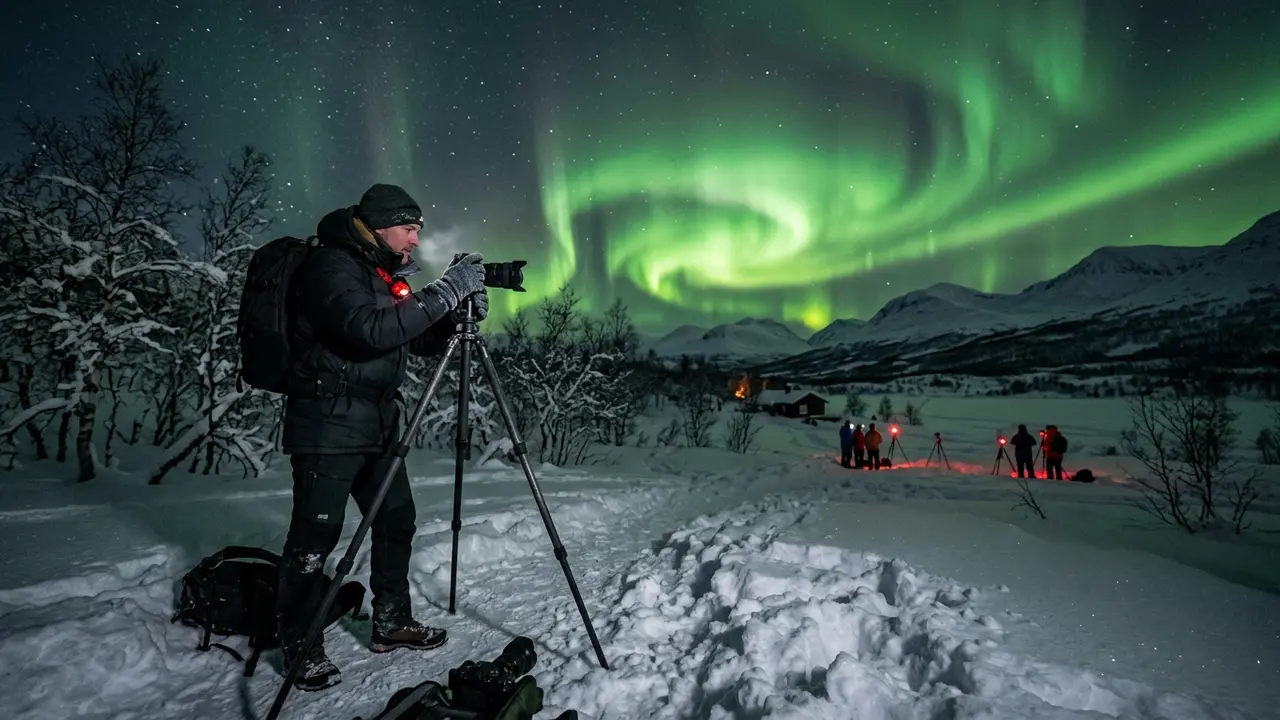
Abisko has one of Swedish Lapland's best reputations for clear aurora skies, driven by the rain-shadow microclimate covered in the Abisko stargazing guide. This tour builds a photography lesson into that advantage. Guides who shoot the aurora professionally teach manual focus locked to infinity, walk through long-exposure shutter speeds for a moving sky, and adjust ISO and aperture in real time as the display brightens or fades. If you've never touched manual mode before, this tour teaches it from scratch.
What a Night Actually Looks Like
Departure runs around 7:00-7:30 PM local time, and the group stays out for roughly 4 hours, longer if the aurora is active and everyone wants to keep shooting. Groups cap at eight participants per guide, small enough that you get real one-on-one time behind the tripod. Expect:
- A guide-led scouting stop for a clean horizon and a foreground worth including, often along Lake Torneträsk
- Camera setup on provided tripods, with presets dialed in before the group starts shooting
- Real-time coaching on exposure, composition, and cold-weather battery management
- Warm drinks and breaks to actually watch the display between shots
Gear, Provided or Otherwise
Cameras with aurora-ready presets are supplied for guests without their own DSLR, along with tripods, headlamps, and arctic-weight overalls. Bringing your own body? Ask about wide-aperture lenses (f/2.8 or faster) before you fly. A kit lens around f/5.6 still works with the provided presets, but you'll fight the high-ISO noise floor far more than someone shooting wider glass.
Booking and Price
Lights Over Lapland runs this tour directly, and the same experience is also bookable through GetYourGuide and Viator. Expect somewhere in the £118-195 GBP ($150-240 USD) range for the 4-hour outing. Currency conversion and seasonal demand shift that figure, so confirm the current price directly with the operator before booking.
Season
Tours run December through March, when Abisko's dark season overlaps with its rain-shadow advantage for some of Swedish Lapland's more dependable aurora viewing. Outside that window, there simply isn't enough darkness to shoot by.