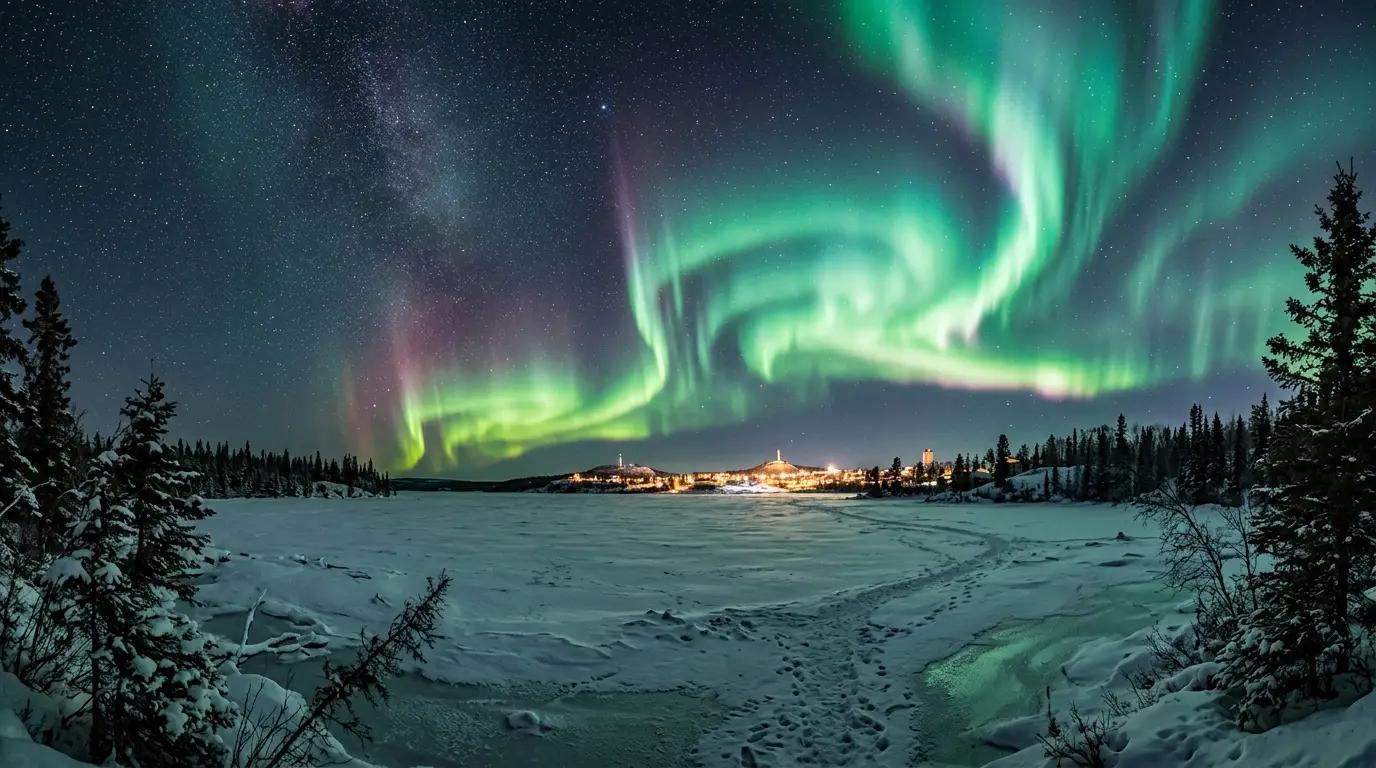

The aurora season runs mid-August through mid-April
Yellowknife's usable aurora season opens in mid-August and closes in mid-April. Outside that window, the sky never gets dark enough for aurora observation at 62°N latitude because of the midnight sun and persistent civil twilight from May through early August[3]. The Astronomy North AuroraMAX observatory resumes its daily Yellowknife-specific forecast on August 10 each year, which doubles as the de facto start-of-season marker tour operators work to.
The season splits into two distinct periods with different trade-offs:
240
- Fall aurora season (mid-August through early October): temperatures run 5°C to 18°C in August and September, the lakes are still open so aurora reflects on still water, and you can watch from a campfire instead of a heated shelter. The trade-off is shorter usable darkness: by mid-August you get 6 to 8 hours, not the 18-hour windows winter delivers.
- Winter aurora season (mid-November through early April): after the October-November transition, stable arctic high-pressure air settles in, humidity collapses, and clear-sky probability jumps. The viewing window extends to 17:00 through 08:00 in December and January, but you trade temperature for time: January averages -21.6°C during the day and -29.4°C overnight, with minimums below -40°C not uncommon[6].
For context on what those temperatures demand from your clothing system, the same layering strategy that works for Fairbanks (see the best time to see northern lights in Fairbanks guide) applies here. Yellowknife runs colder than Fairbanks by a few degrees, so add a mid-layer.
Why the equinox months of October and March are the real peaks
If you look at aurora-tourism marketing, you will see a lot of winter imagery: snow, parkas, December through February. The problem with that picture is that December and January are not, on average, the most geomagnetically active months. The real peaks arrive with the equinoxes.
The driver is the Russell-McPherron effect, identified by astrophysicists C. T. Russell and R. L. McPherron in 1973. Earth's magnetospheric axis aligns more favorably with the solar wind's interplanetary magnetic field (IMF) during the March and September equinoxes, making it easier for solar particles to enter the magnetosphere and trigger geomagnetic substorms that produce the brightest, fastest-moving aurora. At Yellowknife's magnetic latitude of 68°N, the auroral oval runs directly overhead, so these equinox surges produce horizon-to-horizon displays, not the edge-of-oval glimpses you get at destinations further south on the magnetic latitude scale.
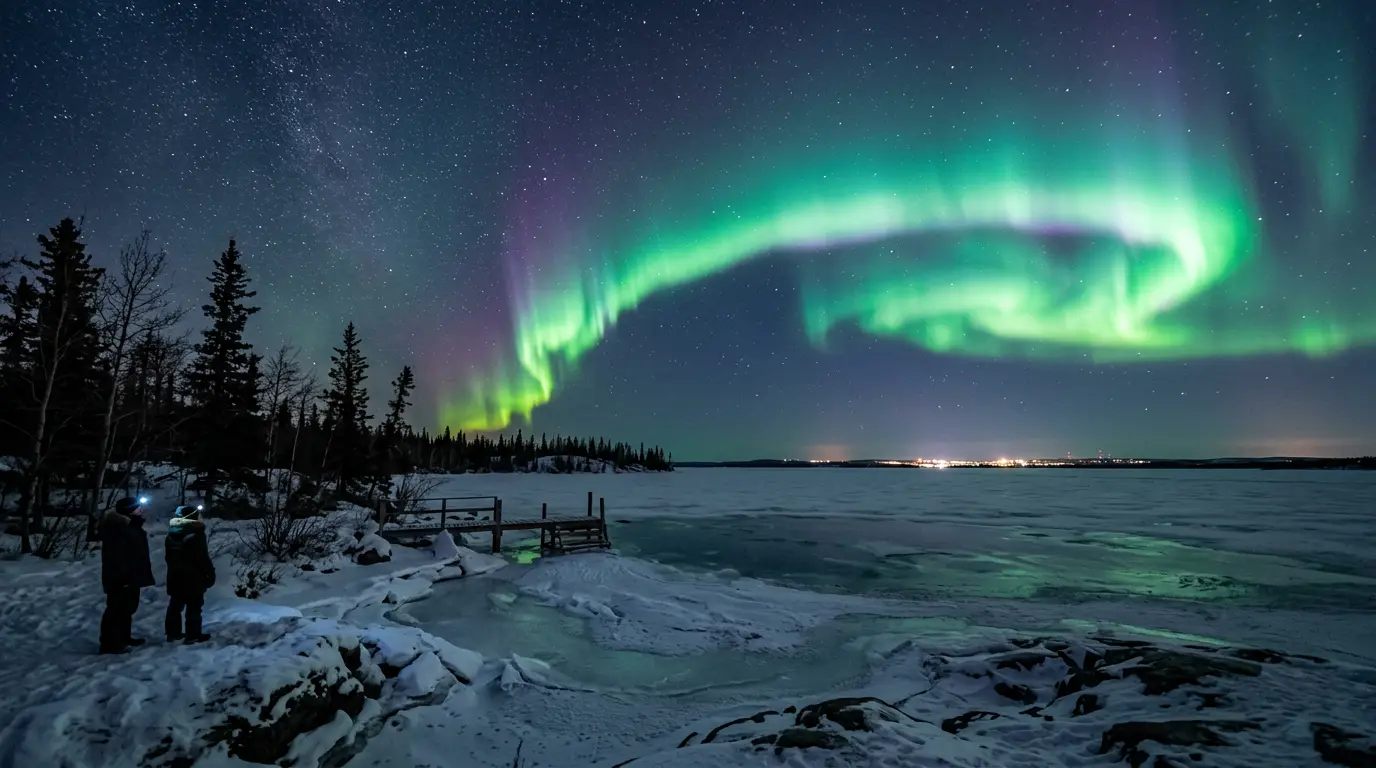
Featured · Destination
Yellowknife Northern Lights
Yellowknife sits beneath the auroral oval: up to 240 aurora nights per year. Guide to seasons, viewing spots, Indigenous-led tours, and cold-weather planning.
In practice, this means October and March deliver consistently stronger displays than December or January. October gets the September-equinox tail plus its own solar-wind geometry. March benefits from the March-equinox alignment combined with winter's stable arctic air mass, the best of both worlds. If you are choosing between a December trip and a March trip, the data favors March every time.
The Kp index thresholds for Yellowknife are lower than for most other aurora destinations: overhead aurora is visible at Kp 2, and any clear night at Kp 3 or above delivers a strong show. Because you are under the oval's center rather than at its edge, you are not waiting for a Kp 5+ event the way you might be in Reykjavik.
The October to mid-November cloud gap most guides skip
Here is the single most useful thing this article can tell you: early October through mid-November is Yellowknife's cloudiest period, and booking a trip during this October-November window is a gamble most visitors lose.
The physics is straightforward. In early autumn, Great Slave Lake, one of the largest freshwater lakes on the continent, releases the heat it absorbed all summer. That warm, moist air rises into the cooling autumn atmosphere and condenses into persistent cloud cover[2]. Snow cover has not yet fully established, so there is no reflective surface cooling to stabilize the boundary layer. The result is a gray lid that can sit over Yellowknife for weeks.
NWT Tourism describes it explicitly: the fall aurora season is said to end after the first two weeks of October because the change into winter brings a brief period of snowy cloud cover. This cloud cover disappears in late November when humidity drops and the crisp winter sky opens for the winter season[2].
Tour operators largely pause operations during this gap. If you see a great flight deal for the last week of October and think you will catch the aurora, think again. The geomagnetic activity is real (October is an equinox month), but if clouds block the sky for your entire stay, that activity is academic. Book either side of the gap: early October if the weather holds, or late November onward.
Winter viewing: clearest skies meet the coldest nights
Late November through February is Yellowknife's clearest-sky period, and also its coldest. The two facts are causally linked: the same subarctic high-pressure system that suppresses cloud formation drives temperatures deep into the negatives.
Yellowknife is Canada's sunniest city in spring and summer, with 60.4% sunny skies April through August versus Toronto's 53.6%[4]. In winter, the pattern holds: cold, dry arctic air masses dominate, humidity drops, and clear-sky probability in December through March significantly exceeds coastal aurora destinations like Iceland or Tromsø, where maritime cloud cover is the primary viewing obstacle. In Yellowknife, if the sky is dark and clear, aurora is almost certainly visible; the geomagnetic activity threshold is low, and nothing blocks it.
Recommended tours
Tours are selected for quality, not commission. I earn a small fee if you book — at no extra cost to you.


The trade-off is the cold, and it is a real one:
- December: average highs -18.0°C, average lows -25.6°C. Shortest daylight window (5-6 hours) means the longest viewing opportunities; aurora can appear from late afternoon through dawn.
- January: average highs -21.6°C, average lows -29.4°C. Record low of -51.2°C. This is the peak of the dark but also the peak of the cold. A multi-hour stationary vigil without proper arctic-rated gear is dangerous.
- February: average highs -18.0°C, average lows -27.4°C. Daylight window stretching to 8-11 hours but still plenty of darkness. Temperatures begin a slow climb.
| Month | Temp range | Daylight hours | Clear-sky odds |
|---|---|---|---|
| December | -18.0°C / -25.6°C | 5-6h | Highest |
| January | -21.6°C / -29.4°C | 5-8h | Highest |
| February | -18.0°C / -27.4°C | 8-11h | Highest |
| March | -8°C / -19°C | 11.5-13h | Very high |
Tour operators provide heated shelters, warm drinks, and guided short-exposure viewing; they know the cold is the real variable, not the aurora. For a primer on dressing for subarctic aurora vigils, the how to see the northern lights guide covers the layering system and battery care that applies here exactly.
March is the month to book
After cross-referencing geomagnetic activity, clear-sky probability, temperature, and usable darkness, March emerges as Yellowknife's single best aurora month. Here is why, in the order it matters:
- Geomagnetic activity peaks at the March equinox. The Russell-McPherron IMF alignment that drives equinox aurora surges is in full effect. The auroral oval sits squarely overhead at 68°N magnetic latitude.
- Clear-sky probability is still very high. Winter's arctic air mass has not yet broken down. Humidity stays low, and cloud cover remains well below the October-November trough.
- Temperatures are improving. March averages -8°C highs and -19°C lows, still cold but a full 10 to 15 degrees warmer than January. A multi-hour vigil in proper gear is uncomfortable rather than dangerous.
- Daylight is long enough to do things during the day. With 11.5 to 13 hours of daylight, you can snowshoe, dogsled, or ice-fish before sunset, then be outside for aurora by 21:00 or 22:00. December's 5-hour daylight window leaves you mostly waiting in the dark.
- Tour operators are running at full capacity. Unlike the October gap when many pause operations, March sees the full range of aurora lodges, chasing tours, and Indigenous cultural experiences operating.
September is the runner-up: still-mild temperatures plus equinox activity, but shorter nights and moderate cloud cover from lingering lake moisture make it a less reliable bet. If you book March and give yourself time for a cloud-day buffer, you are playing Yellowknife's strongest statistical hand. For a side-by-side look at the four months most visitors actually choose between, see Yellowknife aurora by month.
Featured · Destination
Yellowknife Northern Lights
Yellowknife sits beneath the auroral oval: up to 240 aurora nights per year. Guide to seasons, viewing spots, Indigenous-led tours, and cold-weather planning.
How Yellowknife compares to coastal aurora destinations
Yellowknife's aurora advantage is its subarctic continental climate. Most of the world's other famous aurora destinations (Iceland, Tromsø, the Lofoten Islands) sit on coasts or islands where the North Atlantic pumps moisture into the air year-round. In those places, cloud cover, not geomagnetic activity, is the primary variable that determines whether you see anything at all. The best time for northern lights in Iceland guide walks through this problem in detail: you can chase clear-sky windows in Iceland's maritime climate, but you will spend a lot of your trip studying weather radar.
In Yellowknife, the winter sky is clear more often than it is not. The subarctic high-pressure zone that establishes after the mid-November freeze-up suppresses cloud formation for months at a stretch. The trade-off is the cold: continental interiors shed heat faster than coasts, and Yellowknife's winter temperatures run 15 to 25 degrees colder than Tromsø's for the same calendar month. Dress for the cold, and you get statistically more aurora hours per night than at any coastal destination.
Yellowknife also sits 3 to 4 degrees higher in magnetic latitude than Fairbanks (64°N magnetic) and roughly 3 degrees higher than the Iceland viewing belt (~65°N magnetic). Those few degrees matter because they place Yellowknife closer to the auroral oval's center, where displays appear directly overhead at lower Kp values and cover more of the sky. Fairbanks' own seasonal comparison confirms the pattern: Fairbanks gets excellent displays, but at equivalent Kp levels, Yellowknife's are brighter and more overhead.
If your priority is maximizing clear-sky nights and you are willing to invest in arctic-rated winter gear, Yellowknife beats every coastal competitor on pure viewing-stats. If you want a milder climate and do not mind cloud-chasing, Iceland or Tromsø may suit you better. The decision is which variable you prefer to gamble on: cold or clouds.