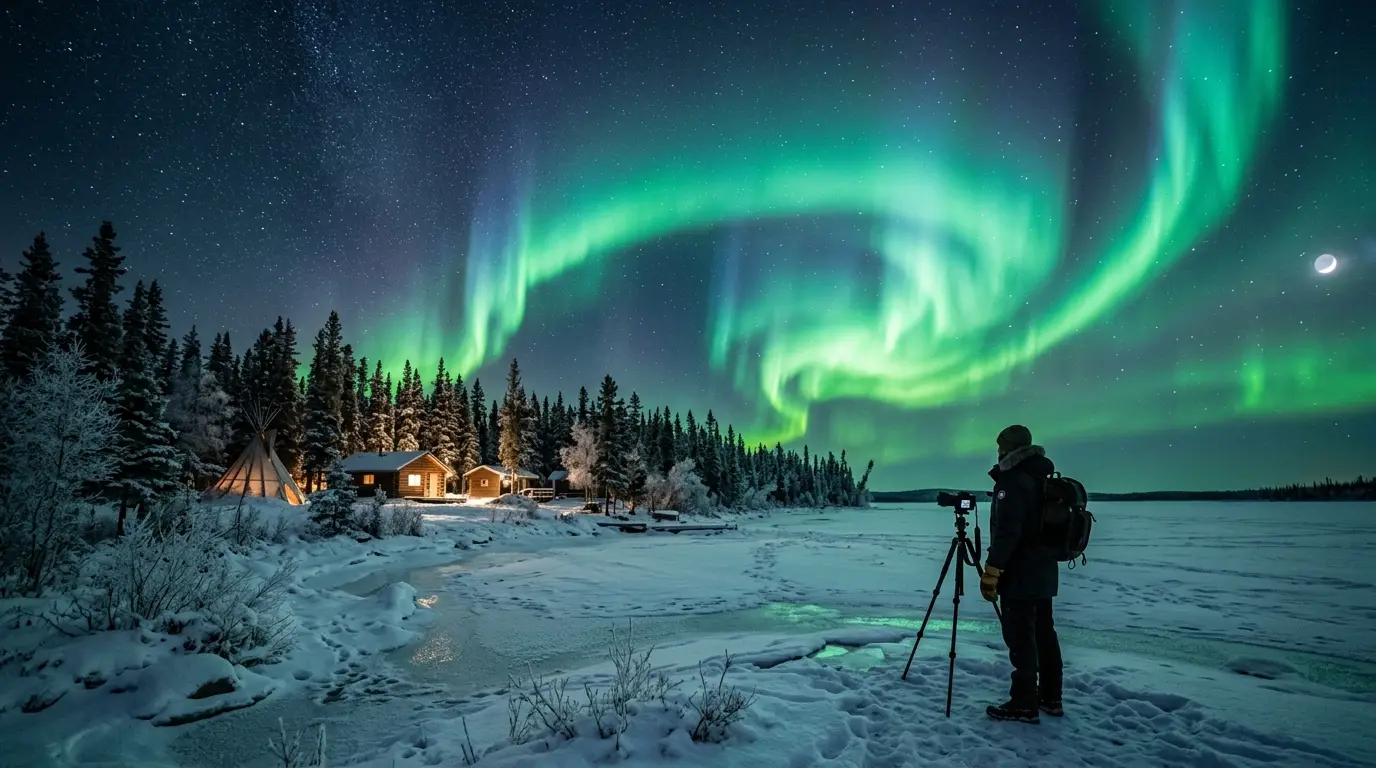

The magnetic advantage: why Yellowknife needs a local forecast
The auroral oval is a ring of geomagnetic activity centered roughly on Earth's magnetic north pole. It expands and contracts with solar wind pressure and shifts with Earth's rotation, which means the same Kp value produces entirely different viewing conditions at different magnetic latitudes.
Yellowknife sits at 62°N geographic but roughly 68°N magnetic latitude[1]. Those six extra degrees of magnetic pull place it inside the oval's core, not at its edge. A Kp of 2, which most forecast apps label quiet, already means faint but visible overhead structure here. Kp 3 delivers recognizable bands and movement. Kp 4 is bright green and purple. At Kp 5+, the entire sky fills horizon to horizon.
Compare that to Reykjavik at roughly 65°N magnetic: you need Kp 4 or 5 for the same overhead experience. Kp 2 or 3 in Iceland produces only a glow on the northern horizon. The practical upshot is that the threshold for a good Yellowknife night is noticeably lower than in coastal destinations.
68°N
This is why generic aurora apps fail here. They draw the same NOAA Kp data every app draws but apply no local magnetic calibration to a specific sky. The Fairbanks aurora forecast works on the same principle for Alaska: the UAF Geophysical Institute calibrates NOAA data to 64.8°N. For Yellowknife, the equivalent local calibrator is Astronomy North.
Astronomy North is the first tab you open every morning
The Astronomy North aurora forecast at astronomynorth.ca is the only daily forecast calibrated specifically to Yellowknife's magnetic position. A team of volunteers updates it before 2:00 PM Mountain Time each day during the aurora season, which runs from August 10 through early May[1]. The site closes during summer when the midnight sun washes out all usable darkness at 62°N.
The forecast uses a simple three-tier rating: Calm, Moderate, or Active, plus a Storm Watch flag when conditions warrant. Behind that rating, Astronomy North forecasters take the global NOAA data: Kp, solar wind speed, Bz orientation, and the 3-day prediction. They translate it into a probability specific to this one sky. The same NOAA data that says Kp 3 planet-wide gets interpreted differently at 68°N magnetic than it does at a station in Germany.
Featured · Destination
Yellowknife Northern Lights
Yellowknife sits beneath the auroral oval: up to 240 aurora nights per year. Guide to seasons, viewing spots, Indigenous-led tours, and cold-weather planning.
The site also runs AuroraMAX, a live webcam from an observatory near Yellowknife that streams real-time sky conditions[3]. The webcam is the last thing you check before driving the Ingraham Trail. It shows whether clouds have moved in since the afternoon forecast was issued. On nights when the forecast says Active but the webcam shows black sky, you save yourself a cold drive. On nights when green bands are already pulsing on the feed, you get in the car immediately.
Astronomy North describes its own process plainly: the community-specific forecasts are built from NOAA global space weather data, and forecasters examine global geomagnetic field conditions to determine aurora probability above northern communities.
NOAA's 3-day forecast: the Kp numbers that matter at this latitude
The NOAA Space Weather Prediction Center 3-day forecast at spaceweather.gov is the raw data Astronomy North starts from, and the tool you use for planning two or three days ahead[4]. Updated every 12 hours at 0030 and 1230 UTC, it reports observed Kp for the past 24 hours and predicted Kp in 3-hour blocks for the next 72 hours.
For Yellowknife, the practical Kp thresholds are lower than what most travellers expect from reading general northern lights guides. The Kp index explained article covers the physics of how NOAA builds the number, but here is the Yellowknife-specific scale:
- Kp 0–1: The oval sits far north. Even at 68°N magnetic, overhead aurora is unlikely. Use the night for sleep or test exposures.
- Kp 2: Faint green arcs may appear overhead. Long-exposure photography picks up structure the naked eye barely registers. This is the minimum viable Yellowknife viewing night.
- Kp 3: The practical baseline for a good show. Visible bands with recognizable movement. Tour operators are actively chasing at Kp 3.
- Kp 4: Bright displays with clear green and purple. The kind of night that makes subarctic cold irrelevant.
- Kp 5+ (G1 storm and above): Full-sky coverage, horizon to horizon. Kp 7+ can produce red aurora visible well south of the oval.
The 3-day forecast is most reliable for the first 24 hours. Accuracy drops noticeably for days 2 and 3; solar wind conditions change faster than the models predict[4]. Treat day 1 as your operational forecast, days 2 and 3 as trend indicators. Check again the morning of your viewing night for the updated block.
The real-time toolkit: OVATION, Bz, and SpaceWeatherLive
Kp is a backwards-looking three-hour average. Even the nowcast Kp tells you what already happened. For the final pre-drive decision, you need real-time data, and the single most useful number is not Kp. It is Bz.
Bz is the north-south component of the interplanetary magnetic field (IMF) carried by the solar wind. When Bz is positive (northward), Earth's magnetosphere stays closed and solar particles slide past. When Bz turns negative (southward, typically below −5 nT), the magnetosphere opens up: solar wind plasma pours in along field lines, and aurora activity surges within 30 to 60 minutes. A sudden southward swing at sunset is the signal to drive the Ingraham Trail immediately.
SpaceWeatherLive.com displays Bz in real time alongside live Kp, solar wind speed, and a 72-hour Kp history chart[8]. The history chart is especially useful: if Kp has been trending upward over the past six hours and Bz is negative, you have a window. The site loads quickly on hotel Wi-Fi and works on any phone browser.
The NOAA OVATION model at spaceweather.gov uses live solar wind data from the L1 Lagrange point, roughly 1.6 million kilometers upstream of Earth, to map the auroral oval's current position 30 to 90 minutes ahead[5]. Yellowknife sits inside the green oval band at almost any Kp. The output is simple: if the green oval covers Yellowknife and the intensity bar shows moderate (green) or active (red), aurora is overhead now.
Natural Resources Canada runs a Canadian Space Weather Forecast Centre at spaceweather.ca with a Quicklook Summary that breaks the 24-hour geomagnetic forecast into Polar, Auroral, and Sub-auroral zones[6]. Yellowknife lives in the Auroral zone. The NRCan forecast adds a Canadian-government data source that cross-validates what Astronomy North and NOAA show; useful on nights when the three tools disagree.
The daily workflow, from coffee to the Ingraham Trail
Here is the sequence that local guides and experienced chasers follow during aurora season in Yellowknife. It is designed to minimize the chance of missing a window while avoiding unnecessary hours in subarctic cold.
Morning (before 2:00 PM MT): Open Astronomy North. The daily forecast posts by early afternoon. Active means you are likely on. Moderate with a Storm Watch note means plan to go but check back. Calm means the evening is probably quiet; rest for tomorrow.
Late afternoon: Check the NOAA 3-day forecast for the day's Kp block. If the predicted Kp is 3 or above and the Astronomy North rating is Active or Moderate, the two sources agree: plan to head out. Open Environment Canada or Windy.com for cloud cover. Yellowknife's winter skies are clear more often than not, but the October-to-mid-November freeze-up is a known trap: persistent cloud from Great Slave Lake steam makes October the single worst month for aurora in the NWT. The best time for northern lights in Yellowknife article covers that seasonal window in detail.
60 to 90 minutes before sunset: Open the OVATION 30-minute forecast and SpaceWeatherLive. Check three things: Is the green oval covering Yellowknife? Is Kp trending up? What is Bz doing? If Bz is negative and dropping, suit up now.
Featured · Article
What Is Astrotourism? The Complete Beginner's Guide
Astrotourism means travel built around dark skies: meteor showers, auroras, the Milky Way. What it means, where to go, and how to plan your first trip.
Recommended tours
Tours are selected for quality, not commission. I earn a small fee if you book — at no extra cost to you.


Before leaving the hotel: Open AuroraMAX. The webcam shows exactly what is above the observatory at this moment. Green sky means go. Black sky means wait 30 minutes and check again.
On the road: Drive east on Highway 4, the Ingraham Trail, for 15 to 25 minutes. The best aurora viewing spots near Yellowknife list the specific pullouts that offer unobstructed northern horizons and escape the city's light dome. The trail is a paved two-lane highway plowed and maintained through winter, but temperatures below −30°C demand a vehicle with a block heater and a full tank. Do not pull onto lake ice unless you have confirmed ice thickness with a local operator.
This workflow applies from late November through early April, when stable arctic high pressure delivers the clearest skies. For what to wear and how to keep camera batteries alive at these temperatures, the how to see the northern lights guide covers the layering and cold-weather systems that make a stationary vigil survivable.
What a forecast cannot tell you: cloud, moon, and the freeze-up gap
A perfect Kp forecast is meaningless if clouds sit over Yellowknife. Two cloud patterns matter.
The first is the October-to-mid-November freeze-up. Great Slave Lake, one of the largest freshwater lakes on the continent, releases stored summer heat into the cooling autumn air during this window, generating persistent low cloud that can sit over the region for days. Tour operators largely pause operations during this period. If you see a cheap flight for late October, do not book it for aurora.
The second is the December-to-March arctic high. After the lake freezes and snow cover stabilizes, a cold high-pressure cell settles over the region. Humidity collapses and clear-sky probability climbs sharply, giving Yellowknife a reputation among aurora chasers for some of the most reliably clear winter skies in the North.
Moon phase is the other variable forecast tools do not show. A full moon illuminates the snow-covered landscape like a floodlight and washes out faint to moderate aurora. The aurora is still there (a Kp 5 storm punches through moonlight) but Kp 2 or 3 displays become harder to see. Book your trip around the new moon or a waxing crescent if you can. A crescent sets early and leaves the sky dark for the main viewing window.
Understand that even the best forecast is probabilistic. The solar wind is a turbulent, magnetized plasma flowing outward from the Sun at roughly 400 km/s in its slow state and 500 to 800 km/s in its fast state[11]. NOAA models it with real skill[9], and Astronomy North adds local judgment, but a predicted Kp 5 night can arrive as a Kp 2, and the reverse happens too. Give yourself a buffer: three nights in Yellowknife gives roughly a 90 percent probability of seeing aurora during the winter season. One night is closer to a coin flip.
“The aurora can often be observed somewhere on Earth from just after sunset or just before sunrise. The aurora does not need to be directly overhead but can be observed from as much as a 1000 km away when the aurora is bright.”