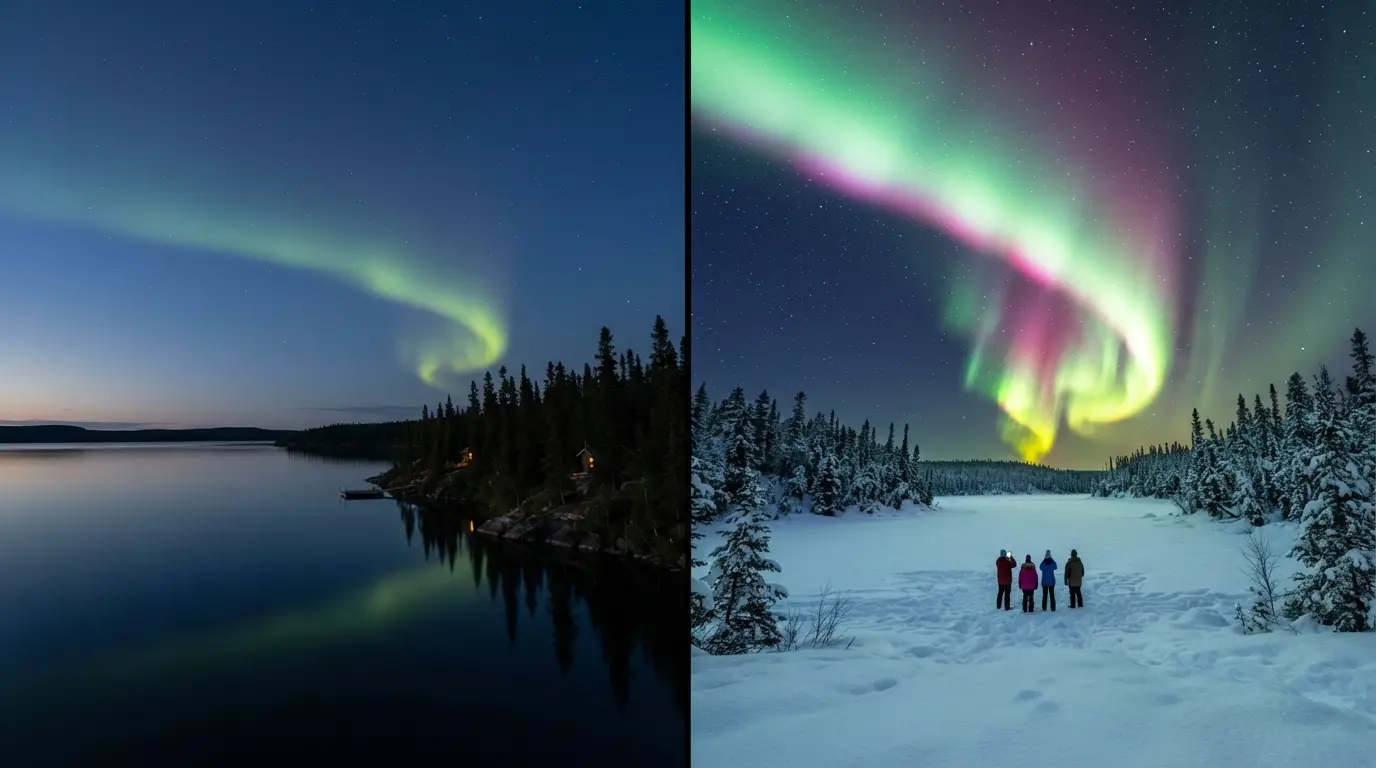

August: long twilight, warm nights, easy logistics
August is where Yellowknife's fall aurora season opens, with the aurora season window starting in mid-August[4]. The trade-off is daylight: true darkness doesn't return until late in the month, so early-August trips lose an hour or two of viewing time compared to September. What you gain is comfort. Average daily high sits at 18.4°C, the low at 10.5°C, and the mean temperature is 14.5°C[5], and the month averages 276.2 sunshine hours[6], among the sunniest months of the season and the mildest weather of the four.
That sunshine total matters for more than comfort. It means fewer daytime clouds have built up by dusk, and the short, warm nights make waiting outdoors for a display far less punishing than a January stakeout at −30°C. If you're weighing whether comfort or darkness matters more for your first trip, the best time for northern lights in Yellowknife guide walks through the trade-off across the whole season.
What August doesn't offer: the deepest darkness or the strongest geomagnetic activity of the year. Displays tend to be shorter and lower on the horizon in the month's first two weeks. Book the back half of August, not the front, if this is your only shot.
September: the fall window at its sharpest
September is the month most locals recommend for a first trip, and the data backs that up. Sunshine hours drop to 157.7 for the month, roughly 45% below August's total[7], but that isn't a warning sign: it reflects genuinely dark, cooler nights replacing lingering summer twilight. Temperatures settle into a daily high of 10.9°C and a low of 4.2°C[8], cool enough for a jacket, not yet the deep-cold gear a winter trip demands.
The fall-season window runs from mid-August through the end of September[4], and September sits at the sweet spot inside that window: full darkness has returned, tour operators are running a full schedule, and the punishing cold of October and beyond hasn't arrived. The Kp index explained guide is worth reading before a September trip specifically, since the equinox period brings statistically elevated geomagnetic activity that a quick Kp check can help you plan around.
The one caveat: September is also the month right before the cloud gap hits. Book the first three weeks if you can; late September starts to show the same cloud buildup that dominates October.
October: the month tour operators warn you about
October is where Yellowknife's reputation for reliable aurora breaks down, and the numbers explain why. Sunshine drops to just 65.0 hours for the month, the lowest of the entire aurora season[1], while the mean temperature sits at −1.0°C[3], cold, but not the deep freeze that makes December through February punishing. The problem isn't temperature. It's cloud.
Monthly precipitation is only 28.8 mm[9], about two-thirds of August's or September's total, which rules out heavy rain or snow as the cause. NWT Tourism attributes the gap directly to the seasonal transition: "the change into winter brings a brief period of snowy cloud cover"[10], as Great Slave Lake releases stored summer heat into the cooling air and generates a persistent low deck that sits over the city for weeks. Some tour operators scale back or pause entirely during this stretch rather than book guests into a month with a structurally worse clear-sky rate than either side of it.
Featured · Destination
Yellowknife Northern Lights
Yellowknife sits beneath the auroral oval: up to 240 aurora nights per year. Guide to seasons, viewing spots, Indigenous-led tours, and cold-weather planning.
If October is your only available month, don't write it off completely — the aurora itself is just as active, and a break in the cloud still delivers a real display. But go in knowing you're betting against the calendar's worst odds, and build in extra nights to cover for it.
April: winter's last stand, with daylight coming back
April closes the aurora season, and its weather profile looks almost nothing like October's despite sitting on the opposite side of winter. Sunshine hours climb back to 276.4 for the month, essentially matching August[11], while the daily high reaches just 0.3°C and the low still drops to −11.3°C[12], a wide day-night swing typical of a subarctic spring. The winter aurora window runs roughly mid-November through early April, and the City of Yellowknife's own tourism page names mid-November to the beginning of April, alongside late summer into early autumn, as its best viewing windows[13].
Recommended tours
Tours are selected for quality, not commission. I earn a small fee if you book — at no extra cost to you.


What makes April distinct from December or January isn't clearer skies. It's comfort layered on top of still-strong odds. You get winter's dry, high-pressure clarity without needing gear rated for −30°C. The trade-off is darkness: nights are shortening fast by late April, and a trip booked for the last week of the month will lose real viewing hours compared to one booked for the first. Pack for genuine cold regardless — the Arctic winter packing list is written for exactly this shoulder-season gap between what the daytime high suggests and what a clear midnight actually feels like.
Featured · Article
What Is Astrotourism? The Complete Beginner's Guide
Astrotourism means travel built around dark skies: meteor showers, auroras, the Milky Way. What it means, where to go, and how to plan your first trip.
Book early-to-mid April rather than the tail end if darkness length matters more to you than daytime comfort.
The four months side by side
Put the climate data next to each other and the pattern is stark: October is the outlier, not the rule. August and April are near-twins on sunshine hours despite sitting five months apart on the calendar, and September's steep sunshine drop is a sign of returning darkness, not bad weather.
| Month | Sunshine hours | Mean temperature | Character |
|---|---|---|---|
| August | 276.2 h | 14.5°C | Mildest, shortest darkness |
| September | 157.7 h | 7.6°C | Full darkness, full tour schedule |
| October | 65.0 h | −1.0°C | Cloudiest month, tours scale back |
| April | 276.4 h | −5.5°C | Winter odds, spring comfort |
Which month actually fits your trip
If you want the clearest skies with the least cold-weather gear, August or April are your two real options: they post nearly identical sunshine totals, and the choice between them comes down to whether you'd rather deal with lingering summer twilight or a −11°C overnight low. If darkness and geomagnetic timing matter more than comfort, September is the strongest single month: full darkness, a full tour calendar, and the equinox effect working in your favor. Avoid building a trip around October alone unless you have no other choice — pair it with extra nights or shift into early November instead.
Weigh the two shoulder-season months against each other rather than against October: September's occasional drizzle tends to clear, and it pairs the mildest cold of the four months with a full tour calendar, while April holds on to winter's drier, higher-pressure skies but asks for real cold-weather gear against a −11°C overnight low. Neither trade-off is wrong; the sunshine-hours table above is the guide to which one suits you. Whatever month you land on, check the Astronomy North's daily activity rating daily once you're there. A good month improves your odds, but it doesn't replace a same-night check. For how many of those nights you should actually book, the how many nights for Yellowknife northern lights guide runs the math against each season's odds.