
The magnetic pole that shapes the oval — and why it isn't fixed over Canada
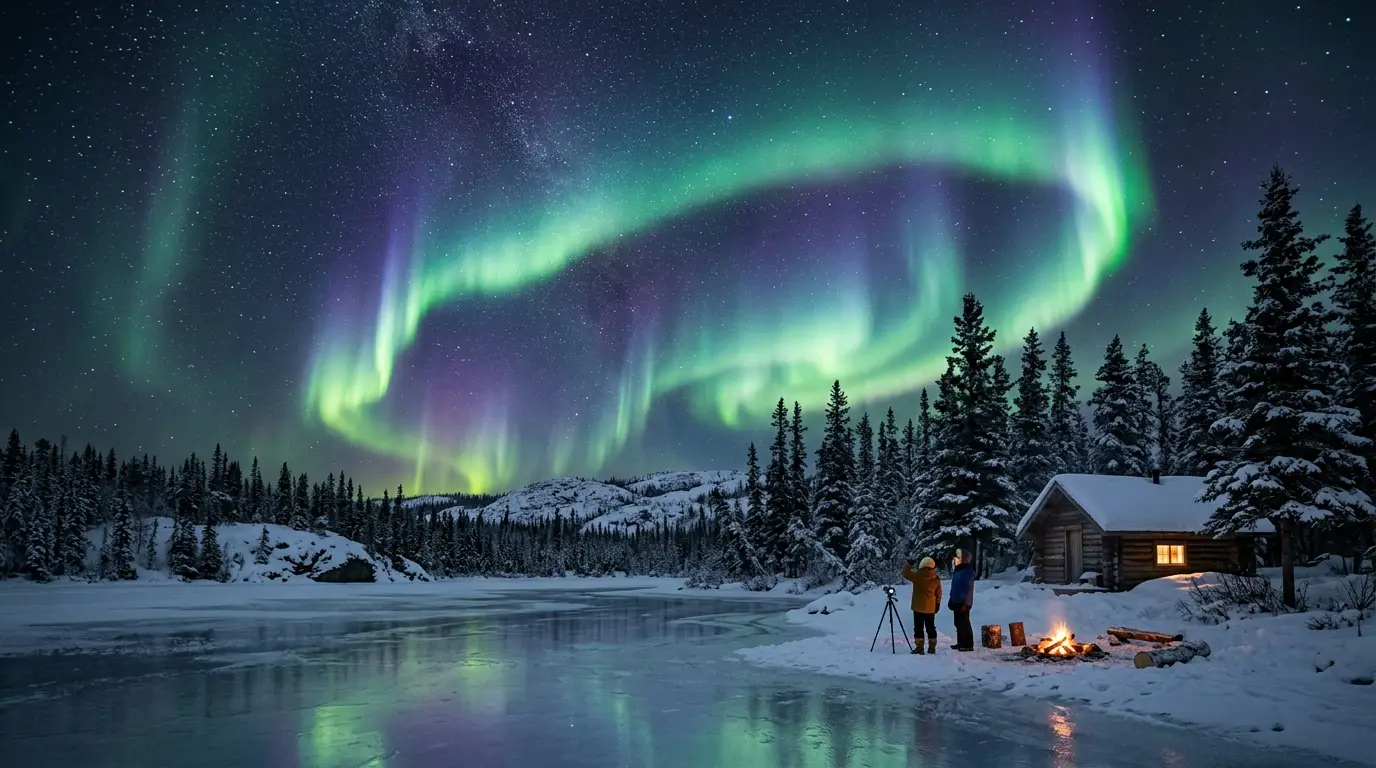
The auroral oval is a permanent ring of auroral activity encircling Earth's magnetic poles, not the geographic ones. It stays roughly in place, contracting toward the pole during quiet conditions and expanding equatorward during geomagnetic storms. The instantaneous north magnetic dip pole — the point where a compass needle points straight down — is not fixed. NOAA's 2024 tracking places it near 86°N, 142°E, out over the Arctic Ocean north of Siberia, having drifted there from the Canadian Arctic at roughly 55 kilometers a year since at least 2019[8].
That drift matters less for Yellowknife than it sounds. The instantaneous dip pole is a wandering, short-term measurement; the figure that actually shapes the auroral oval is geomagnetic latitude, calculated from a modeled, averaged dipole axis (the IGRF model) rather than the pole's day-to-day position. That averaged axis has sat over northern Canada for most of the past century, which is why North American high-latitude stations built up an oval-position advantage the pole's recent eastward drift hasn't erased. The solar wind feeds the system: charged particles stream from the Sun, funnel along magnetic field lines toward the poles, and collide with atmospheric gas to produce the glow[1]. Where the geomagnetic axis tilts, the aurora follows. For the full chain from coronal mass ejection to visible glow, the how to see the northern lights guide walks through every step.
During quiet geomagnetic conditions (Kp 0–2), the oval hugs the pole and most of the world sees nothing. During a storm, it swells southward, and destinations on its edge start getting aurora on the horizon. Yellowknife's position under the oval's southern edge means it catches both quiet-night aurora overhead and storm-time displays that fill the entire sky from horizon to horizon.
Yellowknife's position under the oval's southern edge means it catches both quiet-night aurora overhead and storm-time displays that fill the entire sky from horizon to horizon.
68°N magnetic: the number that matters more than 62.5°N geographic
Pull up Yellowknife on a map and you will see 62.5°N, a latitude roughly level with southern Greenland. The number that actually determines whether you see aurora is magnetic latitude: your distance from the magnetic pole, not the rotational one. Yellowknife's magnetic latitude clocks in around 68°N[2], a full 5.5 degrees higher than its geographic latitude. That gap is the whole game.
At 68°N magnetic, Yellowknife sits inside the auroral oval's peak intensity zone. Overhead aurora is visible at Kp 2, a reading so low that most forecast tools classify it as quiet[2]. At Kp 3, moderate activity produces visible structure and movement directly overhead. At Kp 4 and above, displays become bright and fill the sky. Compare that to destinations further south on the magnetic scale:
86°N, 142°E
- Fairbanks, Alaska (65°N magnetic): overhead displays are common but less intense than Yellowknife at the same Kp value. You typically need Kp 3 for good overhead aurora.
- Reykjavik, Iceland (65°N magnetic): you need Kp 3 or 4 for overhead aurora; at Kp 2 you get a glow on the northern horizon, not overhead.
- Tromsø, Norway (67°N magnetic): the closest competitor on oval proximity, but cloud cover from the North Atlantic Drift means fewer clear-sky nights.
The practical implication is straightforward: on a clear night in Yellowknife during aurora season, if the Kp index registers anything above "quiet," you are almost certainly going to see aurora. You are not waiting on a storm. The Kp index explained breaks down what each value delivers at your specific latitude.
Clear skies: the continental advantage coastal destinations can't match
Position under the oval means aurora is available. Seeing it requires a clear sky. And this is where Yellowknife's subarctic continental climate does what no amount of geomagnetic positioning can: it delivers cloud-free nights at a rate coastal aurora destinations cannot approach.
Yellowknife's annual precipitation runs around 300 mm, a semi-arid regime that produces the driest air of any major aurora-viewing destination on Earth[5]. From April through August, Yellowknife ranks as Canada's sunniest city, with 60.4% sunny skies[5]. That dryness carries straight into winter: once the mid-November freeze-up locks moisture out of the atmosphere and snow cover stabilizes the boundary layer, the dominant winter weather pattern is a subarctic high-pressure system that suppresses cloud formation for weeks at a stretch.
Coastal destinations fight the ocean every night. Tromsø sits at 69.6°N geographic[9], and its magnetic latitude is often cited at around 67°N, roughly comparable oval proximity to Yellowknife's. But Tromsø's maritime climate, fed by the North Atlantic Drift, pumps moisture into the air year-round. Cloud cover is the default condition. An aurora chaser in Tromsø spends as much time studying weather radar as space-weather data. In Yellowknife during winter, the clear-sky default flips: you check the Kp forecast, walk outside, and look up.
| Destination | Geographic lat | Magnetic lat | Cloud-free nights (winter) |
|---|---|---|---|
| Yellowknife | 62.5°N | ~68°N | Highest: dry high pressure, ~300 mm/yr precip |
| Tromsø | 69.6°N | ~67°N | Moderate: maritime moisture, ~1,000 mm/yr precip |
| Fairbanks | 64.8°N | ~65°N | High: interior Alaska dry, ~290 mm/yr precip |
The one notable exception is the October to mid-November cloud gap, when Great Slave Lake releases stored summer heat into the cooling autumn atmosphere, generating persistent low cloud[4]. Tour operators largely pause during this window. For a month-by-month breakdown of Yellowknife's seasonal weather pattern and how it interacts with aurora visibility, the best time for northern lights in Yellowknife guide covers every month's trade-off between temperature, daylight, and cloud probability.
The '240 nights' claim: what the data actually supports
NWT Tourism states that aurora is visible "up to 240 nights per year" from the Northwest Territories[3]. In a separate story piece on the same site, the figure softens to "more than 200 times each year"[4]. The variance is revealing: 240 is an aspirational upper bound, achievable during solar maximum years when sunspot activity, coronal mass ejections, and geomagnetic storms all peak in frequency; 200 is a more conservative floor that holds across a wider range of solar activity.
Recommended tours
Tours are selected for quality, not commission. I earn a small fee if you book — at no extra cost to you.


NASA and NOAA jointly announced in October 2024 that Solar Cycle 25's sunspot peak had already occurred[10], which means 2025–2026 sits in the cycle's declining phase rather than its peak. Elevated activity typically persists for a couple of years past a solar maximum, so the higher end of that range is still more realistic now than at any point since 2014, even though the cycle has passed its high point. During the solar minimum years between cycles (the trough for Solar Cycle 24 bottomed out around 2019–2020), the aurora does not vanish. Yellowknife's oval position is structural, not seasonal. But the frequency of bright, fast-moving displays drops, and the achievable viewing-night count edges closer to the 200 figure.
Featured · Destination
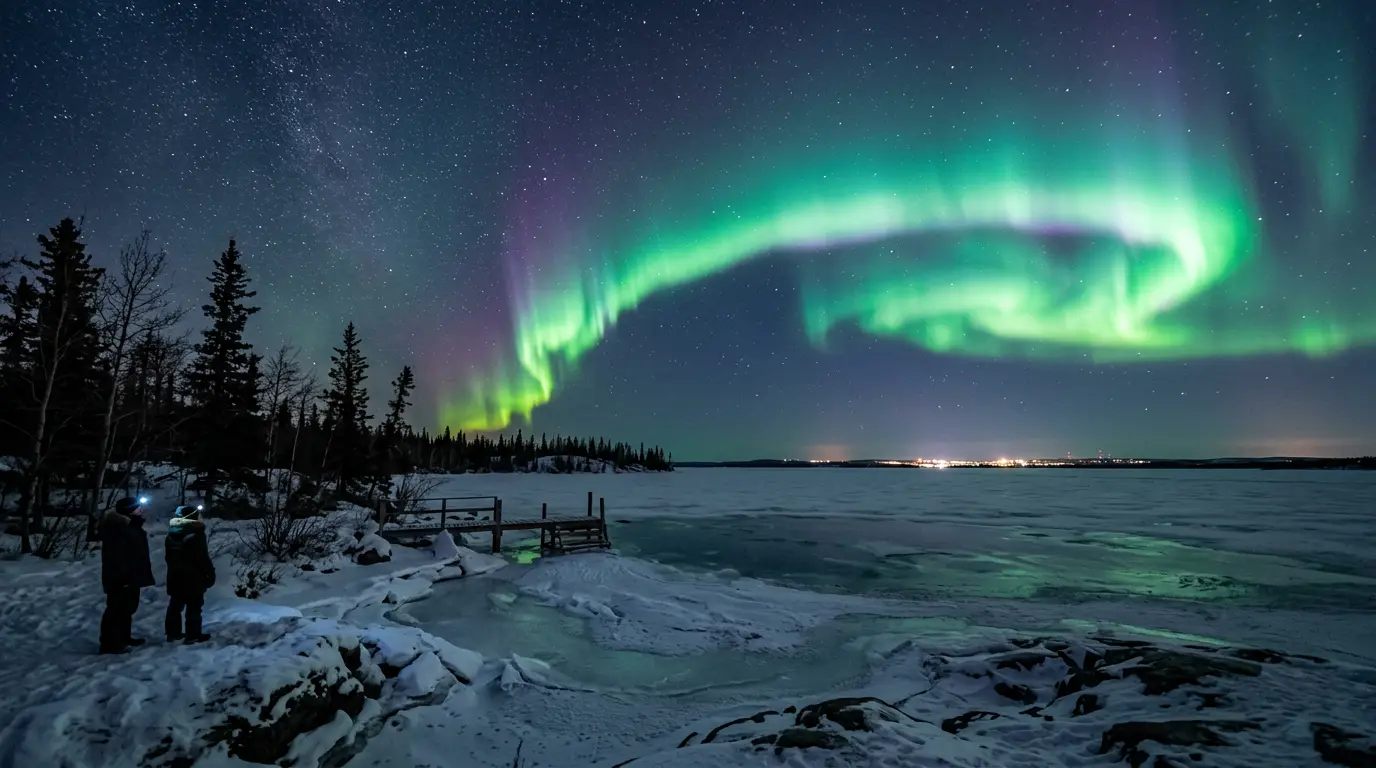
Yellowknife Northern Lights
Yellowknife sits beneath the auroral oval: up to 240 aurora nights per year. Guide to seasons, viewing spots, Indigenous-led tours, and cold-weather planning.
The qualifier that matters most for planning: "up to 240 nights" counts any night with detectable geomagnetic activity above the NWT, regardless of cloud cover, moonlight, or whether the display was actually visible from Yellowknife. It is a measure of oval coverage, not guaranteed viewing nights. For a visitor planning a specific multi-night trip, a more useful framing: during the aurora season (mid-August through mid-April), on any clear, dark night with the moon below the horizon, the probability of seeing aurora is extremely high, easily above 90%, because the oval sits overhead and the Kp threshold is low. The the daily activity rating for Yellowknife provides daily probability ratings that are more actionable than any annual average.
What '240 nights' actually counts
The figure is a geomagnetic activity metric, not a visibility guarantee. It counts nights when instruments detect aurora-generating conditions somewhere in the NWT sky, irrespective of ground-level weather. A cloudy night with active aurora above the cloud deck counts. A night when the display peaked at 3:00 AM under a full moon counts. The denominator is the whole territory, not a single viewing spot.
Solar Cycle 25 and what it means for your trip timing
Solar cycles run roughly 11 years from peak to peak. Cycle 25 peaked around October 2024, the most active point since Cycle 24 roughly a decade earlier. The decline from solar maximum to minimum takes years, not months, so 2025–2026, and even 2027–2028, will still carry elevated activity levels — the immediate post-peak years remain the best odds for a booking, even though the true peak has passed.
What the oval position means for your actual trip
Understanding the auroral oval changes how you plan. You are not booking a destination and hoping for a storm. You are booking a destination parked under the oval and stacking the odds with good timing and daily forecast monitoring. Here is what that looks like in practice:
- Book the right season. Yellowknife's aurora window runs mid-August through mid-April, when true darkness returns to 62°N. Avoid the October to mid-November cloud gap, when Great Slave Lake's thermal inertia generates persistent low cloud. March delivers the best combination: equinox geomagnetic activity from the Russell-McPherron effect, stable clear skies from winter's lingering high pressure, and temperatures averaging a manageable -8°C to -19°C. The Yellowknife northern lights destination hub has lodge and tour recommendations for every season.
- Plan for multiple nights. Even parked under the oval, day-to-day Kp variation, cloud cover, and moon phase mean no single night is a lock. Budget three to four nights for a high-confidence trip; two nights if you can watch the short-term forecast and remain flexible on dates.
- Check both the Kp and the cloud forecast. A Kp 5 reading under overcast skies is useless. A Kp 2 reading under a clear Yellowknife sky still produces overhead aurora. Use NOAA's real-time OVATION model for the 30-minute aurora position forecast[6] and a standard weather app for cloud cover.
- Wait for magnetic midnight. Aurora activity statistically peaks around magnetic midnight, roughly one hour after local midnight in Yellowknife (1:00–2:00 AM local time)[2]. The strongest substorm activity clusters in that window. A quiet sky at 10:00 PM says nothing about what the sky will look like at 1:30 AM.
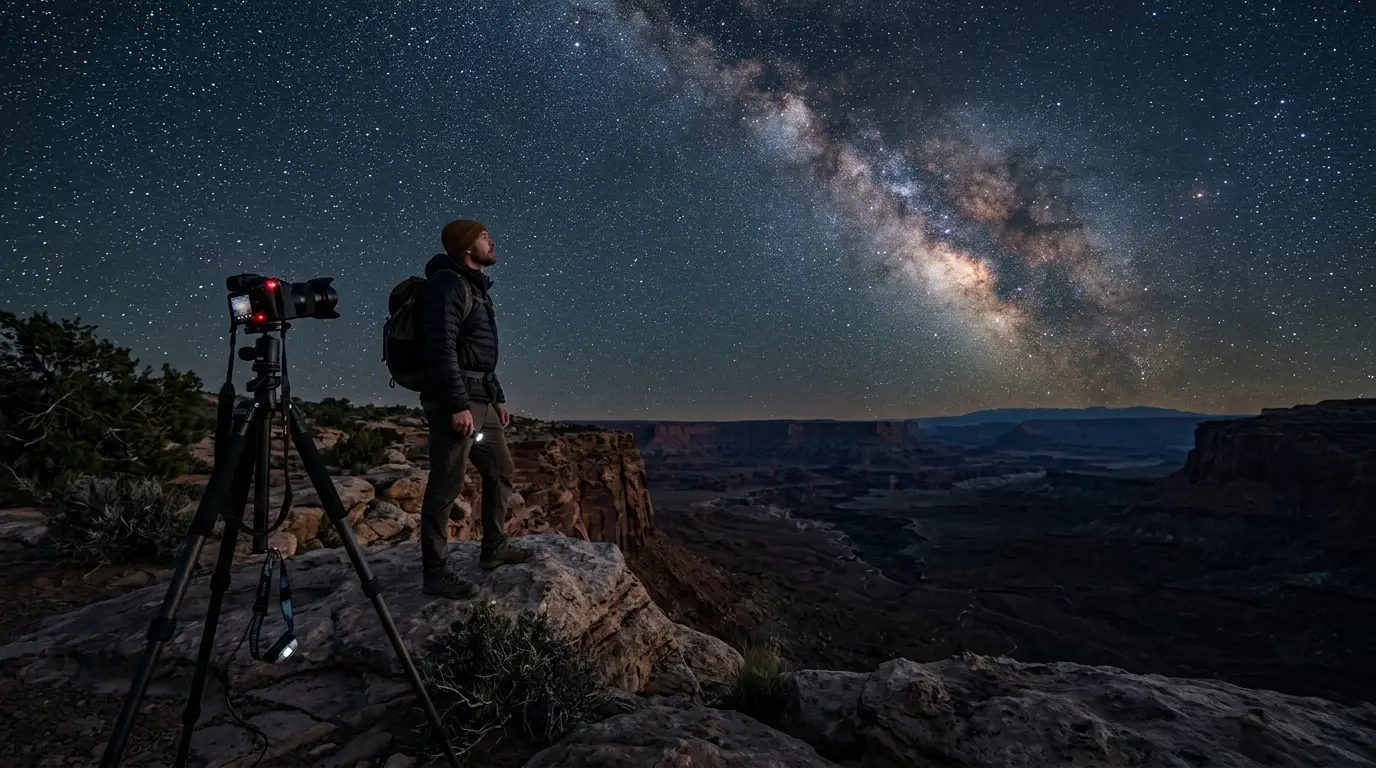
Featured · Article
What Is Astrotourism? The Complete Beginner's Guide
Astrotourism means travel built around dark skies: meteor showers, auroras, the Milky Way. What it means, where to go, and how to plan your first trip.
Yellowknife's auroral oval position is a structural advantage, not a weather roll of the dice. The oval sits overhead because Yellowknife's geomagnetic latitude, built up from a dipole axis that has favored North America for most of the past century, places it under the oval's southern edge. The sky stays clear because the subarctic high pressure suppresses cloud formation. Those two factors, magnetic latitude plus continental dryness, operate independently of the solar cycle, the season, and the nightly Kp forecast. The oval is overhead. The sky, more often than not, is clear. Book accordingly.