
The auroral oval decides more than your tour booking
Most travelers pick a northern-lights destination by looking at a map and choosing the northernmost dot. That instinct is backward. What matters is not how far north a city sits on a road map but where it falls on the magnetic-latitude scale, the invisible coordinate system that places every destination relative to the auroral oval, the ring where geomagnetic substorms concentrate aurora activity most nights of the season[10].
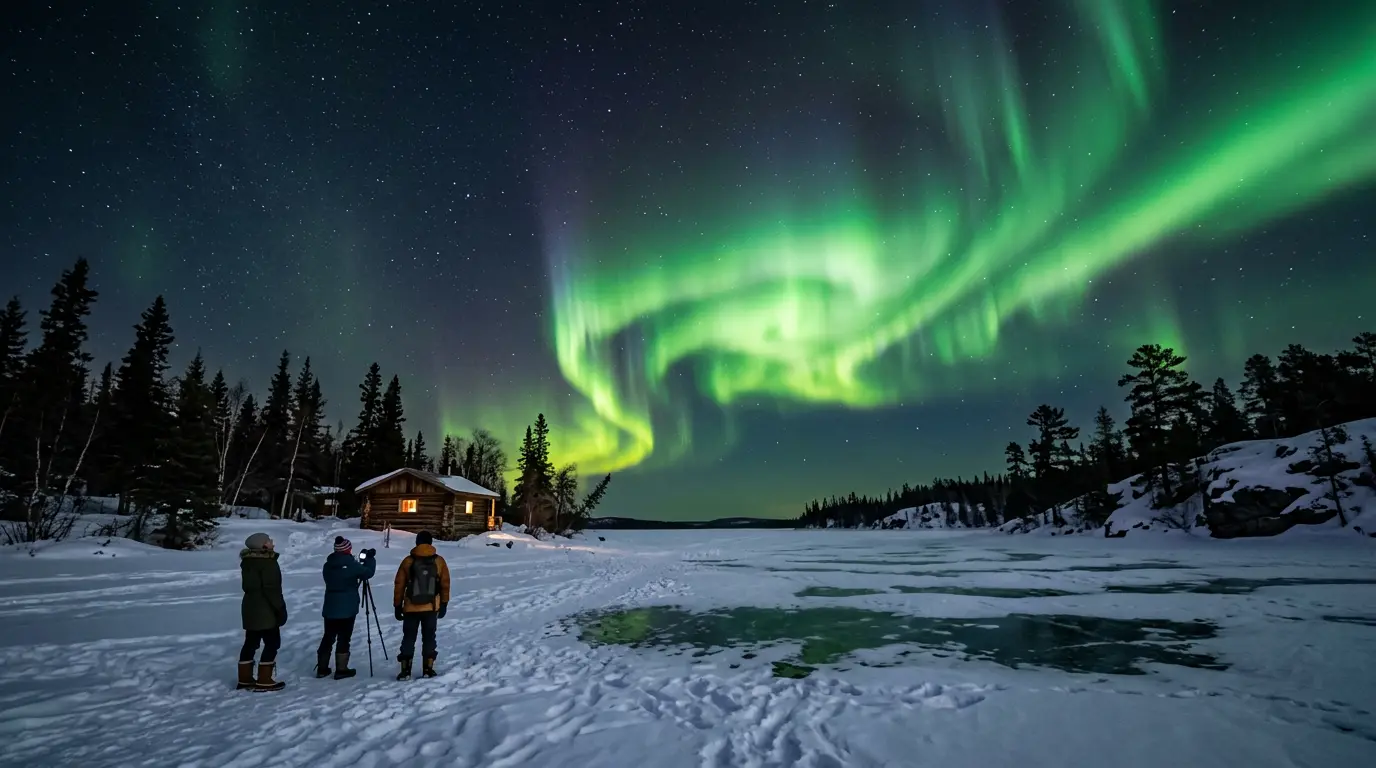
Yellowknife's advantage is baked into these numbers. The city sits at 62.5°N geographic latitude, but its geomagnetic latitude, the measurement that actually correlates with aurora visibility, is roughly 68°N[11][1]. That puts Yellowknife directly under the auroral oval's peak intensity zone. At Kp 2, the threshold where most of the inhabited world sees nothing at all, Yellowknife gets green bands moving overhead. At Kp 3, the show is strong. At Kp 4, the entire sky fills horizon to horizon.
| Kp level | Yellowknife (68°N geomag) | Fairbanks (65°N geomag) |
|---|---|---|
| Kp 1 | Faint glow on horizon | Not visible |
| Kp 2 | Overhead bands, visible structure | Low on northern horizon |
| Kp 3 | Bright overhead, fast movement | Mid-sky, visible movement |
| Kp 4 | Full-sky display, horizon to horizon | High overhead, strong color |
| Kp 5+ | Storm-level, vivid color, rapid motion | Full-sky, horizon to horizon |
Fairbanks sits at 64.8°N geographic but only approximately 65°N geomagnetic[11][2], south of the oval's densest core. At equivalent Kp index levels, Fairbanks sees the aurora lower on the northern horizon: still visible, still worth the trip, but rarely filling the full dome the way it does in Yellowknife on an ordinary geomagnetic night. Up-to-date thresholds for both cities are covered in the Kp index explained guide.
Climate: subarctic dryness beats maritime-influenced cold
The auroral oval position sets the floor for what is possible each night. The sky above your head sets what you actually see. And on that metric, Yellowknife's subarctic continental climate gives it an edge Fairbanks cannot match, for reasons that have nothing to do with geomagnetism.
Yellowknife sits in a low-precipitation[12] subarctic zone. Annual precipitation runs approximately 300mm, and the city qualifies as Canada's sunniest spring and summer destination with 60.4% sunny skies from April through August[5]. In winter, the same pattern holds: cold, dry arctic high-pressure air settles over the region after mid-November and suppresses cloud formation for long stretches. If the sky is dark and the aurora is active, you see it. The limiting variable is the cold, January averages -27°C, not the weather.
60.4%
Fairbanks gets its weather from a more complicated set of influences. Interior Alaska's climate is also continental, but the Bering Sea and Gulf of Alaska push moisture inland more often than Yellowknife's air mass allows. Fairbanks' annual precipitation is comparable on paper, roughly 300mm as well, but its cloud patterns are shaped by coastal air masses that Yellowknife, shielded by the Mackenzie Mountains to the west, never receives. The practical difference: on a night when both cities sit under the same Kp 3 substorm, the traveler in Yellowknife is more likely to be looking at aurora. The traveler in Fairbanks is more likely to be checking a cloud-cover forecast.
Neither city is immune to weather. Yellowknife's October-to-mid-November cloud gap, driven by Great Slave Lake releasing stored summer heat into the cooling autumn air, is a well-known trap that wipes out viewing for weeks[6]. The best time for northern lights in Yellowknife covers that window in detail along with the March-equinoctial peak. Fairbanks' cloudiest stretch tends to run earlier in the autumn. For either destination, the Kp index is only half the equation; a cloud-cover forecast is the other half.
Getting there, staying there, and what it costs
Logistics split these two destinations more sharply than any other variable. If your trip starts from a US airport, Fairbanks is the easier answer. If you are already in Canada or willing to connect, Yellowknife rewards the extra effort.
Fairbanks International Airport (FAI) has direct flights from Seattle (3.5 hours) and Anchorage (1 hour) via Alaska Airlines, with seasonal service from other US hubs[9]. Land, pick up a rental car at the terminal, and drive 15 minutes to your hotel. You can be checked in and studying the UAF Aurora Forecast before dinner. Winter driving conditions are a separate consideration worth researching before you book.
Featured · Destination
Yellowknife Northern Lights
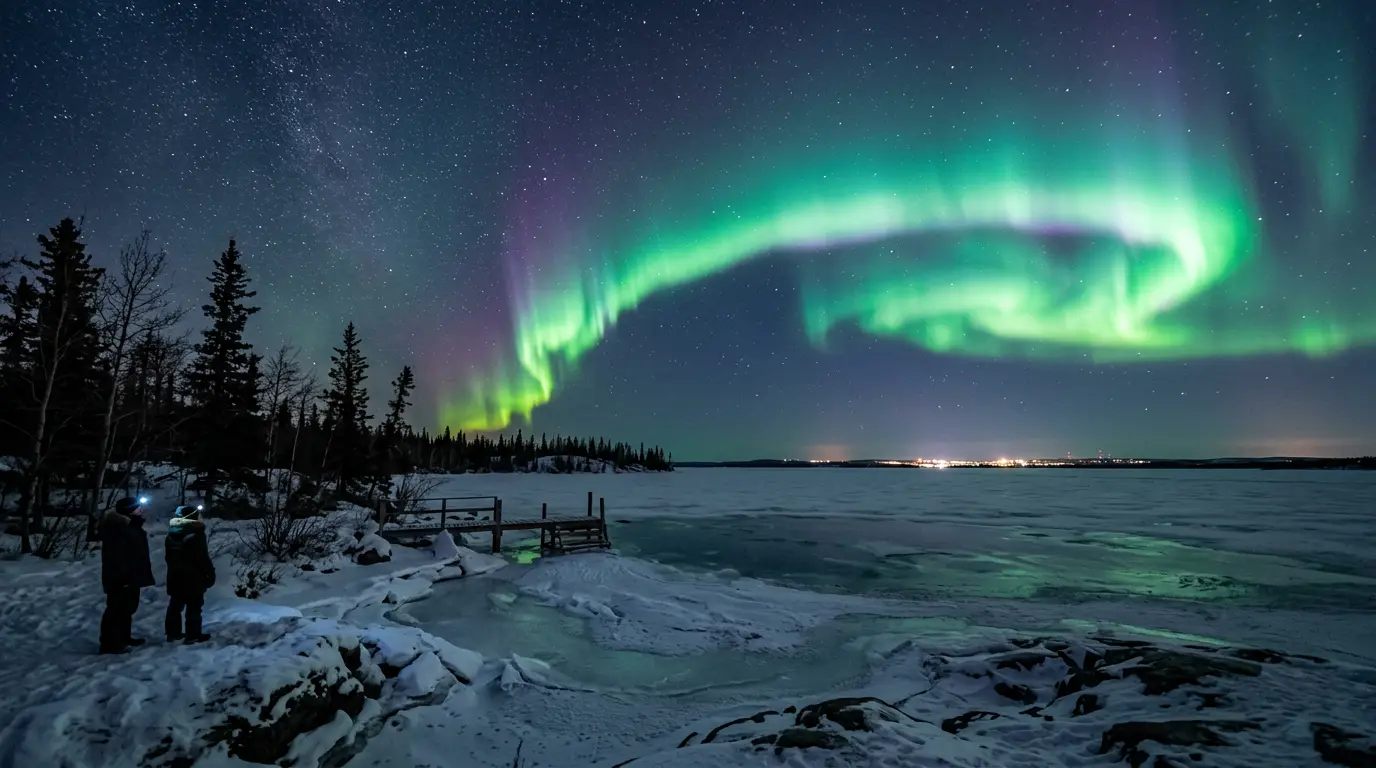
Yellowknife sits beneath the auroral oval: up to 240 aurora nights per year. Guide to seasons, viewing spots, Indigenous-led tours, and cold-weather planning.
Yellowknife Airport (YZF) has no direct flights from the United States. You reach it from six Canadian cities: Calgary (2 hours), Edmonton (1.5 hours), Vancouver (2.5 hours), Ottawa, Toronto, and Whitehorse[8], via Air Canada, WestJet, Air North, and Canadian North. A traveler starting from Seattle or Portland needs a connection through YYC, YEG, or YVR, adding at least half a day to the total journey.
Cost follows a roughly inverse pattern. Lodging in Fairbanks runs less expensive across the board. Chains like the Wedgewood Resort and boutique options like Aurora Villa typically undercut Yellowknife's limited hotel stock, where the Explorer Hotel and Nova Inn set the mid-range floor. Tour pricing also favors Fairbanks: a three-hour aurora-viewing tour runs 20 to 30 percent less than a comparable Yellowknife outing, partly because Fairbanks has more operators competing and partly because Yellowknife's Indigenous-led experiences, which incorporate Dene storytelling, drumming, and traditional food, price themselves as cultural exchanges rather than commodity sightseeing.
A week in Fairbanks all in (flights from Seattle, mid-range hotel, three nights of tours, rental car) commonly runs lower than an equivalent week in Yellowknife from a US gateway. The savings are real, but they buy a different kind of trip.
Tour culture: Dene storytelling versus Chena hot springs
This is where the two destinations diverge in ways a flight comparison cannot capture. The aurora is the same physical phenomenon in both places. The experience of waiting for it, and who you wait with, is not.
Yellowknife's Indigenous-led aurora tourism is structurally woven into the city's visitor economy. North Star Adventures, a 100% Dene-owned operator, runs aurora-viewing tours that include Dene language lessons, hand-drum songs, and traditional foods like dry fish and bannock cooked over a fire while you wait for the lights[7]. B. Dene Adventures, also Indigenous-owned, operates on the same model: the aurora is the draw, but the cultural exchange around the campfire is what travelers remember. Aurora Village, Yellowknife's largest aurora-viewing operation, builds the experience around heated teepees and a lakeside setup designed specifically for staying warm during long winter vigils. The North Star Adventures aurora tour review covers what each operator actually delivers on the ground.
Fairbanks' tour landscape runs more toward the commercial and the eclectic. Chena Hot Springs Resort, about 56 miles northeast of town[13], combines aurora viewing with natural hot springs, a genuinely unusual experience: you sit in 41°C water while green bands pulse overhead in air that sits at -25°C. It is the single most distinctive aurora-viewing setup in either city. The rest of the Fairbanks tour market splits between photography-focused guides, heated-lodge viewing tours, and the glass-igloo stays at Borealis Basecamp, which lean into the appeal of watching aurora from your bed through a curved transparent ceiling.
Neither approach is superior. If you want to learn Dene words for the constellations while eating bannock by a campfire at -30°C, Yellowknife's Indigenous operators deliver something Fairbanks cannot replicate. If you want to soak in a hot spring while aurora ribbons pass overhead, Fairbanks has no Yellowknife equivalent. Pick the experience, not the city, and the destination follows.
Great Slave Lake and the photography edge no brochure mentions
Photographers trading notes on aurora-forum threads fixate on sensor noise, lens speed, and Kp forecasts. The variable that separates a good aurora photo from a memorable one is simpler: what is in the foreground.
Yellowknife's foreground asset is Great Slave Lake, the tenth-largest lake in the world by surface area and the deepest in North America at 614 meters[6]. In winter, the lake freezes into a flat, snow-dusted ice sheet that reflects aurora like a second sky. In early autumn, when the water is still open, still-water reflections double the aurora's vertical reach, creating the kind of symmetrical composition that sells itself without post-processing. The lake's sheer size (roughly the area of Belgium) means you can find an unbroken horizon line in any direction, with zero artificial light visible from the far shore.
Fairbanks' foreground is boreal forest and, at elevation, the Alaska Range. Both produce strong images when aurora arches above snow-loaded spruce or Denali's silhouette, but they lack the wide-open reflective plane that Great Slave Lake provides. Fairbanks photographers tend to drive to Murphy Dome, Cleary Summit, or Chena Lakes to escape the tree line; Yellowknife photographers walk to the lake.
The practical difference for a traveling photographer: in Yellowknife, you can frame a strong composition without leaving town. In Fairbanks, you are driving 30 to 45 minutes to reach a cleared horizon. Neither city requires a tour for good aurora photos, but Yellowknife's geography makes self-guided photography the lower-friction option.
The verdict by traveler profile
The question this article opens with, which city is better, is the wrong question. The right question is: which city fits the trip you are actually taking. Run through these profiles honestly and the answer mostly makes itself.
Pick Yellowknife if:
- You are optimizing for the highest-probability overhead aurora on a given clear night. The 3° magnetic-latitude advantage means shows at Kp 2 that Fairbanks would see as a low green smear on the horizon.
- You want an Indigenous cultural dimension to your aurora trip: Dene storytelling, language, and traditional food around the fire are not an add-on, they are the default for Yellowknife's most prominent operators[7].
- You shoot aurora photography and want a foreground that works without driving 40 minutes out of town. Great Slave Lake's frozen surface and unbroken horizon deliver that.
- You can handle colder temperatures and a connection flight through a Canadian hub. Yellowknife's January averages -27°C; its airport serves zero US cities directly[8].
Recommended tours
Tours are selected for quality, not commission. I earn a small fee if you book — at no extra cost to you.
Pick Fairbanks if:
- You are flying from the US West Coast and want a direct flight to your aurora destination. Seattle to Fairbanks is 3.5 hours and one boarding pass.
- You want lower trip costs, both for lodging and for tours. A Fairbanks week from a US gateway routinely undercuts an equivalent Yellowknife week.
- You have always wanted to watch the aurora borealis from a natural hot spring. Chena Hot Springs is the only place on the planet where that combination is a bookable product, not a fantasy.
- You are combining aurora viewing with a broader Alaska trip (Denali National Park, the Dalton Highway, the Arctic Circle) and Fairbanks functions as your base rather than your sole destination.
Featured · Article
What Is Astrotourism? The Complete Beginner's Guide
Astrotourism means travel built around dark skies: meteor showers, auroras, the Milky Way. What it means, where to go, and how to plan your first trip.
A small number of travelers link both cities in a single trip, flying Seattle-Fairbanks, then Fairbanks-Anchorage-Seattle-Vancouver-Yellowknife (or some variation). It is possible. It is also slow, expensive, and for most people the wrong use of a week of vacation. Pick one, commit, and spend your planning energy on dates and moon phases rather than on stitching two destinations together.
If you are still weighing the Yellowknife case after reading through, the is Yellowknife worth it for northern lights article makes the deeper argument.